What Is A Bosnian Breakfast?
What a Bosnian breakfast looks like in Mostar, from burek and somun to Bosnian coffee, plus what to expect at a bakery counter in Herzegovina.
In Mostar, the city on the Neretva river at the heart of Herzegovina, breakfast is a modest, savoury, deeply local meal. It is built around what comes out of the bakery ovens in the morning: burek and its family of filled pastries, somun bread, white cheese, kaymak, jam, and a small cup of Bosnian coffee drunk slowly from a copper pot. There is no tourist invention in it. The same counter that serves a baker at dawn serves a traveller at nine, and the question of what a Bosnian breakfast actually is can be answered in one walk along the streets near Kujundžiluk, the Old Bazaar.
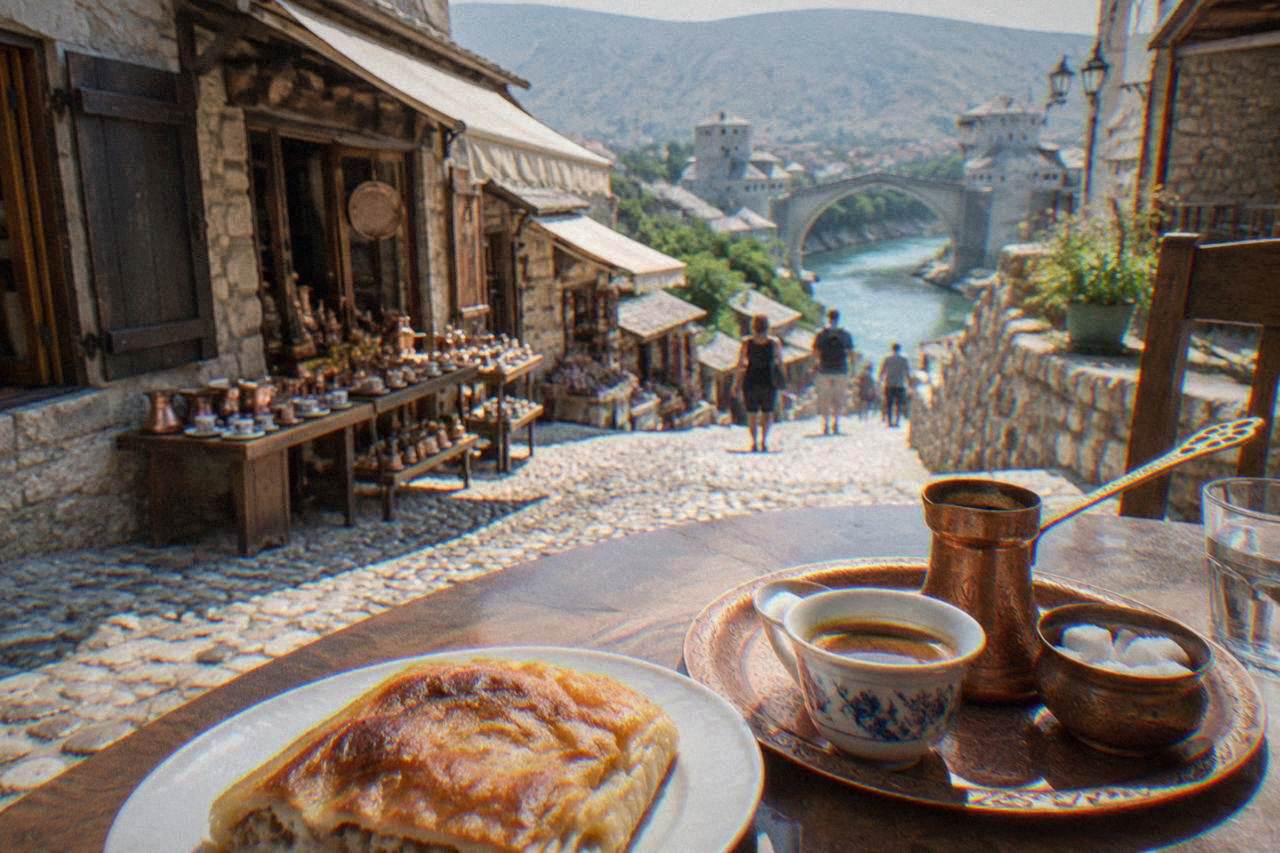
A Bosnian breakfast is a savoury morning meal built on baked goods and dairy: burek or another filled pie (pita) such as sirnica or krompiruša, warm somun bread, white cheese and kaymak, olives or jam on the side, and Bosnian coffee served from a džezva on a copper tray. It is eaten in bakeries, kafanas and homes across Bosnia and Herzegovina, and in Mostar it is part of the daily rhythm rather than a performance for visitors. Nothing about it is fussy. The pastry is the centrepiece and the coffee is the ritual that follows it.
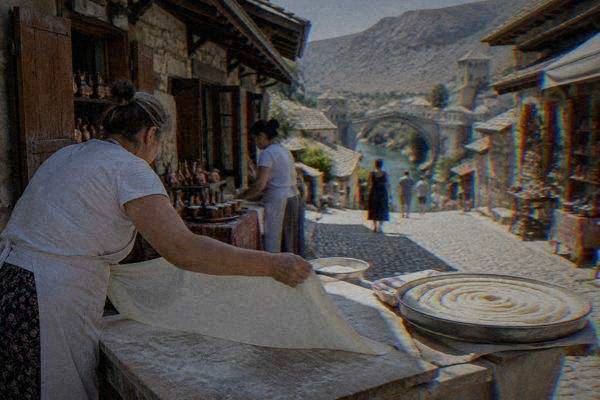
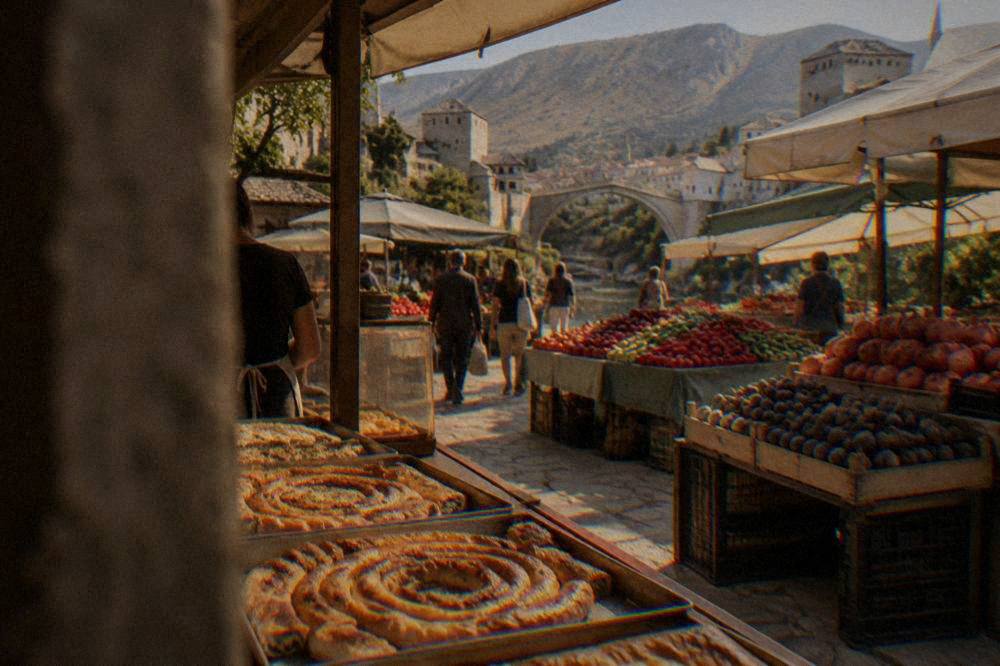
Burek deserves its own sentence because it anchors everything. It is a spiral of thin, hand-stretched dough wrapped around a filling, most classically minced meat, and it is sold by weight or by the piece from bakeries that start baking before sunrise. The wider family of filled pies, called pita collectively, includes sirnica with cheese, krompiruša with potato, and zeljanica with greens. Order by name, not by pointing, and the counter will cut you a segment and weigh it on the spot.
Around the pastry sits the rest of the table. Somun is a soft flatbread, best known for its role at Ramadan evenings but eaten year round. Kaymak is a rich dairy spread, thicker than butter, somewhere between clotted cream and cheese. White cheese, often brined like feta though milder, appears with raw onion and tomato in summer. Jam, usually fruit-heavy and not too sweet, rounds it off for those who want something sweet after the savoury course. Boiled eggs and suho meso, a cured dried beef, are the heartier additions in kafanas and hotel breakfasts.
How Does Bosnian Coffee Fit Into The Mostar Morning?
Bosnian coffee is the non-negotiable second half of a Bosnian breakfast: finely ground coffee boiled in a small copper pot called a džezva, poured into a miniature cup, and sipped slowly over anything from ten minutes to an hour, often with a square of lokum or a sugar cube held in the mouth. It is unfiltered, strong and served on a tray with the pot, the cup and a glass of water. In Mostar the ritual is not rushed, and asking for it to be rushed misses the point of the meal entirely.**
The technique matters more than the bean. The džezva is brought to the heat until the grounds rise and foam, then pulled back, then briefly reheated before pouring. The cup is tiny by international standards, closer to an espresso cup than a mug, and the grounds settle at the bottom of the pot rather than in the cup. It is closer in spirit to Turkish coffee than to anything filtered, and it is drunk at the table, never on the move.
Cafes in Mostar, including many within a short walk of Stari Most, serve it all day, not only at breakfast. That matters for planning. A morning that starts with pastry at a bakery counter can continue with coffee at a cafe twenty minutes later, and neither establishment will consider the split strange. Tea, usually served in the same small cups, is the alternative, and herbal teas are common. For travellers wondering about the broader food culture, the site's Bosnian food overview for Mostar neighbours this page, and the question of how many days in Mostar is enough usually turns on how many slow breakfasts you can fit in.
What Does A Typical Breakfast Table In Mostar Hold?
A typical breakfast table in Mostar holds one warm filled pie cut into segments, somun or white bread, kaymak and white cheese, olives and tomato, jam, and Bosnian coffee, with eggs, cured meat and yoghurt-based drinks appearing in kafanas and hotel spreads. The spread is dairy-heavy and pastry-heavy rather than sweet, and the portions are sized for sharing. No single item is mandatory, but coffee comes closest to being compulsory.
The components, in the order a visitor usually meets them:
| Item | What It Is | Where You Meet It |
|---|---|---|
| Burek | Spiral pie of stretched dough with minced meat filling | Bakery counters, sold by weight |
| Sirnica | Same dough, cheese and egg filling | Bakery counters |
| Krompiruša | Same dough, potato and onion filling | Bakery counters |
| Zeljanica | Same dough, spinach and herbs | Bakery counters, seasonal |
| Somun | Soft flatbread, plain, baked fresh | Bakeries and street stalls |
| Kaymak | Rich spread between clotted cream and butter cheese | Served with bread |
| Bijeli sir | Brined white cheese, milder than feta | Served with onion and tomato |
| Suho meso | Air-dried cured beef, sliced thin | Kafana and hotel breakfasts |
| Bosnian coffee | Unfiltered boiled coffee in a džezva | Every cafe and kafana |
| Lokum | Sugar-dusted sweet cube served with coffee | On the coffee tray |
Two habits are worth knowing before the first order. First, the filled pies are morning food above all, and bakeries sell out of the best trays early; a mid-morning arrival can mean the choice is down to whatever remains. Second, the meal is not expensive by the standards visitors bring from euro-zone cities, a point covered in detail on the page about whether Mostar is expensive: the currency is the convertible mark (KM), pegged at 1 EUR = 1.95583 KM, and euro cash is often accepted in tourist areas, though the rate should be confirmed before paying.
Can You Learn To Make Burek And Pita Yourself In Mostar?
Yes, Mostar has hands-on baking workshops where visitors roll, stretch, fill and bake their own burek under instruction, then eat what they made, which is the most direct way to understand what the pastry in a Bosnian breakfast actually involves. The dough is stretched by hand to translucency before it is rolled, and the difference between watching that and doing it is the difference between reading about breakfast and understanding it. One such session is the Burek Masterclass in Mostar, where the finished pie is eaten at the table, Check availability if the idea appeals.**
The class format suits the food. Burek is made in stages, the dough resting, the filling seasoned, the spiral assembled, the oven doing the last of the work, and a workshop that walks through those stages produces a lunch as well as a lesson. It also answers the question children ask immediately, which is why the dough does not tear. For a fuller cooking session there is also a Bosnian cooking class with burek, lunch and drinks that widens the menu beyond breakfast. The rest of the planning pages sit on Mostar Travel Guide.
Learning the pastry changes how the rest of the trip tastes. After stretching the dough once, a bakery counter in the morning becomes legible: which spirals were rolled that morning, which have sat, which filling sits under which crust. Herzegovina's bakers are proud of exactly that distinction, and Mostar rewards anyone who arrives at the counter with a little knowledge.
What Do People Drink With Breakfast Besides Coffee?
Besides Bosnian coffee, the breakfast table in Mostar offers yoghurt drunk from a glass, a habit carried over from the region's dairy tradition, plus herbal tea, plain water served alongside every coffee, and, in kafanas later in the day, rakija, the fruit brandy that belongs more to the rest of the day than to the morning. Yoghurt with pastry is the classic pairing many visitors have not met before: cold, slightly sour, poured not spooned. Salep and other hot winter drinks appear in colder months.**
Rakija deserves a careful sentence. It is a distilled fruit spirit, plum and grape the common bases, and in Herzegovina grape rakija sits close to the region's wine tradition. It is offered as a gesture of welcome and at celebrations far more often than it is drunk at breakfast, and a visitor is never obliged to match a host's pour. The culture around alcohol in the city is covered plainly on the page about whether you can drink alcohol in Mostar, which also explains why some establishments serve none.
Water comes with the coffee tray unasked, and it is meant to be drunk first, to clear the palate. Tap water in Mostar is treated and generally safe, though some travellers stick to bottled water as a precaution. In summer, when Mostar's July mean temperature runs to 24.7 C on the FHMZ 1961-1990 station series and modelled ERA5 1991-2020 daily highs reach 29.9 C, the morning meal is best taken before the heat builds; the page on whether Mostar is too hot in August treats the summer question in full.
Where Does Breakfast Fit In A Day Of Sightseeing Around Mostar?
Breakfast in Mostar fits best in the first two hours of the day, before the Old Bridge and the Kujundžiluk bazaar fill with day-trippers arriving from Dubrovnik, Split and Sarajevo, and it pairs naturally with a slow morning walk across Stari Most while the light is still low on the Neretva. The bridge is free to cross at any hour, and the bakery counters near the Old Town are at their fullest early. Eating first, walking second, is the local order of operations.**
The day-trip traffic shapes this. Coaches from the Croatian coast and from Sarajevo arrive through the late morning, so the Old Town is at its calmest from early morning until mid-morning, which is exactly the window a bakery breakfast occupies. Anyone planning a fuller itinerary around Herzegovina, with Blagaj 13.7 km and about 19 minutes by road from Stari Most, Počitelj 30.0 km and about 31 minutes, and Kravica waterfall 55.2 km and about 54 minutes, will find that an early breakfast leaves the whole countryside within a day's reach; a good Herzegovina circuit is carded below.
Afternoon and evening bring their own food culture, and breakfast's savoury pies give way to ćevapi, grilled minced meat served in somun with raw onion, the dish most associated with the region. The site's overview of what is so special about Mostar places the food in the context of the city's Old Bazaar and its UNESCO-listed Old Bridge Area, inscribed in 2005.
Common Questions About A Bosnian Breakfast
What Is A Bosnian Breakfast?
A savoury morning meal of filled pies such as burek, sirnica or krompiruša, somun bread, white cheese and kaymak, jam or olives, and Bosnian coffee boiled in a džezva. In Mostar it is bought from bakery counters in the morning and eaten unhurried.
Is Bosnian breakfast sweet or savoury?
Savoury, mostly. The pies are filled with meat, cheese, potato or greens, and the dairy sides are salty. Sweetness appears only at the edges, as jam on the table or a lokum square served with coffee.
What is the difference between burek and pita?
Strictly, burek is the pie with minced meat; the others, cheese, potato or greens, are pita by name. In everyday bakery speech the word burek is sometimes used loosely for the whole family, but ordering by the specific name gets the right tray.
Is Bosnian coffee the same as espresso?
No. It is unfiltered coffee boiled with the grounds in a small copper pot, poured into a tiny cup, and drunk slowly. The grounds stay behind in the pot, and a glass of water is served alongside to drink first.
Can I find a Bosnian breakfast near the Old Bridge in Mostar?
Yes. Bakery counters and cafes a short walk from Kujundžiluk and Stari Most serve pies, somun, kaymak and Bosnian coffee through the morning. Going early means the fullest trays and the calmest Old Town.
Is breakfast in Mostar vegetarian-friendly?
Largely, yes. Sirnica with cheese, krompiruša with potato and zeljanica with greens contain no meat, and the dairy sides, bread, jam and coffee make a complete meal without any meat dish.