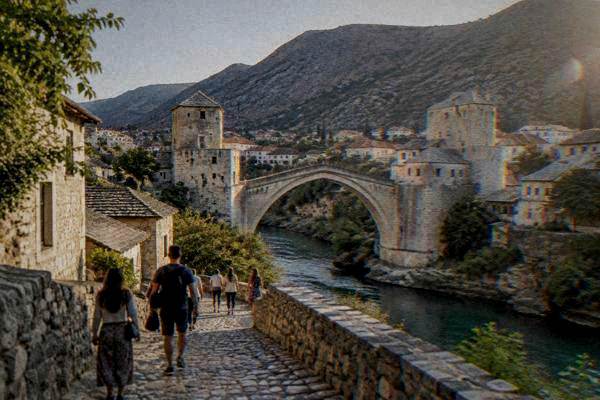
What Is So Special About Mostar?
Mostar, in Herzegovina, stands out for its Old Bridge of 1566, rebuilt in 2004, its Ottoman Old Bazaar on the Neretva, and day trips to Blagaj, Počitelj and Kravica waterfall. Here is what makes the city different.
Mostar, an inland city on the Neretva river in Herzegovina, Bosnia and Herzegovina, is special because it compresses an extraordinary range of history into a very small walkable centre: a single-arch Ottoman bridge completed in 1566, a restored bazaar street beneath it, minarets and bell towers sharing one skyline, and a river that stays cold even in August. The city has about 105,000 residents by the 2013 census, yet its Old Bridge Area has been a UNESCO World Heritage property since 2005, inscribed under criterion (vi) for what it came to symbolise after its destruction and reconstruction. Around the city, within an hour's drive, lie a dervish tekke at a karst spring, a walled Ottoman village, and a waterfall you can swim beneath in summer.
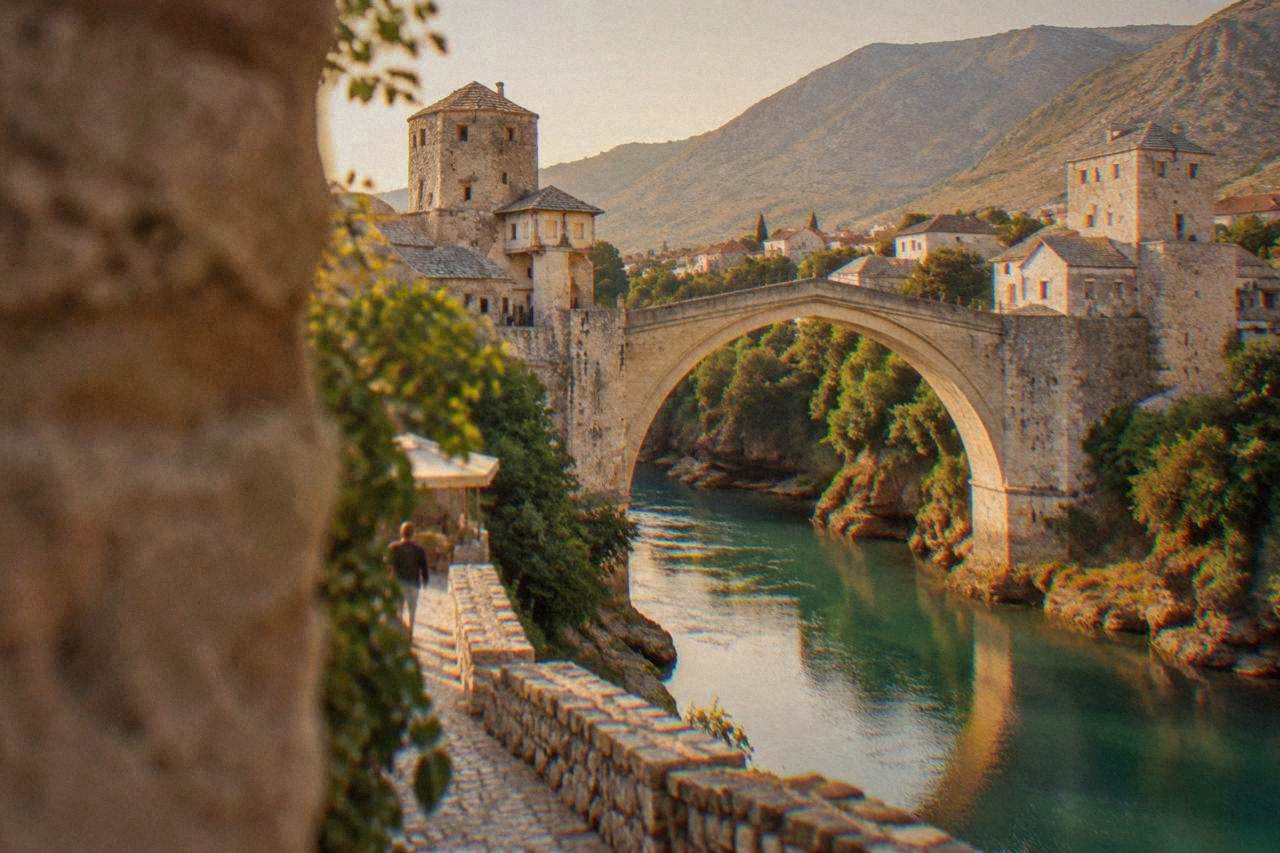
Mostar is special because it is built around a single stone arch, the Old Bridge, which was completed in 1566, destroyed on 9 November 1993 during the war, and rebuilt and reopened in July 2004. The Old Bridge Area of the Old City was inscribed by UNESCO in 2005 as property 946. The city sits inland on the Neretva river in Herzegovina, with no sea coast, and its centre is compact enough that the bridge, the bazaar and the main mosques are all within a short walk of each other.
That concentration is the honest answer. Other Balkan cities have old towns; few have one arranged around a river as vividly green as the Neretva, crossed by an arch that took the stone from local quarries and a builder, mimar Hayruddin, working in the tradition of the architect Sinan. The name of the city itself comes from the bridge keepers, the mostari, who guarded the earlier wooden crossing, and the first written mention of the name dates from 1474. More on why the bridge carries such fame is in why the Mostar bridge is so famous.
The second part of the answer is the setting. Herzegovina is karst country: stone, hot valleys, cold springs that emerge from cliffs. Blagaj, Počitelj, Kravica waterfall and Međugorje are all within an hour of the city, which is why the question "is it worth staying the night" has a different answer here than in a city with an old town and nothing behind it.
The Old Bridge And The Story It Carries
The Old Bridge, Stari Most, is a single stone arch with a span of about 29 metres, standing about 21 to 24 metres above the Neretva depending on the river level, and it is free to cross at any hour as a public pedestrian route. It was commissioned under Suleiman the Magnificent and completed in 1566. It was destroyed on 9 November 1993 and reopened in July 2004, rebuilt with original materials and techniques in a reconstruction supported by UNESCO and World Bank partners.
The bridge is what made the city, in the most literal sense. Before stone, there was a wooden crossing and the bridge keepers who gave the settlement its name; the town grew at the narrowest gorge of the Neretva because that is where a bridge could be built. The UNESCO inscription in 2005 covers not just the arch but the whole Old Bridge Area, about 7.6 hectares of bazaar, towers and approach streets with a buffer zone around it.
Today the bridge is also a diving platform, though only for members of the Mostari diving club, who train for years before jumping. The 460th traditional diving competition ran on 26 July in 2026, and the Red Bull Cliff Diving World Series stopped in the city from 30 July to 1 August in 2026, with the women diving from 21-metre platforms and the men from 27 metres. Visitors do not jump; the club reports no pay-to-jump option for untrained guests. The story of the destruction and rebuilding is covered in why the Mostar bridge was destroyed and whether the bridge has been rebuilt.
Ottoman Mostar: The Bazaar, The Mosques, The Houses
Kujundžiluk, the Old Bazaar street that runs down to the bridge, is a free public street of coppersmith shops and stone, and together with Koski Mehmed-pašina džamija and the Ottoman courtyard houses it forms the walkable core that earned the UNESCO listing. Kriva ćuprija, the Crooked Bridge, a smaller single-arch crossing on a side channel, is also free and public. The bazaar takes its name from the coppersmiths, kujundžije, whose trade gave the street its character.
The mosques around the bazaar are working buildings as well as monuments. Koski Mehmed-pašina džamija sits right on the river bank near the bridge, with a minaret that gives one of the closest views over the arch; a small cash fee applies to enter, more with the minaret, and reports of the amount vary, so confirm on site. Karađoz-begova džamija stands a short walk away on the other side of the bazaar. Access pauses for worship.
A few Ottoman houses survive as museums, most of them courtyard houses built half over the running water of side channels. Bišćević House is reported at about 4 KM entry and Muslibegović House at about 8 KM; both figures are reported rather than official, and opening arrangements change with the season. Kujundžiluk itself, like the bridge, is open at any hour and costs nothing to walk.
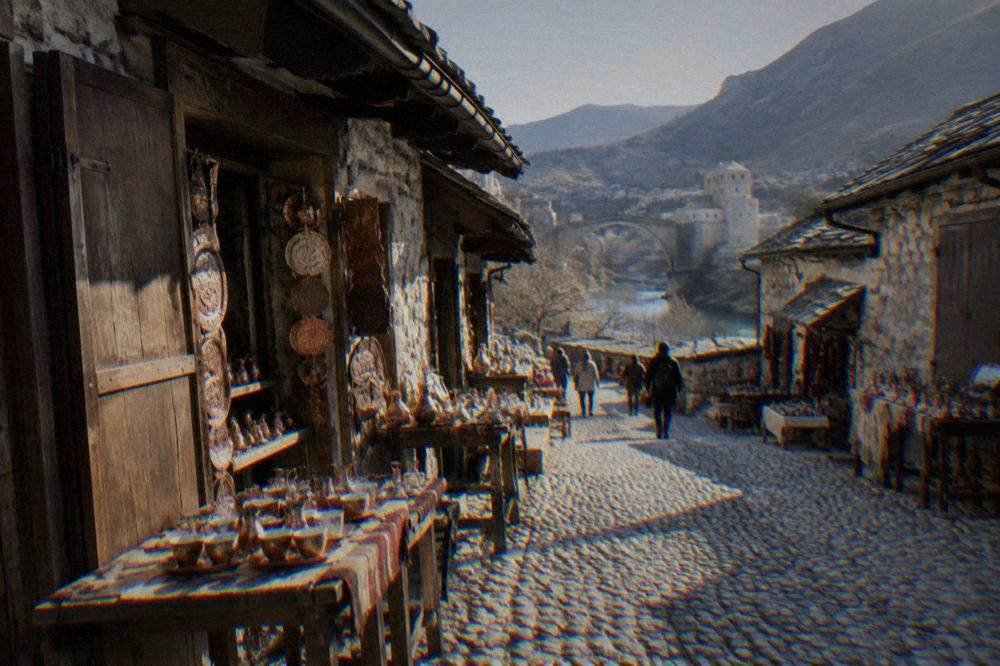
A guided walk ties these pieces together, and the city tour is the practical way to hear the history where it happened: the Mostar city tour covers the Old Bridge area, the bazaar and the streets around the Neretva, and there is an option to Check availability before committing to a date.
Herzegovina Within An Hour: Blagaj, Počitelj, Kravica
What makes Mostar unusual is how close the Herzegovina sights sit: Blagaj Tekke is 13.7 km and about 19 minutes away, Počitelj 30 km and about 31 minutes, Kravica waterfall 55.2 km and about 54 minutes, all by road from Stari Most in free-flow conditions. Međugorje is 28.3 km and about 40 minutes.
| Place | Road distance from Stari Most | Free-flow drive time |
|---|---|---|
| Blagaj Tekke | 13.7 km | about 19 min |
| Međugorje (St James church) | 28.3 km | about 40 min |
| Počitelj | 30.0 km | about 31 min |
| Kravica waterfall | 55.2 km | about 54 min |
| Stolac | 36.8 km | about 47 min |
| Jablanica | 47.4 km | about 57 min |
Blagaj is a dervish tekke built at the mouth of the Buna spring, where the river bursts from a cliff face. Entry is reported at 10 KM with hours of 08:00 to 22:00 from April to October and shorter winter hours, and shoulders and knees should be covered, with wraps provided at the entrance. Počitelj is a stone village climbing a hillside to a fortress tower, free to wander. Kravica waterfall charges 20 KM for an adult all year, 10 KM for residents of Bosnia and Herzegovina, with children under 7 free, and the park is open every month of the year with hours that stretch to 22:00 in summer; swimming is allowed in summer in the designated pool below the falls, with no lifeguard reported, so check the park's rules on arrival.
These three sit naturally on one loop, which is why Herzegovina day tours from the city are such a large part of what people do here. A question worth settling early is how many days in Mostar is enough: the answer depends on whether the Herzegovina loop is on the list, because the city centre alone is a single full day for an unhurried visitor.
Why The Setting And The Weather Are Different
Mostar sits in a Mediterranean climate zone at the edge of Herzegovina's karst valley, with a FHMZ 1961-1990 station mean of 24.7 C in July against 4.8 C in January, 1,515.4 mm of rain a year concentrated in winter, and a river that stays cold even in August. The ERA5 reanalysis for 1991-2020 puts modelled mean daily highs at 30.5 C in August and 8.4 C in January. The absolute station maximum on record is 41.2 C, set in July.
| Figure | Value | Period and source |
|---|---|---|
| July mean temperature | 24.7 C | FHMZ Mostar station, 1961 to 1990 |
| January mean temperature | 4.8 C | FHMZ Mostar station, 1961 to 1990 |
| Absolute maximum recorded | 41.2 C (July) | FHMZ Mostar station, 1961 to 1990 |
| November rainfall | 200.0 mm | FHMZ Mostar station, 1961 to 1990 |
| July rainfall | 42.9 mm | FHMZ Mostar station, 1961 to 1990 |
| Annual rainfall | 1,515.4 mm | FHMZ Mostar station, 1961 to 1990 |
The pattern matters for planning. November averages 200.0 mm of rain and July 42.9 mm, roughly four and a half times less, so the same city is two different places across the year: a hot, dry riverside town in summer where the midday hours belong to shade, and a green, wet one from late autumn. The Neretva is fed by karst springs and its water stays cold even in August, which is exactly why swimming in the river at Mostar is a shorter business than the air temperature suggests. More on the summer heat is in is Mostar too hot in August.
Food, Coffee And The Everyday City
Bosnian food in Mostar means ćevapi and burek served in small shops and ćevabdžinicas where the city eats daily, coffee drunk slowly from a džezva, a cuisine that is cheap by regional standards, and a burek masterclass that teaches the pastry rolled and baked by hand, with Herzegovina wine country a short drive into the hills. A burek masterclass in the city teaches the rolling and baking of the pastry by hand, and it is one of the more distinctive food experiences available anywhere in the region.
The everyday city is part of the answer too. Spanish Square is the modern centre, the Partisan Memorial Cemetery by Bogdan Bogdanović, inaugurated in 1965, stands as a listed monument in a neglected state after over 700 of its stone markers were destroyed in 2022, and Hum hill rises over the whole valley. These are the layers that a single photo of the bridge does not show: an Ottoman core, an Austro-Hungarian ring of public buildings, a socialist-era monument, and a rebuilt centre, all within walking distance.
Food has its own pages: what a Bosnian breakfast is, ćevapi, burek and Bosnian coffee cover the specifics. What matters here is that eating in Mostar is not a museum experience; the burek shops and ćevabdžinicas are where the city eats daily, and the burek masterclass is built around exactly that.
Practical Things That Shape A Visit
The practical facts that shape a Mostar trip: the currency is the convertible mark (KM, BAM) pegged at 1 EUR = 1.95583 KM, Bosnia and Herzegovina is not in the EU or Schengen so the Croatian land border carries full passport checks, and visa-exempt visitors may stay up to 90 days in a six-month period from first entry. The emergency number is 112. A tourist tax reported at 3 KM per person per night applies in the canton; confirm the amount at booking.
Euro cash is often accepted in the tourist areas, usually at a rounded 1-to-2 rate, but that is a convenience, not an official rule, so confirm the rate before paying. In rural Herzegovina, stay on marked paths because of suspected mine areas, which the national authority BHMAC maps and signs. Getting there is easier than its inland position suggests: the train from Sarajevo resumed on 15 October 2026 after a suspension, with two trains a day each way, and the full picture is in how to get to Mostar.
For anyone weighing the city against alternatives, the honest comparisons are is Mostar worth visiting and whether Mostar or Sarajevo is the better fit. On the money question, is Mostar expensive covers costs in detail; in short, KM prices in the bazaar and beyond remain gentle next to the Croatian coast two hours away. That contrast, an old stone city at continental prices a short drive from the Adriatic, is the last piece of what makes the place special, and the reason the Mostar Travel Guide keeps the whole inventory in one place.
Common Questions About Mostar
What Is So Special About Mostar?
A single-arch bridge of 1566, rebuilt in 2004, that is a UNESCO World Heritage symbol, an Ottoman bazaar on the cold green Neretva, and Blagaj, Počitelj, Kravica waterfall and Međugorje all within an hour's drive. The city is small, walkable and inland, in Herzegovina, Bosnia and Herzegovina.
Is the Old Bridge free to visit?
Yes. Stari Most is a public pedestrian route, free to cross and open around the clock. No ticket is needed for the bridge itself.
Can tourists jump off the Old Bridge?
No. Jumps are made by members of the Mostari diving club, who train for years. No pay-to-jump option for visitors is reported. The bridge stands about 21 to 24 metres above the river depending on the water level.
How far is Kravica waterfall from Mostar?
55.2 km by road, about 54 minutes in free-flow conditions. Entry is 20 KM for an adult all year, 10 KM for residents of Bosnia and Herzegovina, free for children under 7, and the park opens every month of the year.
Do I need euros in Mostar?
No. The currency is the convertible mark (KM, BAM), pegged at 1 EUR = 1.95583 KM. Euro cash is often accepted in tourist areas at a rounded rate, but paying in KM is the default; confirm the rate where a shop offers to take euros.
How many days does Mostar need?
One full day covers the Old Bridge area, Kujundžiluk and the main mosques at an unhurried pace. Two days allow the Blagaj, Počitelj and Kravica loop, either independently or on a day tour.