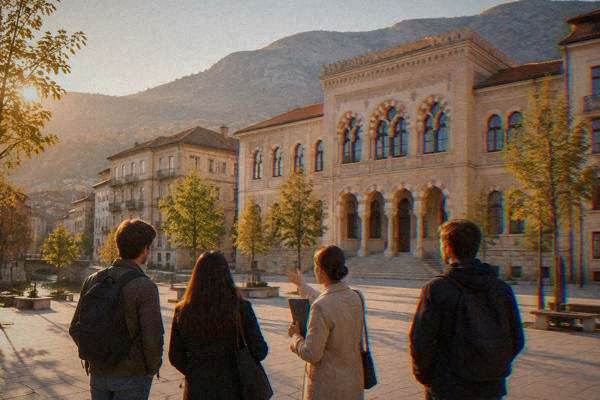
Partisan Memorial Cemetery: Bogdanović's Stone City Of The Dead
The Partisan Memorial Cemetery in Mostar is a hillside monument of stone terraces and carved markers designed by Bogdan Bogdanović, inaugurated in 1965, damaged in 2022, and now on Europa Nostra's list of endangered heritage.
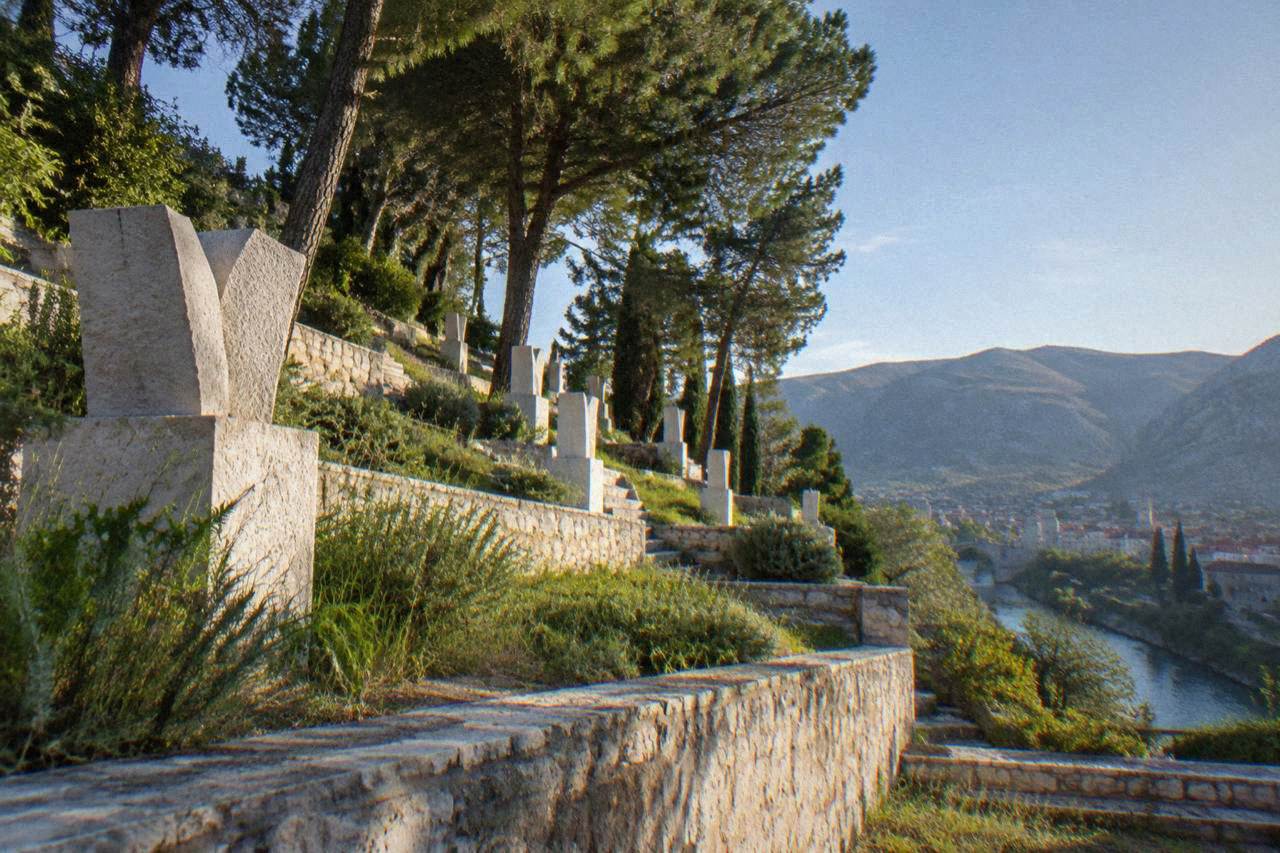
The Partisan Memorial Cemetery in Mostar is a memorial park by architect Bogdan Bogdanović, inaugurated in 1965 on a hillside west of the city centre. It has no ticket, no staffed hours and no services, and it appears on Europa Nostra's 7 Most Endangered list after over 700 stone markers were destroyed in 2022.
The Partisan Memorial Cemetery in Mostar, in Herzegovina, Bosnia and Herzegovina, is unlike anything else in the city. While the Old Town draws the crowds down by the Neretva, this monument sits apart on a hillside west of the centre: a vast terraced enclosure of pale stone, built to hold the remains of Partisan fighters of the Second World War, and designed as a city of the dead rather than a conventional graveyard. It was inaugurated in 1965 to a design by the architect Bogdan Bogdanović, and in 2025 it marked the 60th anniversary of that inauguration. Today it stands half-empty and openly endangered: over 700 of its stone memorial markers were deliberately destroyed in 2022, and in May 2026 Europa Nostra presented a landmark report calling for its urgent revitalisation. For a visitor willing to look past the polished postcard Mostar, it is one of the most affecting sites in the country.
What Is The Partisan Memorial Cemetery In Mostar?
The Partisan Memorial Cemetery in Mostar is a memorial park and burial ground for Partisan fighters, designed by the architect Bogdan Bogdanović and inaugurated in 1965. It is built as a terraced stone enclosure on a hillside west of the city centre, holding hundreds of carved memorial markers, an amphitheatre-like ceremonial space and a symbolic gateway, and it carries national monument designation in Bosnia and Herzegovina.
Bogdanović, one of the former Yugoslavia's most distinctive architects and later mayor of Belgrade, designed memorials across the country, and the Mostar cemetery is among his most fully realised works. His approach rejected heroic statuary in favour of geometry: the site reads as a walled necropolis, a reduced city of the dead laid out in terraces that climb the slope, with markers that resemble stylised houses, sarcophagi and plant forms carved from local stone. The entrance sequence was designed as a processional route, moving visitors upward through the terraces toward a ceremonial plateau.
The site is not a museum and does not behave like one. There is no ticket office, no staffed desk and no interpretation centre. What exists is the architecture itself: the retaining walls, the water channel that once ran through the composition, the stone markers in their rows, and the views back over the city and the hills that frame it. That bareness is part of why the place lands so hard on visitors who make the walk. Nothing is curated, nothing is explained, and the monument carries its own history, including its recent history of damage, entirely in stone.
Visitors who want the full sweep of the city's memory landscape often pair this site with the war photography displays downtown or the Museum of War and Genocide Victims, which cover later periods of the city's past in an indoor, interpreted setting.
Who Was Bogdan Bogdanović, And Why Does His Mostar Monument Matter?
Bogdan Bogdanović was a Serbian architect, writer and urbanist who designed memorials across the former Yugoslavia and served as mayor of Belgrade, and his Mostar cemetery of 1965 is regarded as one of the defining works of Yugoslav memorial architecture. Its significance rests on its scale, its integrity as a single-author composition, and its national monument designation, which the site has now held for about two decades.
Yugoslav memorial architecture of the post-war era produced some of the most uncompromising public sculpture of its age, and Bogdanović's contribution to that movement was distinctive for its language of myth and symbol rather than abstraction alone. At Mostar he worked with the hillside rather than against it. The terraces follow the contour of the slope, the stone is local, and the composition refers to ancient necropolises rather than to any modern political iconography. He described his memorials as cities for the dead, and at Mostar that idea is literal: streets, squares, gateways and house-form markers, all in stone, all scaled to a population that no longer walks.
The monument matters today for two reasons. First, it survives as a complete architectural idea, one of the few Yugoslav-era memorials of this size that still exists as a whole designed landscape rather than a fragment. Second, its condition has made it an international heritage cause. The destruction of over 700 of its stone markers in 2022, and the Europa Nostra report presented in May 2026, have placed the site at the centre of a debate about how the region cares for monuments that carry difficult political associations. That debate is the reason many travellers now seek the site out.
| Fact | Detail |
|---|---|
| Architect | Bogdan Bogdanović |
| Inaugurated | 1965 |
| 60th anniversary | Marked in 2025 |
| National monument designation | About 20 years ago |
| Markers destroyed in 2022 | Over 700 |
| Europa Nostra status | 7 Most Endangered, report presented May 2026 |
| Admission | None, open ground |
| Staffed hours | None |
Is The Partisan Memorial Cemetery In Mostar Free To Visit, And When Is It Open?
The Partisan Memorial Cemetery in Mostar costs nothing to enter: there is no ticket, no desk and no posted opening schedule, because the site is an unstaffed open landscape rather than a managed attraction. Visitors can walk in at any hour, though daylight is strongly advisable given the terraced terrain and the site's neglected condition, and there are no facilities of any kind on the ground.
That absence of management cuts both ways. On one hand, nothing stands between a visitor and the architecture: no queue, no price list, no rope line. On the other hand, nothing on site explains the monument, marks safe routes or watches over the stones. The terraces are stepped and uneven in places, vegetation grows through the paving in season, and loose stone is a real hazard on the upper slopes. Sturdy shoes and daylight are simple precautions that make the walk straightforward.
The site's unstaffed character is also why reports of its condition change from month to month. Access is described as limited or restricted in some periods, and the condition of the monument itself is the subject of the Europa Nostra campaign. Nothing about the site requires booking, and nothing can be booked: it is simply there, as it has been since 1965, waiting on the hillside. Combine it with a coffee or a meal afterwards in the city centre, or fold it into a wider plan using the site's things to do in Mostar overview.
For travellers building a day around guided visits rather than self-guided wandering, a city walk with a guide covers the Old Town core and the wider urban context; Check availability for the current schedule.
What Happened To The Cemetery In 2022, And Why Is It Endangered Now?
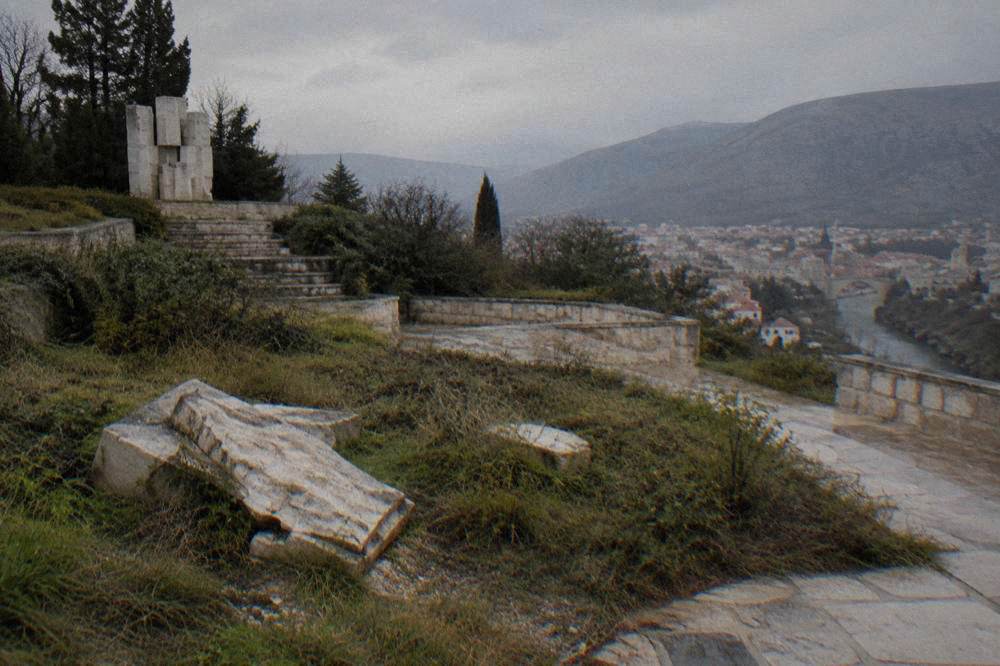
In 2022, over 700 of the cemetery's stone memorial markers were deliberately destroyed, an act of damage that removed the majority of the carved elements from the terraces, and the site has not been restored since. In May 2026, Europa Nostra presented a landmark report at the Parliamentary Assembly of Bosnia and Herzegovina, placing the cemetery on its 7 Most Endangered programme and calling for urgent protection, security and revitalisation.
The number bears repeating because it defines what a visitor actually encounters. This was not opportunistic graffiti or weathering: over 700 individual markers, each carved as a distinct symbolic form, were broken. The terraces, retaining walls and gateway structure survive, and the architecture of the site remains legible, but the population of carved stones that gave the necropolis its meaning is largely gone. Europa Nostra's report, presented in Sarajevo and covered on national television channels in Bosnia and Herzegovina, frames the site as being in critical condition and calls for improved security, a management structure and a phased revitalisation.
Why the damage happened is bound up with the politics of memory in the region, and this page sticks to dates and physical facts: the monument was inaugurated in 1965, it carries national monument designation, it was massively damaged in 2022, and in 2026 it sits on an international endangered list. A traveller who wants to understand the memorial landscape of Bosnia and Herzegovina more broadly can extend the theme east to Konjic and its Cold War-era bunker, or stay in Mostar and read the layered history at the Herzegovina Museum.
How Do You Reach The Partisan Memorial Cemetery In Mostar?
The cemetery sits on a hillside on the western side of Mostar, above the Bulevar axis and within walking range of the city centre, reached on foot via city streets that climb steadily toward the site. There is no dedicated transit stop and no parking operation at the monument itself; the practical approach is a walk from the centre or a short, inexpensive taxi ride to the nearest street, finishing on foot.
The route is uncomplicated once you accept the gradient. From the Spanish Square area, city streets lead west and then uphill toward the monument's green enclosure, which is visible on its slope long before you reach the gateway. The final stretch is a path, not a road, and the footing is best in dry weather. Allow more time than a flat city walk of the same distance would take, and treat the climb as part of the experience: Bogdanović designed the approach as an ascent, and arriving tired and quiet at the upper terraces is close to the intended effect.
Visitors with limited mobility should know that the site is terraced, stepped and unlit, with no managed access infrastructure of any kind. Coming at dawn or late afternoon gives the best light on the stone and the widest views over the city toward Hum hill on the opposite side of the valley. Avoid visiting after dark entirely; the terrain alone makes that a poor idea, and there is no reason the monument needs to be seen by flashlight.
| Waypoint | What To Expect |
|---|---|
| Spanish Square | Flat central city streets, cafés and shops |
| Bulevar axis | Wide boulevard, steady westward progress |
| Hillside streets | Residential slopes, climbing gradient |
| Monument gateway | Path entrance, stone gateway structure |
| Lower terraces | Rows of marker bases, retaining walls |
| Upper terraces | Ceremonial space, views across the city |
What Will You Actually See At The Partisan Memorial Cemetery In Mostar?
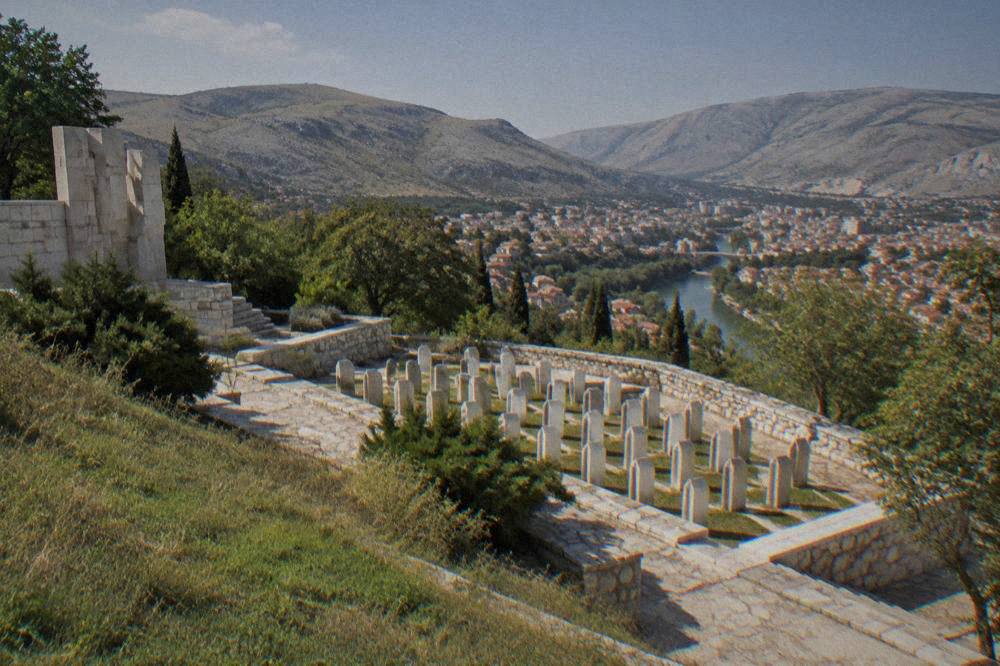
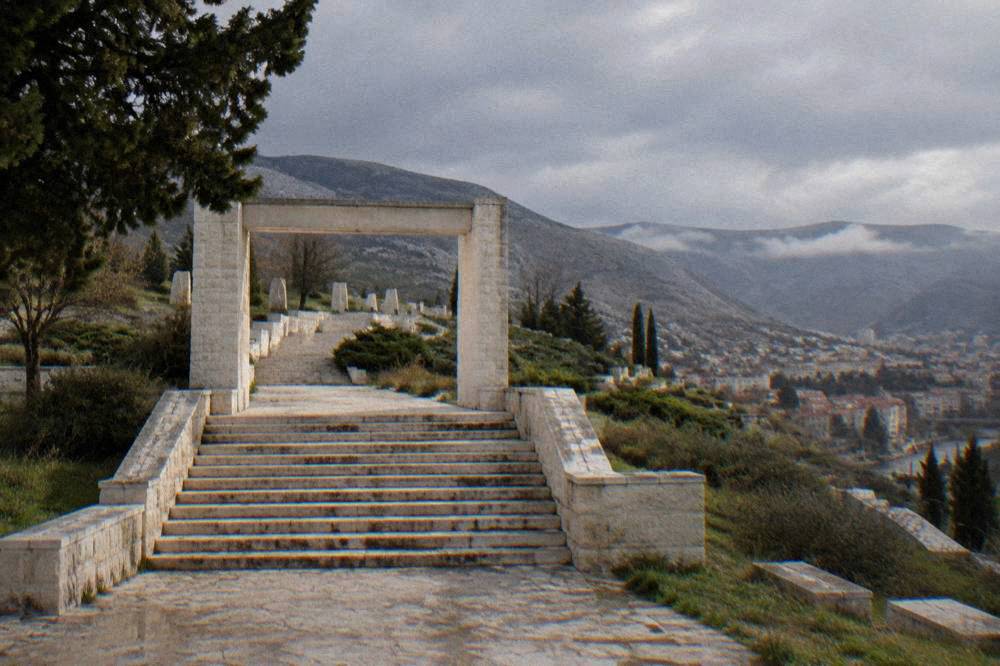
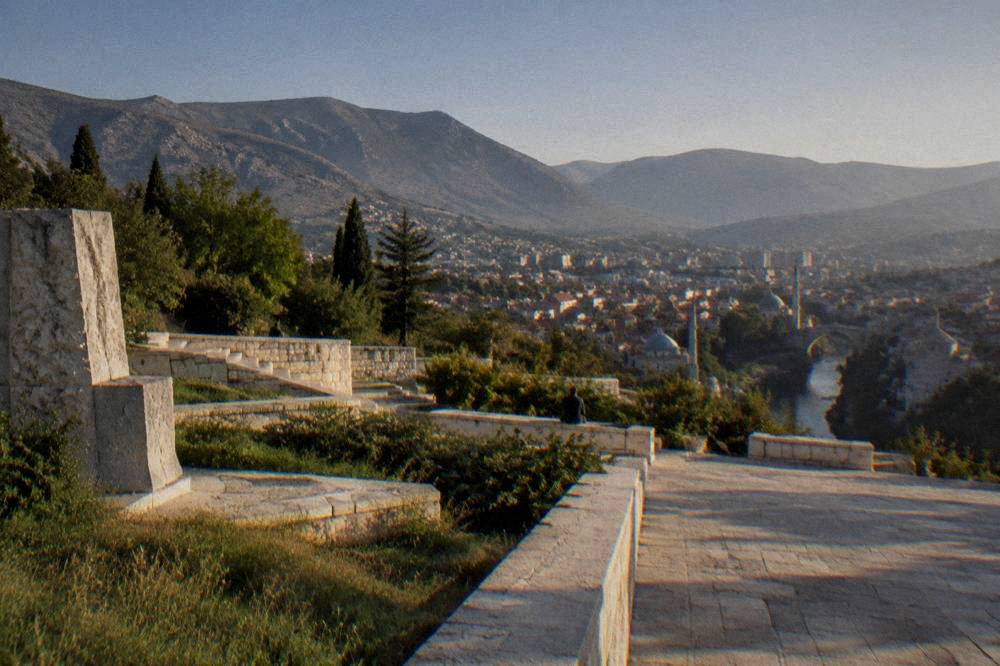
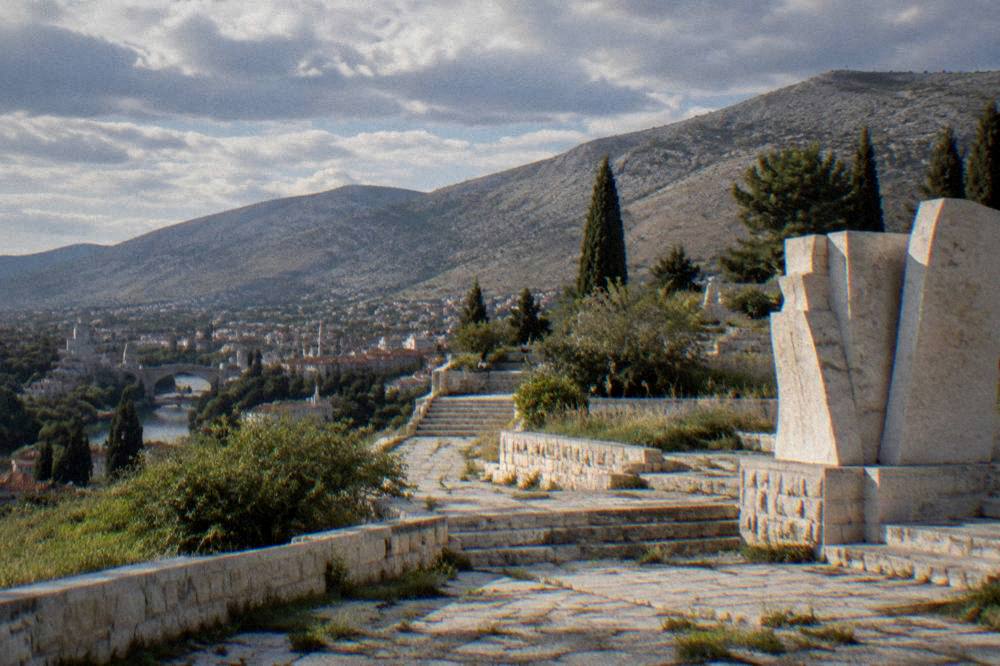
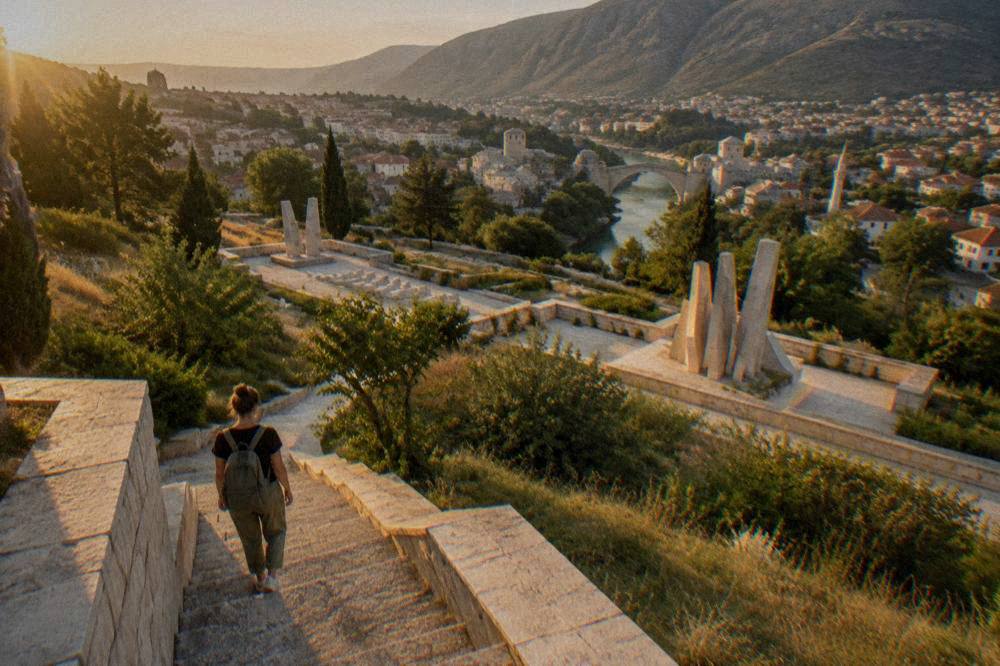
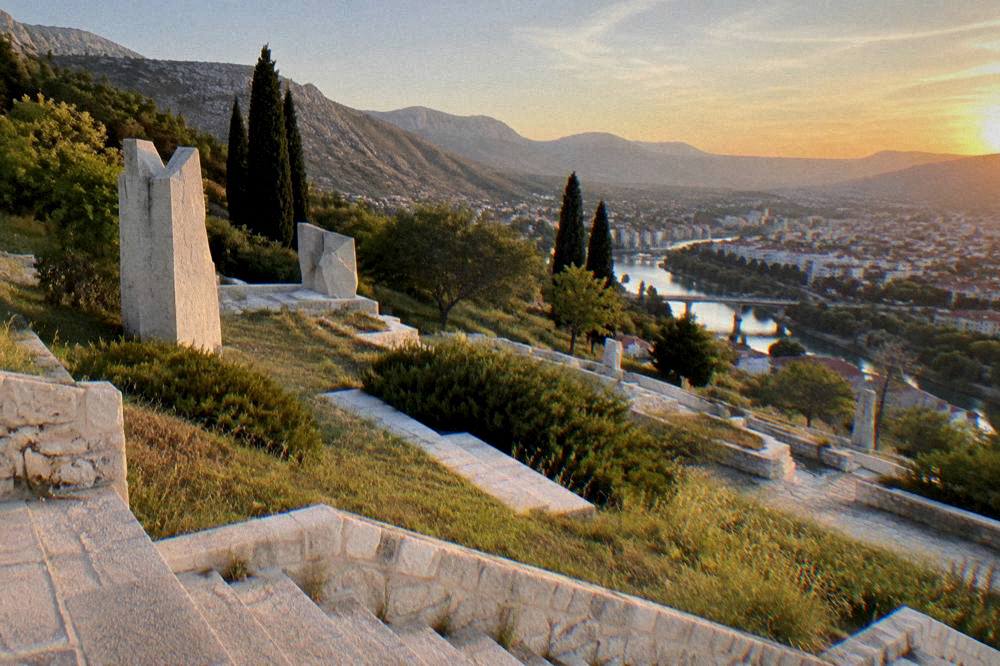
You will see a walled, terraced necropolis in local stone: a monumental gateway and processional stair, water-channel elements that once ran through the composition, terrace retaining walls holding the hillside, rows of bases where hundreds of carved markers stood, the surviving carved stones themselves, and a ceremonial plateau with open views over Mostar and the surrounding mountains.
The gateway is the first architectural statement, a heavy stone composition that announces the transition from the city of the living to the city of the dead. Beyond it the terraces begin, each level a platform of paving and low walls, and each originally populated with markers carved as stylised houses, chests, buds and abstract forms. Many bases now stand empty. The surviving stones, and the fragments of the destroyed ones, tell the site's two stories at once: the ambition of 1965 and the destruction of 2022.
The vegetation is part of the current character. Grass and wildflowers push through the paving in spring, and the trees that frame the enclosure have matured since planting. The effect is closer to an ancient ruin than to a maintained monument, and photographers respond to exactly that quality: soft stone, hard geometry, encroaching green, and a city skyline with the minarets and towers of the Old Town in the middle distance. Bring water, because there is none on site, and give the place an unhurried hour at least.
Visitors consistently group this site with the other memory sites of the city. The Sniper Tower offers a different, later register of the same recent past, while the interpreted, indoor experience sits at the museum of war and genocide victims. Between them, the cemetery is the earliest chapter and the most architectural.
How Does The Cemetery Compare With Mostar's Other Memory Sites?
The Partisan Memorial Cemetery is the earliest and the most purely architectural of Mostar's memory sites: an open-air monument from 1965 concerned with the Second World War, whereas the war photography exhibition and the Museum of War and Genocide Victims interpret the war of the 1990s indoors, and sites such as the Sniper Tower stand as uninterpreted ruins of that later period. Each demands a different kind of attention, and together they cover the modern span of the city's history.
The cemetery rewards preparation. Because nothing on site is explained, reading even a short account of Bogdanović and of Yugoslav memorial architecture before the walk changes what the terraces mean. The indoor museums do that work for you, with curated material and shelter from the summer heat, which the cemetery offers none of; the FHMZ station table for Mostar puts the July mean at 24.7 C with an absolute maximum of 41.2 C, and the exposed stone terraces hold that heat. Visit the cemetery early, visit the museums at midday.
A third difference is price. The cemetery is free and always has been, in keeping with its nature as public ground. Several of the city's other sights charge small cash fees, and the figures below are the ones worth knowing before you plan a day of them. Note that for a few listed sights the fees are reported figures rather than official postings, so confirm at the door.
| Mostar Memory Sight | Period Covered | Setting | Admission |
|---|---|---|---|
| Partisan Memorial Cemetery | Second World War | Open-air terraces | Free |
| War Photo Exhibition | War of the 1990s | Indoor gallery | Confirm on site |
| Museum of War and Genocide Victims | War of the 1990s | Indoor museum | Confirm on site |
| Old Bridge Museum | Bridge history | Tower, indoor | About 10 KM, reported |
| Koski Mehmed-pašina džamija | Ottoman era | Mosque and minaret | Small cash fee, reported |
| Sniper Tower | War of the 1990s | Ruined tower, open | Free |
For context on the Ottoman and UNESCO-listed layers of the city, the Old Bridge and the bazaar street of Kujundžiluk anchor the other end of Mostar's historical span, and a walk between the two poles, Ottoman bridge and Yugoslav necropolis, is one of the most complete history walks any mid-sized European city can offer.
What Should You Know Before Visiting The Partisan Memorial Cemetery In Mostar?
Visit in daylight, wear shoes with grip, carry water, and expect no facilities, no shade beyond the trees and no interpretation of any kind. The site is unstaffed open ground, so standard city precautions apply, and the general rural Herzegovina advice about staying on marked paths because of suspected mine areas matters here only in the sense that you should not wander off the monument's terraces into untended ground around it. In an emergency anywhere in Bosnia and Herzegovina, dial 112.
The unstaffed nature of the place also means no one will stop you from doing something unwise, so the responsibility is entirely the visitor's. The upper terraces have loose stone and drops between levels; the low walls are not seating; and the fragments of destroyed markers, tempting as they are to handle or move, are the very material whose protection the Europa Nostra campaign is about. Look, photograph, leave everything exactly where it lies.
Timing within the year matters less than timing within the day. The FHMZ rainfall table for Mostar shows a winter maximum, with November averaging 200.0 mm against July's 42.9 mm, so the terraces are greener and the footing softer from late autumn to early spring, and the summer months are dry, hot and bright. Early morning in any season gives the calmest light and the fewest other people, and the site needs no more than a spare hour unless you plan to photograph it seriously.
| Practical Point | Guidance |
|---|---|
| Hours | None posted, open ground |
| Ticket | None |
| Terrain | Terraced, stepped, loose stone in places |
| Facilities | None, carry water |
| Best light | Early morning, late afternoon |
| Emergency number | 112 |
Can You Combine The Cemetery With Other Mostar Sights In One Day?
Yes, comfortably: the cemetery is a single uphill detour of an hour or so, and it slots naturally into a day built around the Old Town, the city's museums and the viewpoints on the surrounding hills. A realistic full day pairs a morning at the Old Bridge and Kujundžiluk, an early-afternoon walk up to the cemetery, and a late afternoon at a viewpoint or an indoor museum, with the whole plan walkable or a short, inexpensive taxi ride between the far points.
Mostar's sightseeing geography is compact. The Old Bridge Area of the Old City, the UNESCO World Heritage property inscribed in 2005, sits at the bottom of the valley; the cemetery climbs the western slope; and Fortica and Hum frame the valley from above. A walker with average fitness can cover the Old Town, the cemetery and a viewpoint in a single day without transport, though in July and August, when modelled ERA5 reanalysis 1991 to 2020 daily highs reach about 30 C, the order matters: bridge early, cemetery before the heat peaks, museum or shade in the afternoon.
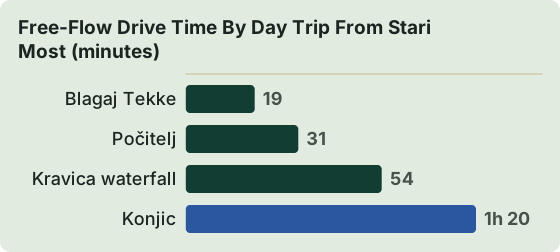
For travellers with a second day, the Herzegovina countryside begins practically at the city edge. Blagaj Tekke is 13.7 km and about 19 minutes by road from Stari Most, Počitelj 30.0 km and about 31 minutes, and Kravica waterfall 55.2 km and about 54 minutes, all free-flow driving times that exclude any queues. Kravica's own visitor page lists entry at 20 KM for an adult all year, with children under 7 free, so a countryside day is easy to budget alongside a free city day.
| Day Trip From Stari Most | Road Distance | Free-Flow Drive Time |
|---|---|---|
| Blagaj Tekke | 13.7 km | About 19 min |
| Počitelj | 30.0 km | About 31 min |
| Kravica waterfall | 55.2 km | About 54 min |
| Konjic | 69.0 km | About 80 min |
Guided options cover both halves of that plan. A city walking tour handles the urban history, and a Herzegovina day tour takes in Blagaj, Počitelj and Kravica waterfall in one loop from Mostar; check availability for departure details. Food-minded travellers can round out the day with a hands-on burek class; check availability for sessions.
Why Does The Cemetery's Fate Matter Beyond Mostar?
The cemetery's fate matters beyond Mostar because it has become the test case for how post-conflict Europe treats monuments whose politics are contested but whose architecture and heritage value are undisputed: a nationally designated monument by a major architect, massively damaged in 2022, unrestored, and now the subject of an international campaign led by Europa Nostra with a report presented to the Parliamentary Assembly of Bosnia and Herzegovina in May 2026.
Heritage bodies do not put sites on endangered lists lightly, and the language used about this one is strong: critical condition, urgent action, revitalisation. The report calls for security, management and a phased future for the monument, which implies a long road rather than a quick restoration. For a visitor in 2026, that means seeing the site in its damaged state is not a lesser experience to be regretted but the current chapter of a live heritage story. The empty terraces, the broken stones and the silence are what a monument under threat actually looks like, and seeing it firsthand is why people leave moved.
There is also a simple architectural argument that travels well. Bogdanović's necropolis is a complete designed landscape from a period whose public monuments are increasingly studied worldwide, and few of them sit inside a living European city this small. Students of architecture make the walk for the composition alone, gateway to terraces to plateau, and many leave with the sense that the site's best defence is simply being understood. Whether revitalisation comes or not, the stones, the slope and the view over the Neretva valley remain, and they speak clearly enough on their own.
For everything else the city offers, from the UNESCO-listed Old Bridge Area to the mosques, museums and markets of the old core, the Mostar Travel Guide homepage is the full index, and the cemetery deserves its place on any list that goes deeper than the bridge.
Common Questions About The Partisan Memorial Cemetery In Mostar
Is the Partisan Memorial Cemetery in Mostar free?
Yes. There is no ticket, no desk and no charge of any kind. The site is unstaffed open ground, a national monument with no admission operation.
When was the Partisan Memorial Cemetery built?
It was inaugurated in 1965 to a design by the architect Bogdan Bogdanović, and its 60th anniversary was marked in 2025.
What happened at the cemetery in 2022?
Over 700 of its carved stone memorial markers were deliberately destroyed. The terraces, walls and gateway survive, and the site has not been restored.
Is the cemetery safe to visit?
The site itself is urban and open, but it is unstaffed, unlit and terraced with loose stone in places. Visit in daylight, wear shoes with grip, stay on the monument's terraces and do not wander into untended ground around it.
Why is the cemetery on an endangered heritage list?
Europa Nostra placed it on its 7 Most Endangered programme and presented a landmark report in May 2026 calling for urgent protection, security and revitalisation of the site.
How long should a visit take?
About an unhurried hour covers the gateway, terraces and upper plateau. Photographers and anyone reading the architecture closely will want longer.