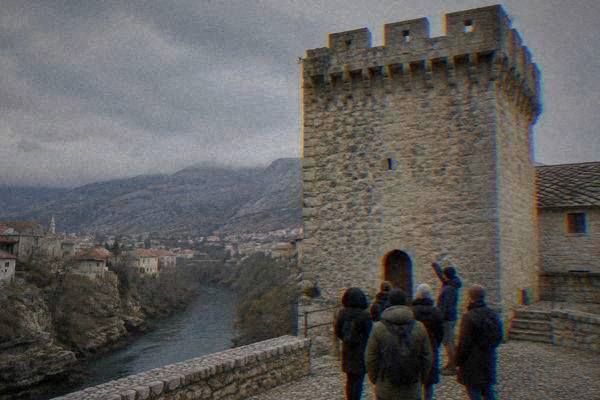
Stari Most: The Old Bridge Of Mostar
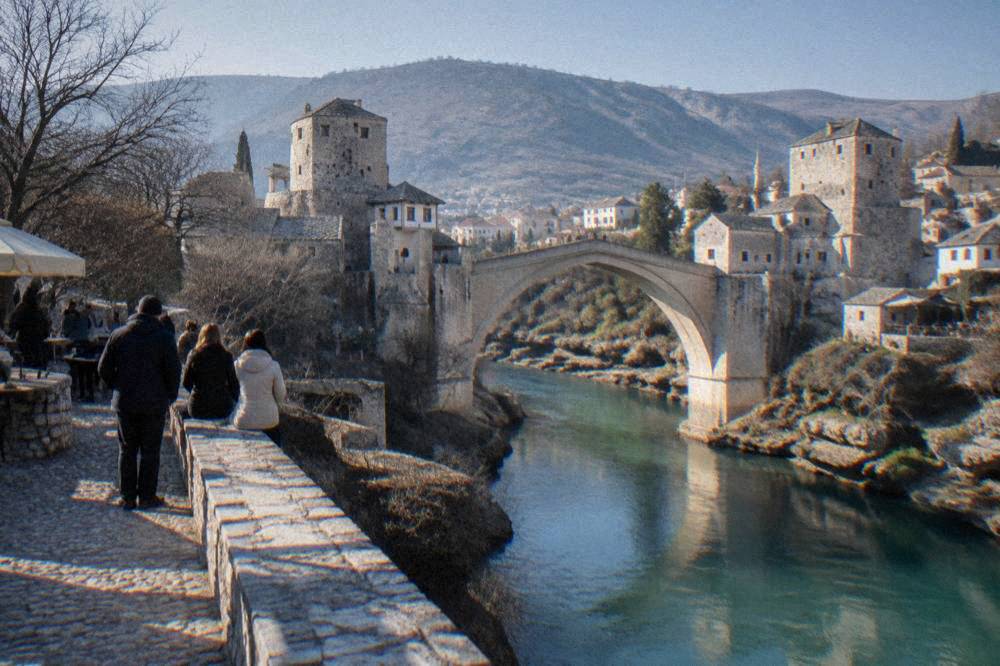
Stari Most, the Old Bridge of Mostar, is a single stone arch over the Neretva river, completed in 1566, destroyed in 1993 and reopened in 2004. It is the centre of a UNESCO World Heritage property and the single most recognised sight in Herzegovina.
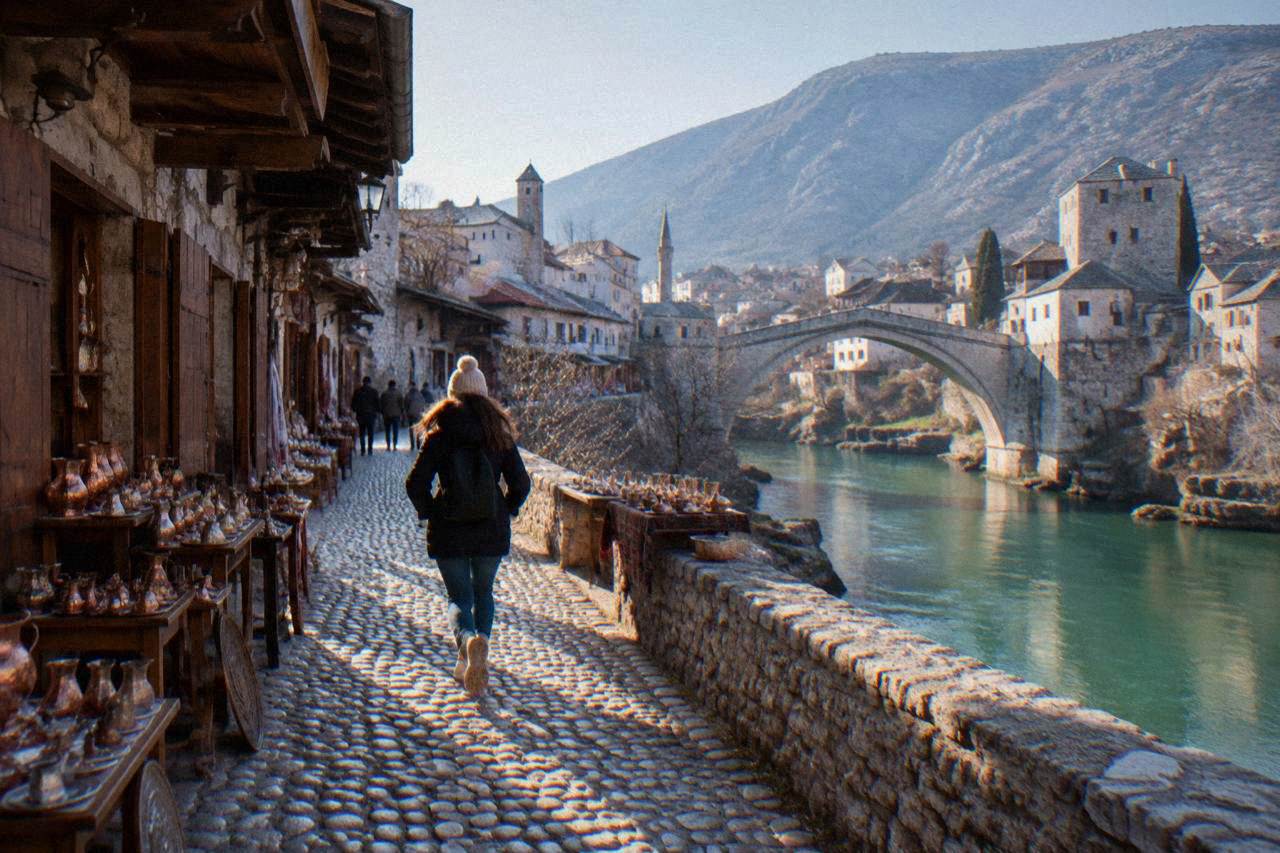
Stari Most in Mostar, Herzegovina, is an Ottoman stone bridge completed in 1566 over the Neretva river, about 29 metres across and roughly 21 to 24 metres above the water. Crossing is free and open around the clock, and the surrounding Old Bridge Area has been a UNESCO World Heritage property since 2005.
Mostar sits inland on the Neretva river in Herzegovina, Bosnia and Herzegovina, with no sea coast, and its centre of gravity is a single stone arch. Stari Most, the Old Bridge, was completed in 1566, destroyed on 9 November 1993 and rebuilt and reopened in July 2004, and since 2005 the Old Bridge Area of the Old City of Mostar has been a UNESCO World Heritage property. This page lays out what the bridge is, why it is famous, how tall it stands, who jumps from it, what happened to it, and what surrounds it on both banks.
What Is Stari Most In Mostar?
Stari Most is a single-arch Ottoman stone bridge over the Neretva river in the centre of Mostar, Herzegovina, completed in 1566 under Suleiman the Magnificent to a design by mimar Hajruddin, a student of the great architect mimar Sinan. Its span runs about 29 metres, it stands about 21 to 24 metres above the river depending on the water level, and crossing it is free at any hour.
The bridge gave the city its purpose and then its name. The name Mostar appears in a written document of 1474, and it comes from "mostari", the bridge keepers who guarded the earlier wooden crossing on the same spot. When the stone arch replaced the timber bridge in 1566, the crossing became the fixed point around which the bazaars, mosques and houses of the Ottoman town grew. The UNESCO description of the property records settlement in the town from the 15th century and notes that Hajruddin's design follows that of his master-teacher Sinan.
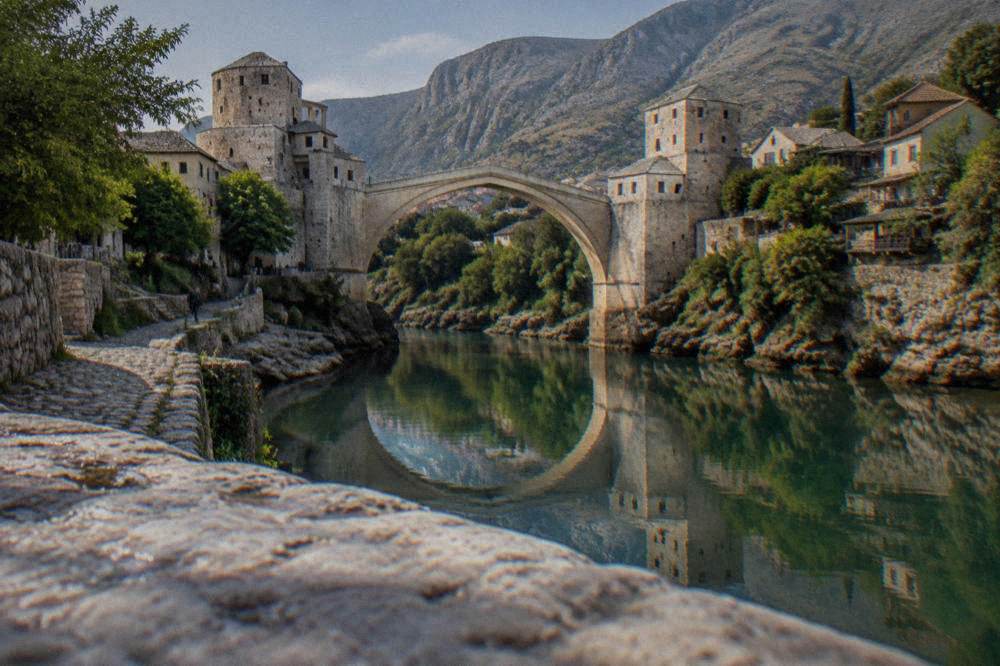
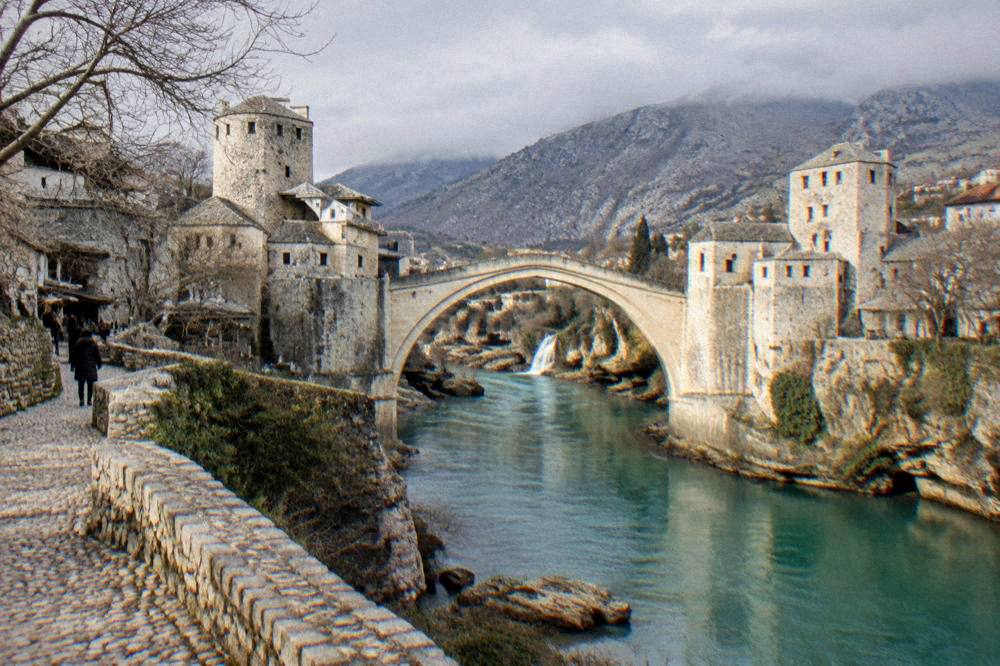
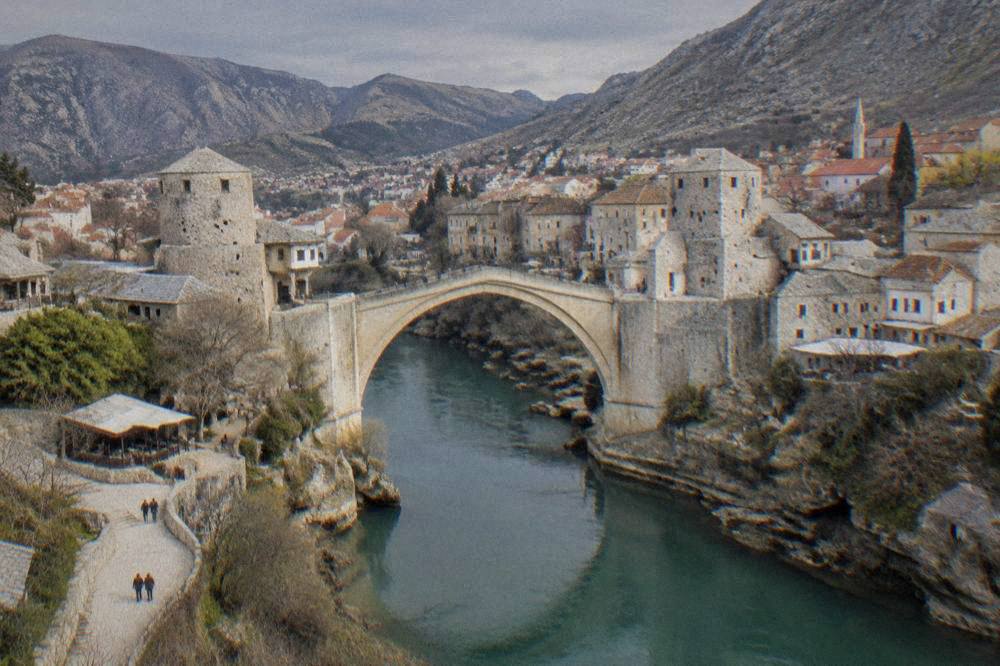
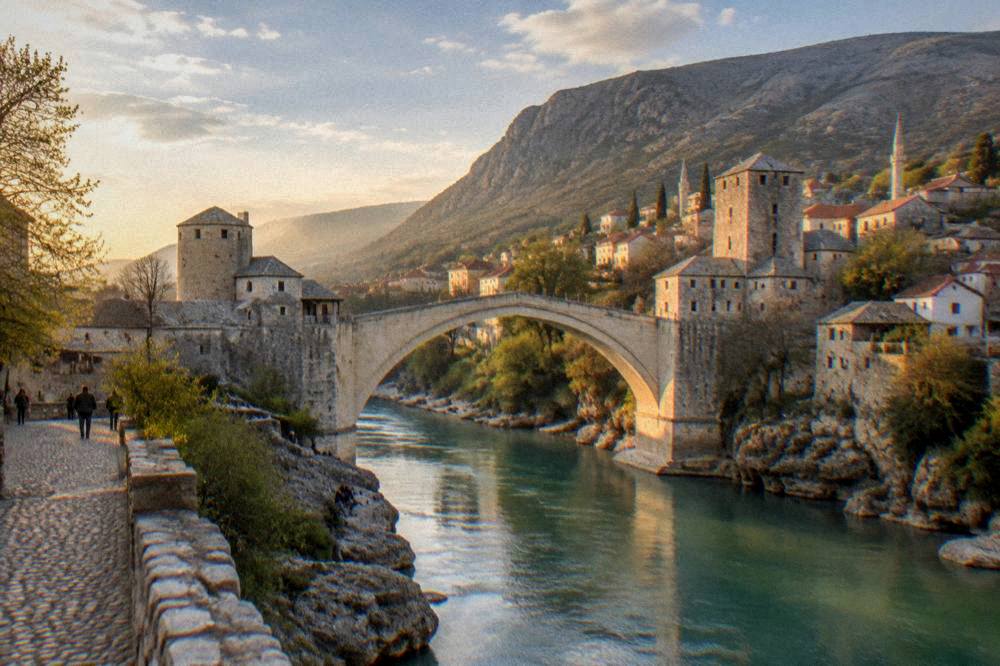
The stone itself matters to how the bridge looks. It was built of local tenelija limestone, a pale stone that changes tone with the light over the Neretva, and its arch springs directly from the rock banks rather than from piers in the water. That single decision, one clean arch between two cliffs, is what makes the silhouette so distinct. The rebuilt bridge of 2004 reused original material recovered from the river wherever possible, following the original techniques, so the arch you cross today follows the same curve as the 1566 one. More on the destruction and rebuilding sits further down this page, and the question why the Mostar bridge is so famous has its own answer page on this site.
| Bridge fact | Figure |
|---|---|
| Completed | 1566 |
| Commissioned by | Suleiman the Magnificent |
| Architect | mimar Hajruddin, after a design by his teacher mimar Sinan |
| Span | about 29 metres |
| Height above the Neretva | about 21 to 24 metres depending on the river |
| Destroyed | 9 November 1993 |
| Rebuilt and reopened | July 2004 |
| UNESCO inscription | 2005, property 946, criterion (vi) |
| Crossing cost | free, open 24/7 |
Why Is The Old Bridge Of Mostar So Famous?
The Old Bridge of Mostar is famous because it is a single stone arch of unusual elegance built in 1566, because its destruction in 1993 and reconstruction in 2004 made it a symbol of recovery, and because UNESCO inscribed the whole Old Bridge Area in 2005 under criterion (vi), which honours its association with multicultural coexistence and international cooperation.
Criterion (vi) is worth pausing on, because it is the only criterion the property was inscribed under. UNESCO's decision text inscribes the Old City of Mostar on that basis alone, tying the bridge's significance to what it stands for rather than to architectural novelty, even though the arch itself is a remarkable piece of Ottoman engineering. The rebuilt bridge was reconstructed with the support of UNESCO and World Bank partners using original materials and techniques, and the reopening in July 2004 turned the crossing back into a working street, not a museum piece.
Fame also feeds on the divers. Members of the Mostari diving club jump from the bridge's ledge into the Neretva, a tradition with its own annual competition, and the Red Bull Cliff Diving World Series has made the bridge a regular stop. The result is that the bridge is photographed from roughly the same few spots on both banks all day, every day. For framing those spots, the Mostar viewpoints guide lists the banks and towers that look back at the arch, and the wider Old Town area page covers the lanes that lead down to it.
A practical note on crowds and heat, because the two combine. The bridge is busiest and the stone slickest under midday summer sun, and Mostar's July mean temperature runs 24.7 C on the FHMZ 1961-1990 station series, with modelled mean daily highs of 29.9 C in the ERA5 reanalysis, 1991-2020. Early morning and evening crossings give calmer conditions and better light on the limestone.
A guided walk is one way to hear the layers of the bridge's story in one pass. The private group city tour of Mostar and the Old Bridge centres itself on the crossing and its surroundings, and you can Check availability alongside it. The rest of this page stays with the bridge itself.
How Tall Is Stari Most, And What Does Crossing It Cost?
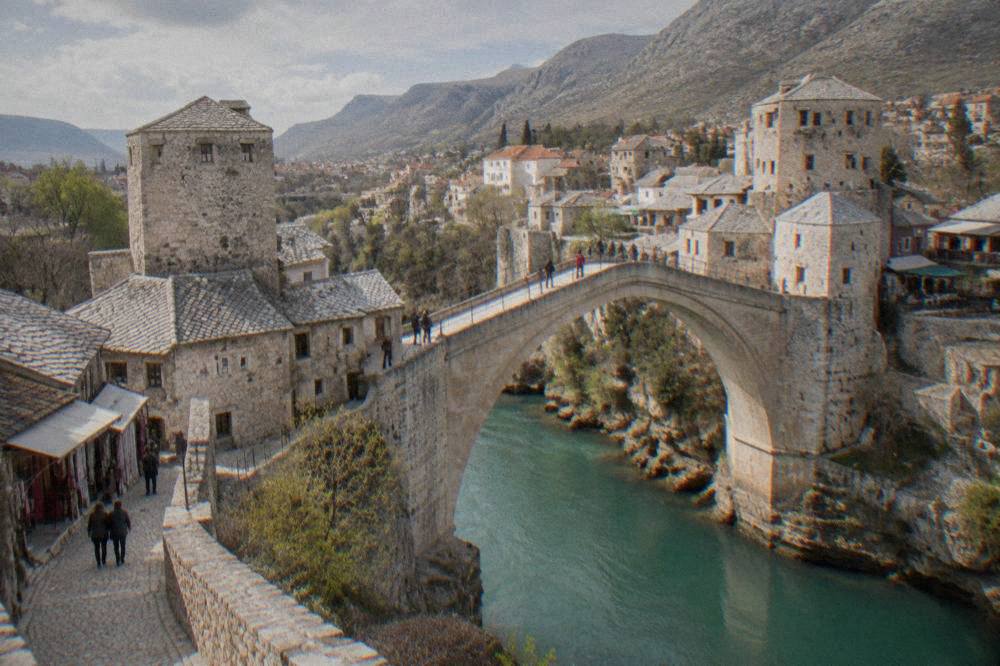
Stari Most stands about 21 to 24 metres above the Neretva, depending on the river level, with a span of about 29 metres, and crossing it costs nothing: it is a public pedestrian route, open around the clock, with no ticket, no gate and no closing time.
The height range is not carelessness, it is the river. The Neretva's level moves with upstream dams and the seasons, so the drop from the ledge to the water shifts, and figures quoted anywhere between about 21 and 24 metres are all describing the same bridge at different water. A widely repeated 29-metre height figure confuses the span with the height; the span is the roughly 29-metre distance between the banks. When the Red Bull Cliff Diving World Series comes to Mostar, the competition adds its own platforms at 21 metres for the women and 27 metres for the men, and those are event structures, not the bridge's own height.
Costs around the bridge are few. Crossing is free. The Old Bridge Museum in the Tara tower beside the bridge is reported to charge a cash admission of about 10 KM with daily hours from 08:00 to 16:00 between 1 April and 1 November, and that figure is reported rather than official, so confirm at the door. The Old Bridge Museum page on this site covers what the tower holds. Koski Mehmed-pašina džamija, just downhill, charges a small cash fee reported at around 10 KM for the mosque and more with the minaret climb, again reported rather than official.
| Measurement or cost | Figure |
|---|---|
| Height above the river | about 21 to 24 metres, depending on water level |
| Span between banks | about 29 metres |
| Red Bull women's platform | 21 metres |
| Red Bull men's platform | 27 metres |
| Crossing the bridge | free, 24/7 |
| Old Bridge Museum entry | reported about 10 KM, confirm on site |
| Koski Mehmed-pašina džamija | reported about 10 KM, more with the minaret, confirm on site |
The stone surface is the one real hazard on a free crossing. The limestone paving is worn smooth and becomes slippery when wet, so walk the arch rather than photograph while walking it. The path over the bridge is stepped and uneven by modern standards, and the approach lanes on both sides are cobbled. There is no barrier on the outer edge beyond a low stone course, which is exactly why the crossing photographs so well and why steady shoes matter.
Who Jumps From The Old Bridge In Mostar?
The jumpers on Stari Most are members of the Mostari diving club, who train for years before solo jumps off the ledge; there is no pay-to-jump option for visitors, and the bridge height of about 21 to 24 metres into cold Neretva water makes an untrained jump genuinely dangerous.
The club's tradition is the city's signature event. The 460th traditional diving competition ran on Sunday 26 July 2026, organised by the Mostari club, with head dives and feet dives judged separately, and the Red Bull Cliff Diving World Series followed from 30 July to 1 August 2026, Mostar's tenth time hosting the stop. The Red Bull weekend opens with traditional jumps from the bridge itself before moving to the added platforms at 21 metres for women and 27 metres for men. Treat all of these as 2026 editions of annual events; dates for future years are not fixed in advance here. Other pages covering the same trip are gathered on Mostar Travel Guide.
Members of the club also jump informally through the warmer months, collecting spectator contributions on the riverbank before a dive. The water is the reason training matters: the Neretva is fed by karst springs and stays cold even in August, and the safe entry window from the ledge is narrow. Visitors watch, they do not jump. The full story, including the competition and the club, sits on the Mostar bridge diving guide.
| Diving event or fact | Detail |
|---|---|
| Who jumps | members of the Mostari diving club |
| Visitor jumps | none offered; untrained jumps are dangerous |
| Traditional competition 2026 | 460th edition, 26 July 2026 |
| Red Bull Cliff Diving 2026 | 30 July to 1 August 2026, 10th Mostar stop |
| Women's platform | 21 metres |
| Men's platform | 27 metres |
| Water condition | cold even in August, karst-fed |
What Happened To Stari Most In 1993, And When Was It Rebuilt?
The Old Bridge was destroyed on 9 November 1993 during the war and stood destroyed for over a decade; reconstruction using original materials and techniques, supported by UNESCO and World Bank partners, returned the rebuilt bridge to the city in July 2004, and UNESCO inscribed the Old Bridge Area of the Old City of Mostar as a World Heritage property in 2005.
The record this site keeps is deliberately physical. The bridge fell on 9 November 1993. It was rebuilt in 2004, reopened in July of that year, and the surrounding Old Bridge Area was inscribed on the World Heritage List in 2005 as property 946, under criterion (vi) alone. The reconstruction recovered original tenelija limestone blocks from the riverbed where they could be reused and followed the original construction techniques, so the rebuilt arch follows the 1566 geometry. Two companion answer pages on this site carry the same record in question form: why was the Mostar bridge destroyed and has the Mostar bridge been rebuilt.
After 2004 the bridge returned to ordinary use, which is its own kind of point. It carries pedestrians between the two halves of the old city, the Kujundžiluk bazaar on the east bank and the mosque-quarter lanes on the west, at every hour of the day. The UNESCO property is compact, 7.60 hectares with a 48-hectare buffer zone, so everything in this section sits within a short walk of the arch itself.
What Can You See Around The Old Bridge In Mostar?
Within a few minutes' walk of Stari Most you can reach the Kujundžiluk bazaar street, the Koski Mehmed-pašina džamija with its minaret viewpoint, the Old Bridge Museum in the Tara tower, the Crooked Bridge (Kriva ćuprija) upstream, and the Ottoman courtyard houses Bišćević House and Muslibegović House, all inside or beside the UNESCO property.
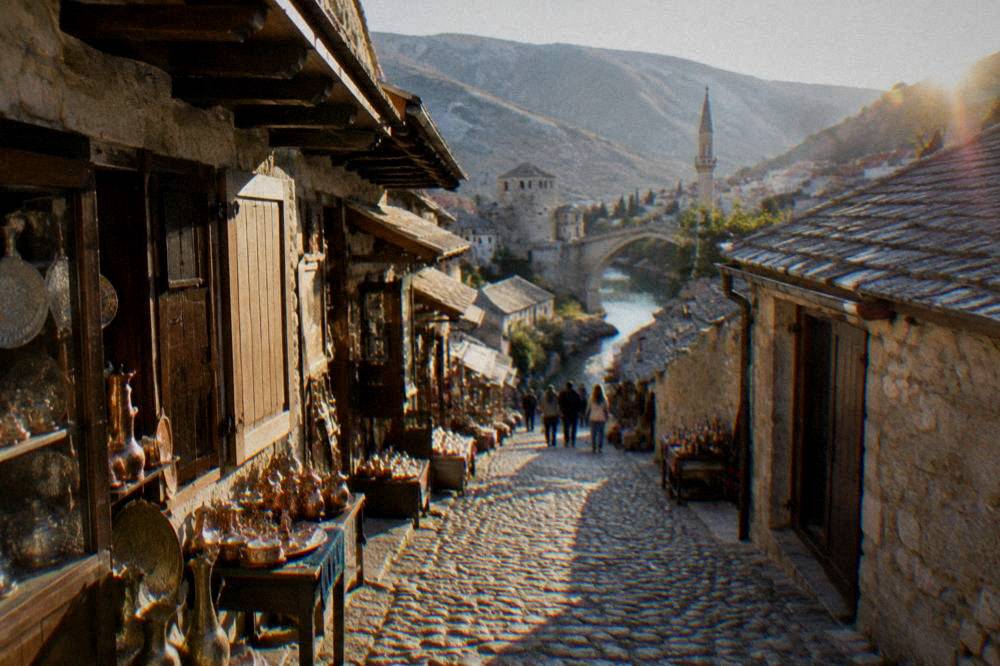
Start on the east bank. Kujundžiluk, the old coppersmith bazaar, runs from the bridge down the river, a lane of small shops under overhanging roofs, and it is the approach almost every photograph of the arch is taken from. At its river end the Crooked Bridge crosses a side channel, a small single arch that reads as a miniature rehearsal for the great one.
Cross to the west bank for the climbs. Koski Mehmed-pašina džamija sits a few steps from the bridge, and its minaret terrace is one of the closest raised views over the arch. The Tara tower beside the bridge itself houses the Old Bridge Museum. Further afield but still walkable, Bišćević House and Muslibegović House preserve Ottoman domestic architecture with courtyards open to visitors for a small cash fee, reported at about 4 KM and about 8 KM respectively, so confirm at the door. Spanish Square and the modern city centre sit a short walk north, and the Spanish Square page covers that end of town.
| Sight near Stari Most | Bank | Entry |
|---|---|---|
| Kujundžiluk bazaar | east | free, public street |
| Kriva ćuprija (Crooked Bridge) | east | free, public structure |
| Koski Mehmed-pašina džamija | west | reported about 10 KM, more with minaret |
| Old Bridge Museum (Tara tower) | west, at the bridge | reported about 10 KM |
| Bišćević House | east, downstream | reported about 4 KM |
| Muslibegović House | west | reported about 8 KM |
Grouping the bridge with its surroundings is where guided walks earn their keep. A focused option is the small-group Old Town guided tour, which works the bridge and the lanes around it, and the wider walking options are compared on the two days in Mostar itinerary, which places the bridge on day one and the wider city around it. For everything beyond the Old Town, the root things to do in Mostar page is the site's full index.
When Is The Best Time Of Day And Year To See Stari Most?
Early morning and late afternoon are the calmest times on Stari Most, before and after the day-trip peak, and late spring and early autumn give the most comfortable walking weather: the ERA5 reanalysis for 1991-2020 puts July mean daily highs at 29.9 C and August at 30.5 C, while May highs average 22.3 C and October's 19.5 C with cooler nights.
Rain, not cold, is the winter consideration. On the FHMZ 1961-1990 station series for Mostar, November averages 200.0 mm of precipitation against July's 42.9 mm, a nearly five-fold difference, and the year totals 1,515.4 mm with a clear winter maximum. Summer is dry and hot, with an absolute maximum of 41.2 C recorded in July on the same station series. Winter crossing is quiet and often bright, the stone can be icy after frost, and January mean daily lows sit at 0.2 C on the ERA5 1991-2020 modelled normals, so a cold snap can glaze the arch.
The light is the photographer's variable. The arch faces the river's course, so morning sun strikes the east bank and the bazaar lane, while evening sun warms the west-bank mosque quarter, and the water's green reads deepest in the middle of the day. Festival weeks change the picture entirely: in 2026 the city ran Mostarsko ljeto from 25 June to 7 August, the Mostar Summer Fest from 2 to 4 July, the Blues & Rock Festival on 24 and 25 July, the Jazz Fest from 23 to 25 August, and the two diving weekends of late July and early August around the bridge itself. Those are past 2026 editions of annual events, and the bridge's surroundings are at their fullest then.
| Month | Modelled mean daily high (C) | Modelled mean daily low (C) | Rain (mm) |
|---|---|---|---|
| January | 8.4 | 0.2 | 142.8 |
| April | 17.7 | 7.0 | 150.9 |
| May | 22.3 | 11.4 | 116.1 |
| July | 29.9 | 17.7 | 45.4 |
| August | 30.5 | 18.1 | 52.6 |
| October | 19.5 | 9.8 | 186.8 |
| November | 14.1 | 5.7 | 235.8 |
Modelled rows are ERA5 reanalysis, 1991-2020; the valley floor around the river runs hotter than these grid values suggest in high summer. Whichever month you choose, cross the arch early or late, and use the middle of the day for the museums, the courtyard houses and a long lunch.
How Does Stari Most Fit Into Day Trips Around Herzegovina?
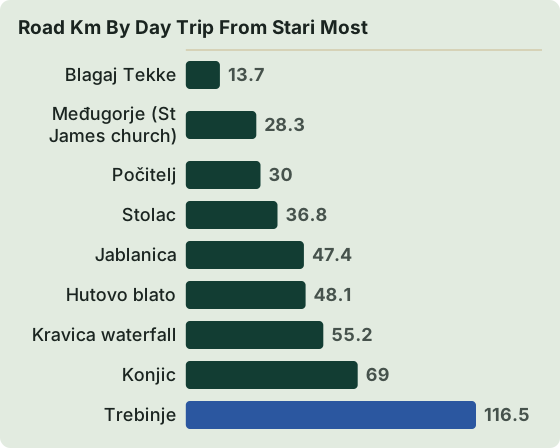
Stari Most is the anchor of nearly every Herzegovina day trip, and the drives from the bridge are short: Blagaj Tekke is 13.7 km and about 19 minutes away, Počitelj 30.0 km and about 31 minutes, Kravica waterfall 55.2 km and about 54 minutes, and Konjic 69.0 km and about 80 minutes, all free-flow road times that exclude any border queues.
The classic loop from Mostar runs Blagaj, Počitelj and Kravica waterfall in one day, and dozens of variations do exactly that. Blagaj holds the dervish tekke at the Buna spring, reported at 10 KM entry with hours from 08:00 to 22:00 between April and October. Počitelj is a free fortified village on a hillside above the Neretva. Kravica waterfall charges 20 KM for an adult all year, 10 KM for residents of Bosnia and Herzegovina, and nothing for children under 7, with summer hours from 07:00 to 22:00, per the park's own visitor page. Swimming in the pool below the falls is allowed in summer in a designated area, with no lifeguard reported, so check the park's rules on arrival.
North of the city, Konjic and Jablanica extend the list, and Konjic and Jablanica have their own day-trip pages on this site, as do Stolac with the Radimlja necropolis and, further east, Trebinje. Radimlja's medieval stećci tombstones are part of a UNESCO property of their own, inscribed in 2016, which makes a Stari Most plus Radimlja day a two-property itinerary.
| Day trip from Stari Most | Road km | Free-flow minutes |
|---|---|---|
| Blagaj Tekke | 13.7 | 19 |
| Međugorje (St James church) | 28.3 | 40 |
| Počitelj | 30.0 | 31 |
| Stolac | 36.8 | 47 |
| Jablanica | 47.4 | 57 |
| Hutovo blato | 48.1 | 62 |
| Kravica waterfall | 55.2 | 54 |
| Konjic | 69.0 | 80 |
| Trebinje | 116.5 | 142 |
Two practical cautions for drivers. Bosnia and Herzegovina is not in the EU or Schengen, so every crossing into Croatia is an external-border check with passports, and reported waits run longer at summer peaks. And in rural Herzegovina, stay on marked paths because of suspected mine areas, following BHMAC guidance. For eating before or after all this, the restaurants guide covers the city, and the deeper background of the city around the bridge is on the Mostar history page.
What Should You Know Before You Cross Stari Most?
Before crossing Stari Most you should know four things: the bridge is free and open at every hour, the stone is worn smooth and slippery especially when wet, the arch has no high barrier on its outer edge so it is walked rather than treated as a photo platform, and the surrounding Old Town is compact enough to cover on foot from anywhere central.
Wear shoes with grip. Cobbles approach both ends and the arch's own steps are centuries of wear polished by feet. In high summer carry water for the exposed stone, in winter watch for ice, and in rain treat the whole crossing as slower going. The bridge is a public street, so it never closes and never charges, and there is no ticket desk, queue or gate anywhere near it.
Money around the bridge works in convertible marks. The currency is the KM (BAM), pegged at 1 EUR = 1.95583 KM, and euro cash is often accepted in tourist areas at a rounded rate, so confirm the rate before paying in euro notes. Small sights around the bridge take cash for entry. A tourist tax of 3 KM per person per night is reported in the canton from 1 January 2026, and you should confirm it at booking. The emergency number is 112, with 122 police, 123 fire and 124 ambulance reported alongside it.
Common Questions About Stari Most In Mostar
Is Stari Most free to cross?
Yes. The bridge is a public pedestrian route, open around the clock, with no ticket and no gate. The nearby museums and the mosque charge small cash admissions, reported at around 10 KM each, but the bridge itself costs nothing.
How high is the Old Bridge of Mostar?
About 21 to 24 metres above the Neretva, depending on the river level. The roughly 29-metre figure that circulates is the span between the banks, not the height. The Red Bull event platforms reach 21 metres for women and 27 metres for men.
Can tourists jump off Stari Most?
No. Jumps are made by members of the Mostari diving club, who train for years, and no pay-to-jump option for visitors is offered. The water is cold even in August and the entry window is narrow, so watching is the correct role for a visitor.
Is Stari Most the original bridge from 1566?
The bridge you cross today was rebuilt and reopened in July 2004 after the original arch was destroyed on 9 November 1993. Reconstruction used original materials recovered from the river and original techniques, so the arch follows the 1566 geometry of mimar Hajruddin's design.
Why is the Old Bridge a UNESCO World Heritage site?
The Old Bridge Area of the Old City of Mostar was inscribed in 2005 as property 946, under criterion (vi) alone, recognising the bridge's association with multicultural coexistence and international cooperation following its reconstruction.
When is the bridge diving competition held?
The traditional competition is an annual summer event; the 460th edition ran on 26 July 2026, and the Red Bull Cliff Diving World Series followed from 30 July to 1 August 2026. Treat these as the latest editions of annual events and check current dates before planning a trip around them.
Stari Most rewards a slow crossing, an early start and a loop through both banks, and everything else in Mostar, from the bazaar to the waterfall at Kravica, arranges itself around that single arch over the Neretva.