Crooked Bridge: Kriva Ćuprija Over The Radobolja
The Crooked Bridge, Kriva ćuprija, is a small stone footbridge over the Radobolja in the Old Town of Mostar, a few steps from the Kujundžiluk bazaar and Stari Most. This guide covers where it is, what it is, what sits around it and how to fit it into a day in the city.
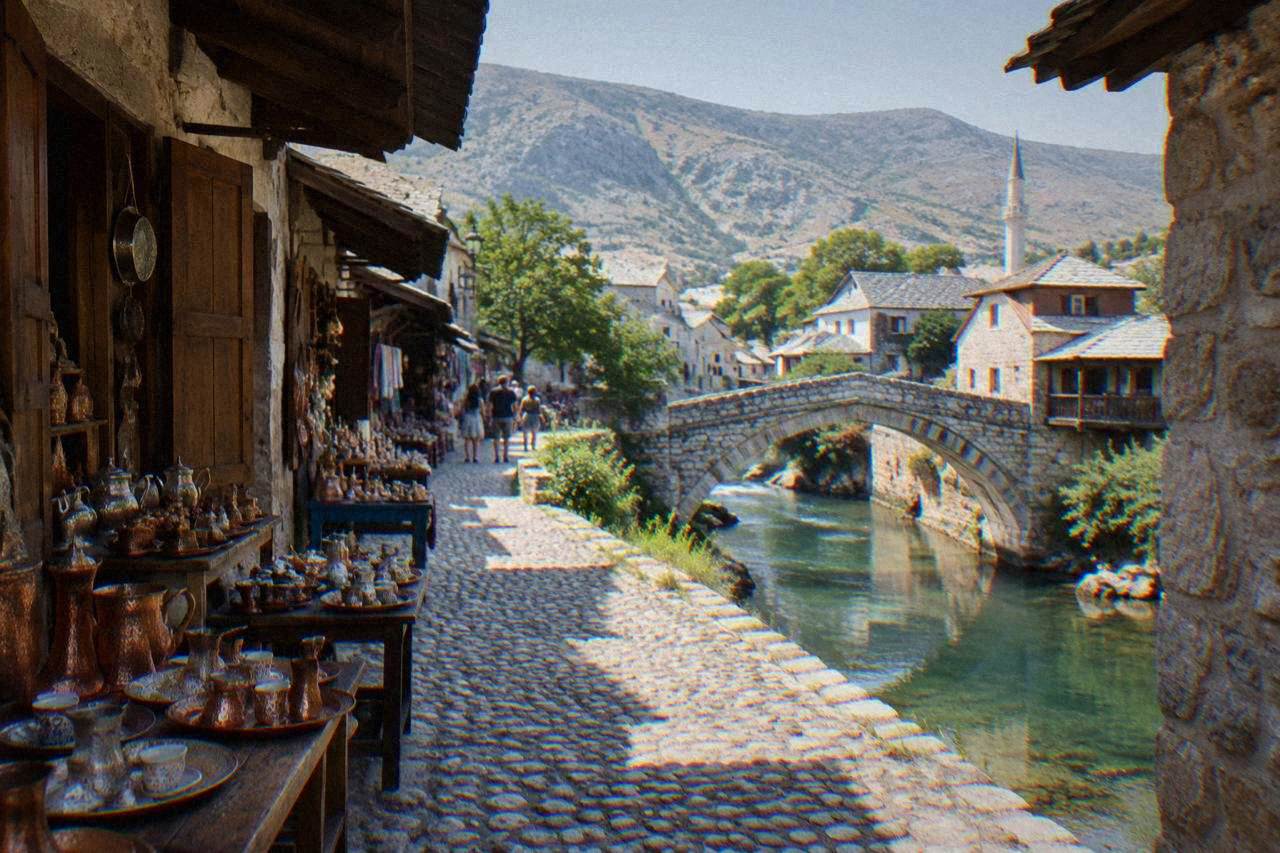
The Crooked Bridge (Kriva ćuprija) is a free, public stone footbridge over the Radobolja brook in the Old Town of Mostar, Herzegovina, Bosnia and Herzegovina, standing near the Kujundžiluk bazaar and a short walk from Stari Most.
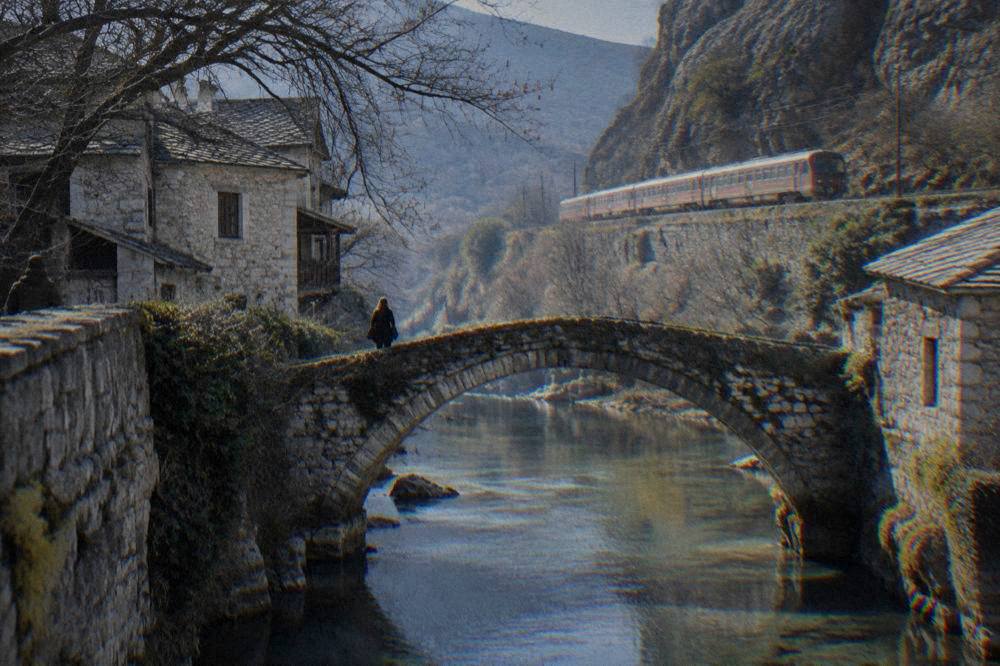
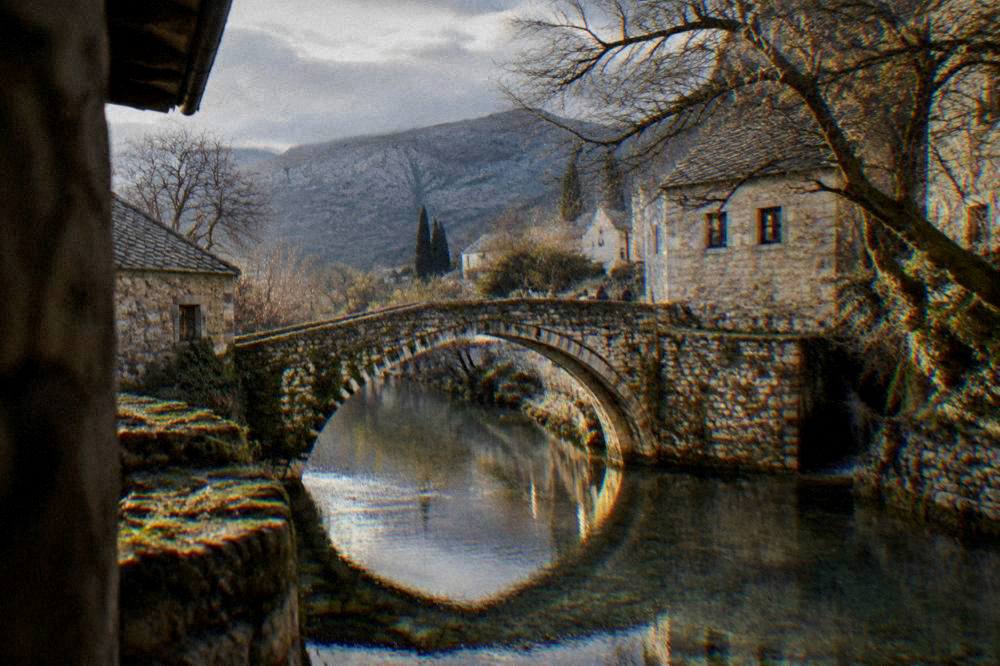
The Crooked Bridge, Kriva ćuprija in local spelling, is a small stone footbridge over the Radobolja, the brook that slips through the Old Town of Mostar before joining the Neretva. It sits in the shadow of its far larger neighbour: Stari Most, the Old Bridge, completed in 1566, destroyed on 9 November 1993 and reopened in July 2004, stands only a short stroll away and draws the crowds. The Crooked Bridge asks nothing of a visitor. There is no ticket, no queue and no fence, just old stone, running water and a stretch of the Old Town that changes character within a single block.
This page from the Mostar Travel Guide editorial desk covers the bridge itself, its place in the Old Town, the walk between it and Stari Most, and the practical details that shape any visit to this part of the city: climate, money, day trips and safety. Where a fee or an hour can shift, the page says so plainly and leaves the confirmation to the reader.
What Is The Crooked Bridge In Mostar?
The Crooked Bridge, Kriva ćuprija, is a small stone footbridge over the Radobolja in the Old Town of Mostar, Herzegovina, an inland city on the Neretva river with no sea coast. It is a public structure: crossing is free and it is open at any hour. It stands near the Kujundžiluk bazaar and close to Stari Most, the Old Bridge, which gives the UNESCO World Heritage property its name.
Its role in the city is best understood by scale. Stari Most spans the Neretva with a single stone arch of about 29 m and rises about 21 to 24 metres above the river depending on the water level. Kriva ćuprija crosses the Radobolja, a narrow brook, and everything about it is smaller: the arch, the span and the number of people on it at any given moment. Where the Old Bridge is the stage, the Crooked Bridge is a side room, and that is exactly its appeal.
The name itself is plain. "Kriva" means crooked in the local language, and "ćuprija" is the word for bridge, so the local name and the English one say the same thing. The Radobolja it crosses is a tributary that reaches the Neretva a short distance downstream, which means the two bridges of the Old Town sit almost within sight of each other over two different waters.
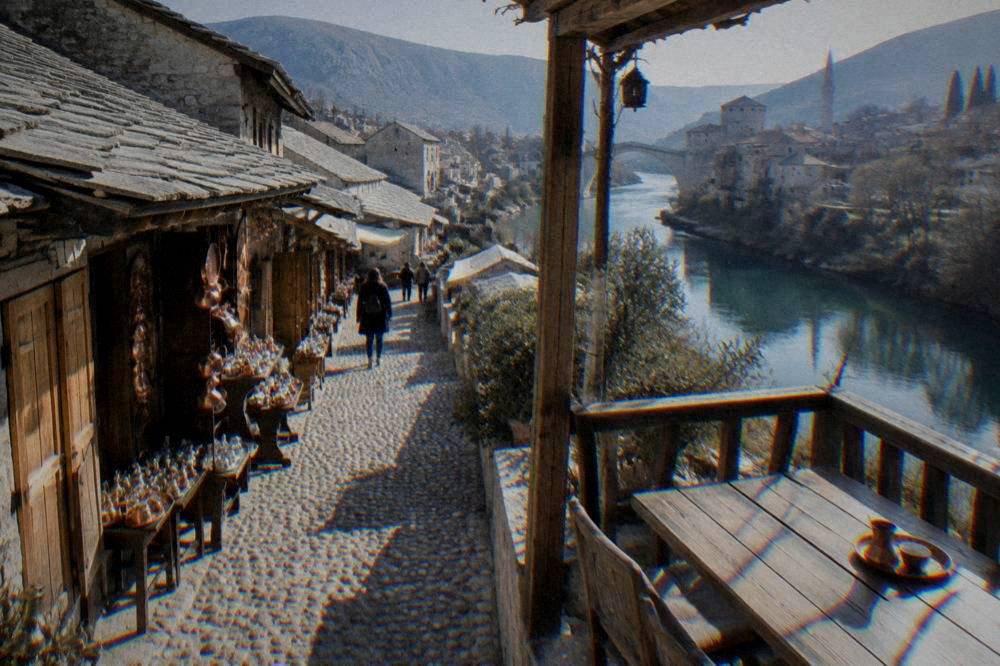
Practically, the bridge is a place to pause. The lanes around it hold craft shops, small cafes and the coppersmiths' stretch of the bazaar described on the Kujundžiluk bazaar page, and the whole area is walkable in ordinary street shoes. Nothing about the visit needs booking, tickets or planning beyond comfortable shoes and, in summer, water.
Where Is The Crooked Bridge In Mostar And How Do You Fit It Into A Walk?
The Crooked Bridge stands in the Old Town of Mostar, over the Radobolja brook, just off the Kujundžiluk bazaar and within a short, flat walk of Stari Most, the Old Bridge. The natural route is to cross the Old Bridge, follow the bazaar street downstream, and turn aside to the Radobolja: the two bridges and the bazaar form one compact loop that covers the historic core on foot.
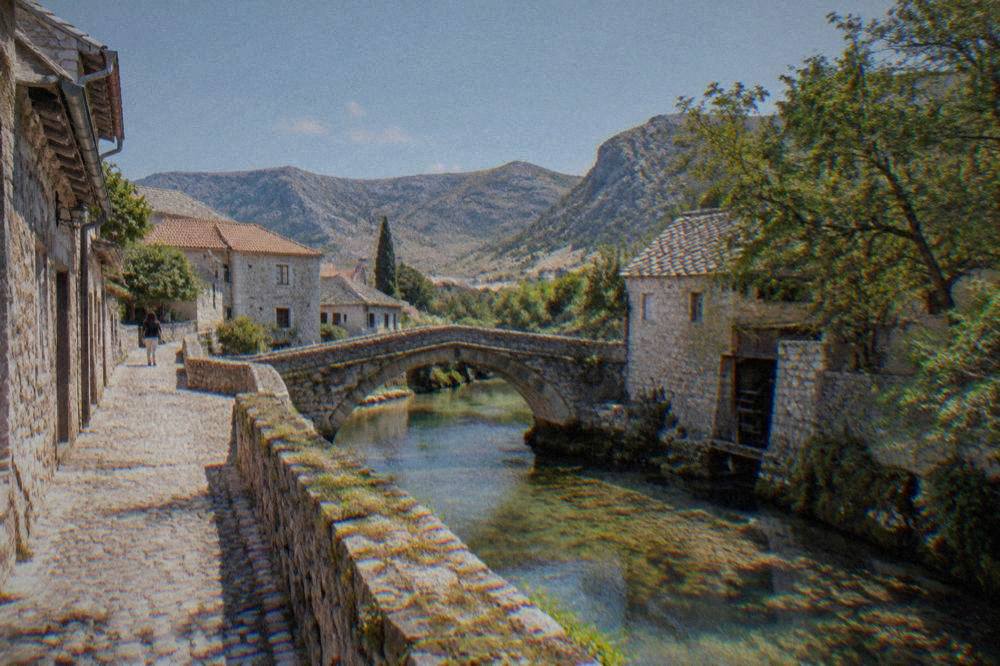
There is no transport question here. The Old Town is a pedestrian district of short lanes, and the Crooked Bridge is part of it, reached on foot from anywhere in the historic core. Visitors arriving from farther out will find the city compact: Mostar's airport lies 8.2 km and about 12 minutes by road from Stari Most, and the intercity bus and train stations sit outside the Old Town, a short, inexpensive taxi ride or a walk from the centre.
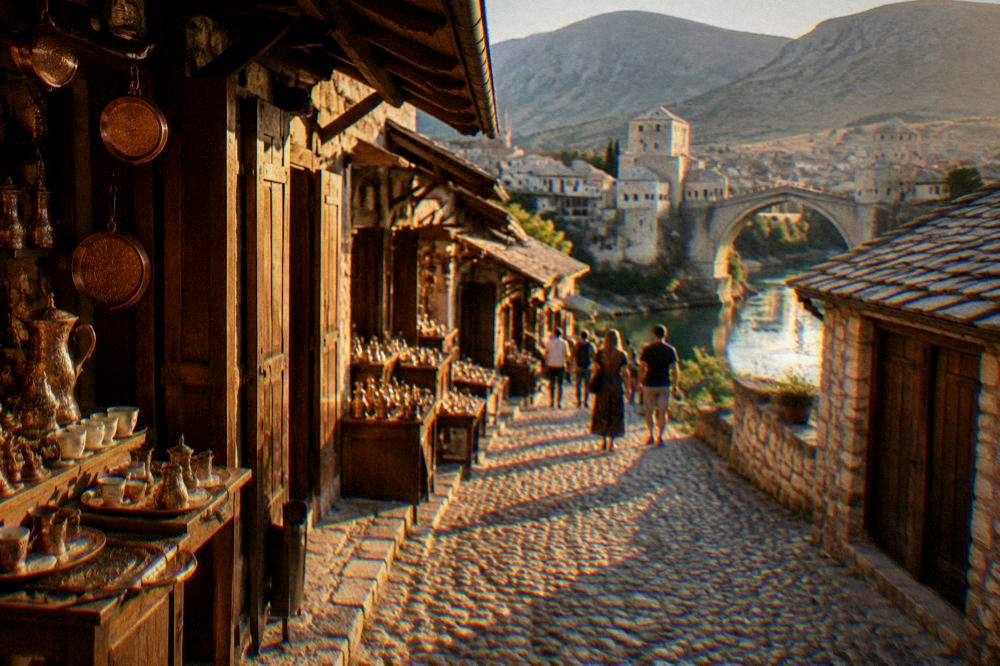
A walk that includes both bridges works well in a loop. Start on the west bank, cross Stari Most, and drop into Kujundžiluk, the bazaar street that runs along the Neretva. The bazaar's shops spill downhill toward the Radobolja, and the Crooked Bridge crosses the brook a few steps in from the main street. From there the lanes climb back past the Koski Mehmed-pašina džamija, the mosque that stands beside the Neretva, described on the Koski Mehmed-pašina džamija page, and return to the bridge square.
Visitors who want the loop explained rather than discovered have options. A guided walk strings these sights together, and the private option suits anyone who wants the Old Town's history unpacked at their own pace. The rest of this section's picks cover the same core on foot and the countryside beyond it.
For a self-guided day, pair the Old Town loop with a viewpoint. The terrace above the river and the viewpoints around Mostar put both bridges in one frame, and a longer plan is laid out in the two days in Mostar itinerary, which slots the Crooked Bridge into a first afternoon alongside Stari Most and the bazaar.
How Does The Crooked Bridge Compare With Stari Most In Mostar?
The two bridges differ in every dimension that matters. Stari Most spans the Neretva with a stone arch of about 29 m and stands about 21 to 24 metres above the river depending on its level; Kriva ćuprija crosses the small Radobolja brook. Crossing Stari Most is free and open around the clock, and crossing Kriva ćuprija is equally free: neither bridge has a ticket, a gate or staffed hours.
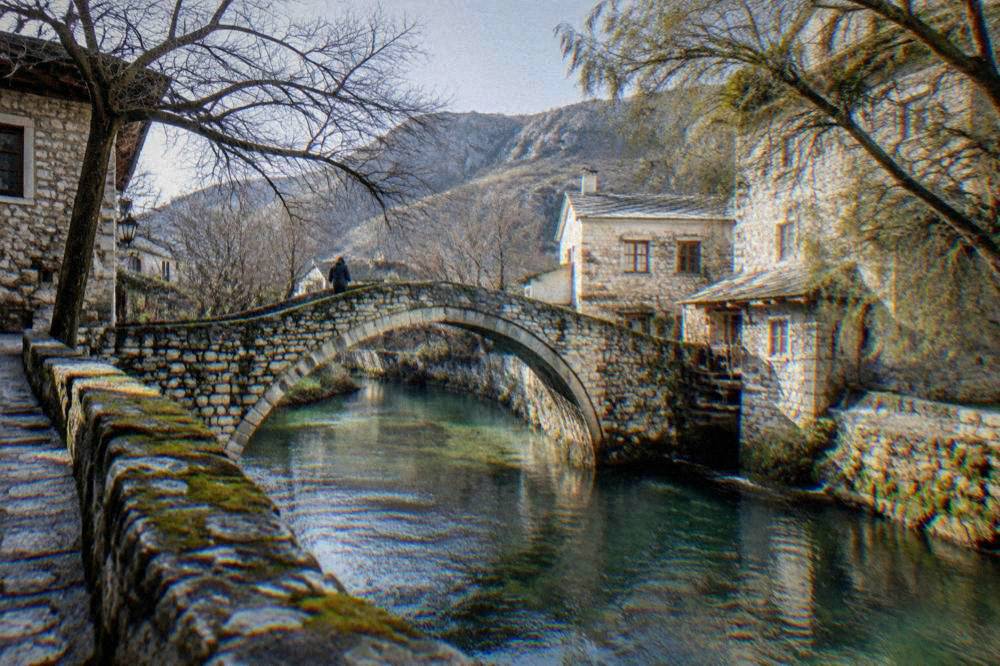
The comparison in one table:
| Feature | Stari Most (Old Bridge) | Kriva ćuprija (Crooked Bridge) |
|---|---|---|
| Water crossed | Neretva river | Radobolja brook |
| Completed | 1566, under Suleiman the Magnificent | A smaller, later footbridge in the same Ottoman stoneworking tradition |
| Scale | Span about 29 m; about 21 to 24 m above the river | A small single-arch footbridge sized for pedestrians |
| Cost to cross | Free | Free |
| Access | Public route, open 24/7 | Public route, open at any hour |
| Status | Centrepiece of the UNESCO World Heritage property inscribed 2005 | A quiet fixture of the Old Town beside the bazaar |
The Old Bridge carries the weight of history. Commissioned under Suleiman the Magnificent and built by mimar Hajruddin, whose design followed his master Sinan, it was destroyed on 9 November 1993 during the war and rebuilt and reopened in July 2004; the reconstruction was supported by UNESCO and World Bank partners. The why the Mostar bridge is so famous and why the bridge was destroyed pages carry that story in full, and whether it has been rebuilt answers the question directly: yes, in 2004.
The Crooked Bridge carries none of that ceremony, and that is its use. In July, when the diving competition and the cliff diving crowds fill the river gorge, the lanes around the Radobolja stay comparatively calm. The 460th traditional Old Bridge diving competition ran on 26 July 2026, and the Red Bull Cliff Diving round followed from 30 July to 1 August, with women diving from 21 m platforms and men from 27 m. On those days the small bridge upstream is where the Old Town exhales; the diving tradition itself is covered on the Mostar bridge diving page.
What Can You See Around The Crooked Bridge In Mostar?
Within a short walk of the Crooked Bridge sit the whole of the Old Town's core: Stari Most, the Kujundžiluk bazaar, the Koski Mehmed-pašina džamija with its river terrace, the Crooked Bridge's own stretch of the Radobolja, and the Ottoman houses on the east bank such as Bišćević House and Muslibegović House, both small museums with modest cash fees. Every one of these sits inside the same walkable quarter.
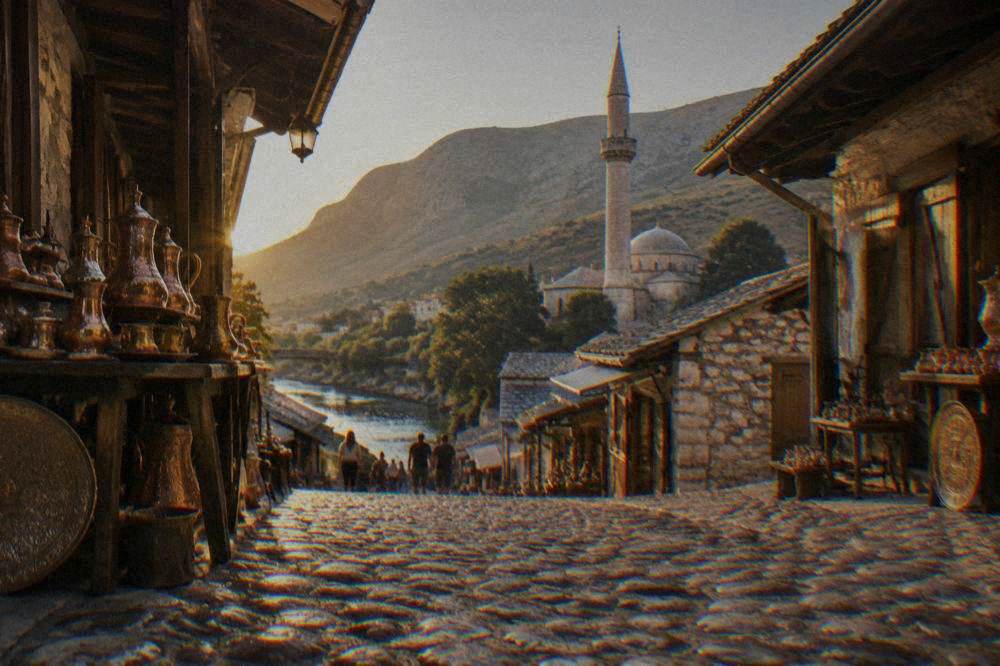
The compact geography rewards wandering. The Old Town area guide maps the quarter street by street, and the Stari Most attraction page covers the bridge itself in depth. The Museum of the Old Bridge in the Tara tower, reported at 10 KM for an adult with daily hours from 08:00 to 16:00 between 1 April and 1 November, sits at the bridge's west end; the fee is reported and visitors should confirm it on arrival.
The houses are the quiet highlights. Bišćević House, reported at about 4 KM, and the Muslibegović House, reported at about 8 KM, preserve Ottoman domestic interiors a few lanes from the Radobolja. The Karađoz-begova džamija stands a little farther out on the east side. Each fee is reported rather than official, so treat the figures as planning numbers and confirm at the door.
Across the river, Donja Mahala holds the east bank's slower lanes, and the city's wartime past is documented at the War Photo Exhibition and the Sniper Tower, while the Partisan Memorial Cemetery, designed by Bogdan Bogdanović and inaugurated in 1965, stands on the hills above; its over 700 memorial markers were destroyed in 2022 and the site is neglected and unstaffed. These pages together cover the ground a longer stay opens up.
Is The Crooked Bridge Free To Visit, And What Does Nearby Sightseeing Cost In Mostar?
The Crooked Bridge itself costs nothing: it is a public structure over the Radobolja, open at any hour, with no ticket or gate. Around it, the Old Town's headline sights are largely free to see from the street, while a handful of interiors charge modest cash fees in the local currency, the convertible mark (KM), which is pegged at 1 EUR = 1.95583 KM. Fees below are reported figures and should be confirmed on arrival.
| Sight | Entry | Notes |
|---|---|---|
| Stari Most | Free | Public crossing, open 24/7 |
| Kriva ćuprija (Crooked Bridge) | Free | Public footbridge over the Radobolja |
| Kujundžiluk bazaar | Free | Open bazaar street |
| Old Bridge Museum (Tara tower) | Reported 10 KM | Reported hours 08:00 to 16:00 daily, 1 April to 1 November |
| Koski Mehmed-pašina džamija | A small cash fee; more with the minaret | Reports vary; confirm on site |
| Bišćević House | Reported about 4 KM | Ottoman house museum |
| Muslibegović House | Reported about 8 KM | Ottoman house museum |
| Kravica waterfall | 20 KM adult, all year | 10 KM for BiH residents; children under 7 free |
Two money notes shape a day here. The currency is the KM, never the euro, though euro cash is often accepted in tourist areas at a rounded rate, so confirm the rate before paying. And a tourist tax reported at 3 KM per person per night applies in the canton from 1 January 2026: it is normally folded into accommodation bills, and guests should confirm it at booking.
When Should You Visit The Crooked Bridge In Mostar?
Mostar's climate argues for mornings and for the shoulder months. The FHMZ Mostar station, 1961 to 1990, puts the July mean at 24.7 C with an absolute maximum of 41.2 C, and the ERA5 reanalysis, 1991 to 2020, models mean daily highs of 30.5 C in August. Rain concentrates in winter: November averages 200.0 mm against July's 42.9 mm, so summer days are dry but seriously hot by late morning.
| Month | Mean temp (FHMZ 1961-1990) | Rain mm (FHMZ 1961-1990) | Modelled daily high (ERA5 1991-2020) |
|---|---|---|---|
| January | 4.8 C | 164.7 | 8.4 C |
| April | 13.3 C | 127.3 | 17.7 C |
| July | 24.7 C | 42.9 | 29.9 C |
| August | 24.2 C | 73.7 | 30.5 C |
| November | 10.1 C | 200.0 | 14.1 C |
The practical reading is straightforward. From June to September, walk the Old Town early, rest through the peak of the afternoon, and return to the bridges as the light drops; the Radobolja's shade keeps the Crooked Bridge lanes cooler than the open bridge square. From late autumn through winter, rain is more frequent and the light softer, but the bridges, the bazaar and the museums carry on, and the Mostar in winter coverage holds the seasonal detail.
The Neretva itself stays cold even in August, fed by karst springs, which matters to anyone tempted by the water rather than the bridges. Summer visitors will find the fuller picture on the Mostar in summer page, including how the July events reshape the Old Town's rhythm.
Which Day Trips From Mostar Pair Well With The Old Town?
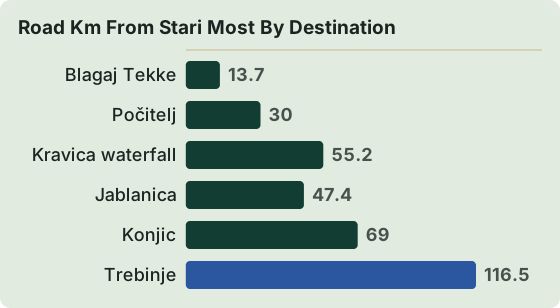
The classic pairing is one Old Town day plus one Herzegovina day trip, and the road distances make both easy. Blagaj Tekke lies 13.7 km and about 19 minutes by road from Stari Most, Počitelj 30.0 km and about 31 minutes, and Kravica waterfall 55.2 km and about 54 minutes free-flow. Farther afield, Konjic is 69.0 km and about 80 minutes, Trebinje 116.5 km and about 142 minutes, and Sarajevo's old quarter 127.1 km and about 134 minutes.
| Destination | Road km from Stari Most | Free-flow drive time |
|---|---|---|
| Blagaj Tekke | 13.7 | about 19 min |
| Počitelj | 30.0 | about 31 min |
| Kravica waterfall | 55.2 | about 54 min |
| Jablanica | 47.4 | about 57 min |
| Konjic | 69.0 | about 80 min |
| Trebinje | 116.5 | about 142 min |
The standard countryside loop runs Blagaj, Počitelj and Kravica waterfall in one day, and dozens of operators run it from Mostar itself. Kravica charges 20 KM for an adult all year, with 10 KM for BiH residents, 10 KM for school groups aged 7 to 18, and free entry for children under 7; the park is open year-round with hours by month, from 07:00 to 22:00 in June through September to 07:00 to 17:00 in January, February, November and December. Swimming in the pool below the falls is allowed in summer in the designated area, with no lifeguard reported, and visitors should check the park's rules on arrival.
North of the city, Konjic holds the ARK D-0 bunker, a reported 40 KM for foreign visitors with booking required, and Jablanica the ruined bridge over the Neretva and its museum, entry a few KM. Eastward, Trebinje makes a slower full day. The full menu of routes, borders and timings sits in the things to do in Mostar overview, and the historical thread that ties the region together runs through the Mostar history guide.
What Should You Know Before Visiting Mostar?
Four practical facts cover the essentials. Bosnia and Herzegovina is not in the EU and not in Schengen, so the Croatian land border is an external border with full checks since 1 January 2023. Visa-exempt visitors may stay up to 90 days in a six-month period from first entry. The currency is the convertible mark, pegged at 1 EUR = 1.95583 KM. In rural Herzegovina, stay on marked paths because of suspected mine areas, an advice maintained by BHMAC.
| Practical item | Figure |
|---|---|
| Currency | Convertible mark (KM, BAM), pegged 1 EUR = 1.95583 KM |
| Visa-exempt stay | Up to 90 days in a six-month period from first entry |
| Emergency number | 112 (general), 122 police, 123 fire, 124 ambulance |
| Plugs and power | Type C and F, 230 V, 50 Hz |
| Schengen status | Not in the EU or Schengen; Croatian border fully checked since 1 January 2023 |
Getting in is simple enough. Mostar International Airport sits 8.2 km and about 12 minutes by road from Stari Most, with reported routes to Zagreb and Stuttgart plus seasonal flights, while arrivals also come via Sarajevo or Dubrovnik airports. The train line to Sarajevo, suspended in September 2026 after a fire along the corridor, resumed on 15 October 2026 and runs two trains a day each way between Sarajevo and Čapljina via Mostar; the fare is reported at about 14 KM one way, and timetables should be checked before travel. The full arrival picture is on the how to get to Mostar page.
In the city itself, normal urban caution applies, and the Bosnia safety for travellers page holds the detail. Tap water is generally treated and safe. Tipping is appreciated, not obligatory. Cards work at hotels and larger restaurants, while small vendors in the bazaar expect cash, and the mixing of two currencies in one wallet is covered on the Mostar money page.
Common Questions About The Crooked Bridge In Mostar
Is the Crooked Bridge in Mostar free?
Yes. Kriva ćuprija is a public footbridge over the Radobolja in the Old Town, with no ticket, gate or staffed hours. Cross it at any time of day.
How far is the Crooked Bridge from Stari Most?
The two bridges stand in the same walkable quarter of the Old Town, a few lanes apart: Stari Most over the Neretva and Kriva ćuprija over the Radobolja brook beside the Kujundžiluk bazaar. The stroll between them is flat and short.
What does Kriva ćuprija mean?
The name is plain local speech: "kriva" means crooked and "ćuprija" means bridge, so the Bosnian name and the English one say the same thing.
Can you jump from the Crooked Bridge like the divers at Stari Most?
No. The bridge dives at Stari Most are performed by members of the Mostari diving club, who train for years, and no pay-to-jump option for visitors is on offer there or at the Crooked Bridge. The Radobolja is a shallow brook in any case.
When is the best light for photographs at the Crooked Bridge?
Morning and late afternoon. In summer, FHMZ data for Mostar puts July rainfall at just 42.9 mm, so dry light is reliable, but midday heat pushes the lanes into hard shadow; early and late hours flatter the stone.
Do you need a tour to see the Crooked Bridge?
No, the bridge is free and public. A guided walk adds context to the Old Town's history around it, and the links on this page cover both guided and self-guided options.
The Crooked Bridge asks for ten unhurried minutes and gives back the Old Town at its own volume: water under a small stone arch, the bazaar one lane over, and the great arch of Stari Most waiting a short stroll downstream. Cross it on the way between the bigger sights, and the visit costs exactly nothing but time.
