Getting Around Mostar: Walking, Taxis And Parking
Mostar is a small, walkable city on the Neretva river, and nearly everything a visitor wants to see sits within a few minutes' walk of the Old Bridge. This guide covers walking, taxis, city buses, the train line, driving and the parking picture around the Old Town.
No public price list exists for Old Town parking, so plan to check lots locally.
Mostar, the main city of Herzegovina in Bosnia and Herzegovina, is built around a short, steep river valley: the Old Bridge Area of the Old City is a UNESCO World Heritage property on the Neretva, and nearly every street a visitor needs runs downhill from the boulevards to the water. That geography decides how the city should be travelled. The centre is small enough that walking beats every other mode for sightseeing, taxis cover the short hops, and a car earns its keep only when the day's plan leaves town for Blagaj, Počitelj or Kravica waterfall.
Is Mostar A Walkable City?
Yes, and walking is the right default: the Old Bridge, the Kujundžiluk bazaar, the Crooked Bridge, Spanish Square and the riverside mosques all sit within a few minutes of one another on foot, connected by cobbled lanes and stone steps. The city centre is compact and gradients are short. Comfortable shoes matter more than transport, because the Old Town paving is rounded cobblestone, uneven in places and slick when wet.
The Old Town itself is essentially pedestrian. Kujundžiluk, the old bazaar street, runs along the Neretva from the bridge southwards, and the lanes feeding it are narrow, stepped and free of through traffic. Crossing Stari Most itself is free and open around the clock, and the crossing is short: the stone arch carries pedestrians from one bank to the other, with a steep climb on each approach. The bridge stands about 21 to 24 metres above the river depending on the water level.
Above the Old Town, the street grid turns into the Austro-Hungarian era boulevards around Spanish Square, and everything of interest between there and the river is reachable on foot. The walk from the boulevard level down to the bridge drops through a series of streets and stairways, and the return climb is the only real effort the centre demands. Visitors who want the geography explained as they walk can look at the Mostar walking tour options or the free walking tour of Mostar, both of which cover the ground between the squares and the bridge.
A few practical notes make walking easier. In summer the valley heat builds through the afternoon, and the ERA5 reanalysis for Mostar, 1991 to 2020, puts the average daily high at 29.9 C in July and 30.5 C in August, so mornings are the comfortable hours for covering ground. In November and December the FHMZ station table for Mostar, 1961 to 1990, shows 200.0 mm and 178.7 mm of rain respectively, the higher monthly totals of the year, and wet cobblestones deserve care. There is no metro, tram or funicular anywhere in the city; none is needed.
Night walking raises fewer practical obstacles than in many cities, since the centre stays active around the restaurants and the bridge is lit. The same cobbles and steps apply, so the advice on footwear does not change after dark. Questions about evening safety on the streets are covered separately in is it safe to walk around Mostar at night.
How Do You Get From Mostar Airport To The City?
Mostar International Airport (OMO) sits 8.2 km from Stari Most by road, about a 12-minute drive in free-flowing traffic, so the transfer into the centre is a short, inexpensive taxi ride or a ride on the local city bus line that serves the airport. The route list is small, with reported Croatia Airlines flights to Zagreb and Eurowings flights to Stuttgart kept through the winter 2026/27 schedule, plus seasonal Düsseldorf flights.
For flights into the bigger hubs, the picture changes. Visitors can arrive via Sarajevo or Dubrovnik airports, and both are straightforward overland runs: Sarajevo's airport is 120.4 km and about two hours five minutes by road from Stari Most, while Dubrovnik's is 163.4 km and about two hours 52 minutes free-flow, before any border queue. The Croatia-to-Bosnia border is a Schengen external border with full checks since 1 January 2023, so arriving from Dubrovnik adds passport control on top of the drive; reported waits run up to about 30 minutes, longer at summer peaks. The border crossing process is covered in detail in crossing the Croatia-Bosnia border.
| Arrival point | Road distance from Stari Most | Free-flow drive time | Notes |
|---|---|---|---|
| Mostar International Airport (OMO) | 8.2 km | about 12 min | Small route list, reported Zagreb and Stuttgart flights |
| Sarajevo airport (SJJ) | 120.4 km | about 2 h 05 | No border; train and bus alternatives from Sarajevo |
| Dubrovnik airport (DBV) | 163.4 km | about 2 h 52 | Add Schengen border checks at the BiH-Croatia line |
Free-flow drive times exclude border queues and any roadworks. Works are reported on the Mostar south bypass and on the Corridor Vc motorway section around the city, so allow extra time on arrival days and check the route on the day. Full arrival routes by plane, train and bus are broken down in how to get to Mostar and Mostar airport.
Where Do You Park In Mostar, And What Should You Know Before Driving In?
No public price list covers parking around Mostar's Old Town: lots and street spaces exist within a few minutes' walk of Stari Most, but published figures are not available, so the practical plan is to park in an attended lot, confirm the rate before leaving the car, and keep the vehicle there. The Old Town itself is a maze of cobbled, partly pedestrianised lanes that no visitor should attempt to drive, let alone park in.
That is the honest core of the parking question. Blogs repeat specific per-hour figures for lots near the Old Town, but none of them trace to an official source, and rates in Bosnia and Herzegovina are quoted in convertible marks (KM), pegged at 1 EUR = 1.95583 KM, not in euro. Treat any number a website prints as unconfirmed until the attendant says it. What is safe to say: parking closest to the river fills first in the high season, arriving earlier in the day widens the choice, and a spot a ten-to-fifteen-minute walk uphill from the bridge is a normal outcome rather than a failure.
Driving itself is calm by regional standards. Roads are two-lane outside the motorway stretches, the M17 follows the Neretva valley towards Sarajevo and Čapljina, and signposting in and around the city is adequate. Fuel stations and car-hire desks cluster on the boulevards; the practicalities of hiring, insurance and taking a Bosnian-plated car across the Croatian border are covered in Mostar car rental. One rule matters more than any other in rural Herzegovina: stay on marked paths and roads because of suspected mine areas, which the national mine-action centre continues to map.
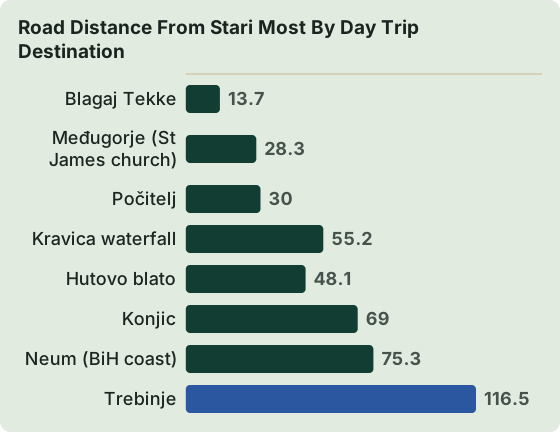
A car in Mostar is a day-trip tool, not a city tool. Once the vehicle is parked, the logic of the first section applies: everything between Spanish Square and the bridge is a walk. Where the car pays for itself is Herzegovina, and the free-flow drive times from Stari Most make the case:
| Day trip destination | Road distance from Stari Most | Free-flow drive time |
|---|---|---|
| Blagaj Tekke | 13.7 km | about 19 min |
| Međugorje (St James church) | 28.3 km | about 40 min |
| Počitelj | 30.0 km | about 31 min |
| Kravica waterfall | 55.2 km | about 54 min |
| Hutovo blato | 48.1 km | about 62 min |
| Konjic | 69.0 km | about 80 min |
| Neum (BiH coast) | 75.3 km | about 82 min |
| Trebinje | 116.5 km | about 142 min |
These times are computed free-flow figures without border queues and without roadworks. Kravica waterfall is the one every blog gets wrong: it is 55.2 km from the Old Bridge by road, not a short hop out of town, and entry to the park is 20 KM for an adult all year, with the park open year-round on monthly hours (07:00 to 22:00 from June to September). A guided option that removes the driving question entirely is the Full-Day Herzegovina Tour with Blagaj, Počitelj and Kravice Waterfalls, and the wider set of options is compared in things to do in Mostar.
How Do Taxis Work In Mostar?
Taxis in Mostar are metered, plentiful around the bus station, the boulevards and the Old Town approaches, and a cross-town ride is a short, inexpensive trip by regional standards. There is no ride-hail ecosystem worth planning around, so the working method is to flag a cab, use a rank, or have a restaurant or hotel call one. Agree that the meter runs, or agree the fare before setting off, and keep small KM notes for payment.
Reported aggregator figures put the start fare around 2 to 2.5 KM with roughly 1 KM per kilometre after that, and the airport run is reported in the low tens of euro-equivalent, but these are aggregator numbers rather than an official tariff, so treat them as orientation and confirm with the driver. The currency is the convertible mark; euro cash is often accepted in tourist-facing settings, usually at a rounded rate, and confirming the rate before paying avoids surprises. Cards are accepted at hotels and larger businesses, while cash is the safer assumption in a cab.
The trips that actually justify a taxi in Mostar are few, because the centre walks so well. The realistic list is short: airport transfers, the bus station with luggage, a return from an evening out uphill, or a dash to a meeting point for a tour. For everything else, feet are faster than the detours a one-way street system forces on a car.
Do City Buses Help A Visitor Get Around Mostar?
City and suburban buses matter mainly for two lines: the local service towards the airport, and the suburban routes towards Blagaj, both published by the local operator with seasonal timetable updates. Within the city centre itself buses are of little use to a visitor, because the distance from the boulevards to the Old Bridge is a walk measured in minutes, and the Old Town's lanes bar anything the size of a bus.
The timetables are published by the local operator and change, so checking the current schedule before relying on a specific departure is the working rule, and the same applies to the buses that run on from Mostar to nearby towns. For regional journeys the bus station on the north side of the centre is the hub: Autoprevoz and other operators run Mostar to Sarajevo in about 2 h 20 to 2 h 40, and several daily buses connect Mostar with Dubrovnik and with Split. Fares vary by operator and timing, so buy at the station and confirm the price at the counter. More of these guides are collected on Mostar Travel Guide.
| Mode | Best for | Watch out for |
|---|---|---|
| On foot | The entire centre: Old Bridge, Kujundžiluk, squares, mosques | Cobbles and steps; heat in July and August afternoons |
| Taxi | Airport, bus station, short evening hops | Confirm the meter or the fare; carry KM cash |
| City bus | Airport line, Blagaj suburban route | Timetables change; check the current schedule |
| Intercity bus | Sarajevo, Dubrovnik, Split, Međugorje | Fares vary by operator; buy at the station |
| Train | The Sarajevo corridor only | Two trains a day each way; times change |
Can You Take A Train From Mostar?
Yes, on one line: the official ZFBH timetable shows two trains a day each way between Sarajevo and Čapljina via Mostar, a journey of about two hours from Sarajevo. Service was suspended from about 8 September 2026 after a fire along the corridor and regular service resumed on 15 October 2026, so the working advice is simple: times and operating days change, check the operator before planning a rail arrival or departure.
The line is one of the scenic rail routes of the Balkans, tracking the Neretva through Jablanica and Konjic, and for travellers connecting through Sarajevo it is a genuine alternative to the bus. The reported one-way fare from Sarajevo to Mostar is about 14 KM, an aggregator figure worth confirming at booking. There is no rail link towards Dubrovnik, Split or the coast; the rail map of Bosnia and Herzegovina is sparse, and everything south and west of Mostar is bus or car territory.
For anyone assembling a wider itinerary, the arrival routes have their own pages: Dubrovnik to Mostar, Split to Mostar and Sarajevo to Mostar each break down the bus, train and transfer options with the drive times that apply.
What About Getting Around Herzegovina On A Day Trip?
Herzegovina's headline sights fan out along two corridors from Mostar: the Buna valley and Počitelj towards the south, and the Neretva canyon towards Kravica, Ljubuški and Neum, with Blagaj just 13.7 km and about 19 minutes from Stari Most by road. A car, a guided tour or a suburban bus each cover the near stops; the far stops such as Trebinje at 116.5 km reward a full day. Free-flow times exclude border queues.
Blagaj is the nearest and easiest: the Tekke at the Buna spring is a 19-minute drive, reported open 08:00 to 22:00 from April to October with an entry fee of about 10 KM, and suburban buses also reach the village. Počitelj, the fortified village on a hillside above the Neretva, is 30.0 km and about 31 minutes, and the village streets are free to wander, with small optional fees reported at individual buildings. Kravica waterfall, 55.2 km out, is the furthest of the standard trio and the one where an organised trip saves the most driving decisions; the Dubrovnik Mostar and Kravica Waterfalls day trip covers the same corridor for travellers based on the coast.
Two practical warnings travel with any Herzegovina drive. The first is mines: suspected areas persist in rural parts of the canton, so stay on marked paths and roads, a rule that matters at viewpoints, riverbanks and unofficial swimming spots alike. The second is the border: Bosnia and Herzegovina is not in the EU and not in Schengen, the Croatian line has carried full checks since 1 January 2023, and ETIAS is not in operation, so the paperwork that matters is a passport, not a travel authorisation that does not yet exist.
For planning the year, the best time to visit Mostar and Mostar weather set the scene, and where to stay in Mostar helps with the walkability question in reverse: a room near the Old Bridge or on the boulevard edge puts the whole centre on foot.
Common Questions About Getting Around Mostar
Is Mostar easy to walk around?
Yes. The Old Bridge, the Kujundžiluk bazaar, Spanish Square and the main mosques all lie within a short walk of each other, and the only real effort is the climb back up from the river. The Old Town is cobbled and partly stepped, so comfortable shoes matter.
Do I need a car in Mostar?
Not for the city itself. A car pays off for day trips into Herzegovina, to Blagaj, Počitelj, Kravica waterfall and beyond. In the centre, walking is faster and easier than driving the one-way streets near the Old Town.
Where can I park near the Old Town?
Spaces nearest the river fill first in the high season, so arriving earlier in the day widens the choice.
How much is a taxi in Mostar?
Short cross-town rides are inexpensive by regional standards. Reported aggregator figures put the start fare around 2 to 2.5 KM plus roughly 1 KM per kilometre, but these are not an official tariff: ask the driver to run the meter or agree the fare first, and carry cash in KM.
Is there public transport from Mostar airport?
The airport is 8.2 km and about 12 minutes by road from Stari Most, and a local city bus line serves it on a published timetable that changes seasonally. A taxi covers the same run as a short, inexpensive ride. Check the current bus schedule before relying on a specific departure.
Can you take a train to Mostar?
Yes, from the Sarajevo corridor: the official ZFBH timetable shows two trains a day each way between Sarajevo and Čapljina via Mostar, about two hours from Sarajevo. The service resumed on 15 October 2026 after a suspension, so always check the operator for the current days and times.
What Is The Simplest Way To Plan Movement In Mostar?
Walk the centre, taxi the edges, and reserve wheels for Herzegovina: that three-part plan covers nearly every visitor's needs, because the UNESCO-listed Old Bridge Area and the streets around it are compact, cobbled and closed to practical driving, while Blagaj at 19 minutes and Kravica waterfall at 54 minutes by road are the trips that justify a car, a bus or a guided day tour. Parking near the Old Town means an attended lot with a rate confirmed on arrival.
Build the stay around that and the logistics shrink. Book a room within walking distance of the Old Town if the budget allows, arrive by plane through Sarajevo, Dubrovnik or Mostar's own small airport, use the train for the scenic run from Sarajevo when the timetable fits, and hand the Herzegovina roads to a driver on at least one day. The rest of the time, the city does what it has always done best: it puts everything worth seeing within a walk. More practical planning, from money to food to border formalities, sits in Bosnia and Herzegovina travel tips, and the sightseeing side of the city starts at things to do in Mostar.