Is It Safe To Walk Around Mostar At Night?
A plain answer to whether Mostar is safe to walk at night: which streets stay busy after dark, what to keep in mind, and what the evening hours actually look like in Herzegovina's main city.
Mostar, the main city of Herzegovina on the Neretva river, keeps its historic core open and walkable after dark, and the question of walking around at night comes down to ordinary city sense rather than anything unusual. The Old Bridge Area of the Old City is a UNESCO World Heritage property, inscribed in 2005, and it is a living neighbourhood, not a gated attraction: Stari Most itself is a public pedestrian crossing, free and open around the clock. This page sets out what the evening hours look like, which parts of the city stay lit and busy, and the handful of practical points worth knowing before you head out.
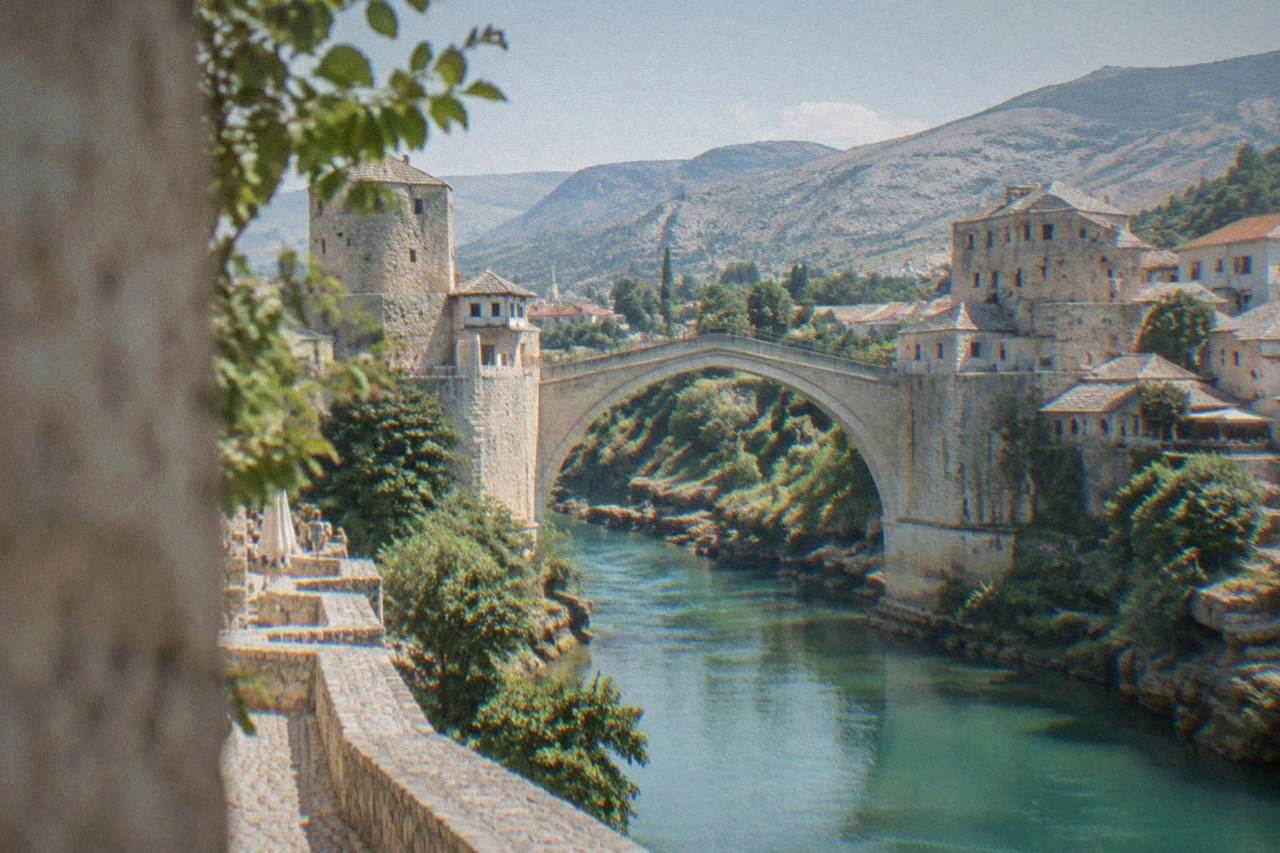
Yes, in the ordinary way a small European city is safe at night: central Mostar, and above all the Old Town around Stari Most and Kujundžiluk, stays a public, walkable area where restaurants and cafes keep the main lanes active into the late evening. The Old Bridge itself is free to cross and open 24 hours. The precautions that matter are the usual ones anywhere: watch your footing on cobbles, keep valuables out of back pockets, and take a taxi for long, dark stretches rather than walking them.
That answer surprises nobody who has spent an evening in the city. Summer nights in particular bring people out late, because daytime heat pushes life toward the cooler hours. The FHMZ 1961-1990 station series gives a July mean of 24.7 C for Mostar, and the ERA5 reanalysis for 1991-2020 models mean daily highs of 29.9 C in July and 30.5 C in August, so evenings are simply the comfortable time to be outside. Locals dine late, stroll the riverbanks, and cross the bridge after sunset, and the bazaar lanes around Kujundžiluk remain public streets at every hour.
Nothing about that requires special planning. The city centre is compact: the distance from Spanish Square to the Old Bridge is a short, flat stroll, and the whole Old Town is a pedestrian-scale network of stone lanes. If you want a fuller picture of how the city is laid out for walking generally, the guide to getting around Mostar covers buses, taxis and walking times, and the question of whether Mostar is a walkable city has its own answer page.
One honest caveat applies to any city, not to Mostar specifically: nobody publishes a crime statistic for an evening stroll here, and none is needed. Treat the night the way you would treat a night out in any unfamiliar town, keep to lit streets, and the question answers itself.
Which Parts Of Mostar Stay Busy And Lit After Dark?
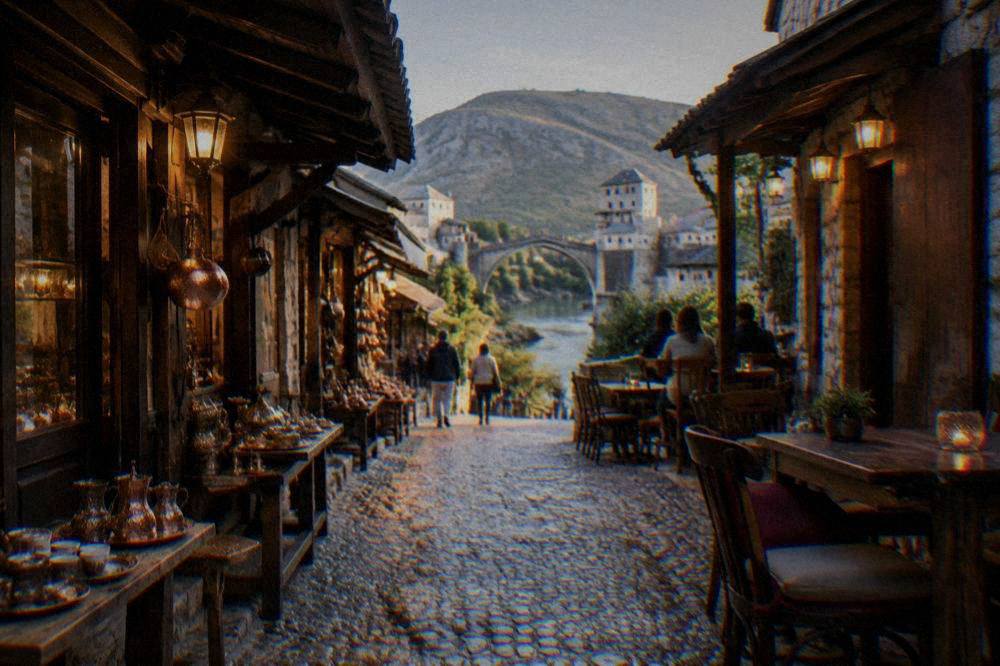
The Old Town core, from Stari Most through Kujundžiluk to Kriva ćuprija, is the part of Mostar that stays active and lit longest, because its restaurants, cafes and shops line the very streets walkers use. Spanish Square and the Bulevar stretch form a second lit spine of central Mostar. Away from these corridors the city darkens quickly, and riverbank paths and hillside stairways are quieter and less lit.
The contrast matters for planning. Inside the Old Town, the evening economy keeps the stone lanes populated well past midnight in summer, and the bridge is crossed constantly. Out along the Bulevar, cafe terraces and shopfronts keep the pavement lit. But a fifteen-minute walk in the wrong direction can put you on a residential street with thin lighting, and the pedestrian routes up toward Hum or down along the Neretva outside the centre are dark in a way the Old Town simply is not.
A simple way to picture the evening geography:
| Area of Mostar | What the evening is like |
|---|---|
| Stari Most and the river gorge | Public, free to cross, lit and busy late in the season |
| Kujundžiluk bazaar lanes | Public streets, restaurants and cafes active into the night in summer |
| Kriva ćuprija and Radobolja banks | Quieter, dimmer stone lanes a minute from the bridge |
| Spanish Square to the Bulevar | Lit central corridor, cafe terraces, easy flat walking |
| Donja Mahala, east bank | Livelier in summer, patchier lighting away from the main drag |
| Riverbanks outside the centre and hill paths | Dark and quiet, better by daylight or by taxi |
A guided orientation earlier in the day pays off at night, because the lanes you have already walked are the lanes you can find again in the dark. A Mostar walking tour is one option; a shorter city walk is another, and both cover the ground you will retrace after dark.
The same logic applies to themed walks. A Mostar war history tour runs in daylight and shows you the east bank and the streets above the Old Town, which makes the geography of an evening walk far easier to read. And if you are weighing whether to sleep here at all rather than day-trip in and out, the question is it worth staying the night in Mostar has its own page.
What Should You Keep In Mind On A Mostar Evening?
Three practical things matter more than any worry about crime. First, the footing: the Old Town is polished stone, cobbles and steps, which are treacherous in the dark or in rain, so decent shoes beat sandals. Second, the numbers: 112 is the general emergency line, with 122 for police, 123 for fire and 124 for ambulance. Third, money: the currency is the convertible mark, KM, and small evening vendors want cash, not cards.
Start with the footing, because it is the genuine hazard. The descent to the river on both banks is stepped stone worn smooth by centuries of feet, and it is dim in places even when the bridge itself is lit. After rain it is slick. This is the one place an evening in Mostar can genuinely go wrong, and flat shoes with grip solve it.
Cash comes second. Bosnia and Herzegovina is not in the eurozone and the currency is the KM, pegged at 1 EUR = 1.95583 KM. Euro cash is often accepted in the tourist lanes, usually at a rounded rate, so confirm before handing it over, and expect the small late-evening vendors to want marks. A tourist tax reported at 3 KM per person per night applies in the canton from 1 January 2026, charged through accommodation, so confirm it at booking rather than carrying cash for it.
Distances at night deserve respect too. A taxi is a short, inexpensive way to cover the stretches beyond the lit corridors, and there is no virtue in walking a dark suburban road at midnight. Tap water in Mostar is generally treated, and plugs are type C and F at 230 V, which matters more for your evening kettle than your walk.
One rural point, if your night ends somewhere outside the city: suspected mined areas remain in rural Herzegovina, and the standing advice from the mine clearance authority is to stay on marked paths. This applies to countryside walks and viewpoints, not to the streets of central Mostar, but it is the single most important safety rule in the region. The page on Bosnia safety for travellers covers it in full.
Is It Safe To Cross Stari Most And The River Banks At Night?
Yes: the Old Bridge is a public pedestrian crossing, free to cross, with no ticket and no closing time, and it stays lit and used at night through the visitor season. The river banks immediately below it, on the other hand, are dim stone stairs and gravel terraces, so cross the bridge freely but take the banks slowly, and keep to the lit lanes either side rather than the water's edge.
The bridge at night is arguably the best moment of a visit. The single stone arch, completed in 1566 and rebuilt after its destruction on 9 November 1993, reopened in July 2004, catches floodlight from both banks, and the drop to the Neretva below is real: about 21 to 24 metres depending on the river level. Members of the Mostari diving club jump from it in the daytime season, gathering spectators' contributions before each dive, and no visitor jump option exists for untrained tourists, so the bridge at night is for crossing and looking, not for anything else.
The water below is worth knowing about even if you never touch it. The Neretva stays cold even in August, fed by karst springs, and the question of whether you can swim in the river at Mostar has its own answer. At night, the rule is simpler: enjoy the view from the parapet and the terraces, and let the banks wait for daylight.
If an evening walk leaves you wanting the full story of the bridge, the day-time city walks cover it properly.
A two-hour guided walk with a local guide runs through the Old Town, the bridge and the streets on both banks, and it costs about what a dinner costs, with a live listing showing the current from-price and times.
Do The Nights Change With The Seasons In Mostar?
They change a great deal: summer evenings in Mostar are warm, long and busy, with modelled ERA5 1991-2020 mean daily highs of 29.9 C in July and 30.5 C in August pushing city life into the late hours, while winter evenings are cold, short and quiet, with a January modelled low of 0.2 C and the FHMZ station table showing mean temperatures of 4.8 C. Rain matters more than darkness: November averages 200.0 mm against July's 42.9 mm.
In July and August the evening is the pleasant part of the day, and the city acts accordingly: terraces fill after sunset, the bridge stays crossed late, and the festival calendar lands here too. The 2026 season ran Mostarsko ljeto from 25 June to 7 August, the Mostar Summer Fest from 2 to 4 July, the Mostar Blues & Rock Festival on 24 and 25 July with free entry, and the Mostar Jazz Fest from 23 to 25 August. Next year's dates are not yet published, but these are annual events, so a summer visit will likely land near one.
| Month | Modelled mean daily high C (ERA5 1991-2020) | Modelled mean daily low C (ERA5 1991-2020) | Mean rain mm (FHMZ 1961-1990) |
|---|---|---|---|
| January | 8.4 | 0.2 | 164.7 |
| April | 17.7 | 7.0 | 127.3 |
| July | 29.9 | 17.7 | 42.9 |
| August | 30.5 | 18.1 | 73.7 |
| November | 14.1 | 5.7 | 200.0 |
Winter flips the picture. Darkness falls mid-afternoon, the stone radiates cold, and the wettest months, with November at 200.0 mm and December at 178.7 mm in the FHMZ 1961-1990 series, make those polished lanes exactly as slick as you would expect. A winter evening walk is still perfectly sensible between lit streets, but it is a short, waterproof-shoe affair rather than a long promenade, and the outdoor terraces that make summer nights lively are closed.
Alcohol is part of the evening economy here without fuss, and the question can you drink alcohol in Mostar covers the detail. The broader point for a night out is the same in every season: the centre is small, taxis are cheap and easy, and there is no need to walk far in the dark unless you want to.
Common Questions About Walking Around Mostar At Night
Is it safe to walk around Mostar at night?
Yes, in the ordinary sense: central Mostar, especially the Old Town around Stari Most and Kujundžiluk, stays public, lit and busy into the late evening in season. The Old Bridge is free to cross and open 24 hours. Use normal city precautions: steady shoes on the stone, valuables secured, and a taxi for long dark stretches.
Is the Old Bridge open at night?
Stari Most is a public pedestrian crossing with no ticket and no closing time, so it can be crossed at any hour. It is lit and frequently used late in the visitor season. The stepped river banks below it are dimmer and slick, so take those slowly.
What are the emergency numbers in Mostar?
The general emergency line is 112. Police is 122, fire is 123 and ambulance is 124.
Are taxis available at night in Mostar?
Taxis operate in the city, and a ride from the centre is a short, inexpensive way to cover dark stretches. Agree the destination clearly and expect to pay in convertible marks.
Is it safe to walk along the Neretva riverbanks after dark?
The banks immediately around the Old Bridge are stone steps and terraces that are dim and slippery when wet, so keep to the lit lanes above them at night. Riverside paths outside the centre are unlit and better saved for daylight.
Does Mostar get dangerously hot at night in summer?
Summer evenings are warm rather than dangerous: the ERA5 reanalysis 1991-2020 models mean daily highs of 29.9 C in July and 30.5 C in August, and nights cool from those peaks. The FHMZ 1961-1990 station series gives a July mean of 24.7 C. Water and a slower pace handle it.
An evening walk in Mostar, across a lit bridge and through lanes that have carried night-time foot traffic for centuries, is one of the plain pleasures of a visit, and the Mostar Travel Guide covers the rest of the city, from the main sights to day trips across Herzegovina, for the daylight hours on either side of it.