Is It Worth Staying The Night In Mostar?
Whether an overnight stay in Mostar beats a day trip: what changes after the crowds leave, what mornings unlock, day-trip logistics and 2026 costs.
Mostar sits inland on the Neretva river in Herzegovina, and for a large share of its visitors it is a midday stop between Dubrovnik or Split and somewhere else. The buses arrive in the late morning, the Old Bridge and the Kujundžiluk bazaar fill up, and by late afternoon the city empties again. The question of whether to stay the night is really a question about which of those two versions of the city you want to see. This page sets out what changes after the day trips leave, what an early morning in the Old Town is worth, and what staying overnight does for the day trips into the Herzegovina countryside.
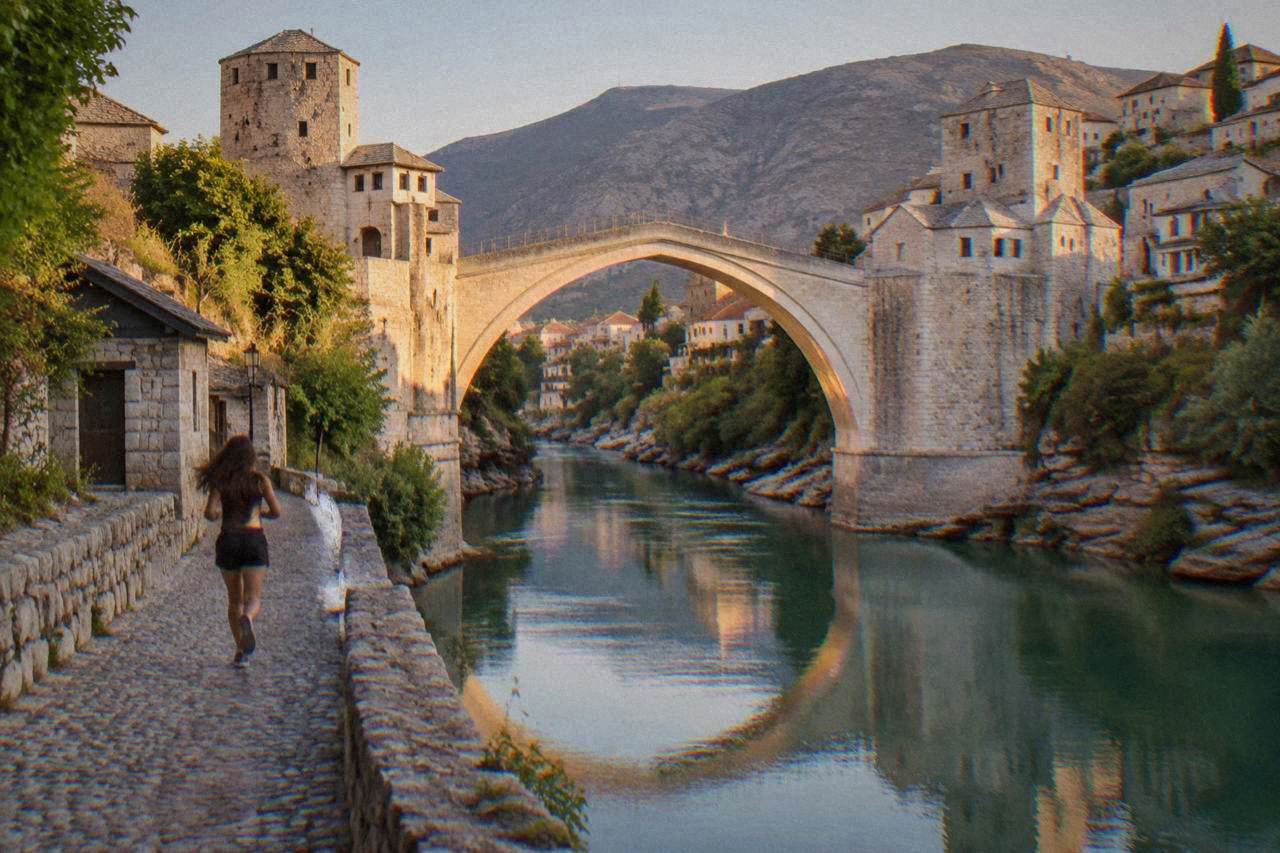
Yes, for almost every kind of traveller, one or two nights in Mostar are worth it, because the Old Bridge Area of the Old City, a UNESCO World Heritage property since 2005, is a different place in the evening and early morning than it is at midday. The bridge itself is free to cross at any hour, and staying overnight also puts Blagaj, Počitelj, Kravica waterfall and Međugorje within an easy day-trip radius of under an hour by road.
The practical case is simple arithmetic. Kravica waterfall is 55.2 km from Stari Most, about 54 minutes by road. Blagaj Tekke is 13.7 km, about 19 minutes. Počitelj is 30.0 km, about 31 minutes. A visitor based in Dubrovnik, 145.5 km away, or Split, 174.1 km away, spends most of a very long day in a vehicle and gets a compressed slice of Mostar itself. A visitor sleeping in Mostar wakes up already inside the region.
There is also a qualitative case. The Old Bridge was completed in 1566, destroyed on 9 November 1993 during the war, and rebuilt and reopened in July 2004. It is a public pedestrian crossing, open around the clock and free. At midday it carries a steady stream of tour groups; at seven in the morning and after ten at night it belongs to whoever is standing on it. If the bridge is the reason you came, the overnight stay is the way to see it.
For travellers weighing Mostar against the capital, is Mostar or Sarajevo better is a separate question with its own trade-offs. And if the whole country is new to you, is Mostar worth visiting covers the baseline case for the city itself.
What Changes In Mostar After The Day Trips Leave?
Between roughly mid-afternoon and mid-morning, Mostar reverts to a lived-in city: the Kujundžiluk bazaar stalls thin out, the restaurants around the bridge serve locals and overnight guests, and the light on the Neretva changes from harsh overhead glare to long evening colour. The day-trip wave is real, because Mostar is the anchor stop on circuits running from Dubrovnik and Split, and it arrives and departs on a schedule you can plan around simply by being there before or after it.
Evening is when the city earns its keep. The stone of Stari Most and the minaret of Koski Mehmed-pašina džamija hold the last light long after the buses have gone, and the riverbanks below the bridge stay warm late into summer nights. The FHMZ station table for Mostar (1961 to 1990) puts the July mean at 24.7 C and the absolute maximum at 41.2 C, so midday in high summer is genuinely punishing, and the evening is not just prettier, it is more comfortable. Modelled normals (ERA5 reanalysis, 1991 to 2020) put the mean daily high at 29.9 C in July and 30.5 C in August, which tells the same story with a cooler floor.
An overnight stay also reframes the walking options. A private guided walk such as the Best of Mostar private walking tour can be booked for a first evening or an early start, when the lanes around Kriva ćuprija and the Crooked Bridge are quiet and a guide has room to talk. For travellers who prefer to orient themselves on foot first, the question is Mostar a walkable city has a short answer: the core is compact and pedestrian, with the real distances lying in the hills and the west of the city.
What Does An Early Morning In The Old Town Give You?
An early start gives you the Old Bridge, the bazaar street and the riverbanks nearly to yourself, in light that photographers travel for, before the first coaches reach the Old Town. It also gives you a full day afterwards for a Herzegovina excursion without watching the clock, because you are not burning three or four hours of road time to Dubrovnik or Split at both ends. That combination, an empty bridge at dawn and a whole day in the region, is the single strongest argument for the night in Mostar.
Morning also suits the practical errands. The currency here is the convertible mark (KM, BAM), pegged at 1 EUR = 1.95583 KM, and while euro cash is often accepted in tourist areas, usually at a rounded 1 to 2 rate, confirming the rate and using marks is the better default. Bosnia and Herzegovina is not in the EU and not in Schengen, so if you arrived from Croatia you have already crossed a full external border, and you will cross it again on the way out; waits at the Doljani-Metković and Bijača-Nova Sela crossings run up to about 30 minutes, longer at summer peaks.
A cooking class with lunch and drinks is one of the more rewarding morning formats for overnighters, since day-trippers on a compressed schedule rarely have room for one. The same logic applies to food generally: a sit-down Herzegovinian lunch, with the local burek or the wines of the region, is an activity in itself, not a refuelling stop.
The safety question comes up here too, and it has a plain answer: the central streets around the Old Bridge are active and lit in the evening, and there is no reason to treat a night walk there differently from any other small European city. More detail sits on the page is it safe to walk around Mostar at night.
Which Day Trips Become Easy If You Sleep In Mostar?
Every major Herzegovina day trip becomes easy, because Mostar is the natural hub of the region: Blagaj Tekke is 13.7 km and about 19 minutes away by road, Počitelj 30.0 km and about 31 minutes, Međugorje 28.3 km and about 40 minutes, and Kravica waterfall 55.2 km and about 54 minutes in free-flow traffic. A single overnight stay converts four separate long-haul excursions into one loop of under two hours of total driving.
These figures are road distances and free-flow times from Stari Most, with border queues excluded, but no crossing is involved on any of them: all four sit inside Bosnia and Herzegovina.
| Destination from Stari Most | Road km | Approx. free-flow minutes |
|---|---|---|
| Blagaj Tekke | 13.7 | 19 |
| Međugorje (St James church) | 28.3 | 40 |
| Počitelj | 30.0 | 31 |
| Radimlja necropolis | 33.5 | 42 |
| Kravica waterfall | 55.2 | 54 |
| Hutovo blato | 48.1 | 62 |
| Jablanica | 47.4 | 57 |
| Trebinje | 116.5 | 142 |
Kravica deserves the note it always needs: the park's own visitor page lists entry at 20 KM for an adult all year, 10 KM for residents of Bosnia and Herzegovina, 10 KM for school groups aged 7 to 18, and free entry for children under 7. The park is open all year, with hours by month: 07:00 to 17:00 in January, February, November and December, extending to 07:00 to 22:00 from June to September. It is not a summer-only sight, and the "15 minutes from Mostar" claim you may have read is simply wrong.
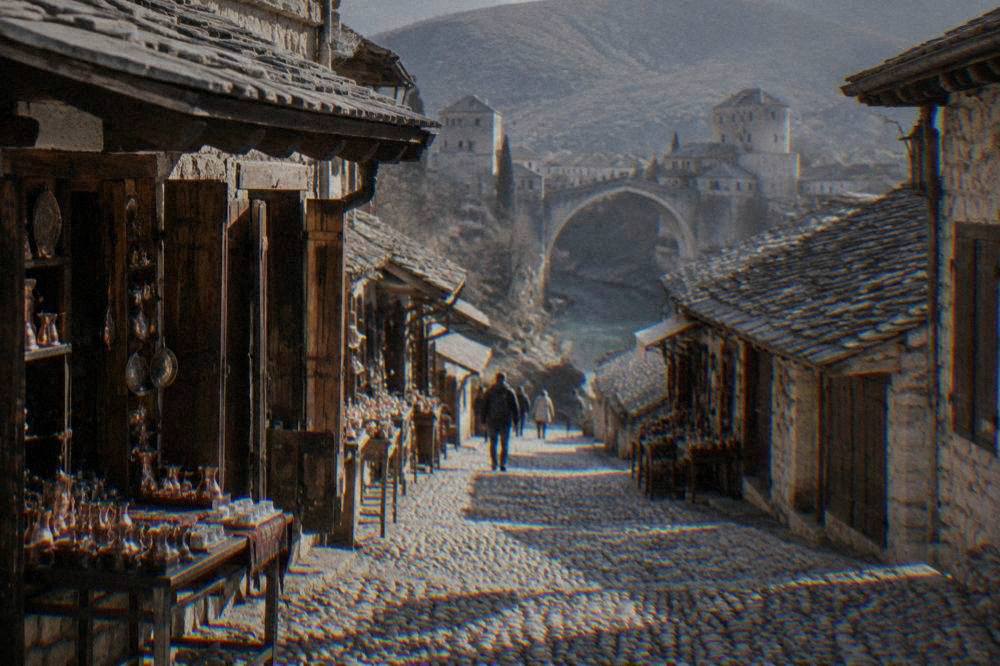
An organised full-day tour covering Blagaj, Počitelj and Kravica handles the driving, the parking and the sequence, and there are strong ones departing from Mostar itself. This is the second dividend of the overnight stay: the good local departures leave from Mostar in the morning, and you can only take them if you are already there.
What Does An Overnight Stay In Mostar Cost?
The honest headline is that the lodging itself is not the expensive part: no nightly rate belongs on this page, but the known add-on is a tourist tax reported at 3 KM per person per night in Herzegovina-Neretva Canton from 1 January 2026, usually folded into the bill, and the budget question hinges on how you travel, not where you sleep.
Food, coffee and entry fees in KM terms are modest, and the convertible mark's fixed peg to the euro at 1.95583 makes mental pricing easy for anyone arriving from the euro zone.
The tourist tax figure is reported rather than official, so confirm it at booking. Beyond that, the cost structure of an overnight stay is mostly the cost of the day trips you would otherwise pay a Dubrovnik or Split operator to run, minus their long-haul premium. If you are weighing budget overall, the page on whether Mostar is expensive breaks down daily spending, and how many days in Mostar is enough covers the sizing question for longer stays.
Events can also tip the decision. The 2026 summer calendar ran deep: Mostarsko ljeto from 25 June to 7 August, Mostar Summer Fest on 2 to 4 July, the Mostar Blues and Rock Festival on 24 and 25 July with free entry, the 460th traditional Old Bridge diving competition on 26 July, the Red Bull Cliff Diving round from 30 July to 1 August with men diving from 27 m and women from 21 m platforms, and the Mostar Jazz Fest on 23 to 25 August. Next year's dates are not yet published, but a city with a programme that dense rewards the people still in it at nine in the evening.
Diving from the bridge itself is done by members of the Mostari diving club, who train for years before jumping; there is no pay-to-jump option for visitors, so treat the jumpers as the evening show rather than an activity. The bridge stands about 21 to 24 metres above the river depending on the water level, and the Neretva is cold even in August.
For the reverse traveller, arriving from the coast on one of the Dubrovnik or Split day circuits and then staying, the logistics are already solved: the same corridor brings you in. This site's editorial desk, Mostar Travel Guide, keeps a full things to do in Mostar index for filling the second day.
Common Questions About Staying Overnight In Mostar
Is It Worth Staying The Night In Mostar?
Yes. The Old Bridge Area is a UNESCO World Heritage property, free to cross at any hour, and it is transformed once the day-trip coaches leave. Staying overnight also turns the whole of Herzegovina, Blagaj, Počitelj, Kravica waterfall and Međugorje, into short drives of under an hour.
Is One Night Enough In Mostar?
One night is enough to see the Old Town empty in the evening and the morning and to take one day trip. Two nights allow two day trips or a slower city day; anything beyond that suits travellers adding Vjetrenica, Hutovo blato or Trebinje.
Do I Need Cash To Stay Overnight In Mostar?
Yes for parts of the stay. The currency is the convertible mark (KM), pegged at 1 EUR = 1.95583 KM. Cards are accepted at hotels and larger restaurants, but small vendors, markets and some entry points want cash, so keep marks on hand.
Is There A Tourist Tax In Mostar?
A tourist tax of 3 KM per person per night is reported for Herzegovina-Neretva Canton from 1 January 2026, typically added to the accommodation bill. Confirm the amount at booking.
Can I Walk Around Mostar At Night?
The central streets around Stari Most and the Kujundžiluk bazaar are lit and active in the evening in the tourist season. As anywhere, keep normal care of belongings after dark.