Is Mostar A Walkable City?
Is Mostar a walkable city? A plain answer on walking in Mostar, Herzegovina: the compact Old Town, the hills, the heat, and when a bus or a tour makes more sense.
Mostar, in Herzegovina in the south of Bosnia and Herzegovina, is one of the more compact cities a traveller can base themselves in. The Old Bridge Area of the Old City is a UNESCO World Heritage property, inscribed in 2005, and the whole protected zone covers just 7.60 hectares with a 48 hectare buffer around it. In practical terms, the bridge, the Kujundžiluk bazaar, Kriva ćuprija (the Crooked Bridge), Koski Mehmed-pašina džamija and the Ottoman houses on the riverbank all sit within a few minutes of one another on foot, and the rest of the centre, from Spanish Square to the west bank streets, spreads out over a walkable distance beyond them.
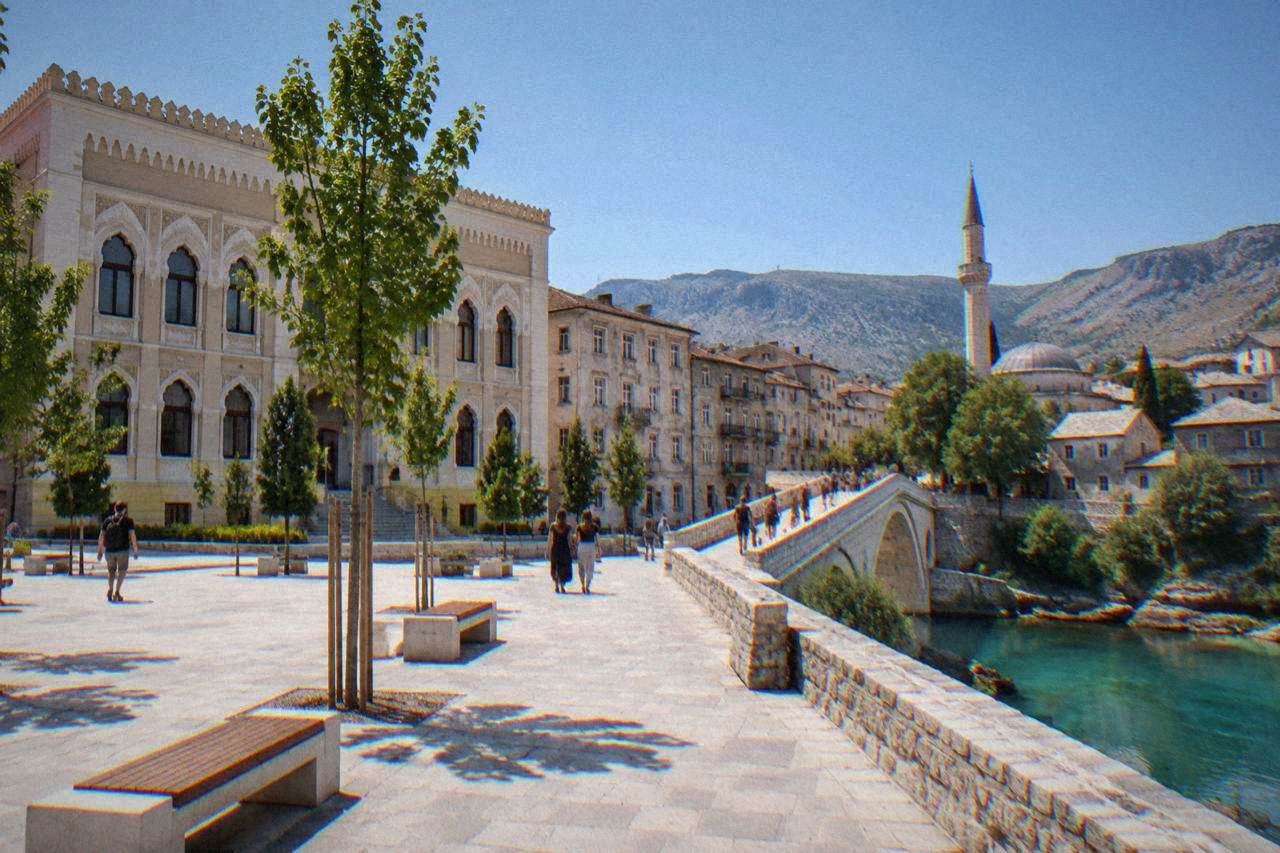
The short answer is that the historic centre is thoroughly walkable and needs no car at all, while the wider city is partly walkable: the two banks are connected by several bridges, main boulevards have pavements, and the hills above town ask for sturdy shoes rather than a vehicle. Where walking stops working is the countryside. Blagaj is 13.7 km away by road, Počitelj 30.0 km and Kravica waterfall 55.2 km, and no amount of shoe leather covers those in a day. For more on the city itself, start with things to do in Mostar and a plan such as one day in Mostar.
Yes, Mostar is a walkable city, and for the historic core it is a city best seen entirely on foot. The Old Bridge, the Kujundžiluk bazaar, the Crooked Bridge, Koski Mehmed-pašina džamija and the Ottoman courtyard houses all stand within a few hundred metres of one another, and the Old Bridge itself is a free public crossing open around the clock. Spanish Square lies an easy walk to the west, across the river and along the boulevards.
The city is built on both banks of the Neretva, and the two halves meet at the bridge. The east bank holds the bazaar streets and the mosques; the west bank holds Spanish Square, the shopping streets and most of the guesthouses. Between them, the riverbank paths and a series of smaller crossings make a loop that takes in nearly every headline sight without a single taxi ride.
Beyond the centre, the scale stays human. The city is home to about 105,000 people by the 2013 census, but the parts a visitor moves through are far smaller than that figure suggests, strung along the valley rather than spread over a vast plain. Distances that look long on a map usually turn out to be twenty minutes on flat pavement.
What the centre does ask for is patience rather than stamina. The bazaar lanes are cobbled, they can be crowded in the middle of the day in summer, and the surfaces around the bridge are worn stone. Comfortable shoes matter more than anything else you can pack. If you are weighing the city against the capital, is Mostar or Sarajevo better covers the comparison, and why is the Mostar bridge so famous explains why so much of a visit ends up anchored to one small river crossing.
How Walkable Is The Mostar Old Town Really?
The Old Town is completely walkable, car-free in its core lanes, and free to enter, with no ticket for the Kujundžiluk bazaar, the Crooked Bridge or the Old Bridge crossing itself. Everything inside the UNESCO property stands within a five to ten minute walk of Stari Most, so the Old Town works as a place you explore on foot for a morning or a full day without repeating a street.
The geography is simple. Kujundžiluk, the old bazaar street, runs along the east bank down to the bridge, its lanes stepped with small shops on both sides. A short walk uphill from the bazaar brings you to Karađoz-begova džamija and the residential streets behind it. Downstream, Kriva ćuprija crosses a quiet side channel of the Neretva, and from there the riverside path leads to Bišćević House and Muslibegović House, the Ottoman courtyard houses on the west bank.
Crossing the Old Bridge is itself the walk. The bridge was completed in 1566, destroyed on 9 November 1993 during the war, and rebuilt and reopened in July 2004, with reconstruction supported by UNESCO and World Bank partners. Its height above the river is about 21 to 24 metres depending on the river level, so the climb over it is a short stone staircase rather than a flat deck; the steps are worn smooth and worth taking slowly.
Two practical notes shape a day on foot here. First, the lanes are working bazaar streets, so early morning and late afternoon are the calmer windows for photographs. Second, the riverbank paths link the sights without any need to retrace steps, which makes a loop of the whole Old Town, both banks included, a comfortable half-day walk with stops. The question what is so special about Mostar goes deeper on what makes that loop unusual.
Where Does Walking Stop Working Around Mostar?
Walking stops working the moment you leave the city for the Herzegovina countryside: Blagaj is 13.7 km and about 19 minutes away by road, Počitelj is 30.0 km, Međugorje 28.3 km, and Kravica waterfall is 55.2 km and about 54 minutes by road in free-flowing traffic. These are day trips by car, minivan or organised tour, not walks, and trying to reach them on foot uses a whole day each way.
The pattern is consistent across Herzegovina: the sights are close by Balkan standards but far by pedestrian ones, and the roads between them are rural routes without footpaths. Here is how the headline destinations stack up from Stari Most, with free-flow road times that exclude any border queues:
| Destination | Road distance | Drive time | Walkable from Mostar? |
|---|---|---|---|
| Blagaj Tekke | 13.7 km | about 19 min | No |
| Međugorje | 28.3 km | about 40 min | No |
| Počitelj | 30.0 km | about 31 min | No |
| Kravica waterfall | 55.2 km | about 54 min | No |
| Konjic | 69.0 km | about 80 min | No |
| Sarajevo (Baščaršija) | 127.1 km | about 134 min | No |
Inside the city, walking covers everything worth reaching. Mostar International Airport is 8.2 km and about 12 minutes from Stari Most by road, but flights are few: reported routes are Zagreb with Croatia Airlines and Stuttgart with Eurowings, kept through the winter 2026/27 schedule, plus seasonal services. Arrivals usually come via Sarajevo or Dubrovnik airports instead, both reached by bus, train or transfer rather than a walk. More of these guides are collected on Mostar Travel Guide.
For the countryside, an organised day trip solves the problem neatly, and the standard circuit, Blagaj, Počitelj and Kravica waterfall, is run as a guided day tour from Mostar. Kravica is worth planning for specifically: the park's own visitor page lists entry at 20 KM for an adult all year, with 10 KM for residents of Bosnia and Herzegovina and children under 7 free, and opening hours that run from 07:00 to 22:00 in June through September. Any tour listing shows its own inclusions and current times.
What About Hills, Steps And Heat When Walking In Mostar?
Mostar's centre is mostly flat along the river, but the streets rise quickly on both sides, and the summer heat is the bigger obstacle than the gradient: ERA5 reanalysis for 1991 to 2020 puts the mean daily high at 29.9 C in July and 30.5 C in August, and the FHMZ 1961 to 1990 station series records an absolute maximum of 41.2 C. Hills ask for shoes; heat asks for an early start.
The climbs are short rather than severe. The lanes behind Kujundžiluk step uphill to the mosques, and the west bank rises toward the ridge where the Hum hill cross stands above the city. The Fortica viewpoint above town is reached by a genuine uphill path, and anyone adding it to a walking day should treat it as the strenuous item on the itinerary rather than a stroll between sights.
Heat changes the rhythm of a walking day more than the terrain does. The FHMZ Mostar station table for 1961 to 1990 shows a mean temperature of 24.7 C in July against 4.8 C in January, and rainfall of 42.9 mm in July against 200.0 mm in November, so summer days are hot and largely dry while winter is mild but wet. The practical reading: walk early, rest through the early afternoon, and walk again in the evening, which is also when the bridge and the bazaar are at their calmest. Is Mostar too hot in August covers the season in detail, and does it ever snow in Mostar covers the other end of the year.
The Neretva itself is a fixed point in all of this: its water stays cold even in August, fed by karst springs, so the riverside paths are the shadiest and most pleasant walking routes in the city. Whether a swim is an option is a separate question, answered in can you swim in the river at Mostar.
| Month | Mean temp (FHMZ 1961-1990) | Mean daily high (ERA5 1991-2020) | Rainfall mm |
|---|---|---|---|
| January | 4.8 C | 8.4 C | 164.7 |
| April | 13.3 C | 17.7 C | 127.3 |
| July | 24.7 C | 29.9 C | 42.9 |
| August | 24.2 C | 30.5 C | 73.7 |
| November | 10.1 C | 14.1 C | 200.0 |
Do You Need A Guide To Walk Mostar?
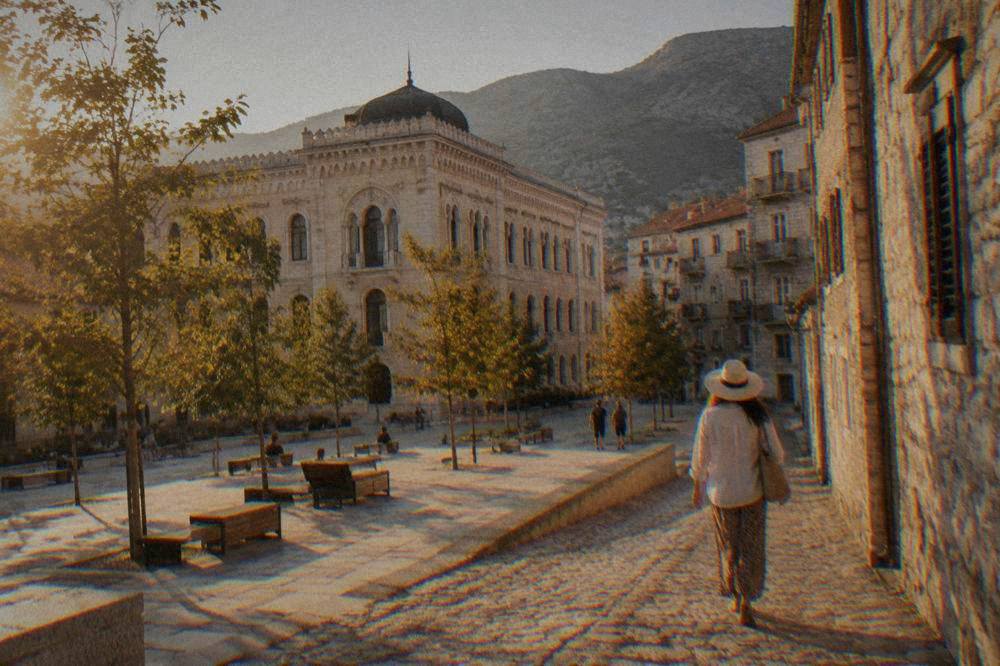
A guide is not needed to walk Mostar, since the Old Town's lanes are public, free and easy to follow, but a guided walk adds the history that the stones do not explain: why the bridge matters, what happened to it in 1993, and what the street names remember. A private walking tour lets a visitor set the pace and the focus, whether that is Ottoman architecture, the war years or food.
The history layer is where a guide earns the fee. The written record of Mostar begins with a mention of the name in 1474, the bridge went up in 1566 under Suleiman the Magnificent, and the destruction and rebuilding of 1993 and 2004 sit within living memory of the people running shops in the bazaar today. Dates and physical facts are easy to state; the layered story of the city is easier to absorb with someone walking you through it, and why was the Mostar bridge destroyed and has the Mostar bridge been rebuilt give the factual spine if you would rather walk alone.
A private walk suits the city's layout well, because the whole core is small enough that a guided route can be tailored to interest rather than trimmed to fit a bus schedule. The Mostar Private Walking Tour is this site's featured walk, covering the Old Town, the bridge and the streets beyond at a pace you set, and you can Check availability alongside its own page. For independent walkers, how many days in Mostar is enough helps with pacing the visit.
Beyond the core, the same logic applies to food and to the countryside: the burek masterclasses and cooking classes in the roster put a kitchen inside walking distance of the bridge, and the Herzegovina day tours put Blagaj, Počitelj and Kravica waterfall inside one planned day. Whichever mix you choose, the walking part of Mostar asks for nothing more than good shoes, an early alarm in summer and a willingness to cross the bridge more than once.
Common Questions About Walking In Mostar
Is Mostar A Walkable City?
Yes. The Old Bridge, the Kujundžiluk bazaar, the Crooked Bridge and the Ottoman houses all sit within a few hundred metres of one another, the bridge crossing is free and open around the clock, and Spanish Square is an easy flat walk to the west. A car is only needed for countryside day trips such as Blagaj or Kravica waterfall.
Is the Old Town of Mostar pedestrianised?
The core bazaar lanes around Kujundžiluk and the bridge are effectively pedestrian streets, cobbled and closed to through traffic. The surrounding city blocks carry normal traffic with pavements, and the riverbank paths on both banks are for walkers.
How long does it take to walk across Mostar's centre?
Edge to edge, the visitor-relevant centre, from the Old Bridge to Spanish Square, is a walk of roughly twenty minutes at an unhurried pace. The full loop of both banks through the Old Town is a comfortable half day with stops at the mosques, the courtyard houses and the viewpoints.
Is Mostar hilly for walking?
The riverbanks are flat, but the streets rise on both sides of the valley, and the lanes behind the bazaar are stepped. The climbs are short. The Fortica viewpoint above the city is the one genuinely steep walk close to the centre, and sturdy shoes are the main requirement everywhere.
Can you walk in Mostar in summer?
Yes, with an early start. ERA5 reanalysis for 1991 to 2020 shows mean daily highs of 29.9 C in July and 30.5 C in August, and the FHMZ 1961 to 1990 series records an absolute maximum of 41.2 C. Walking in the morning and evening, with a long midday break, is the standard pattern.
Do you need a car in Mostar?
Not for the city itself. A car, transfer or organised day tour is only needed for Herzegovina's sights beyond town: Blagaj is 13.7 km away, Počitelj 30.0 km and Kravica waterfall 55.2 km by road, all of them rural routes without footpaths.
