Does It Ever Snow In Mostar?
Yes, snow falls in Mostar, but it rarely lasts long in the city itself. Here is what the climate record says about snow, cold and winter visits to Mostar in Herzegovina.
Mostar sits in a steep valley of the Neretva river in Herzegovina, the southern part of Bosnia and Herzegovina, and the question of snow there has a split answer. Yes, it snows in Mostar, nearly every winter, but the city sits low in a sheltered karst basin and the white cover rarely survives long on the streets. The hills that frame the city, Hum to the east and the Herzegovinian ridges beyond, hold their snow far longer than the valley floor does, so a January morning can give you a snow-dusted panorama above a merely frosty Old Bridge.
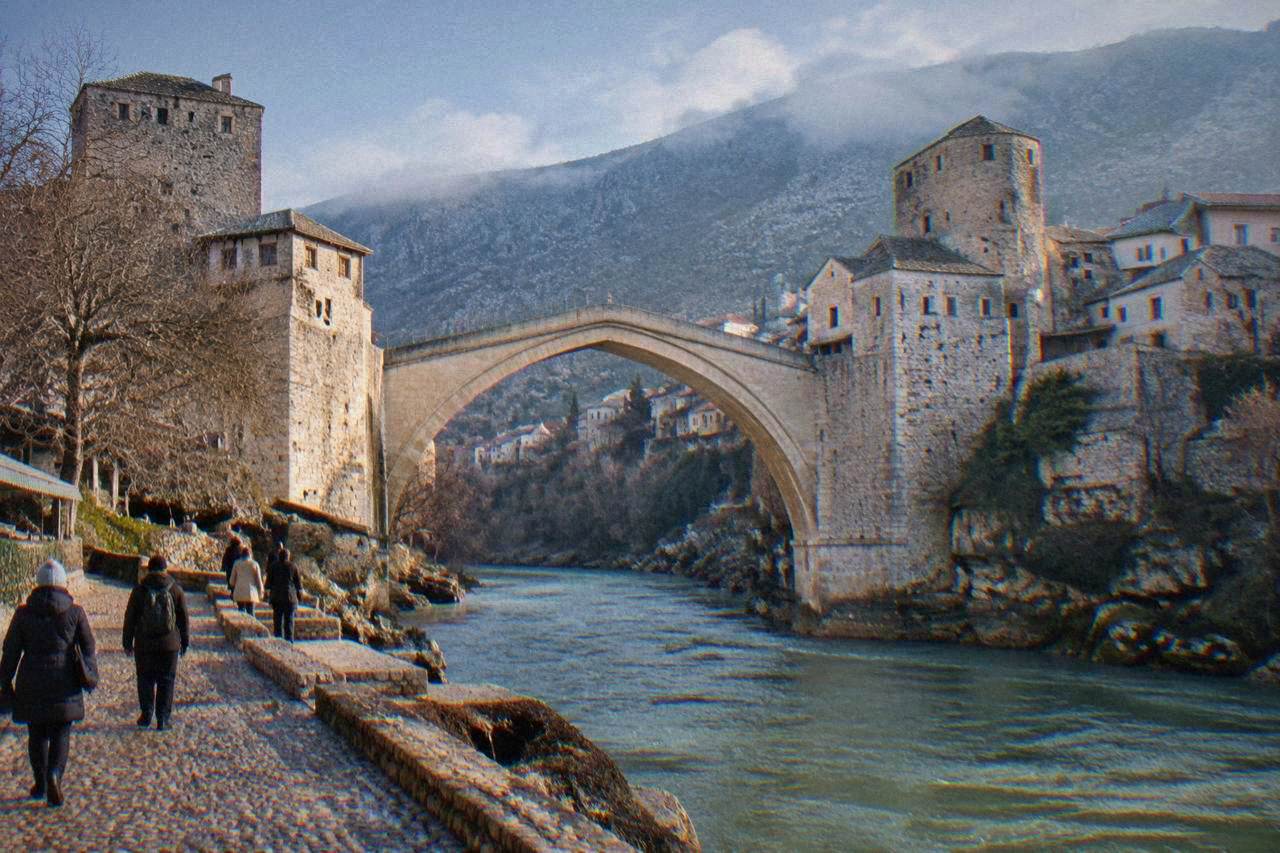
Yes, snow falls in Mostar, but it is a modest, short-lived event in the city itself rather than a lasting cover. The FHMZ climate record for the Mostar station, covering 1961 to 1990, shows a maximum snow cover of 31 cm in January, 28 cm in February and 37 cm in March, with 21 cm possible in December, figures that represent the deepest accumulation in the whole period, not a typical winter morning.
The distinction that matters is between snow falling and snow staying. Mostar's valley floor sits at roughly 45 to 80 metres above sea level in one of the warmer pockets of Bosnia and Herzegovina, and the same shelter that makes the city baking in summer works against deep winter cold. A fall of a few centimetres can arrive with a cold snap in December, January or February, then melt within a day or two as daytime temperatures climb back above freezing.
The record also shows that March, oddly, carries the deepest single snow depth in the whole FHMZ table at 37 cm, more than January. Late-winter storms pushing down the Neretva valley can drop heavy wet snow when the surrounding mountains are still cold enough. If a white photo of Stari Most is the goal, the statistically better bet is a cold spell between late December and early March, not the shoulder edges of the season.
For context on how the city handles weather more generally, the companion piece on summer heat at is Mostar too hot in August covers the opposite extreme, and the question is Mostar worth visiting addresses the city across all seasons.
How Much Snow And Cold Does The Mostar Record Show?
The FHMZ Mostar station table for 1961 to 1990 gives a mean January temperature of 4.8 C, an absolute recorded minimum of -10.9 C in January, and a winter precipitation pattern peaking in November at 200.0 mm against 42.9 mm in July, so the cold season in Mostar is wet more than it is white, with 106 days a year recording more than 1 mm of rain.
That precipitation number explains the snow behaviour. Winter storms over the Adriatic push moisture up the Neretva valley, and whether it lands as rain or snow depends on a threshold of a degree or two. The valley usually sits on the warm side of that line, which is why Mostar winters feel raw and damp rather than Alpine. The ERA5 reanalysis for 1991 to 2020, a modelled dataset rather than a station record, puts the mean daily January high at 8.4 C and the mean daily January low at 0.2 C: afternoons above freezing, nights hovering at the freezing point, exactly the pattern that erases snow quickly.
| Month | Mean temp C (FHMZ 1961-1990) | Absolute min C | Max snow cover cm | Precipitation mm |
|---|---|---|---|---|
| November | 10.1 | -4.8 | 5 | 200.0 |
| December | 6.2 | -7.2 | 21 | 178.7 |
| January | 4.8 | -10.9 | 31 | 164.7 |
| February | 6.6 | -8.6 | 28 | 151.1 |
| March | 9.6 | -6.5 | 37 | 150.1 |
Read the snow column carefully: those are the deepest covers in thirty years of record, not averages. A typical Mostar winter delivers one to three snowfalls that settle in the city, each gone within about two or three days. The absolute minimum of -10.9 C is likewise a record, hit once in the period; ordinary January nights run nearer the modelled low of around freezing.
Daylight is the other winter constraint the tables do not show directly. December days in Mostar run about 9 hours long against about 15 hours in June, which pushes photographers who want the bridge in warm light toward the middle of the day. A private guide can help compress a short winter sightseeing loop; the private group city tour of Mostar and the Old Bridge covers Stari Most and the Old Town core, and Check availability shows current openings for the season.
Is A Snowy Day In Mostar Good For Sightseeing?
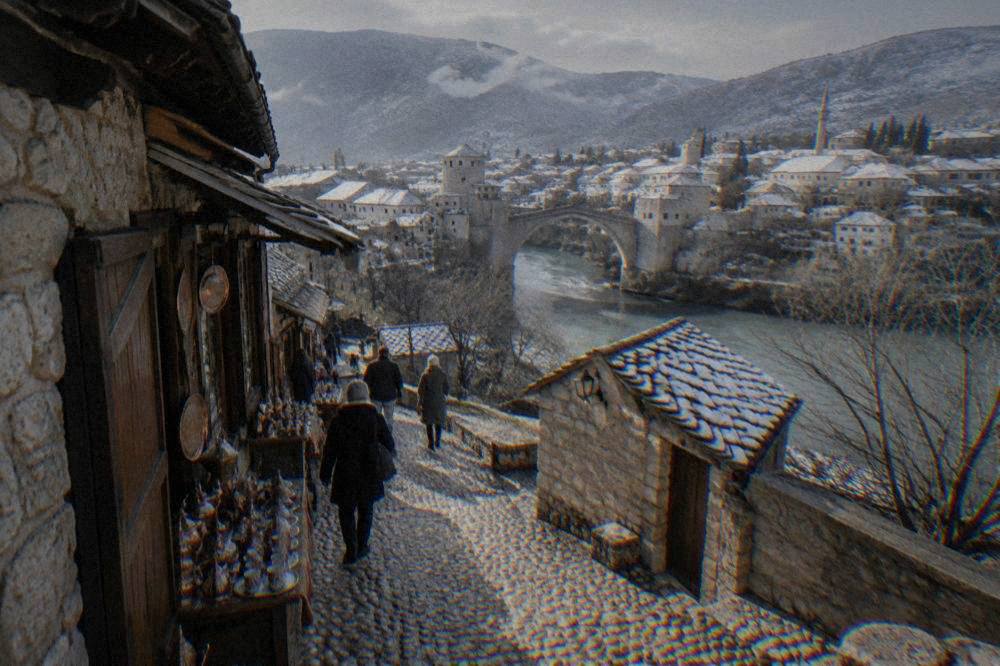
A snowfall in Mostar usually improves the sightseeing rather than stopping it, because the city's core sights are outdoor, free and a short walk apart: Stari Most is open to cross at any hour with no ticket, the Kujundžiluk bazaar is a public street, and Kriva ćuprija sits a few minutes upstream, so snow on the limestone roofs of the Old Town is a photo opportunity, not a closure.
There is no ticket gate to the bridge and no winter shutdown of the Old Town streets, so the logistics of a snowy day are mostly about footing and warmth. The stone slabs of the bridge arch and the cobbled lanes around Kujundžiluk become slick when frost follows a melt, and sensible footwear matters more in January than in any other month. Indoor escapes cluster nearby too: the Old Bridge Museum in the Tara tower is reported to open 08:00 to 16:00 daily from 1 April to 1 November with organized visits outside that window, so a mid-winter visit means checking arrangements in advance, and the Ottoman houses such as Bišćević House and Muslibegović House run small cash entry fees that vary by season.
Cold weather also changes the river. The Neretva stays cold even in August, fed by karst springs, and in winter the contrast between the grey-green water and any snow on the banks is striking from the terrace of Koski Mehmed-pašina džamija downstream of the bridge. Climbing the minaret in a wind, on the other hand, is a warmer-weather pleasure; on a raw day the museum rooms of the Old Town are the better stop.
Snow in the city is one thing; snow on the roads out of it is another. Day trips toward Blagaj, Počitelj and Kravica waterfall run all winter on paper, Kravica is open all year with January and February hours of 07:00 to 17:00 and a 20 KM adult entry that does not drop in the cold months, but mountain sections of the route west of the Neretva can carry ice after a storm. If snow is falling on the day you have set aside for Herzegovina, a city tour with a local guide is the safer booking, and a cooking class is the warm possible alternative.
Do The Hills Around Mostar Keep Snow Longer?
The hills around Mostar hold snow far longer than the streets do, and this is the reliable way to see snow within sight of the city: Hum, the hill that rises directly east of the Old Bridge, and the ridges that frame the Neretva valley regularly stay white for days or weeks after a fall has melted in the city below, because every hundred metres of elevation in this part of Herzegovina buys measurably colder air.
Hum is close enough to be part of the city's daily picture, and the via ferrata route on its flank is a summer and autumn activity rather than a winter one, given the exposed rock. Further out, the higher interior toward Blidinje and the mountains north of Jablanica keep genuine winter conditions through the coolest months. If a winter trip wants guaranteed snow underfoot, the practical answer is to stay in Mostar and travel up to it, not to wait for the valley to whiten.
The contrast also explains a fact that surprises arrivals: it can rain in the Old Town while the panorama above is white. Pack for both outcomes. A waterproof layer serves the November and December months, when the FHMZ table shows 200.0 mm and 178.7 mm of precipitation respectively, and a hat and gloves cover the January mornings when the modelled low sits right at freezing. More on the damp side of the season is covered in the winter planning guide at Mostar in winter, and the swimming question, relevant once spring returns, is answered at can you swim in the river at Mostar.
One caution that applies all year in Herzegovina and doubly under snow: stay on marked paths in rural areas because of suspected mines, a rule BHMAC, the national mine-action centre, maintains data on. Snow hides old track edges exactly as vegetation does, so a shortcut across a white field is the one winter habit to firmly avoid.
Should You Plan A Trip Around Snow In Mostar?
Plan a winter trip to Mostar for the light, the low prices and the empty lanes, not for snow itself, because the climate record shows snow settling in the city only a few times per season and melting within days, while the months from November to January deliver the rain: a late-December or January visit gives the best odds of a white morning, but any itinerary built on snow alone will usually end in frost and sunshine instead.
What a winter itinerary gains is breathing room. The Old Town streets that jam in July are quiet, hotel availability is wide, and the low December sun of about 9 hours of daylight puts a long golden shadow across the Neretva by mid-afternoon. The city's compactness helps: Spanish Square to Stari Most is a flat twenty-minute walk, and the whole core cluster, bridge, bazaar, Crooked Bridge, mosque terraces, works as a single loop on foot even in cold weather. The Mostar Travel Guide planning pages lay out that walk in detail for anyone mapping a short winter stay.
Winter is also the season for Herzegovina's indoor pleasures. A burek masterclass or a Bosnian cooking class turns a cold afternoon into the warmest hour of the day, and the burek and Bosnian coffee traditions are exactly the kind of slow, seated experiences that suit a January schedule. The selection below gathers the options that run year-round from the city itself.
A last practical layer for the cold months. The currency is the convertible mark, pegged at 1 EUR = 1.95583 KM, and cash serves the small Old Town vendors better than cards on a quiet February Tuesday. Bosnia and Herzegovina is not in the EU or Schengen, so if winter travel includes a Dubrovnik departure, the Croatian land border is a Schengen external border with full checks, and waits can stretch in poor weather; allow slack in any cross-border winter schedule. And if the snow does come on your morning in the city, the standard advice holds: walk carefully on the bridge stones, because the arch is smooth even when dry, and head for the museum rooms once the photo is taken.
Common Questions About Snow In Mostar
Does It Ever Snow In Mostar?
Yes. Snow falls in Mostar, with the FHMZ 1961 to 1990 record showing maximum snow depths of 31 cm in January, 28 cm in February and 37 cm in March. Those are the deepest covers in thirty years, though; typical falls settle for a day or two before melting in the valley.
How Cold Does Mostar Get In January?
The FHMZ Mostar station shows a mean January temperature of 4.8 C and an absolute recorded minimum of -10.9 C for the 1961 to 1990 period. The ERA5 reanalysis for 1991 to 2020 models mean January highs of 8.4 C and lows of 0.2 C, so afternoons usually sit above freezing.
Is The Old Bridge Open When It Snows?
Stari Most is a public pedestrian route, free to cross, with no ticket and no opening hours, and no closure in snowy weather is reported. The stone arch gets slippery in frost, so footwear with grip is the practical requirement on a winter visit.
Which Month Has The Deepest Snow In Mostar?
By the FHMZ 1961 to 1990 table, March holds the deepest recorded snow cover at 37 cm, ahead of January at 31 cm. Late-season storms can deliver heavy wet snow while the surrounding hills remain cold, even as the valley warms.
Is Winter A Bad Time To Visit Mostar?
Winter brings rain, short days of about 9 hours of daylight in December and quiet streets rather than closures. The Old Town sights are mostly outdoors and free to walk, indoor museums and cooking classes fill the cold hours, and the snowy hills around the city often stand white above a frosty valley.
