Mostar In Winter: Quiet Streets And What Stays Open
Winter strips the crowds out of Mostar, in Herzegovina, and leaves the stone, the river and the fog. This guide covers the station weather record, what stays open between November and March, and how the day trips change when the season turns.
Mostar in winter is quiet, mild by continental standards and mostly open. January averages 4.8 C at the FHMZ station, the Old Bridge is free to cross around the clock, Kravica waterfall keeps winter hours of 07:00 to 17:00 with the same 20 KM adult ticket, and the Sarajevo train runs twice daily each way after resuming on 15 October 2026.
Winter in Mostar, the main city of Herzegovina on the Neretva river, is the season the crowds release the Old Bridge back to the locals. The stone of Kujundžiluk stays warm-toned under low light, the river runs cold and green, and the queues that define July simply do not exist in January. This guide walks through the weather as the station record actually shows it, what stays open, which prices change and which do not, and how the day trips around Herzegovina reshape themselves between November and March.
What Is Winter Weather Like In Mostar?
Mostar's winters are mild for an inland Balkan city but wetter than its summers, with January averaging 4.8 C at the FHMZ Mostar station for 1961 to 1990 and the modelled January daily high at 8.4 C in the ERA5 reanalysis for 1991 to 2020. Rain peaks in the cold half of the year: November averages 200.0 mm against July's 42.9 mm, and the absolute minimum on the station record is minus 10.9 C.
The station table, labelled FHMZ Mostar station, 1961 to 1990, is the citable record, and its winter rows tell a consistent story. December, January and February each average between 11 and 12 rainy days above 1 mm, against five in July. Snow happens, but it is not the rule: the station's maximum snow cover reaches 31 cm in January and 28 cm in February, yet the same record shows the absolute maximum hitting 18.2 C in January, so a winter week can swing from frost to shirt sleeves.
The modelled figures fill in what the station table does not print. FHMZ publishes means and absolute records, not average daily highs, so the daily-high numbers come from the ERA5 reanalysis, 1991 to 2020, a model rather than a station: January highs average 8.4 C and lows 0.2 C. The valley floor in practice often runs warmer than surrounding hills, and valley fog is the winter signature, sitting over the Neretva in the mornings while Hum and the Fortica ridge stay in sun.
| Month (FHMZ 1961-1990) | Mean temp C | Absolute max C | Absolute min C | Rain mm | Rainy days > 1 mm | Max snow cover cm |
|---|---|---|---|---|---|---|
| November | 10.1 | 23.8 | -4.8 | 200.0 | 11 | 5 |
| December | 6.2 | 19.3 | -7.2 | 178.7 | 11 | 21 |
| January | 4.8 | 18.2 | -10.9 | 164.7 | 11 | 31 |
| February | 6.6 | 25.0 | -8.6 | 151.1 | 10 | 28 |
| March | 9.6 | 27.6 | -6.5 | 150.1 | 10 | 0 |
What that means for planning is simple. Layers beat a heavy coat, because a January afternoon can be mild while the morning fog chills the bazaar. Waterproof shoes matter more than thermal ones, and the umbrella is for rain far more often than snow. The Mostar weather guide carries the month-by-month detail, and the best time to visit Mostar compares winter against the summer peak.
What Stays Open In Mostar In Winter?
The streets and sights that cost nothing stay open all winter: Stari Most is a free public crossing at any hour, Kujundžiluk is a public bazaar street, and Kriva ćuprija stands over the Radobolja with no ticket at all. Among paid sights, Kravica waterfall runs reduced winter hours of 07:00 to 17:00 in January, February, November and December, with the adult entry unchanged at 20 KM all year, and the Blagaj Tekke reports winter hours of 09:00 to 17:00 from November to March.
Winter opening in Mostar is less about closures and more about hours shrinking. The Old Bridge Area of the Old City of Mostar, a UNESCO World Heritage property inscribed in 2005, is an open urban landscape, so its streets, bridges and riverbanks never close and never charge. The bridge itself was completed in 1566, destroyed on 9 November 1993 during the war, and rebuilt and reopened in July 2004; crossing it in winter, sometimes alone, is one of the quiet rewards of the season.
Indoor sights shift toward organized visits. The Old Bridge Museum in the Tara tower is reported at 08:00 to 16:00 daily from 1 April to 1 November, with organized visits outside that window, so a winter visit means asking ahead rather than walking in. The Koski Mehmed-pašina džamija charges a small cash fee reported around 10 KM for the mosque and more with the minaret climb, and reports vary, so confirm the current figure on site. The Muslibegović House is reported around 8 KM and Bišćević House around 4 KM. Each of those is an aggregator figure rather than an official posting: carry some cash in KM and check the current price at the door.
A private walking tour is the most winter-proof way to see the city, because the guide adjusts the route around the weather and moves the story indoors when the fog settles. The Charming Mostar private walking tour covers the Old Town core with a pace that suits a cold day, and you can Check availability at the operator's live listing. For a deeper index of the city's sights in every season, start with things to do in Mostar.
Should You Take A Tour In Cold Weather?
A short answer: yes, because winter makes a guide more useful, not less. Fewer walkers on the bridge means a private guide can linger where a summer tour rushes, and indoor stops, from the Ottoman houses to the mosque interiors, carry the history when the streets feel raw.
Is The Old Bridge Worth Seeing In Winter?
The Old Bridge, Stari Most, is arguably at its best in winter: free to cross at any hour, standing about 21 to 24 metres above the Neretva depending on the river level, and empty enough in December and January that you can stand at its apex without queueing. The diving club Mostari jumps year-round, with peak activity from May to October, so winter crossings are quiet and the river runs cold and green.
The bridge's winter character is physical as much as atmospheric. The single stone arch, spanning about 29 m, was completed in 1566 under Suleiman the Magnificent to a design attributed to the architect Hajruddin, and its pale tenelija limestone takes on a different glow under low winter sun than under the harsh vertical light of July. After rain, the Neretva runs darker and faster, and after the rare cold snap the river's cold is unmistakable: karst-fed water stays cold even in August, let alone January.
Photography rewards the season. The classic viewpoints from the east bank terraces and from beside the Koski Mehmed-pašina džamija work in any weather, but winter mornings add valley fog that lifts as the day warms, and the light angle in December and January rakes across the bridge face in ways the summer sun never manages. The Mostar viewpoints guide maps the angles, and the diving tradition, including the 460th traditional competition held on 26 July 2026, is covered in the Mostar bridge diving guide.
One honest caution about the winter surface: the bridge's stone steps are worn smooth and rain is far more common than frost, so shoes with grip matter. The same goes for Kujundžiluk's cobbles after a wet morning.
Do Day Trips From Mostar Work In Winter?
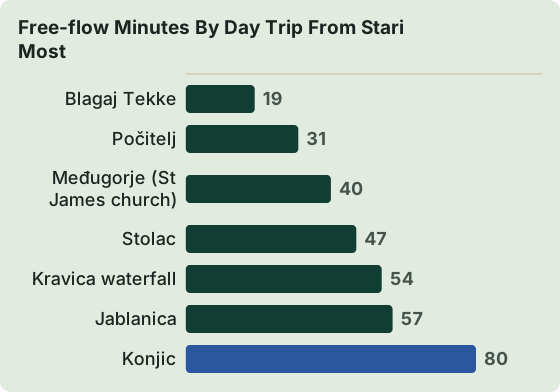
Yes, and winter changes them less than you might expect: Kravica waterfall stays open all year at 20 KM for an adult with hours of 07:00 to 17:00 from November to February, Blagaj is 13.7 km and about 19 minutes from Stari Most by road, and Počitelj is 30.0 km and about 31 minutes, so the core Herzegovina loop remains an easy day out even on short daylight.
The distances do not move with the seasons. What moves is the texture: Kravica's pool below the falls is for looking at in winter rather than swimming, since swimming is reported in the designated summer area, and the leafless landscape around Blagaj and Stolac opens views that summer greenery hides. The Blagaj Tekke at the Buna spring reports winter hours of 09:00 to 17:00 from November to March, with shoulders and knees covered and wraps provided at the entrance.
| Day trip from Stari Most | Road km | Free-flow minutes | Winter note |
|---|---|---|---|
| Blagaj Tekke | 13.7 | 19 | Tekke reported 09:00-17:00 Nov-Mar, 10 KM |
| Počitelj | 30.0 | 31 | Village free to walk; fortress open-air |
| Međugorje (St James church) | 28.3 | 40 | Sites free and open around the clock |
| Stolac | 36.8 | 47 | Radimlja necropolis 8 KM individual |
| Kravica waterfall | 55.2 | 54 | 20 KM adult, 07:00-17:00 Nov-Feb |
| Jablanica | 47.4 | 57 | Museum reported 08:00-16:00 Mon-Fri Nov-Mar |
| Konjic | 69.0 | 80 | ARK D-0 requires advance booking, closed Monday |
Organized day tours keep running through winter, and the lower demand can mean smaller groups. A full-day circuit taking in Blagaj, Počitelj and Kravica covers the three signature stops of Herzegovina in one move, with a vehicle between them that spares you standing at a cold bus stop. The Kravice, Blagaj and Počitelj in one day guide has the detail on the route itself.
If you would rather eat the winter than drive through it, a burek masterclass turns a cold afternoon into a warm room, a rolled dough and lunch. The burek guide explains what you are rolling, and the wider Bosnian food guide covers the rest of the winter table, from cevapi to slow stews.
How Do You Get To Mostar In Winter?
The two daily trains each way between Sarajevo and Čapljina via Mostar are running again after service resumed on 15 October 2026 following a fire-related suspension from about 8 September, with the Sarajevo departures at 07:15 and 16:46 and a journey of about two hours to Mostar. Mostar's own airport is 8.2 km and about 12 minutes from Stari Most, with reported routes to Zagreb and Stuttgart, and most winter visitors still arrive via Sarajevo or Dubrovnik airports.
The train is the winter option that rewards planning. The line follows the Neretva canyon for most of its length, and in winter, with the trees bare and the river high, the scenery through the gorge between Konjic and Mostar is at its most raw. Times below come from the operator's timetable; the fare of about 14 KM one way is a reported figure, so confirm at the ticket office.
| Train | Route | Departs | Arrives |
|---|---|---|---|
| 723 | Sarajevo to Čapljina via Mostar | 07:15 | Čapljina 09:40 |
| 721 | Sarajevo to Čapljina via Mostar | 16:46 | Čapljina 19:18 |
| 720 | Čapljina to Sarajevo via Mostar | 06:03 | Sarajevo 08:35 |
| 722 | Čapljina to Sarajevo via Mostar | 16:42 | Sarajevo 19:07 |
Road arrivals have their own winter logic. Bosnia and Herzegovina is not in the EU or Schengen, and the Croatian land border has carried full checks since 1 January 2023, so a winter drive from Dubrovnik, 145.5 km and about 150 minutes free-flow from Stari Most, needs passport time on top. Queues are reported up to about 30 minutes, typically shorter in winter than at summer peaks, but check live before you set off. The Dubrovnik to Mostar guide and the border crossing guide cover the paperwork, and the Sarajevo to Mostar guide compares train against bus.
What Should You Pack And How Should You Pay In Mostar In Winter?
Pack for rain and mild cold rather than deep frost: layers, waterproof shoes with grip for the worn bridge stones and wet cobbles, and a warm layer for evenings that average near freezing in January. Pay in convertible marks (KM), the official currency pegged at 1 EUR = 1.95583 KM; euro cash is often accepted in tourist areas at a rounded rate, so confirm before handing it over, and carry cash for small vendors.
The currency point catches out winter arrivals in particular, because stalls and small cafes dominate the cold-season bazaar. Cards work at hotels and larger restaurants, but the mark is what opens the small doors, and ATMs are easy to find around the Old Town. The Mostar money guide has the detail, including how the peg works and when paying in euros actually costs you.
Winter clothing arithmetic from the record: modelled January lows average 0.2 C (ERA5 reanalysis, 1991 to 2020) and the station's absolute January minimum is minus 10.9 C, so the realistic range is a few degrees either side of freezing at night and high single digits by day. That is London-in-January cold, not Sarajevo-in-January cold, and it means a good jacket, not expedition gear.
Two winter safety notes carry weight. Daylight is short, about 9 hours in December, so plan viewpoints and canyon drives for the middle of the day. And if you walk rural paths around Blagaj, Stolac or anywhere off-road in Herzegovina, stay on marked paths because of suspected mine areas; the same rule applies in every season, but winter grasses hide markers.
Where Should You Stay In Mostar In Winter?
Stay inside the Old Town or within a short walk of it: winter is the season when location matters most, because evenings are dark by early afternoon and the city's winter life concentrates around Kujundžiluk, the Braća Fejića street axis and the cafes between Spanish Square and the bridge. A reported tourist tax of 3 KM per person per night applies in the canton from 1 January 2026, so confirm it on your booking confirmation.
Winter rates are not printed here, because hotel prices shift week to week, but the structural advice holds: in December and January, a riverside room with heating and a view of Stari Most costs less grief than a distant suburb with a bus connection, since some local frequencies thin out outside the summer season. The where to stay in Mostar guide maps the districts, and the getting around Mostar guide covers the buses and taxis.
Eating well in winter is easy, because Bosnian food is built for it. Burek from the oven, slow-cooked dishes and Bosnian coffee turn a cold afternoon into an event, and the best restaurants in Mostar guide and the Bosnian coffee guide cover where the winter table is set. No names or claims are printed here beyond what those pages carry: pick by dish, not by ranking.
For the return leg, the practical links are all in place: how to get to Mostar for arrivals, Mostar airport if you fly into OMO, and Split to Mostar if your winter route runs down the Croatian coast first.
Winter does not close Mostar. It lowers the volume. The bridge stands free and open at every hour, the waterfall keeps its gates at 07:00 in the dark mornings, the train runs the canyon twice a day, and the tables inside the Old Town stay warm. For travelers who value stone and silence over sunshine, the cold half of the year is when this city on the Neretva shows itself plainly, and Mostar Travel Guide keeps the seasonal detail current across every page.
Common Questions About Mostar In Winter
Is Mostar worth visiting in winter?
Yes. The Old Bridge and the Old Bazaar are public and open at any hour, the FHMZ station record shows January averaging a mild 4.8 C, and Kravica waterfall stays open year-round. Expect rain rather than snow, and shorter opening hours at some indoor sights.
Does it snow in Mostar?
Sometimes. The FHMZ station record for 1961 to 1990 shows a maximum snow cover of 31 cm in January and 28 cm in February, but rain is far more common, with 11 rainy days above 1 mm in both January and December.
Is Kravica waterfall open in winter?
Yes. The park's visitor page lists year-round opening, with hours of 07:00 to 17:00 in January, February, November and December. The adult ticket is 20 KM all year, 10 KM for residents of Bosnia and Herzegovina, and children under 7 enter free.
How cold is the Neretva river in winter?
The Neretva is karst-fed and cold even in August; in winter it is cold enough that swimming is a summer activity only. Swimming at Kravica is reported in the designated summer area, so treat winter visits as viewing, not swimming.
Do trains run between Sarajevo and Mostar in winter?
Yes. Regular service resumed on 15 October 2026 after a suspension from about 8 September, with two trains a day each way between Sarajevo and Čapljina via Mostar. Departures from Sarajevo are at 07:15 and 16:46, and the trip takes about two hours.
What should I pack for Mostar in winter?
Layers, a waterproof jacket and shoes with grip for wet cobblestones and the worn stones of the Old Bridge. Modelled January highs average 8.4 C (ERA5 reanalysis, 1991 to 2020) with lows around freezing, and rain falls on roughly 11 days in each winter month.
