Dubrovnik To Mostar: Bus, Car Or Transfer
Dubrovnik to Mostar is one of the shortest cross-border journeys into Bosnia and Herzegovina: 145.5 km of road, one international border, and a UNESCO-listed old city at the end of it.
The road from Dubrovnik (Stradun) to Stari Most in Mostar is 145.5 km and about 2 hours 30 minutes of free-flow driving, plus time at the Croatia-Bosnia and Herzegovina border, where full passport checks apply. Several daily buses run the route in about 3 to 4 hours, and private transfers and day tours cover the border formalities for you.
Dubrovnik sits close to the border of Bosnia and Herzegovina, and Mostar, the inland city on the Neretva river, is the natural first stop once you cross it. The road distance from Dubrovnik's Stradun to Stari Most, the Old Bridge, is 145.5 km, computed as about 150 minutes of free-flow driving, and the route passes a Schengen external border with full passport checks since 1 January 2023. This page from Mostar Travel Guide sets out the drive, the crossings, the bus options and the organised alternatives, with the times and figures the route actually involves.
How Far Is Dubrovnik From Mostar, And How Long Does The Drive Take?
The road from Dubrovnik's Stradun to Stari Most in Mostar measures 145.5 km and takes about 2 hours 30 minutes of free-flow driving, before any waiting at the border. Bosnia and Herzegovina begins partway along that route, so the drive includes one international crossing with full passport checks. Counting a typical border wait, the door-to-door journey usually runs closer to three hours or more.
That 145.5 km figure is the road distance computed from Stradun to the Old Bridge, and the 150-minute figure is the free-flow drive time, with no queue included. Two factors stretch the real total. First, the border: the Croatia to Bosnia and Herzegovina line is a Schengen external border with full checks, and reported waits at the main crossings near Mostar run up to about 30 minutes, longer at summer peaks. Second, the route itself. There are two broad ways to drive it, and the choice of crossing changes the kilometre count and the character of the road.
The classic corridor runs along the Adriatic coast to the Neum passage, the short Bosnian coastline around the town of Neum, which is 75.3 km and about 82 minutes from Mostar by road. Driving this way means entering Bosnia and Herzegovina at Neum and re-entering Croatia a dozen kilometres later, so the journey carries two extra checkpoint stops. Since the Pelješac Bridge opened in 2022, traffic bound between Dubrovnik and points north can bypass Neum entirely and stay in Croatia, which matters more for Dubrovnik-Split journeys than for Dubrovnik-Mostar, but the bridge has eased queues at the Neum crossings and shifted traffic toward the inland routes to Mostar.
The second, and for Mostar the more useful, family of routes heads inland from the Dubrovnik area to the main crossings at Doljani-Metković or Bijača-Nova Sela, then follows the Neretva valley north through Čapljina toward Mostar. More detail on the crossings themselves sits further down this page, and the practicalities of the checks are covered in the dedicated guide to the Croatia-Bosnia border crossing.
| Route element | Road distance | Free-flow time |
|---|---|---|
| Dubrovnik (Stradun) to Stari Most, Mostar | 145.5 km | about 150 min |
| Dubrovnik airport to Stari Most | 163.4 km | about 172 min |
| Neum (BiH coast) to Stari Most | 75.3 km | about 82 min |
| Čapljina to Stari Most (via the valley road) | about 30 km with Počitelj at 30.0 km from Mostar | about 31 min to Počitelj |
| Opuzen (Neretva delta, Croatia) to Stari Most | 54.2 km | about 56 min |
The free-flow times exclude border queues by definition, so treat them as floor values rather than predictions. In July and August the checks at Doljani-Metković and Bijača-Nova Sela lengthen, and a crossing that takes minutes in April can take the better part of an hour in peak summer. Anyone connecting to a flight or a fixed check-in should plan on the longer end.
What Is The Best Way To Travel From Dubrovnik To Mostar?
For an independent traveller with a car, driving yourself via the Doljani-Metković or Bijača-Nova Sela crossing is the most direct option: 145.5 km, about 2 hours 30 minutes plus checks. Without a car, several daily buses run Dubrovnik to Mostar in about 3 to 4 hours. A private transfer or a small-group day tour covers the border, parking and navigation for you, at a higher price per person.
Each mode suits a different kind of trip. A rental car gives full control and makes it easy to add Počitelj, Blagaj or Kravica waterfall on the way, but a hire car crossing from Croatia into Bosnia and Herzegovina needs the rental company's advance permission and, usually, a Green Card insurance extension, and the contract should state cross-border use explicitly. Fuel, tolls and parking in Mostar's Old Town add their own planning, and the guidance on hiring and driving in the region is collected in the Mostar car rental guide.
The bus is the simple budget answer. Several daily services connect the two cities, with journey times reported in the 3 hour 15 minute to 4 hour range, border stops included in the schedule. Tickets are bought at the station or from the operators' own channels, and times shift with the season, so check the current timetable before locking in a day's plan. The bus delivers you to Mostar's bus station, a short, inexpensive taxi ride or a brisk walk from the Old Town.
An organised tour or private transfer is the third route, and for a one-day visit it removes almost all of the friction. The driver handles the crossing paperwork and the queue, the vehicle parks outside the Old Town, and a guide puts the Old Bridge, the war years and the bazaar into context. The most economical versions pool small groups, and the premium versions are private door-to-door runs. The trio below spans the range: a Dubrovnik departure with a small group cap, a Herzegovina circuit that starts once you are already in Mostar, and a private history walk for depth in the city itself.
Choosing between them comes down to how much of Herzegovina you want in one day. A tour that pairs Mostar with Kravica waterfall turns a city transfer into a full circuit of the region's two headline sights, and it pairs naturally with the Mostar day trip from Dubrovnik itinerary if you are building the day yourself.
One distinction worth fixing early: the two cities run on different currencies. Croatia uses the euro, while Bosnia and Herzegovina uses the convertible mark (KM, BAM), pegged at 1 EUR = 1.95583 KM. Euro cash is often accepted in Mostar's tourist areas at a rounded rate, but paying in KM is better value, and the details are laid out in the Mostar money guide.
Bus Or Private Transfer From Dubrovnik To Mostar?
The bus wins on price and simplicity: several daily departures, about 3 to 4 hours door to station, and no paperwork beyond a ticket. A private transfer wins on time and control: no waiting for scheduled stops, your choice of crossing and departure hour, and stops at Počitelj or Blagaj on the way. Groups of three or more often find the transfer arithmetic closes quickly.
The bus schedule concentrates around morning departures, which matters if you plan a day trip rather than an overnight stay. A same-day return by bus is tight: with roughly 3 to 4 hours each way plus border time, the time actually spent in Mostar shrinks to a few hours around midday. For an overnight visit the bus is comfortable and the evening return options give you the Old Bridge at dusk. Buy tickets in advance in July and August, when the route fills with coastal holiday traffic.
A private transfer, or a small-group tour bus, folds the crossing into the journey. The 145.5 km drive is the same either way, but a tour vehicle's schedule is built around the border's rhythm rather than against it, and the driver knows which crossing is moving on a given morning. For the small-group option, the related tour below is capped at eight travellers and bundles Kravica waterfall with the Mostar visit.
| Option | Approximate journey time | Border handling | Best for |
|---|---|---|---|
| Rental car | about 150 min free-flow plus checks | You drive and present documents | Independent multi-stop trips |
| Scheduled bus | about 3 h 15 min to 4 h | Passport carried, checks at stops | Solo travellers, tight budgets |
| Small-group tour | full-day itinerary | Handled by operator | First visits, day trips |
| Private transfer | about 150 min free-flow plus checks | Handled by driver | Families, fixed schedules |
Whichever way you travel, the border segment deserves a paragraph of its own, and it gets one below.
Crossing The Croatia-Bosnia Border Between Dubrovnik And Mostar?
The two main crossings on the Dubrovnik-Mostar axis are Doljani-Metković and Bijača-Nova Sela, both full-check Schengen external crossings since 1 January 2023. Reported waits run up to about 30 minutes in normal conditions and longer at summer peaks. Passports are checked in both directions, and the EU Entry/Exit System is reported operational since about April 2026, recording entries and exits biometrically.
Doljani-Metković sits at the inland end of the Neretva delta and is the natural crossing for the valley route to Mostar. Bijača-Nova Sela lies closer to the coastal corridor and carries traffic coming off the Dubrovnik side. Neither is avoidable if you are driving: pick one, check the live queue if your schedule is tight, and keep passports for every passenger within reach rather than buried in luggage. Rental-car paperwork, including the cross-border permission and the Green Card, should be in the glovebox, because a border officer can ask for both.
Since Croatia joined Schengen on 1 January 2023, the line between the two countries operates as a full external border. That is the single biggest planning fact on this route: the crossing is a genuine international checkpoint with systematic checks, not a formality. Bosnia and Herzegovina is neither in the EU nor in Schengen, and that status is not in doubt, so a valid travel document is required however short the visit. ETIAS is not in operation.
| Crossing | Position on the route | Typical reported wait |
|---|---|---|
| Doljani-Metković | Neretva valley, direct line to Mostar | up to about 30 min, longer in summer |
| Bijača-Nova Sela | coastal corridor side | up to about 30 min, longer in summer |
| Neum passages (Klek / Zaton Doli) | the Bosnian coast corridor | eased since the Pelješac Bridge opened in 2022 |
The Neum crossings still matter for one specific itinerary: if your day combines Mostar with the Bosnian coast at Neum, you will cross the border four times in a day. The Pelješac Bridge, opened in 2022, lets Dubrovnik traffic bypass Neum completely, which has shortened the pure Dubrovnik-Mostar drive for traffic that would otherwise have queued twice through the corridor.
Do You Need A Passport To Travel From Dubrovnik To Mostar?
Yes. A valid passport is the document to carry, because Bosnia and Herzegovina is outside the EU and Schengen and the Croatian land border has carried full checks since 1 January 2023. Visa-exempt nationals may stay up to 90 days within any six-month period from first entry. ETIAS is not in operation, so no travel authorisation application exists to make or show.
Identity cards work for some European nationals in practice, but the advice that removes all doubt is the passport: it is the one document every category of traveller can present at Doljani-Metković or Bijača-Nova Sela. The 90-day allowance covers a day trip many times over, and border officers occasionally ask about the purpose of a short visit, so a hotel booking or a return ticket is worth having accessible.
Two practical notes round this out. Children need their own documents, and the checks apply to every passenger, not just the driver. And if you are travelling on an organised tour, keep the passport on your person rather than in the coach hold, because at these crossings everyone alights or presents documents at the booth window. The same rules apply in reverse on the way back to Dubrovnik, and queues build in both directions on summer weekends.
Is A Day Trip From Dubrovnik To Mostar Worth It?
Yes, as a day trip Mostar works: the drive is 145.5 km each way, about 2 hours 30 minutes free-flow, which is long but viable with an early start. The Old Bridge Area of the Old City is compact, walkable and free to enter, the bridge itself is free to cross at any hour, and the headline sights sit within a few minutes' walk of one another. An overnight stay buys evening light on the Neretva and a slower pace.
The honest arithmetic: a day trip spends roughly five hours of the day on the road and border, leaving five to seven hours in and around the city. That is enough for the Old Bridge, the Kujundžiluk bazaar, a riverside lunch and one viewpoint, and it is enough for a guide-led walk that explains what the city's rebuilt buildings have been through. The bridge was destroyed on 9 November 1993 during the war and rebuilt and reopened in July 2004, and the Old Bridge Area was inscribed by UNESCO in 2005, so a couple of hours with a knowledgeable guide converts a photo stop into an understood place.
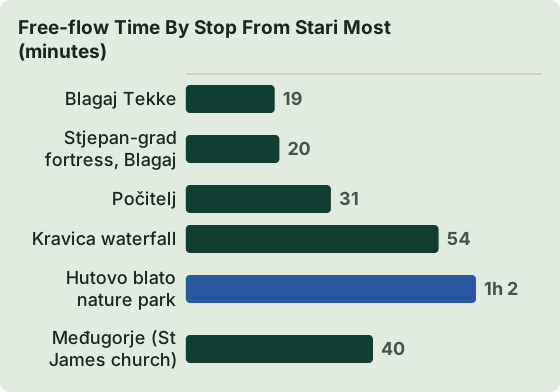
What a day trip cannot comfortably absorb is the Herzegovina hinterland. Blagaj Tekke at the Buna spring is 13.7 km and about 19 minutes from Stari Most; Počitelj is 30.0 km and about 31 minutes; Kravica waterfall is 55.2 km and about 54 minutes. Chaining those onto a Dubrovnik day trip makes the day enormous, which is exactly why the organised options exist: they run the chain on a tested schedule.
| Stop from Stari Most | Road distance | Free-flow time |
|---|---|---|
| Blagaj Tekke | 13.7 km | 19 min |
| Stjepan-grad fortress, Blagaj | 13.9 km | 20 min |
| Počitelj | 30.0 km | 31 min |
| Kravica waterfall | 55.2 km | 54 min |
| Hutovo blato nature park | 48.1 km | 62 min |
| Međugorje (St James church) | 28.3 km | 40 min |
For the timing of the whole venture, the climate matters more than the calendar. The FHMZ Mostar station table, 1961 to 1990, gives a July mean of 24.7 C against a January mean of 4.8 C, with an absolute maximum of 41.2 C recorded in July; the ERA5 reanalysis for 1991 to 2020 puts mean daily highs at 29.9 C in July and 30.5 C in August. Summer day trips should plan the outdoor hours for morning and early evening, and the fuller picture is in the best time to visit Mostar guide.
What To See In Mostar Once You Arrive?
Start at Stari Most itself: free to cross, open around the clock, and about 21 to 24 metres above the Neretva depending on the river level. Then work the Old Town, Kujundžiluk and the Crooked Bridge, all public and free, before climbing a minaret or tower for the view. Allow two to three hours for the core, half a day with a guide, a full day with Blagaj and Kravica added.
The Old Bridge is the anchor. Completed in 1566 under Suleiman the Magnificent and attributed to the architect Hajruddin, the single stone arch has a span of about 29 metres, and its height above the green water shifts with the river. Members of the Mostari diving club jump from it through the warmer months, and the tradition peaks with the annual competition, whose 460th edition ran on 26 July 2026. Visitors do not jump: the leapers are trained club members, and no visitor jump is on offer. The story is told properly in the Mostar bridge diving guide.
Around the bridge spreads the Old Town. Kujundžiluk, the cobbled bazaar street, runs along the Neretva with coppersmiths' shops; Kriva ćuprija, the Crooked Bridge, is a small single-arched crossing a short walk upstream; Koski Mehmed-pašina džamija sits by the river with a reported small cash fee for the mosque and a higher combined fee including the minaret climb. The Old Bridge Museum in the Tara tower is reported at 10 KM, and the Ottoman houses, Bišćević House and Muslibegović House, are reported at about 4 KM and 8 KM respectively, figures worth confirming on arrival.
Two further stops give the day depth. The Partisan Memorial Cemetery, designed by Bogdan Bogdanović and inaugurated in 1965, is a national monument in a neglected state, with no ticket and no staffed hours, and over 700 of its stone markers were destroyed in 2022. And the Museum of the Holy Trinity Orthodox Cathedral opened in May 2025, one of the city's newest institutions. The wider list of sights, hours and viewpoints is collected in the things to do in Mostar page, and the darker chapters of the city's past are covered in the Mostar war history guide.
A guided walk ties it together quickly. The small-group Old Town tour below is the economical option, and the Kravica half-day trip below that suits anyone spending a second day in the city.
If the waterfall calls, the numbers are friendly: Kravica charges 20 KM for an adult all year, 10 KM for residents of Bosnia and Herzegovina, and children under 7 enter free. The park is open every month of the year, with hours from 07:00 to 22:00 between June and September, and swimming is allowed in summer in the designated pool below the falls, with no lifeguard reported, so check the park's rules on arrival. The half-day option.
Should You Stay The Night In Mostar?
Staying overnight is worth it if you can: the evening Old Town empties of day traffic, the bridge is floodlit, and the morning light on the Neretva is the city's best. Practical costs run low by Croatian coastal standards, and a night unlocks Blagaj, Počitelj and Kravica at your own pace the next day before the drive back to Dubrovnik.
The case against the day trip is the case for the night: schedule freedom. With a night in the city you can take the 19-minute drive to Blagaj Tekke, reported at 10 KM entry with opening hours of 08:00 to 22:00 from April to October, and pair it with Počitelj's fortified streets before the crowds arrive. Where to base yourself is covered in detail in the where to stay in Mostar guide, which maps the Old Town, the west side and Donja Mahala neighbourhood by neighbourhood.
Practicalities for the overnight stay are simple. The currency is the mark, pegged at 1 EUR = 1.95583 KM, and cash serves small vendors better than cards. The reported 3 KM per person per night tourist tax is normally collected through the accommodation. Plugs are type C and F at 230 V, tap water is treated and generally safe, and the emergency number is 112. In rural Herzegovina, stay on marked paths because of suspected mine areas, a standing warning maintained by BHMAC.
For travellers stitching a wider route through the region, Mostar is the natural hub: Sarajevo is 127.1 km away, Trebinje 116.5 km, and Kotor beyond it, all mapped in the Balkans itinerary and the Mostar to Kotor guide.
Common Questions About Traveling From Dubrovnik To Mostar
How long does the Dubrovnik to Mostar drive take?
The road distance from Dubrovnik's Stradun to Stari Most is 145.5 km, about 150 minutes of free-flow driving. Add the border check, reported at up to about 30 minutes and longer in summer, for a realistic door-to-door total of around three hours.
Do I need a passport to go from Dubrovnik to Mostar?
Yes. Bosnia and Herzegovina is outside the EU and Schengen, and the Croatian land border has carried full checks since 1 January 2023. A valid passport is the safe document for every traveller.
Is there a bus from Dubrovnik to Mostar?
Several daily buses connect the two cities, with reported journey times of about 3 hours 15 minutes to 4 hours including border stops. Check the current timetable before travel, as departures shift with the season.
Is Mostar a day trip from Dubrovnik?
Yes. The each-way drive is about 2 hours 30 minutes free-flow plus the border, so an early start gives you five to seven hours in the city. Overnight visitors get the quiet evening Old Town and time for Blagaj, Počitelj or Kravica waterfall.
Which border crossing should I use between Dubrovnik and Mostar?
Doljani-Metković serves the Neretva valley route to Mostar, and Bijača-Nova Sela serves the coastal side. Both report waits of up to about 30 minutes, longer at summer peaks. The Neum corridor crossings are an option but involve crossing the border twice.
What currency does Mostar use?
The convertible mark (KM, BAM), pegged at 1 EUR = 1.95583 KM. Euros are often accepted in tourist areas at a rounded rate, but paying in KM is the better value.