Crossing From Croatia Into Bosnia: Passports, Border Posts And Car Papers
Bosnia and Herzegovina is outside the EU and Schengen, so the crossing from Croatia into Mostar is a real international border with passport checks. Here is what the rules say, which posts serve Mostar, and what a rental car needs at the line.
You need a valid passport (or national ID if your country has an agreement), Bosnia and Herzegovina is not in the EU or Schengen, and the Croatian land border has carried full checks since 1 January 2023. The main posts near Mostar are Doljani-Metković and Bijača-Nova Sela, with waits of up to about 30 minutes and longer at summer peaks.
Mostar sits inland on the Neretva river in Herzegovina, and every road from the Croatian coast into the city crosses an international frontier: Bosnia and Herzegovina is in neither the EU nor the Schengen area, so the Croatian land border has carried full checks since 1 January 2023. That single fact shapes the whole journey from Dubrovnik, Split or Makarska. The crossing itself is routine, but the rules around passports, rental car papers and the currency on the far side catch travellers out, and this guide walks through each of them for the road into Mostar.
The two border posts that matter for Mostar are Doljani-Metković, on the main route up the Neretva valley from the coast, and Bijača-Nova Sela, on the road toward Dubrovnik. Waits are typically short, reported at up to about 30 minutes, with longer queues at summer peaks. There is no electronic lane for foreign visitors and no fee to cross. Everything else, passports, car papers, money and timing, is set out below, and the Mostar Travel Guide border, money and route pages cover each piece in more depth.
Do You Need A Passport To Cross From Croatia Into Mostar?
Yes, a valid passport is the standard document for crossing from Croatia into Bosnia and Herzegovina on the way to Mostar, because Croatia is in the EU and Schengen while Bosnia and Herzegovina is in neither, so the line between them is a Schengen external border with full checks since 1 January 2023. ETIAS is not in operation, so no travel authorisation application is collected at any stage.
Croatia joined the Schengen area with full land and sea border checks applying from 1 January 2023, which means the Bosnian frontier is now treated like the outer edge of the Schengen zone. Passports are checked in both directions. Some nationalities can enter Bosnia and Herzegovina with a national identity card under bilateral agreements, but the safe assumption for anyone flying into Croatia from outside Europe is to carry a passport, and to check the rule for your own citizenship before travelling.
Two further points matter for timing. First, the EU Entry/Exit System, which records entries and exits biometrically, is reported operational since about April 2026, so the exit stamp era on the Croatian side is ending and processing can take a moment longer per car. Second, visa-exempt visitors may stay in Bosnia and Herzegovina for up to 90 days within a six-month period from the date of first entry, which is generous for any itinerary built around Mostar and Herzegovina.
| Document | Needed To Cross? | Notes |
|---|---|---|
| Valid passport | Yes, standard document | Full checks apply in both directions since 1 January 2023 |
| National ID card | Only for nationalities with an agreement | Check your own country's rule before travel |
| ETIAS authorisation | No | Not in operation |
| Visa | No for visa-exempt nationalities | Stay up to 90 days in any six-month period |
| Green Card insurance | Yes for drivers | See the car papers section below |
Children need their own travel documents; a child cannot be added to a parent's passport for this crossing. Groups in a vehicle may be asked for documents from every passenger, so keep passports reachable rather than buried in the boot.
Which Border Posts Serve Mostar, And How Long Do The Queues Take?
The two main crossings on the road between Croatia and Mostar are Doljani-Metković, reached via the Neretva valley town of Metković, and Bijača-Nova Sela, on the route toward Dubrovnik, with waits reported at up to about 30 minutes per crossing and longer at summer peaks. Both are open to cars and buses, and neither charges a fee.
Doljani-Metković is the natural post if you are coming up the Neretva valley from the direction of Opuzen or the delta, and it feeds directly onto the road to Mostar, 54.2 km and about 56 minutes free-flow from Opuzen. Bijača-Nova Sela sits on the coastal route from Dubrovnik and is the post used by the many organised day trips that run from Dubrovnik to Mostar each week. Queue lengths move with the season: a crossing that takes minutes in October can take an hour or more on a Saturday in July, so the reported figure of up to about 30 minutes is a planning midpoint, not a promise.
The Pelješac Bridge, opened in 2022, changed the geometry of this border for Dubrovnik traffic. It lets vehicles drive from Split down to Dubrovnik entirely within Croatia, bypassing the Neum corridor, the short Bosnian coast around Neum town. That means a Split to Dubrovnik driver no longer crosses into Bosnia and Herzegovina twice unless they choose the older inland route through Neum. For a trip whose destination is Mostar, the bridge is irrelevant: you are entering Bosnia and Herzegovina on purpose, at Doljani-Metković or Bijača-Nova Sela, and staying there.
| Crossing | Serves Traffic From | Typical Wait |
|---|---|---|
| Doljani-Metković | Neretva delta, Opuzen, Split direction via the valley | Up to about 30 minutes, longer at summer peaks |
| Bijača-Nova Sela | Dubrovnik and the coast road | Up to about 30 minutes, longer at summer peaks |
| Klek / Neum corridor | Coastal transit traffic via Neum | Variable; bypassed by the Pelješac Bridge since 2022 |
One practical note: crossing early morning or late afternoon, and avoiding weekend peaks in July and August, is the reliable way to keep the queue short. If a day trip from the coast is the plan, a tour that handles the border is often the calmer option.
A guided departure from Dubrovnik covers the crossing, the driving and the parking in one booking, and the operator's live listing carries the current price, rating and departure details. Independent drivers should read on, because the car papers are where the border gets personal.
What Papers Does A Rental Car Need To Enter Bosnia And Herzegovina?
A rental car crossing from Croatia into Bosnia and Herzegovina for Mostar needs the vehicle registration document or its copy, the rental agreement showing you are authorised to drive, and proof of insurance valid in Bosnia and Herzegovina, which for EU-plated cars is normally the Green Card; written permission from the rental company to take the car across the border is required in advance, so arrange it when you book.
The permission point is the one that strands people. Not every fleet is licensed to leave Croatia, and companies that do allow it usually note the cross-border authorisation on the contract or issue a letter. Ask before you pay, and carry that paperwork to the booth. Insurance is the second check: a Green Card proving third-party cover in Bosnia and Herzegovina is the standard document, and EU-registered vehicles are generally recognised, but confirm in the rental contract that the card covers the country. Some companies issue it free and some charge a fee, so the price belongs to your rental agreement, not to this page.
Beyond the border, driving in Herzegovina is straightforward on the main roads, and the Mostar car rental guide covers picking up a car on the Bosnian side instead, which removes the cross-border question entirely. Fuel is sold in convertible marks, not euro, and motorway tolls on the Croatian side are paid in euro or by card, so keep both currencies reachable on a crossing day. The general Bosnia and Herzegovina travel tips page collects the rest of the small rules, from plugs to emergency numbers.
| Paper | Who Provides It | When You Need It |
|---|---|---|
| Rental contract with cross-border permission | Rental company | Arrange at booking, carry at the booth |
| Vehicle registration (V5 copy or fleet doc) | Rental company | At the booth on request |
| Green Card insurance | Rental company or your insurer | At the booth on request |
| Driving licence | You | Always |
| Passport | You | Always, both directions |
One warning that applies to rural Herzegovina rather than the border itself: suspected mine areas remain in the countryside, so stay on marked roads and paths, as the BHMAC suspected-area guidance advises.
If the paperwork feels heavier than the holiday, the alternative is simple: cross as a passenger. Coach tours from Dubrovnik and Split run the border daily, and the border formalities for a bus passenger amount to handing over a passport when asked.
Can You Drive From Dubrovnik Or Split To Mostar In A Day?
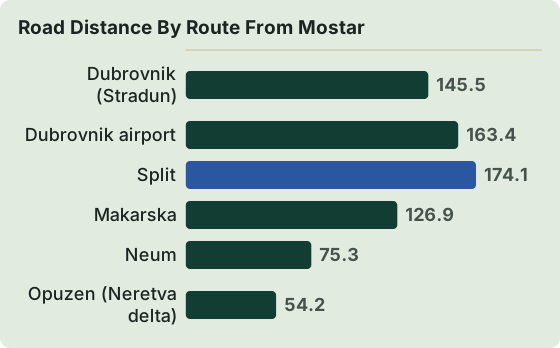
Yes: Dubrovnik's old town is 145.5 km and about 150 minutes of free-flow driving from Stari Most in Mostar, and Split is 174.1 km and about 131 minutes, both before any border queue, so a there-and-back day trip from either city is a long but workable day with a crossing wait of up to about 30 minutes each way at Doljani-Metković or Bijača-Nova Sela.
Those times are road-only, computed free-flow, and they exclude the border. Add the queue, a rest stop and parking in Mostar, and a Dubrovnik day trip is realistically a full day's outing, which is exactly why the organised tours from the coast run to 11 or 12 hours door to door. The route from Dubrovnik runs up the coast to the Bijača-Nova Sela post, then inland through Čapljina toward Mostar; the Split route follows the coast road or the motorway to the Neretva delta and up the valley through Metković and Doljani.
For drivers who want the detail of each route, including the Neum corridor question and where to stop, the Dubrovnik to Mostar and Split to Mostar guides break both corridors down stop by stop. The essential planning frame is the table below: distances and free-flow times from Stari Most, border queues excluded.
| Route From Mostar | Road Distance | Free-Flow Time |
|---|---|---|
| Dubrovnik (Stradun) | 145.5 km | about 150 minutes |
| Dubrovnik airport | 163.4 km | about 172 minutes |
| Split | 174.1 km | about 131 minutes |
| Makarska | 126.9 km | about 105 minutes |
| Neum | 75.3 km | about 82 minutes |
| Opuzen (Neretva delta) | 54.2 km | about 56 minutes |
A middle option is to split the trip: drive the border in the morning, spend the day between Počitelj, Blagaj and Mostar, and return after the evening queue has died down. Počitelj is 30.0 km and about 31 minutes from Stari Most, and the Blagaj Tekke is 13.7 km and about 19 minutes, so the Herzegovina cluster compresses neatly once you are across the line.
Do You Need A Visa Or ETIAS To Visit Mostar From Croatia?
No visa and no ETIAS are needed for visa-exempt nationalities crossing from Croatia into Bosnia and Herzegovina: ETIAS is not in operation, and visa-exempt visitors may stay up to 90 days within a six-month period from the date of first entry, a rule stated by the country's Service for Foreigners' Affairs. The border itself applies full passport checks because the line is a Schengen external border.
The distinction that trips people up is that Croatia is inside the EU and Schengen and Bosnia and Herzegovina is inside neither. A Schengen admission does not carry you across: your entry to Bosnia and Herzegovina is counted separately, and your exit back into Croatia is another check. Travellers on visa-free lists, which include EU, UK, US, Canadian and Australian citizens, simply get a stamp-free or EES-recorded entry and up to 90 days. Anyone outside those lists needs to check the visa rule for their nationality before travel, because the border post grants nothing on goodwill.
For stays in Mostar itself, one further reported figure belongs in the budget: a tourist tax in the Herzegovina-Neretva Canton is reported at 3 KM per person per night from 1 January 2026, normally collected through accommodation. Treat the figure as reported and confirm it at booking, since collection practice varies by property.
What Changes After The Border: Money, Rules And The Road To Mostar?
The currency changes at the line: Bosnia and Herzegovina uses the convertible mark (KM, BAM), pegged at 1 EUR = 1.95583 KM, not the euro, and while euro cash is often accepted in Mostar's tourist areas at a rounded rate, paying in KM is the accurate way to shop, with cards accepted at hotels and larger venues and cash preferred at small vendors.
The peg is exact, so there is no float to worry about: one euro is always 1.95583 KM under the currency board. The catch is the rounding. Vendors who take euro cash commonly round at 2 KM to the euro, which is close but not equal to the peg, and on small purchases the difference lands with the seller. Withdraw marks from a bank machine in Mostar, choose to be charged in KM, and the arithmetic takes care of itself. The Mostar money guide covers cards, machines and the peg in full.
| What Changes | Croatia Side | Bosnia And Herzegovina Side |
|---|---|---|
| Currency | Euro (EUR) | Convertible mark (KM, BAM), pegged 1 EUR = 1.95583 KM |
| Currency block | EU and Schengen | Neither EU nor Schengen |
| Border checks | Full checks since 1 January 2023 | Full checks, both directions |
| Fuel and tolls paid in | Euro or card | KM, cash widely used |
| Language | Croatian | Bosnian, Croatian and Serbian |
The road after Doljani-Metković follows the Neretva valley north to Mostar, and the drive is part of the reward. The same valley holds Počitelj, Blagaj and, further afield, Kravica waterfall at 55.2 km and about 54 minutes from Stari Most, where entry is 20 KM for an adult all year, 10 KM for residents of Bosnia and Herzegovina, and free for children under 7, with summer hours from 07:00 to 22:00. A day tour that strings Blagaj, Počitelj and Kravica together from Mostar is one way to see the valley without driving it yourself; the Herzegovina day tour from Mostar covers exactly that circuit, and Check availability for the current price and dates.
Back in the city, the practical differences are small. Tipping is appreciated and not compulsory, round up or add about ten percent at restaurants. Plugs are type C and F at 230 V. The emergency number is 112, with 122 for police, 123 for fire and 124 for ambulance.
Is The Border Different If You Arrive By Bus, Train Or Plane?
Bus passengers cross the Croatia to Bosnia and Herzegovina border with just a passport, handing it over at the booth while the vehicle waits, and several daily coaches run from Dubrovnik and Split to Mostar; the train does not cross this border at all, since the rail line into Mostar comes from Sarajevo, where passenger service resumed on 15 October 2026 after a suspension that began on 8 September 2026.
The bus is the simplest crossing of all: no car papers, no Green Card, no rental permission, just a passport and a booked seat. Coaches from Dubrovnik and Split reach Mostar bus station daily, and the border adds only the time the queue takes. By train, the geography is different, because the standard gauge line to Mostar runs up the Neretva from the south but regular passenger service today operates between Sarajevo and Čapljina via Mostar, two trains a day each way, taking about two hours from Sarajevo to Mostar. That service resumed on 15 October 2026 after a fire along the corridor suspended it in early September 2026.
Flying is a third answer. Mostar International Airport is 8.2 km and about 12 minutes by road from Stari Most, with reported routes to Zagreb and Stuttgart, the latter kept year-round into the 2026/27 winter schedule. The route list is small, so plenty of visitors instead fly into Sarajevo or Dubrovnik and cross the border by road or rail; the how to get to Mostar page compares every option, and the Sarajevo to Mostar guide covers the train in detail.
| Arrival Mode | Border Formality | Notes |
|---|---|---|
| Bus from Dubrovnik or Split | Passport check at the booth | Several daily coaches; no car papers |
| Train from Sarajevo | No Croatia border involved | Two trains a day each way, resumed 15 October 2026 |
| Car from Croatia | Full checks plus car papers | Doljani-Metković or Bijača-Nova Sela |
| Flight into Mostar (OMO) | Airport entry control | Zagreb and Stuttgart routes reported |
For anyone planning the whole circuit, coast to Mostar and back, the timing rule is the only one that matters: cross outside peak hours, carry marks for the Bosnian side, and keep the passport on your lap rather than in the suitcase.
Once across and parked, a private walking tour of the Old Town is a good first hour in the city, orienting you around Stari Most, Kujundžiluk and the Ottoman houses before you head back over the border.
Common Questions About The Croatia Bosnia Border Crossing
Do you need a passport to cross from Croatia into Bosnia and Herzegovina?
Yes, a valid passport is the standard document, because the line is a Schengen external border with full checks since 1 January 2023. Some nationalities may use a national ID card under an agreement, but check your own country's rule before travelling.
Is there a fee to cross the Croatia Bosnia border?
No, the crossing itself is free for cars, buses and pedestrians. Costs only arise from your own arrangements, such as a rental company's cross-border paperwork or a Green Card fee written into the rental contract.
How long does the border crossing to Mostar take?
Waits are reported at up to about 30 minutes per crossing at Doljani-Metković and Bijača-Nova Sela, with longer queues at summer peaks. Crossing early morning or late afternoon, and avoiding July and August weekends, keeps the wait short.
Can you pay in euro in Mostar after crossing?
The currency is the convertible mark (KM), pegged at 1 EUR = 1.95583 KM. Euro cash is often accepted in tourist areas, usually at a rounded rate of 2 KM to the euro, so confirm the rate and expect to use KM and cards for accuracy.
Is Bosnia and Herzegovina in the EU or Schengen?
It is in neither. Croatia is in both, which is why the land border carries full checks and why the crossing works like entering the wider Schengen neighbourhood rather than driving between two EU states.
Can tourists cross at Neum instead?
The Neum corridor crossings exist, but the Pelješac Bridge, opened in 2022, lets coast traffic bypass Neum entirely within Croatia. For a trip to Mostar the relevant posts are Doljani-Metković and Bijača-Nova Sela, since you are entering Bosnia and Herzegovina deliberately.