How To Get To Mostar: Airports, Trains And Buses
Mostar sits inland on the Neretva river in Herzegovina, and every arrival route runs through either a small local airport, a two-hour train line from Sarajevo, or a cross-border road from Croatia. Here is how each option works in practice.
Fly into Sarajevo or Dubrovnik for the widest route lists, take the two-trains-a-day line from Sarajevo, or ride a bus from Dubrovnik or Split in three to four hours. Mostar's own airport is 8.2 km from the Old Bridge but serves only a few routes.
Mostar is an inland city on the Neretva river in Herzegovina, the southern region of Bosnia and Herzegovina, and there is no sea coast and no high-speed rail link that whisks you in from a capital. What there is instead is a surprisingly workable spread of options: a small airport of its own eight kilometres from the Old Bridge, a twice-daily train down the Neretva valley from Sarajevo, long-distance buses from three countries, and a road network that hooks the city to Dubrovnik in about two and a half hours of free-flow driving plus border time. The right choice depends on where your trip starts and how much of Herzegovina you want to see on the way, and this guide walks through each route with the real numbers attached. Once you have the arrival sorted, the things to see around the Old Bridge are all within walking distance of the bus and train stations' side of town.
What Are The Main Ways To Get To Mostar?
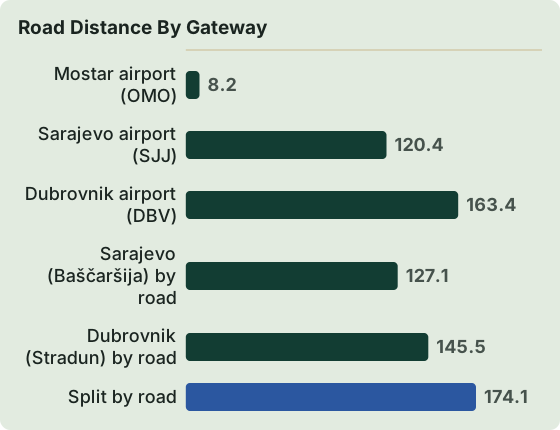
You can reach Mostar by air through three airports, by train from Sarajevo, by long-distance bus from Croatia and within Bosnia and Herzegovina, or by car over the border crossings at Doljani-Metković or Bijača-Nova Sela. Sarajevo airport is about 120 km and 2 hours 5 minutes away by road, Dubrovnik airport about 163 km and 2 hours 52 minutes free-flow, and Mostar's own airport just 8.2 km and about 12 minutes from Stari Most.
Those four figures frame every decision, because they are computed free-flow road times that exclude border queues, and the Dubrovnik route always crosses a border. Bosnia and Herzegovina is not in the European Union and not in Schengen, so every arrival from Croatia passes a passport check, which matters when you compare the train from Sarajevo (no border) with a bus from Split (one border). The train line down the Neretva valley is scenic enough that some travellers build a whole day around it, and buses run frequently enough that a car is a convenience rather than a requirement for the city itself.
A quick comparison of the gateways, with road figures from Stari Most:
| Gateway | Road distance | Free-flow time | Notes |
|---|---|---|---|
| Mostar airport (OMO) | 8.2 km | about 12 min | Small route list, within the city |
| Sarajevo airport (SJJ) | 120.4 km | about 125 min | No border on the way |
| Dubrovnik airport (DBV) | 163.4 km | about 172 min | Border crossing, add queue time |
| Sarajevo (Baščaršija) by road | 127.1 km | about 134 min | Train and bus alternatives |
| Dubrovnik (Stradun) by road | 145.5 km | about 150 min | Border crossing, add queue time |
| Split by road | 174.1 km | about 131 min | Border crossing, add queue time |
The distances are one thing; the rhythm of arrival is another. The train from Sarajevo and the buses from Croatia all deposit you within a short, inexpensive taxi ride of the Old Town, and once you are there the city is compact. For everything on foot after arrival, the getting around Mostar guide covers the local buses and the walkability of the centre.
Which Airport Should You Fly Into For Mostar?
Sarajevo airport is the practical choice for the widest route list and a border-free two-hour transfer, while Dubrovnik airport suits anyone combining Herzegovina with the Croatian coast, and Mostar's own airport (OMO) works only if its thin schedule matches your itinerary, with reported routes to Zagreb and Stuttgart. Mostar airport is 8.2 km and about 12 minutes by road from Stari Most, closer than any other airport in the region.
Mostar airport's route list is small. Reported connections are Croatia Airlines to Zagreb and Eurowings to Stuttgart, plus a seasonal Düsseldorf link, and the Stuttgart service has been reported as extended through the winter schedule. That means a convenient arrival if you can route through those cities, but connecting through Zagreb or Stuttgart from a long-haul origin often costs more time than landing in Sarajevo and taking the train or bus south. The dedicated Mostar airport guide goes deeper on the transfer options from the terminal into town.
Sarajevo airport, about 120 km away, is where the main arrivals funnel through, followed by Dubrovnik for coastal combinations. From either, the onward leg is a bus, a train (Sarajevo only) or a pre-booked transfer, and the airport pages for Sarajevo to Mostar and Dubrovnik to Mostar break down each leg. Whichever airport you choose, an arrival-day walking tour is an efficient way to orient yourself, and the Death of Yugoslavia walking tour is a strong first-evening option that explains the Yugoslavia-era background behind much of what you will see, bookable with free cancellation.
How Do You Get From Sarajevo To Mostar Without A Car?
You have three real options: the train, which runs twice a day each way between Sarajevo and Čapljina via Mostar per the official timetable, the bus, which takes about 2 hours 20 minutes to 2 hours 40 minutes, or a pre-booked private transfer by road in about two hours. The train follows the Neretva valley the whole way and is the route with scenery attached.
The train is the one worth planning around. The official ZFBH timetable lists two departures a day in each direction, Sarajevo to Čapljina via Mostar, with the Sarajevo-Mostar leg reported at around two hours. One practical note for anyone reading older guides: the service was suspended from about 8 September 2026 after a fire along the corridor and regular service resumed on 15 October 2026, so treat the schedule as something to confirm with the operator before you commit. Times and days change seasonally, and weekend extensions toward the Croatian border at Ploče are seasonal rather than year-round.
| Sarajevo to Mostar option | Typical time | Frequency | Notes |
|---|---|---|---|
| Train (ZFBH) | about 2 h | 2 per day each way | Neretva valley scenery; check operator for current days |
| Bus (Autoprevoz and others) | about 2 h 20 to 2 h 40 | several daily | Station-to-station, no border |
| Private transfer by road | about 2 h 05 free-flow | on demand | Road figure excludes traffic |
| Self-drive hire car | about 2 h 05 free-flow | any time | Corridor Vc motorway works near Mostar can add delays |
The bus is the flexible fallback, with several departures a day and no reservation gymnastics. Whatever you choose, arriving from Sarajevo means no border check at any point, since the whole route stays inside Bosnia and Herzegovina. Once you arrive, if your legs are stiff from the journey, a short, inexpensive taxi ride covers the distance from the stations to the Old Town, or you can walk it in well under half an hour.
Can You Get To Mostar By Train From Anywhere Else?
No. The railway that serves Mostar runs between Sarajevo and Čapljina, with seasonal weekend extensions toward Ploče just across the Croatian border, and there is no other passenger line into the city. Arrivals from Zagreb, Split or Dubrovnik by rail require changing to a bus or a car for the final stretch, because no train connects the Croatian coast to Mostar.
That single-line reality surprises people who assume Balkan rail networks interconnect. The Mostar line is a valley route, following the Neretva through Jablanica and Konjic, and it is genuinely one of the more scenic rides in the region, but it is a branch, not a corridor. Two trains a day each way is the entire passenger service on the route, so a missed departure is a long wait. The line's recent history also shows why schedules deserve a check before travel: the September-to-October 2026 suspension after the corridor fire was resolved with the 15 October 2026 resumption, but the episode is a reminder that a single-track line can go quiet for stretches.
For anyone starting in Croatia, the practical pattern is bus or car the whole way. There is no rail answer from Split or Dubrovnik, and the Croatian side of the border offers nothing that connects through. The Split to Mostar guide covers that road and bus corridor in detail, including the border crossings you will pass.
Can You Get To Mostar From Dubrovnik Or Split By Bus?
Yes, several daily buses run from Dubrovnik to Mostar in about 3 hours 15 minutes to 4 hours, and several more run from Split, making the bus the standard cross-border arrival from the Croatian coast. Every one of these crossings passes the Bosnia and Herzegovina-Croatia border with full passport checks, because the border is a Schengen external frontier since 1 January 2023.
That border detail is the thing to plan around. Typical waits at the main crossings near Mostar, Doljani-Metković and Bijača-Nova Sela, run up to about 30 minutes, and longer at summer peaks, so the bus times you see quoted are minimums in July and August. Buses from Dubrovnik and Split handle the crossing at dedicated coach lanes, which is usually quicker than a private car queue at the height of summer, and drivers build a border stop into the schedule. The rest of the planning pages sit on Mostar Travel Guide.
| Route | Typical time | Frequency | Border |
|---|---|---|---|
| Dubrovnik to Mostar (bus) | about 3 h 15 min to 4 h | several daily | Yes, full checks |
| Split to Mostar (bus) | about 4 to 5 h | several daily, more on weekends | Yes, full checks |
| Sarajevo to Mostar (bus) | about 2 h 20 to 2 h 40 | several daily | No |
| Dubrovnik to Mostar (car) | about 150 min free-flow | any time | Yes, add queue time |
Drivers have one decision buses do not: routing. The Pelješac Bridge, opened in 2022, lets Dubrovnik-bound traffic bypass the Neum corridor entirely and stay inside Croatia for longer, while the older route transits Bosnia and Herzegovina briefly at Neum with two extra checkpoint stops. The croatia-bosnia border crossing guide compares the crossings, and note that Bosnia and Herzegovina is not in the EU: ETIAS is not in operation, but your passport and, if driving a rental, the rental company's cross-border permission are both required.
Should You Drive To Mostar, And Where Do You Park?
Driving to Mostar is straightforward and gives you the whole of Herzegovina at your own pace, with Dubrovnik about 150 minutes and Split about 131 minutes of free-flow road time away, but the Old Town itself is a pedestrian zone best reached on foot after you park. The main motorway corridor near the city has ongoing works, including a rerouted Mostar North to Mostar South section and a south bypass under construction, so allow extra minutes on approach roads.
Those works, reported through 2026, are the one recurring annoyance for drivers: the Corridor Vc motorway section through the Mostar area has been rerouted toward a new tunnel, and the southern bypass is under active construction with blasting notices from the city. None of it blocks access; all of it can slow the last twenty kilometres. Inside the city, parking near the Old Town is limited, so the practical pattern is to park a little out from Kujundžiluk and walk in. Rental cars can be picked up at Sarajevo or Dubrovnik airports as well as in Mostar itself, and the Mostar car rental guide covers the cross-border paperwork, which you must arrange with the company in advance.
Driving also unlocks the day trips that define a Herzegovina stay: Blagaj and its tekke at the Buna spring is 13.7 km away, Počitelj 30 km, and Kravica waterfall 55.2 km. Those figures are free-flow and border-free, all inside the country. A warning that belongs in any Herzegovina driving paragraph: stay on marked paths and roads in rural areas, because suspected mine areas from the war remain mapped by BHMAC, and venturing off-track in the countryside is a real risk, not a formality.
| Day trip from Stari Most | Road km | Free-flow time |
|---|---|---|
| Blagaj Tekke | 13.7 | about 19 min |
| Stjepan-grad fortress | 13.9 | about 20 min |
| Međugorje (St James church) | 28.3 | about 40 min |
| Počitelj | 30.0 | about 31 min |
| Kravica waterfall | 55.2 | about 54 min |
| Hutovo blato | 48.1 | about 62 min |
If you would rather leave the mountain roads to someone who drives them weekly, the Blagaj, Počitelj and Kravice day tour from Mostar covers the three signature Herzegovina stops in one loop, or check live availability below.
How Do You Get Around Mostar Once You Arrive?
On foot, almost entirely. The Old Bridge, Kujundžiluk bazaar, the Crooked Bridge and both banks of the Neretva form a walkable core, with Mostar's city buses covering the suburbs, the airport route and lines toward Blagaj, and taxis cheap and plentiful for the short hops a bus does not serve. You do not need a car inside the city, and most people who bring one leave it parked after arrival.
The bus and train stations sit a short, inexpensive taxi ride from the Old Town, and the walk, if your bags allow it, crosses the Boulevard and drops you into the old core within twenty minutes. Local city buses run suburban lines on published timetables, useful mainly for the airport and for outlying accommodation rather than for sightseeing, since everything between the Spanish Square and the bridge is pedestrian-scale. Taxis in the city use meters, and a ride across the centre costs a few convertible marks; the currency here is the KM, pegged at 1 EUR = 1.95583 KM, and card acceptance is common in hotels and larger venues while small vendors want cash, details the Mostar money guide covers.
One orientation idea that saves time: the city's layout compresses 500 years of history into a triangle you can cross in fifteen minutes, from the Spanish Square down to Stari Most and along Kujundžiluk. A guided walk on your first day maps it fast, and if you have worked up an appetite after travel, a burek masterclass is a hands-on introduction to the pastry every bakery window in the city displays, with lunch built in.
When Is The Best Season To Arrive In Mostar?
Late spring and early autumn give the most comfortable arrival weather, with ERA5 reanalysis 1991-2020 showing July mean daily highs of 29.9 C and August 30.5 C against May's 22.3 C and October's 19.5 C, while the FHMZ 1961-1990 station record puts July's mean at 24.7 C and November's rainfall at 200.0 mm against July's 42.9 mm. Winter arrivals are quiet, mild by continental standards and wet.
The summer numbers deserve respect. The absolute maximum on the station record is 41.2 C in July, and the valley floor around the city runs hot, so anyone arriving by bus or train in July or August should plan the walk to their accommodation for morning or evening. Rain is a winter phenomenon here: November averages 200.0 mm and December 178.7 mm, against 42.9 mm in July, a nearly five-fold difference, so a November trip trades heat for umbrellas. The best time to visit Mostar and Mostar weather guides unpack the monthly figures.
| Month | ERA5 mean high (1991-2020) | ERA5 mean low | FHMZ precipitation (1961-1990) |
|---|---|---|---|
| January | 8.4 C | 0.2 C | 164.7 mm |
| April | 17.7 C | 7.0 C | 127.3 mm |
| July | 29.9 C | 17.7 C | 42.9 mm |
| August | 30.5 C | 18.1 C | 73.7 mm |
| October | 19.5 C | 9.8 C | 150.6 mm |
| November | 14.1 C | 5.7 C | 200.0 mm |
Timing interacts with transport, too. Summer peaks lengthen the border queues on every Croatian route, while the winter schedule can thin bus frequencies to the coast. July brings the bridge diving tradition into town, with the 460th traditional competition held on 26 July in 2026 and the Red Bull Cliff Diving round following from 30 July to 1 August, which fills accommodation well before the transport question even arises. Book ahead if your arrival lands on those weekends, and the Mostar bridge diving guide explains the club tradition behind the jumps.
What Should You Sort Out Before You Travel To Mostar?
Three things: your entry documents, your money and your first night. Visa-exempt visitors may stay up to 90 days within a six-month period from first entry, the currency is the convertible mark pegged at 1 EUR = 1.95583 KM rather than the euro, and a tourist tax reported at 3 KM per person per night applies in the canton from 1 January 2026, payable through your accommodation, so confirm it at booking.
Documents are simple for the visa-exempt: a valid passport, since Bosnia and Herzegovina is outside both the EU and Schengen, stamped or logged at the Croatian border on the way in if you arrive from the coast. Emergency numbers worth saving are 112 for general emergencies, 122 police, 123 fire and 124 ambulance. Plugs are type C and F at 230 V, the same as most of continental Europe.
Money works best if you stop at a bankomATM on arrival and withdraw marks, since euro cash is often accepted in tourist areas at a rounded rate but the mark is what every meter, market stall and bakery expects. Cards work in hotels and larger restaurants. And for the first evening, the orientation that ties the city together is a guided walk: the Death of Yugoslavia tour explains the Yugoslavia-era background behind the architecture and the memorials you will pass constantly, with free cancellation if your travel plans shift. Where to sleep, meanwhile, is its own question, and the where to stay in Mostar guide maps the banks and neighbourhoods.
Arrival logistics sorted, the city itself is small, walkable and generous with its viewpoints, and every route described above ends within sight of Stari Most. Plan the border, respect the summer heat, and the journey becomes part of what Herzegovina is worth visiting for rather than an obstacle in front of it.
Common Questions About Getting To Mostar
Does Mostar have its own airport?
Yes. Mostar International Airport (OMO) is 8.2 km and about 12 minutes by road from Stari Most, with reported routes to Zagreb and Stuttgart plus a seasonal Düsseldorf link. The schedule is thin, so many travellers fly into Sarajevo or Dubrovnik instead.
Is there a train from Sarajevo to Mostar?
Yes. The official ZFBH timetable lists two trains a day each way between Sarajevo and Čapljina via Mostar, with the Sarajevo-Mostar leg taking around two hours. The service was suspended from about 8 September 2026 and resumed on 15 October 2026; confirm current days and times with the operator.
Can you take a train from Croatia to Mostar?
Not directly. Seasonal weekend extensions of the line run toward Ploče, but there is no regular passenger rail connection from Split, Dubrovnik or Zagreb; the standard arrival from Croatia is by bus or car.
How long is the bus from Dubrovnik to Mostar?
About 3 hours 15 minutes to 4 hours, with several departures daily. The route crosses the Bosnia and Herzegovina-Croatia border, a Schengen external frontier with full passport checks, and queues can extend the journey at summer peaks.
Do you need a passport to visit Mostar from Croatia?
Yes. Bosnia and Herzegovina is not in the EU or Schengen, so the land border carries full checks. Visa-exempt visitors may stay up to 90 days within a six-month period from first entry.
What currency should you carry on arrival in Mostar?
The convertible mark (KM, BAM), pegged at 1 EUR = 1.95583 KM. Euro cash is often accepted in tourist areas at a rounded rate, but marks are what taxis, markets and small vendors expect, and ATMs are widely available.