Split To Mostar: Bus, Car Or Transfer
The Split to Mostar route crosses an international border, a mountain pass and one of the most photographed river valleys in the Balkans. Here is how each way of making the journey works, in plain terms.
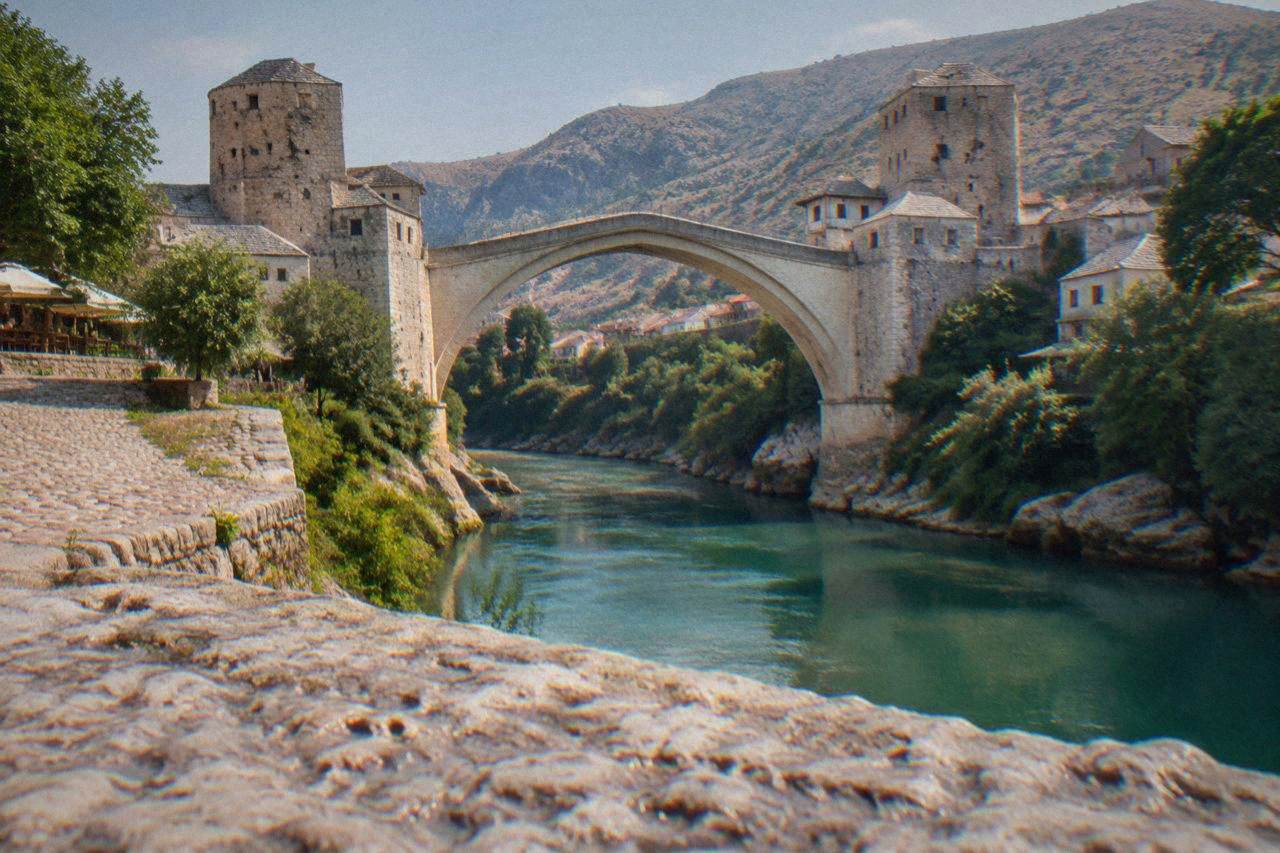
Split to Mostar is 174.1 km by road, about 2 hours 11 minutes free-flow, and crosses the Croatia-Bosnia border, which is a Schengen external border with full passport checks. Several daily buses run the route, a private transfer takes about the same time, and organised day tours from Split combine the drive with Mostar, Počitelj and Kravica waterfall.
Mostar, the inland city on the Neretva river in Herzegovina, Bosnia and Herzegovina, sits 174.1 km by road from Split, a drive of about 2 hours 11 minutes when traffic flows freely and no queue builds at the border. That last part matters more than the distance. The route leaves the European Union at the Croatian line near Metković, and Bosnia and Herzegovina is in neither the EU nor Schengen, so every vehicle and every passport is checked in both directions. Whether a bus, a rental car, a private transfer or an organised day tour suits you best depends almost entirely on how you feel about that border, and about how much of Herzegovina you want to see along the way.
How Far Is Split From Mostar, And How Long Does The Journey Take?
By road the Split to Mostar distance is 174.1 km, about 2 hours 11 minutes of driving without border queues, computed from route data with no waiting time included. The route leaves Croatia near Metković, crosses the Bosnia and Herzegovina border and follows the Neretva valley upstream to Mostar. Border checks add time on top of the drive, reported at up to about 30 minutes in normal conditions and longer at summer peaks.
The free-flow figure is honest but slightly optimistic as a planning number, because the Croatia to Bosnia and Herzegovina crossing is a Schengen external border with full checks since 1 January 2023. Two crossings serve this route: the main one on the coastal corridor near Metković, and alternatives further inland. Wait times are reported at up to about 30 minutes each way for cars, and longer on summer weekends when the Adriatic coast empties eastward. Buses clear the same booths and are counted in the same queues.
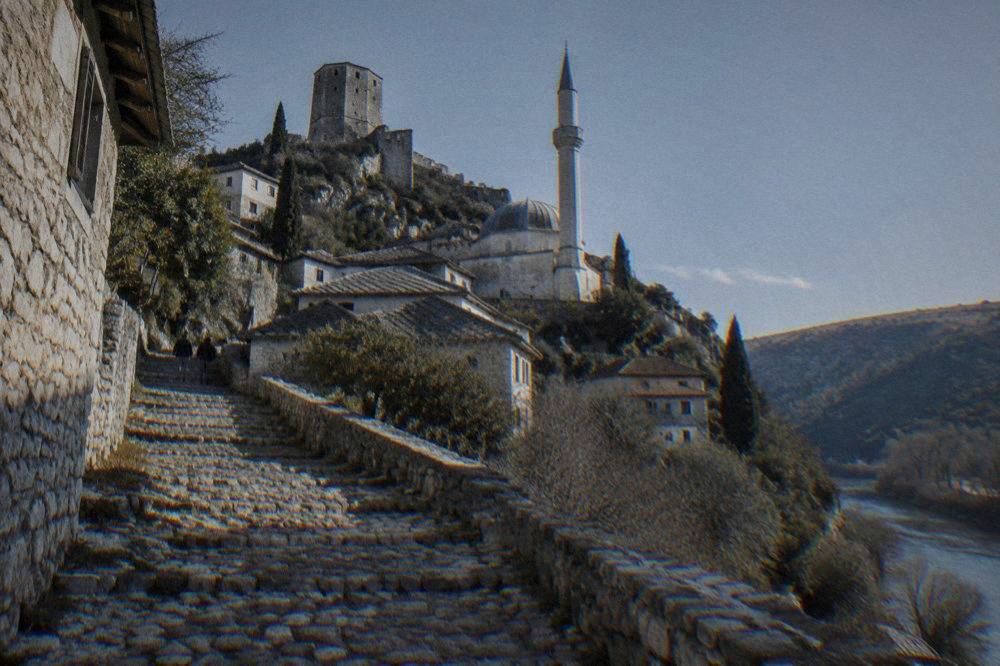
Once across, the road narrows into the Neretva valley. The river runs green and cold all year, fed by karst springs, and the drive from the border to Mostar takes in tangerine orchards around Opuzen on the Croatian side, then the canyon stretch before Čapljina, then Počitelj on its hill, and finally Mostar itself. For context on the wider map: Dubrovnik is a different run entirely, covered in the Dubrovnik to Mostar guide, and the capital connection is covered in Sarajevo to Mostar.
| Route fact | Figure | Notes |
|---|---|---|
| Road distance Split to Mostar | 174.1 km | Computed, free-flow route |
| Driving time | About 2 h 11 min | Excludes border checks |
| Border crossings on the route | Croatia to Bosnia and Herzegovina near Metković | Schengen external border |
| Typical border wait | Up to about 30 min | Reported, longer at summer peaks |
| Currency after the border | Convertible mark (KM, BAM) | 1 EUR = 1.95583 KM, fixed peg |
Is The Split To Mostar Bus A Good Option?
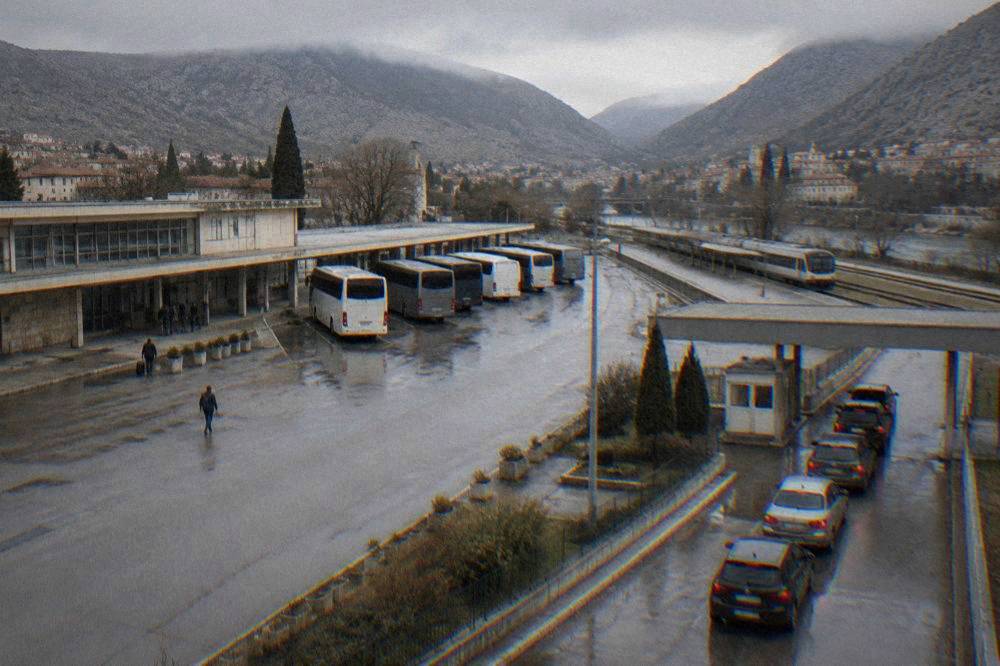
Several buses a day run from Split to Mostar, operated by Croatian and Bosnian companies, with a reported journey of roughly 3 to 4 hours once the border crossing is included. Buses arrive at the main bus station in central Mostar, a short, inexpensive taxi ride or a walk from the Old Town. Tickets are sold at the station and online, and fares vary by operator and season, so check the current fare when you buy.
The bus is the simplest version of this trip for anyone without a car. Departures are spread across the day, with more frequency on weekends in the high season, and the coaches are used to tourists, luggage and border formalities. You stay seated while passports are collected and stamped, which removes the stress of driving an unfamiliar border post.
Two practical points are worth fixing in your mind before you travel. First, the currency changes at the line: Bosnia and Herzegovina uses the convertible mark, pegged at 1 EUR = 1.95583 KM, and euro cash is often accepted in tourist areas at a rounded rate, though paying in KM is the cleaner option, a topic unpacked in Mostar money. Second, entry rules: visa-exempt visitors may stay up to 90 days within six months of first entry, and ETIAS is not in operation, so no electronic travel authorisation is needed to cross. The fuller picture of arriving in the city by every mode is in How To Get To Mostar.
Buses back to Split run on the same pattern. If you plan to stay overnight rather than day-trip, the neighbourhood breakdown is in Where To Stay In Mostar, and a single night is enough to see the Old Bridge at dawn and after dark without the day-trip crowds.
Should You Take An Organised Day Tour From Split To Mostar?
An organised day tour from Split is the only way to see Mostar, Počitelj and Kravica waterfall in one day without driving yourself, because the tour handles the border paperwork, the parking and the timing between three stops that would otherwise eat a full day in logistics. Tours run with a guide, on a fixed itinerary, and the price is shown on the operator's live listing, not in this article.
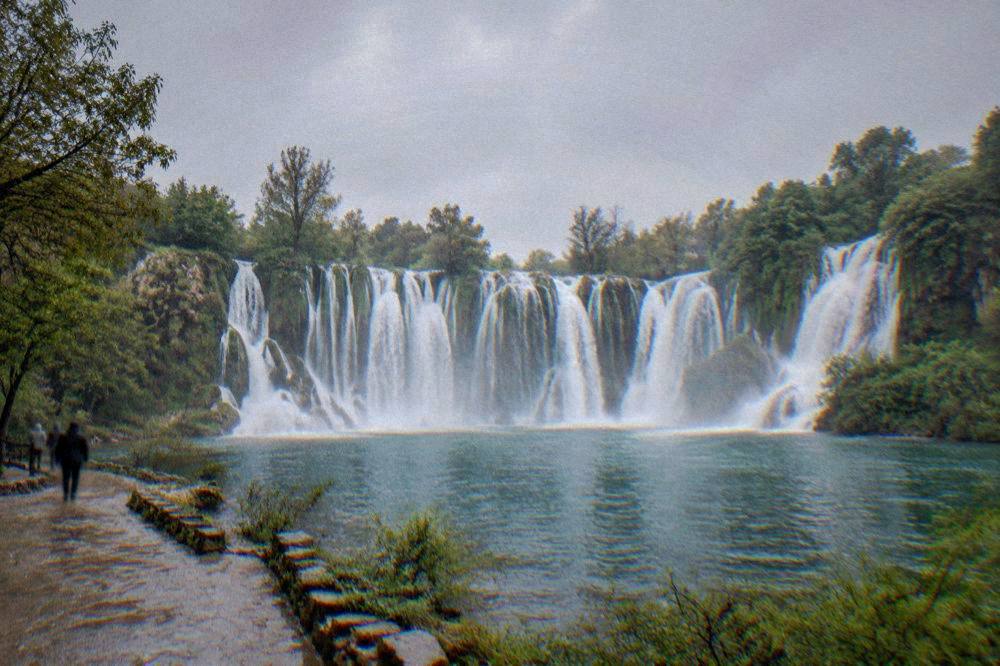
This is the option that suits travellers on a short Adriatic holiday who want Herzegovina as a single, high-yield excursion. The classic itinerary from Split strings together the coastal drive, the border, Mostar's Old Bridge Area, the fortified village of Počitelj and Kravica waterfall, where a wide curtain of water drops into a pool you can swim in during summer in the designated area.
For anyone weighing it against the bus, the arithmetic is straightforward. The bus gets you to Mostar and back, and you organise your own Old Town hours. A day tour packs in two more of Herzegovina's headline sights and removes the border and parking questions entirely. One of the strongest options running this route is a Split, Trogir and Omiš departure covering Mostar, Počitelj and Kravica, and its full itinerary is on the site's Mostar day trip from Split page.
What Is Driving From Split To Mostar Like?
Driving is 174.1 km and about 2 hours 11 minutes free-flow, on a mix of Croatian motorway and A-road and Bosnian two-lane road through the Neretva valley, with one international border crossing where full passport checks apply. The road is paved and signed throughout, traffic is light outside summer peaks, and the last stretch into Mostar runs along the river.
Rent the car in Croatia and you need the rental company's written permission to take it into Bosnia and Herzegovina, arranged in advance, and confirmation that the insurance is valid there. This is a standard request and operators handle it routinely, but turning up at the booth without it can end the trip before it starts. The details of renting on the Bosnian side are in the Mostar car rental guide.
Fuel up before the border if you can. Euro cash is often accepted at Bosnian petrol stations close to the crossing, at a rounded rate, but KM cash or a card that works internationally makes the stops easier. Speed limits are posted in km/h in both countries, and the valley road has towns, tractors and pedestrians on it, so the realistic average speed is well below the limit.
The crossing itself deserves a whole paragraph, because it is where the plans of unprepared drivers come apart. Bosnia and Herzegovina is not in Schengen, so the Croatian side runs exit checks and the Bosnian side entry checks, both with passports for every passenger. Waits are reported at up to about 30 minutes and longer in the July and August peaks; the mechanics of the whole procedure, documents and typical questions are laid out in the Croatia-Bosnia border crossing guide.
| Drive segment | What to expect |
|---|---|
| Split to the border near Metković | Croatian fast road along the coast, then inland |
| Border crossing | Full passport checks both ways, up to about 30 min reported |
| Border to Čapljina | Two-lane road entering the Neretva valley |
| Čapljina to Mostar | Valley road, Počitelj signed on the way, arrival in about 30 min |
Is A Private Transfer From Split To Mostar Worth It?
A private transfer covers the same 174.1 km in about the same driving time as a self-drive, with the border, the route knowledge and the parking handled by a driver who makes the trip regularly, and with door-to-door delivery to your accommodation in Mostar. Prices are set by the operator and appear on the booking page, and transfers can be scheduled to your own clock rather than a bus timetable.
The transfer sits between the bus and the day tour. Like the bus, you sit and let someone else drive. Unlike the bus, you leave when you want, stop where you want and land at your hotel door rather than the bus station. Families, groups of three or four splitting a fare, and anyone on a tight onward connection tend to land here.
The other transfer-shaped argument is photography. The stretch of the Neretva valley between the border and Mostar is the part of the drive people remember, and a private car can pause at Počitelj or at a river viewpoint in a way a scheduled coach cannot. If your trip continues east or south afterwards, the same logic applies to the routes described in Mostar to Kotor.
Can You Fly Or Take A Train From Split To Mostar?
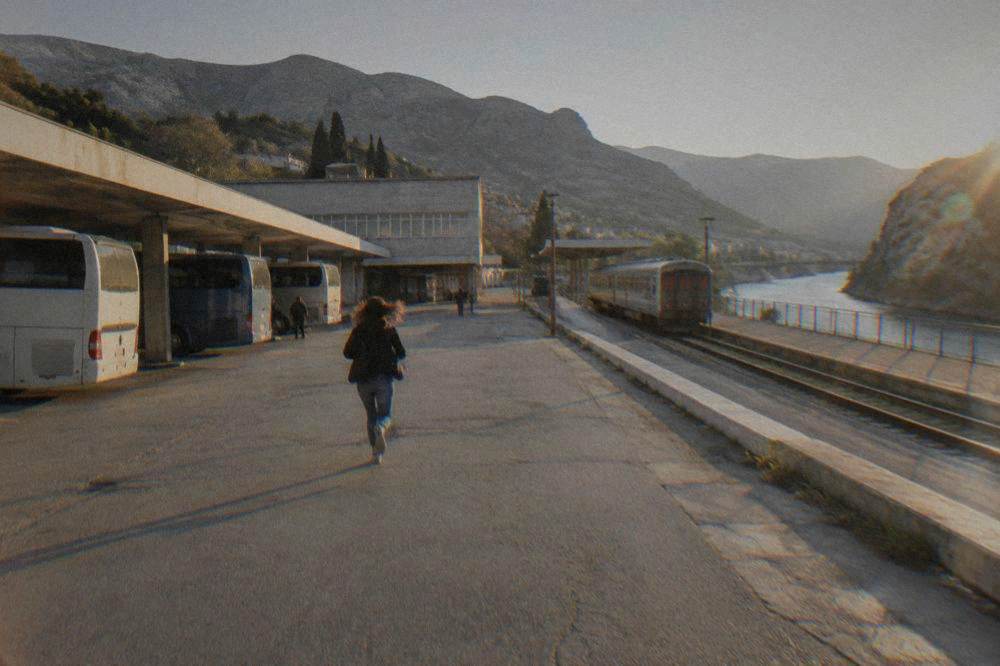
There is no direct train from Split to Mostar and no direct flight: the rail networks on the two sides of the border are not connected by a passenger service, and Mostar airport's small route list does not include Split. The realistic public-transport options are the bus and, with a detour, a flight into Sarajevo followed by the Sarajevo-Mostar train, which runs twice a day each way.
Mostar International Airport is real and closer than people expect, 8.2 km and about 12 minutes by road from Stari Most, but its reported routes are Croatia Airlines to Zagreb and Eurowings to Stuttgart, with Düsseldorf seasonal. Nothing connects it to Split, so the airport serves a different kind of traveller, one described in the Mostar airport guide.
The train is worth a sentence of its own because it is a destination in its own right. The Sarajevo to Čapljina line via Mostar, two trains a day each way per the official ŽFBH timetable, was suspended in September 2026 after a fire along the corridor and regular service resumed on 15 October 2026. Times and days change, so check the operator before committing. For most people coming from Split, though, the bus or the road remains the answer.
What Should You Know About Mostar Before You Arrive?
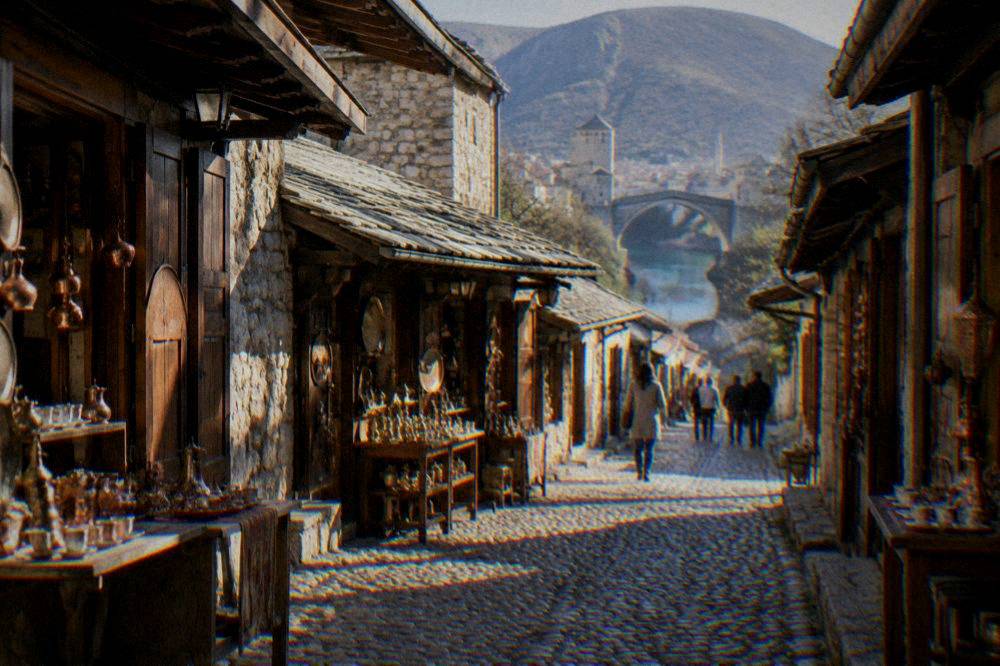
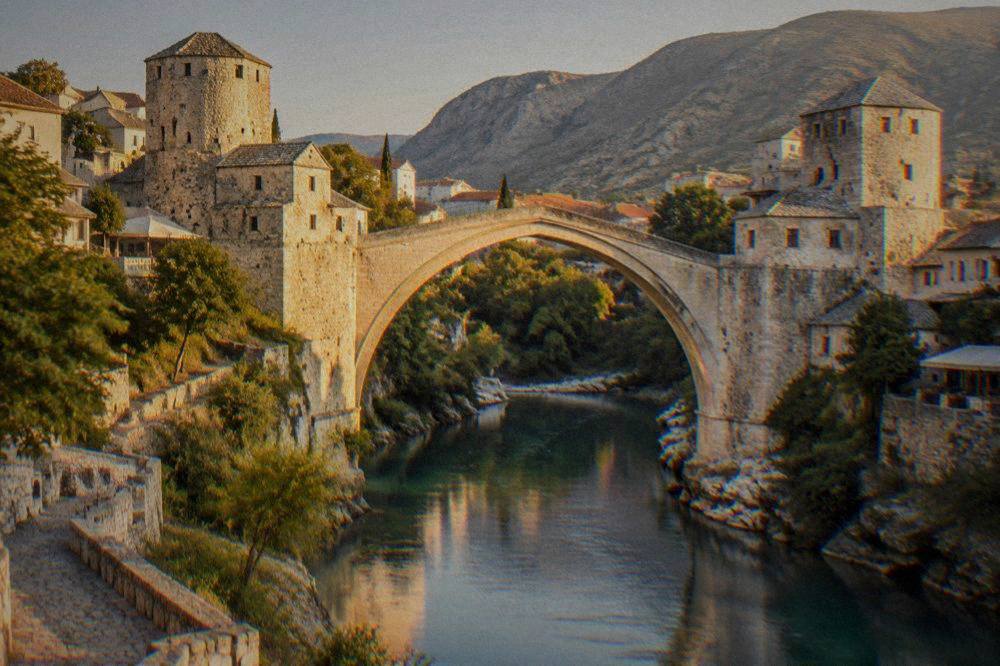
Mostar is an inland city on the Neretva with no sea coast, centred on the Old Bridge, a UNESCO World Heritage Area inscribed in 2005, and on the Ottoman bazaar street of Kujundžiluk; the Old Bridge was destroyed on 9 November 1993 during the war and rebuilt and reopened in July 2004. The city is walkable, the currency is the convertible mark, and summer heat is real, with modelled July highs of 29.9 C.
A few arrival facts repay knowing in advance. The convertible mark is pegged to the euro at 1 EUR = 1.95583 KM, and while euro cash is often accepted in tourist spots, cards work at hotels and larger restaurants while small vendors prefer cash. A tourist tax is reported at 3 KM per person per night in the canton from 1 January 2026, so confirm it on your booking. The emergency number is 112.
The bridge itself is free to cross at any hour, and the diving tradition around it belongs to the Mostari diving club, whose members train for years before jumping from about 21 to 24 metres depending on the river. Visitors do not jump. The story is told properly in Mostar bridge diving and the wider conflict history, with dates and physical facts only, in Mostar war history.
| Arrival fact | Detail |
|---|---|
| Currency | Convertible mark (KM, BAM), 1 EUR = 1.95583 KM |
| Tourist tax | Reported 3 KM per person per night from 1 Jan 2026, confirm at booking |
| Old Bridge | Free to cross, public path, rebuilt and reopened July 2004 |
| Emergency numbers | 112 general, 122 police, 123 fire, 124 ambulance |
| July heat | ERA5 reanalysis 1991-2020 mean daily high 29.9 C |
When Is The Best Time To Make The Split To Mostar Trip?
The crossing and the city are at their easiest from May to June and in September, when the FHMZ 1961-1990 station data shows modest rain, 102.1 mm in May and 96.3 mm in September against 200.0 mm in November, and temperatures that are warm without the valley heat of deep summer. July is the driest month at 42.9 mm but also the busiest on the road and at the border.
The seasonal logic splits two ways. For the border and the road, avoid the Saturday peaks of July and August, when Adriatic holiday traffic pushes waits well past the reported 30-minute norm. For the city itself, the argument is in the Best Time To Visit Mostar guide and the month-by-month numbers in Mostar weather.
A word on what you will feel in August, because it surprises people: the Neretva valley is a heat trap, with ERA5 reanalysis 1991-2020 modelled mean daily highs of 30.5 C in August, and the river water stays cold even then. That combination, hot air and cold river, is precisely why Kravica waterfall is such a popular summer stop on this route.
How Many Days Should You Give Mostar After Arriving From Split?
One day covers the Old Bridge, Kujundžiluk, a mosque courtyard view over the Neretva and a viewpoint, but an overnight stay changes the experience completely, because the Old Town empties of day trippers in the late afternoon and the bridge at dusk is a different sight. Two days allow Blagaj and Počitelj at your own pace, or Kravica waterfall, 55.2 km and about 54 minutes by road from Stari Most.
The day-trip version of Mostar compresses the city into four or five hours between the bus or tour arrival and departure, which is enough for the bridge, the bazaar and a burek. The overnight version gives you the morning market, the east-bank streets of Donja Mahala and time for the museums. The full breakdown is in the Things To Do In Mostar collection.
If you stay, eat twice: once from a bakery window and once at a table. The Bosnian food primer covers what to order, and the deep dives into ćevapi and burek settle the two arguments travelers arrive with.
| Stay length | What it realistically covers |
|---|---|
| Day trip from Split | Old Bridge, Kujundžiluk, one viewpoint, lunch |
| One night | All of the above plus the empty Old Town in the evening and early morning |
| Two nights | Adds Blagaj, 13.7 km from Stari Most, and Počitelj at your own pace |
| Three nights | Adds Kravica waterfall, 55.2 km, and a slower second day in the city |
What About The Return Trip From Mostar To Split?
The return runs on the same infrastructure: several daily buses back toward the coast, the same 174.1 km road with the same border checks in the opposite direction, and the same day tours that run the loop back to Split by evening. Book the return bus ahead in summer, and remember that exit checks apply leaving Bosnia and Herzegovina just as entry checks did on arrival.
One asymmetry is worth flagging. Morning departures from Split are busy with day tours heading east, so the evening return border queues in the direction of Croatia can be the heavier ones, reported longer at summer peaks. If you are self-driving back to a coastal base, crossing earlier in the evening or after dinner shortens the wait.
Travellers continuing along the coast or into Montenegro after Mostar have the onward routes documented separately, including the mountain drive described in Mostar to Kotor, and general preparation is covered in the Bosnia and Herzegovina travel tips guide.
Common Questions About Travel From Split To Mostar
How far is Split from Mostar?
174.1 km by road, about 2 hours 11 minutes of driving without border queues. The route crosses the Croatia to Bosnia and Herzegovina border near Metković.
Do you need a passport to travel from Split to Mostar?
Yes. Bosnia and Herzegovina is not in the EU or Schengen, so full passport checks apply at the border in both directions for every traveller, including EU citizens.
How long does the Split to Mostar bus take?
Reported at roughly 3 to 4 hours including the border crossing, on several daily departures. Fares vary by operator and season, so check when booking.
Can you take a train from Split to Mostar?
No. There is no passenger rail connection across this border. The nearest useful train is the Sarajevo to Čapljina line via Mostar, two trains a day each way, which resumed regular service on 15 October 2026 after a suspension; confirm times with the operator.
Can you fly from Split to Mostar?
No. Mostar airport's reported routes are Zagreb and Stuttgart, with Düsseldorf seasonal, and nothing connects it to Split.
What currency do you need in Mostar?
The convertible mark (KM, BAM), pegged at 1 EUR = 1.95583 KM. Euro cash is often accepted in tourist areas at a rounded rate, but KM or a card is the cleaner option.
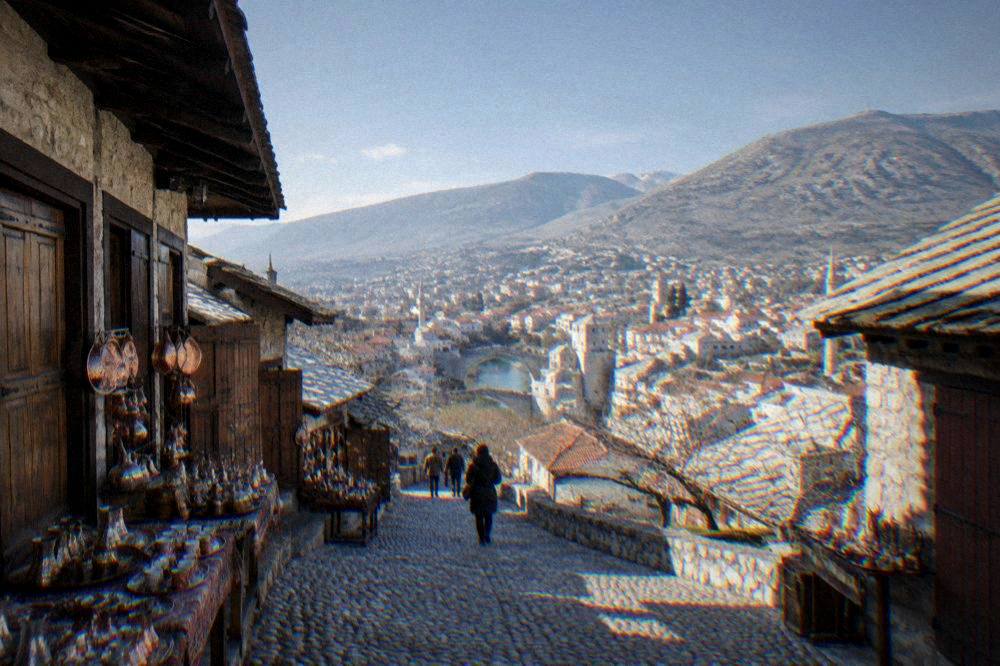
The route from Split to Mostar rewards a small amount of planning: a booked bus seat or tour, a passport in reach rather than buried in a bag, and KM cash for the first coffee beside the Neretva. Beyond that, the border, the valley and the bridge take care of the rest, and the planning pages on Mostar Travel Guide cover every onward leg from there.