Money In Mostar: Convertible Marks, Euros And Cards
Mostar prices things in convertible marks, not euros, and the mark is pegged to the euro at a fixed rate. Here is how the currency works, where cards are accepted and how much the main sights charge in KM.
The currency in Mostar is the convertible mark (KM, BAM), pegged at 1 euro = 1.95583 KM. Euros are often accepted in tourist areas at a rounded rate, cards work at hotels and larger venues, and small vendors want cash in KM.
Mostar runs on the convertible mark, the Bosnian currency known as KM or BAM, and the single most useful thing to know before arriving is the fixed exchange rate: 1 euro = 1.95583 KM, a currency board peg that holds without fluctuation. That rate never moves, which makes mental arithmetic easy once you learn it. Euros are often accepted in the tourist areas of this Herzegovina city on the Neretva river, usually rounded to 2 KM per euro, but the mark is the legal currency everywhere and the one in which every price tag, museum ticket and restaurant bill is written.
This page lays out how the Bosnian currency works in practice in Mostar: the peg, the coins and notes you will handle, where cards are taken and where cash is expected, how ATMs behave, what the main sights around the city and Herzegovina charge in KM, and the small frictions such as the tourist tax and tipping. If you are still building the trip itself, start with things to do in Mostar and work outward from there.
What Is The Currency In Mostar And Bosnia And Herzegovina?
The currency of Bosnia and Herzegovina is the convertible mark, abbreviated KM or BAM, and it is the only legal currency in Mostar. It is pegged to the euro at a fixed rate of 1 euro = 1.95583 KM under a currency board arrangement, so the rate does not change from day to day. Prices in shops, restaurants, museums and taxis across Mostar are quoted in KM. Notes come in 10, 20, 50, 100 and 200 KM, and coins in 5, 10, 20 and 50 feninga plus 1 and 2 KM, with 100 feninga equal to 1 KM. Croatia uses the euro and Bosnia and Herzegovina does not, which matters the moment you cross the border.
The peg has a practical consequence worth internalising: there is no good or bad day to change money, because the euro rate never moves. A price of 20 KM is 10.22 euros today and will be 10.22 euros next month. That removes almost all of the usual currency anxiety from a short trip.
Because the rate is awkward, 1.95583, people round. The common informal convention is 2 KM to the euro, which is roughly two percent in the vendor's favour on small amounts. On a 5 euro purchase that is a difference of a few feninga. On a hotel bill it adds up, which is one reason paying in KM rather than in euros is the better default whenever the choice exists.
The country is not in the European Union and not in the eurozone. Some visitors assume otherwise because Croatia, which joined the euro in 2023, surrounds Mostar's region on two sides. The border reality and the currency reality travel together, and both are covered in the guide to crossing the Croatia and Bosnia border.
Can You Pay With Euros In Mostar?
Euros are often accepted in Mostar's tourist areas, including the Old Bazaar, hotels and sit-down restaurants, but the euro is not the currency and acceptance is a courtesy rather than a rule. Where euros are taken, the rate is usually rounded to 2 KM per euro, slightly worse than the official peg of 1.95583. Change from a euro payment will normally be given in KM. Outside the tourist core, at small vendors, markets and on local buses, cash in KM is what works. Treat the euro as a fallback, not as the default.
The rounding deserves one more sentence. Two KM to the euro means you lose about 2.3 percent versus the peg. On a coffee or a burek that is nothing. On a several-night stay or a private tour paid in cash it is real money, so for anything substantial ask to pay the KM price in KM.
A useful pattern for a day in the city: keep a modest amount of euro cash as an emergency reserve, withdraw KM once from a bank ATM on arrival, and pay in KM for everything. The euro reserve covers the rare moment a card machine is down and KM runs short, and it can be spent in Croatia on either end of the trip, since Dubrovnik and Split are common gateways described in the guides to Dubrovnik to Mostar and Split to Mostar.
Do Cards Work In Mostar, And Where Is Cash Still Needed?
Cards are widely accepted at Mostar's hotels, larger restaurants, supermarkets and museums, while small vendors, market stalls, some taxis and local buses expect cash in KM. Visa and Mastercard are the cards to carry; when an ATM offers to charge you in your home currency, always decline and choose to be charged in KM to avoid a poor conversion. The machine question, sometimes called dynamic currency conversion, is the single biggest silent cost on a Balkan trip. Choosing KM at the ATM and again at any card terminal keeps you on the peg instead of on the terminal operator's markup.
ATMs, called bankomats, are easy to find in central Mostar, around the Old Bazaar and along Bulevar, operated by banks such as Raiffeisen, UniCredit and NLB. Two habits keep costs down: use a machine attached to a bank rather than a freestanding one, and refuse the home-currency option every time it appears.
How the payments landscape splits in practice:
| Situation | Card or cash | Notes |
|---|---|---|
| Hotel bill | Card usually fine | Ask to pay in KM, not euro, where both are offered |
| Old Bazaar souvenir stall | Cash in KM | Small notes help; 10 and 20 KM notes over 100s |
| Sit-down restaurant | Card usually fine | Cash appreciated for tips |
| Street food and bakeries | Cash in KM | Burek shops are fast, cash-based businesses |
| Local bus | Cash in KM | Tickets from the driver or kiosk |
| Museum and sight tickets | Card often possible, cash safest | Sight offices are small operations |
| Taxis | Cash, card sometimes | Agree the destination and check the meter |
The pattern mirrors the rest of the practical picture in Bosnia and Herzegovina, which the broader Bosnia and Herzegovina travel tips guide covers, including the Type C and F plugs at 230 volts and the emergency number 112.
How Much Do The Sights Around Mostar Cost In KM?
Admission at the headline sights around Mostar is modest and quoted in KM: Kravica waterfall charges 20 KM for an adult all year, Blagaj Tekke 10 KM, Radimlja 8 KM and ARK D-0 near Konjic 40 KM for foreign visitors, while Stari Most itself, Kujundžiluk and Počitelj cost nothing to walk through. Children under 7 enter Kravica free and BiH residents pay 10 KM there. Crossing the Old Bridge, the rebuilt stone arch at the heart of the UNESCO World Heritage property, is free at any hour, because it is a public street.
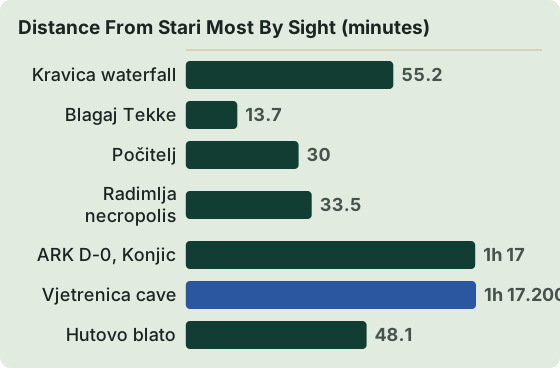
The figures that exist, drawn from operator and park pages, sit in the table below. Where a sight has no published fee, it is simply not listed, and the price to confirm on arrival. More of these guides are collected on Mostar Travel Guide.
| Sight | Distance from Stari Most | Adult entry |
|---|---|---|
| Stari Most and Kujundžiluk | In the city | Free |
| Kriva ćuprija (Crooked Bridge) | In the city | Free |
| Kravica waterfall | 55.2 km, about 54 min | 20 KM all year |
| Blagaj Tekke | 13.7 km, about 19 min | 10 KM reported |
| Počitelj | 30.0 km, about 31 min | Village free |
| Radimlja necropolis | 33.5 km, about 42 min | 8 KM |
| ARK D-0, Konjic | 77.0 km, about 93 min | 40 KM foreign visitors |
| Vjetrenica cave | 77.2 km, about 104 min | About 20 to 25 KM |
| Hutovo blato | 48.1 km, about 62 min | About 5 KM |
Kravica's pricing carries one trap worth spelling out. The park's own visitor page states 20 KM for an adult throughout the year, with hours that shift by month, 07:00 to 22:00 from June to September and 07:00 to 17:00 in the depths of winter. Claims that the falls cost 10 euros in summer and are free in winter do not match the park's page. Swimming in the pool below the falls is allowed in summer in the designated area, with no lifeguard reported, and the park's rules are worth checking on arrival.
The Herzegovina circuit of Blagaj, Počitelj and Kravica is the classic combination, and the per-person economics improve when entrance handling is part of the trip rather than a series of cash stops. The private Herzegovina day tour from Mostar is one option:
Blagaj Tekke, the dervish lodge at the Buna spring, asks for shoulders and knees covered, with wraps provided at the entrance, and its reported hours run 08:00 to 22:00 from April to October and 09:00 to 17:00 in winter. ARK D-0, the former atomic command bunker near Konjic, requires advance booking and is closed on Mondays, so it rewards planning rather than spontaneity.
Is There A Tourist Tax In Mostar?
A tourist tax of 3 KM per person per night is reported for Herzegovina-Neretva Canton, which includes Mostar, applying from 1 January 2026, with a lower reported rate of 1.5 KM for same-day visitors, and it is collected through your accommodation rather than paid at a separate office. Because it is reported by local media rather than published on a reachable canton page, treat it as a figure to confirm rather than a settled fact. In practice it is usually added to the bill at check-in or check-out, and at 3 KM per night it is small enough that it should not shape any decision about where to stay or how long to stay.
Accommodation prices themselves vary by season, and the guide to where to stay in Mostar covers the neighbourhoods. Summer is the peak, and the timing question is tied to the climate: the FHMZ station table for Mostar, 1961 to 1990, shows a July mean of 24.7 C against 4.8 C in January, with an absolute maximum of 41.2 C recorded in July. Modelled ERA5 reanalysis for 1991 to 2020 puts mean daily highs at 29.9 C in July and 30.5 C in August. Shoulder months stretch the same money further, a trade-off the best time to visit Mostar guide works through.
How Does Tipping Work In Mostar?
Tipping in Mostar is appreciated rather than obligatory: rounding up the bill or adding around ten percent at a sit-down restaurant is the reported custom, taxi fares are commonly rounded to the nearest mark, and small change works for cafe staff and guides. No service charge appears on the bill as standard, so a tip is a direct gesture to the person who served you. For a free walking tour, where the guide is paid only by tips, the gesture matters more than the percentage arithmetic.
The word reported is doing honest work there. Tipping norms in Bosnia and Herzegovina come from practice rather than statute, and nobody will chase you for leaving nothing. What is consistently described is a relaxed, low-stakes culture: round up, leave the coins, add a note for good service.
Food is where the small cash habits concentrate. Bosnian coffee, served in a džezva with the grounds still in it, is a sit-down ritual rather than a takeaway, and burek, the rolled pastry covered in the burek guide, is bought over the counter by weight or by piece, always in cash. The Bosnian food guide maps the cuisine; the money rule of thumb is that anything eaten standing up wants KM in coins and notes.
Should You Exchange Cash Or Withdraw From ATMs In Mostar?
Withdrawing KM from a bank-owned ATM in Mostar is usually the better move than exchanging foreign cash, because the fixed peg means there is no rate risk to lock in and exchange offices offer little room to beat it. If you do carry cash to convert, euros are the sensible currency to bring, since the mark is pegged to the euro alone. Decline the ATM's offer to charge you in your home currency and choose KM, the option that keeps the conversion on your own bank's terms rather than the machine operator's.
Amount discipline matters more than method. A few small withdrawals beat one large one only in the sense that you avoid ending the trip with unspendable KM, a currency that is hard to convert back home. Work out roughly what you need: sight entries from the table above, meals, market purchases and a buffer, then withdraw close to that. Leftover marks are a souvenir everywhere except Bosnia and Herzegovina.
One more planning figure belongs here. The train from Sarajevo to Mostar, resumed on 15 October 2026 after a suspension that followed a fire along the corridor, runs twice daily each way and costs about 14 KM one way, per the timetable aggregators, which is a fare to confirm when booking. The route is one of the scenic rail journeys of the region and the Sarajevo to Mostar guide covers it in full.
What Does A Day In Mostar Actually Cost?
A day in Mostar can run from almost nothing to a comfortable mid-range spend: the Old Town, the Old Bridge, Kujundžiluk, Kriva ćuprija and the riverside walk are all free, a paid sight such as the Old Bridge Museum at 10 KM or Koski Mehmed-pašina džamija at about 10 KM adds a little, and food and coffee in KM are inexpensive by European standards. The variable costs are the day trips: Kravica at 20 KM, Blagaj Tekke at 10 KM reported, and the longer runs to Radimlja and Vjetrenica if Herzegovina is on the itinerary.
| Item | Cost |
|---|---|
| Crossing Stari Most and the Old Bazaar | Free |
| Koski Mehmed-pašina džamija entry | About 10 KM |
| Old Bridge Museum, Tara tower | 10 KM |
| Kravica waterfall entry | 20 KM |
| Blagaj Tekke entry | 10 KM reported |
| Tourist tax, one night | 3 KM reported |
| Emergency number if it all goes wrong | 112, free |
That column adds up to roughly 50 KM for a full day with a waterfall attached, under 30 euros at the peg, before food.
Two experiences are worth their price against that backdrop. A Bosnian cooking class turns lunch into the activity itself, with burek rolled, baked and eaten as part of the session:
And a private group city tour of Mostar and the Old Bridge covers the Old Town's story with a guide and a fixed per-person price, which suits families and small groups who would rather not assemble the history themselves. Details and availability are on the walking tour overview, and the Mostar history guide gives the background the walk builds on: a name first written down in 1474, a bridge completed in 1566, destroyed on 9 November 1993 and reopened in July 2004.
Common Questions About Money In Mostar
Is the euro accepted in Mostar?
Euro cash is often accepted in Mostar's tourist areas, such as the Old Bazaar, hotels and sit-down restaurants, usually at a rounded rate of about 2 KM to the euro. It is a courtesy, not a rule, and change comes back in KM. Paying in convertible marks gets you the official peg of 1 euro = 1.95583 KM.
Should I tip in Mostar?
Tipping is appreciated but not compulsory. Rounding up or adding around ten percent at a restaurant, rounding taxi fares, and leaving small change at cafes are the reported customs. Guides on tip-based walks are paid by tips alone.
Are ATMs easy to find in Mostar?
Yes. Bank ATMs are common around the Old Bazaar and Bulevar, operated by banks including Raiffeisen, UniCredit and NLB. Use machines attached to bank branches and always choose to be charged in KM, not your home currency.
How much is the tourist tax in Mostar?
A tourist tax of 3 KM per person per night is reported for Herzegovina-Neretva Canton from 1 January 2026, with 1.5 KM reported for same-day visitors. Your accommodation collects it, usually with the bill. Confirm the amount at booking.
Is Bosnia and Herzegovina in the eurozone?
No. The country is not in the European Union or the eurozone. Its currency is the convertible mark, pegged to the euro at 1.95583, and the Croatian border is a full external Schengen border with passport checks.
Can I pay by card at Kravica waterfall?
Plan on cash. The park's visitor page lists the 20 KM adult entry and monthly hours but payment methods are not stated there, and cash is the reliable assumption across Herzegovina's sights. There is more on the falls in the Kravica waterfalls guide.
The convertible mark is a stable, simple currency made simpler by a peg that never moves. Withdraw KM from a bank machine, keep some coins for the bazaar and the bakeries, and the money side of Mostar takes care of itself.
