Mostar Walking Tour: Which Old Town Walk To Book
Mostar's Old Town is compact, steep in places and dense with history, which makes it one of the few cities in the Balkans where a guided walk genuinely changes what you see. This guide sets out what a Mostar walking tour covers, which sights are free to enter, and how to choose between a short Old Town circuit and a deeper history walk.
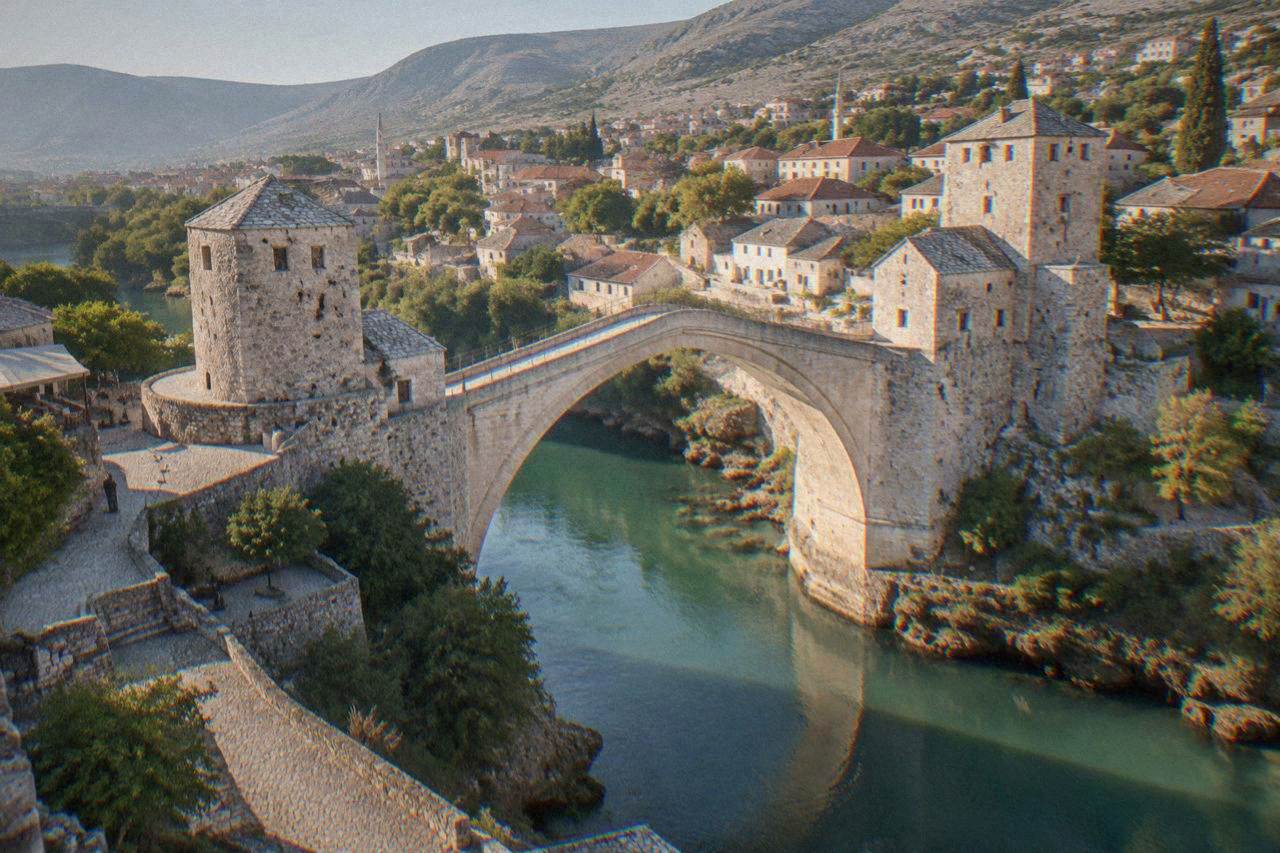
A Mostar walking tour concentrates on the Old Bridge Area of the Old City, a UNESCO World Heritage property since 2005: Stari Most, the Kujundžiluk bazaar, the Crooked Bridge and the riverfront mosques. Walks range from short Old Town circuits to longer routes across the Neretva to Donja Mahala and the Boulevard, and the bridge crossing itself is free at any hour.
Mostar sits inland on the Neretva river in Herzegovina, and almost everything a visitor comes to see sits within fifteen minutes on foot of the Old Bridge. That density is why the mostar walking tour question is less about distance and more about depth: the same square kilometre holds a UNESCO World Heritage core, an Ottoman bazaar, a river that stays cold even in August, and a city that rebuilt its most famous structure after it was destroyed on 9 November 1993. A good walk unpacks all of it. This guide from the Mostar Travel Guide editorial desk lays out the routes, the stops and the practical choices, plainly and without padding.
What Does A Mostar Walking Tour Actually Cover?
A standard Mostar walking tour covers the Old Bridge Area of the Old City of Mostar, inscribed by UNESCO in 2005 under criterion (vi): Stari Most itself, the Kujundžiluk bazaar street on the east bank, the Crooked Bridge, the riverfront around the Neretva, and usually one or two viewpoints over the arch from the west bank terraces. Longer routes add the Boulevard, the former front line, and the Donja Mahala quarter across the river. The bridge was completed in 1566 and rebuilt and reopened in July 2004.
The core zone is genuinely small. The inscribed property covers 7.60 hectares with a 48 hectare buffer zone, and every headline stop in that zone is reachable on foot within a few minutes of the bridge itself. What changes between walks is the storytelling: a short circuit skims the postcard layer, while a history walk spends its time on how the city looked before 1993, what happened during the war, and how the reconstruction was carried out using original materials and techniques, work supported by UNESCO and World Bank partners.
The name of the city itself is part of the story guides tell. It comes from "mostari", the bridge keepers who guarded the earlier wooden crossing, and the first written mention of the name Mostar dates from 1474. The stone bridge that replaced the wooden one was commissioned under Suleiman the Magnificent and built by the architect Hajruddin, working to the design approach of his teacher, the architect Sinan, according to the UNESCO listing text.
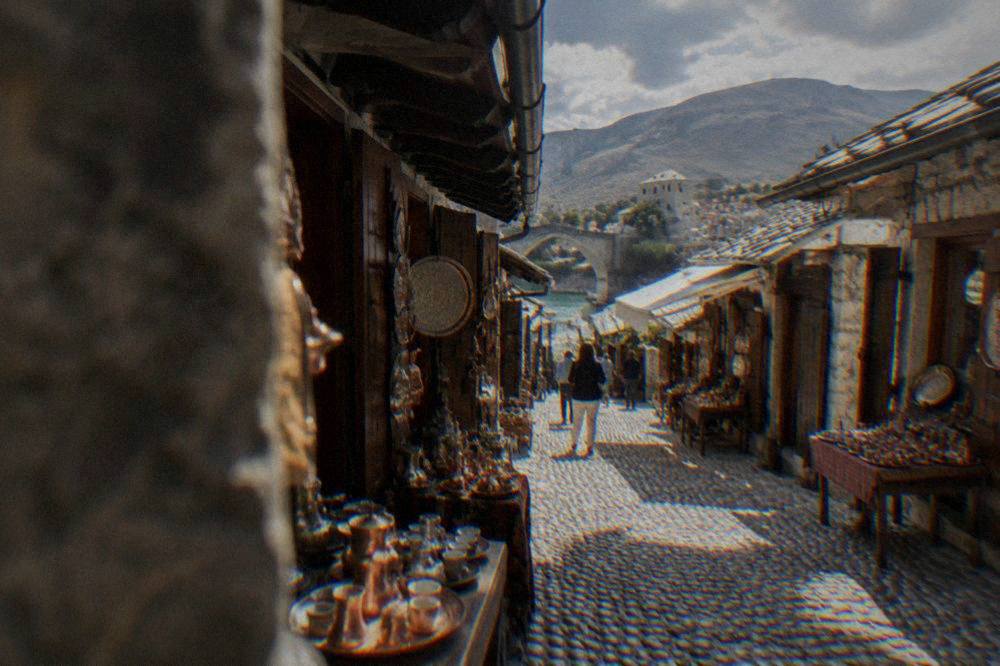
Practically, you can expect a walk to pause at four or five fixed points: the bridge, the bazaar, a mosque terrace or two, a riverside beach or terrace, and a viewpoint. The Old Bridge Museum in the Tara tower sits at the bridge's west end, and the Koski Mehmed-pašina džamija terrace gives the classic downstream view of the arch; both charge a small cash entry fee on the door, so carry a few marks. Details on both stops are in the Stari Most guide.
Which Mostar Walks Can You Book, And How Do They Differ?
Mostar's bookable walks fall into four clear types: short Old Town circuits focused on the bridge and the bazaar, longer general city walks that cross the river into other districts, themed history walks on the war years and the breakup of Yugoslavia, and specialty walks such as street art routes. All of them start and finish within walking distance of the Old Bridge, and none requires transport during the walk itself. The differences are depth, theme and group size rather than geography.
For the headline sightseeing layer, a small-group guided Old Town tour is the standard choice, and it is the featured option on this page: the Old Town guided tour in a small group covers the bridge area with a licensed local guide and keeps numbers low. You can Check availability on the operator's live listing before committing to a date, and free cancellation applies.
For the harder history, Mostar has a distinctive niche: walks built specifically around the breakup of Yugoslavia and life in the city under siege. These routes use the buildings themselves as the narrative, from the Boulevard front line to ruined structures that still stand, and they answer questions the postcard layer cannot. The Mostar war history tour guide on this site breaks down what those walks cover.
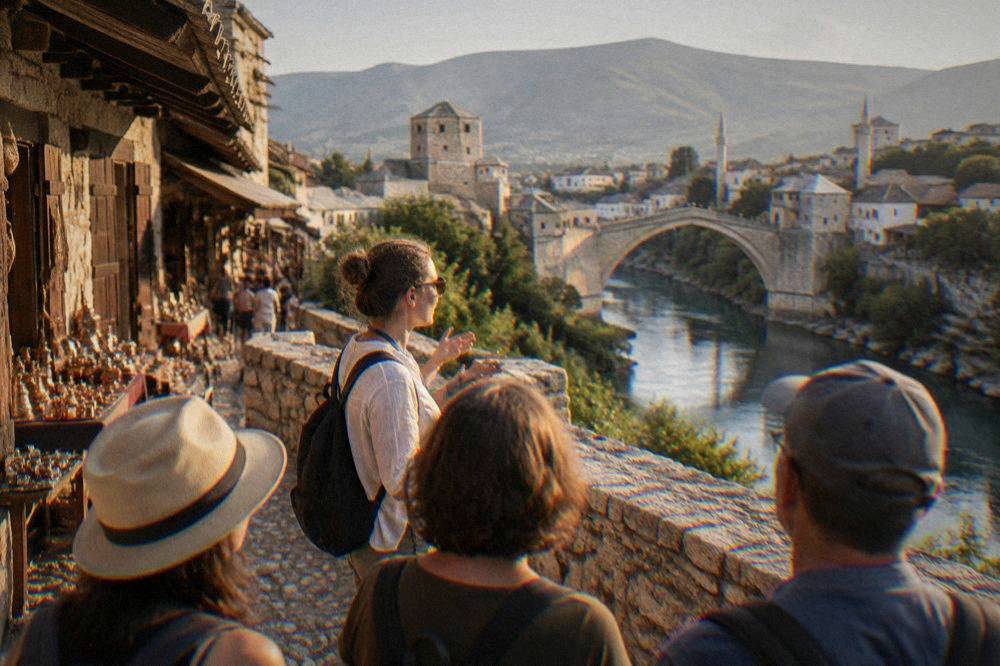
Here is how the walk types compare on what they cover:
| Walk type | Core area | What it adds beyond the bridge | Best for |
|---|---|---|---|
| Short Old Town circuit | Bridge, Kujundžiluk, Crooked Bridge | Mosque terraces, bazaar craft shops, viewpoints | First-time visitors with limited time |
| Full city walk | Old Town plus west bank | Spanish Square, the Boulevard, street layers from different eras | Visitors staying a night or two |
| War and breakup-of-Yugoslavia walk | Front line areas and the Old Town | Ruined buildings, siege-era sites, the 1990s story told factually | Visitors who want the context, not just the photos |
| Street art and murals walk | West bank and side streets | Murals, façades, contemporary Mostar | Repeat visitors, photographers |
One more category exists that costs nothing up front: a pay-what-you-want walk, listed in the free walking tour overview, where you tip the guide at the end. Whatever you book, the meeting points cluster around the Old Town and the west bank, so a hotel or guesthouse in or near the Old Town area puts you within a short stroll of any of them.
What Should A First-Time Visitor See On Foot In Mostar?
A first walk through Mostar should cover, in rough order: the Old Bridge itself, the Kujundžiluk bazaar on the east bank, the Crooked Bridge a few streets deeper into the old quarter, the Koski Mehmed-pašina džamija terrace for the classic bridge view, and the west bank terraces and shore path along the Neretva. All of the outdoor stops are public and free, and the whole loop is doable in under an hour at a photo-taking pace.
Start at the bridge. Stari Most is a public pedestrian crossing, open around the clock, with no ticket and no barrier; you simply walk over it. The arch rises about 21 to 24 metres above the river depending on the water level, and members of the Mostari diving club jump from it in the warmer months, collecting tips from the crowd before they leap. Visitors do not jump: the jumps are made by trained club members only, and there is no pay-to-jump arrangement for travellers.
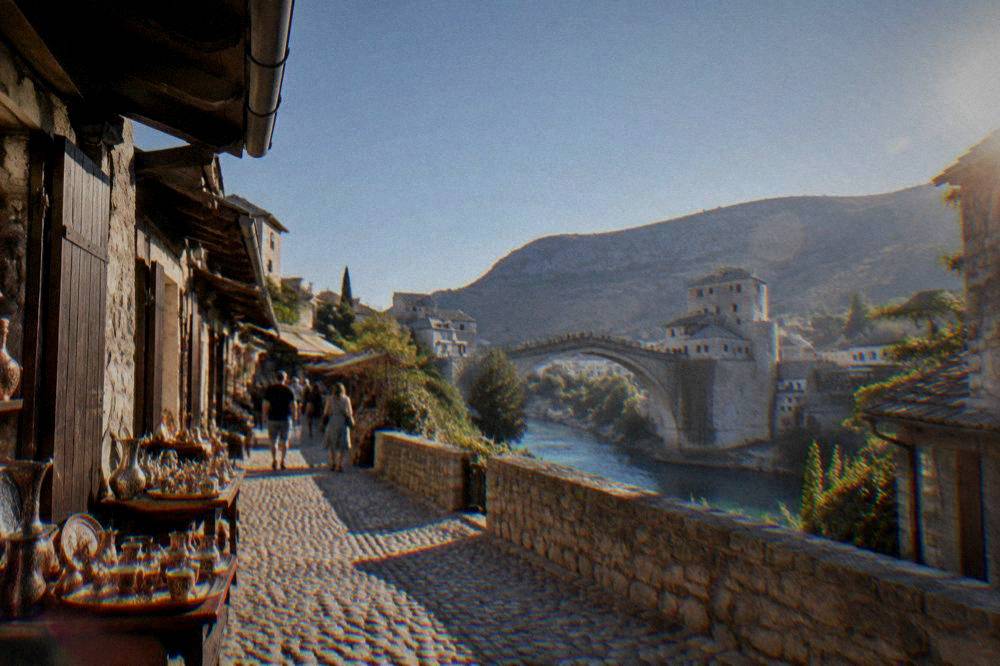
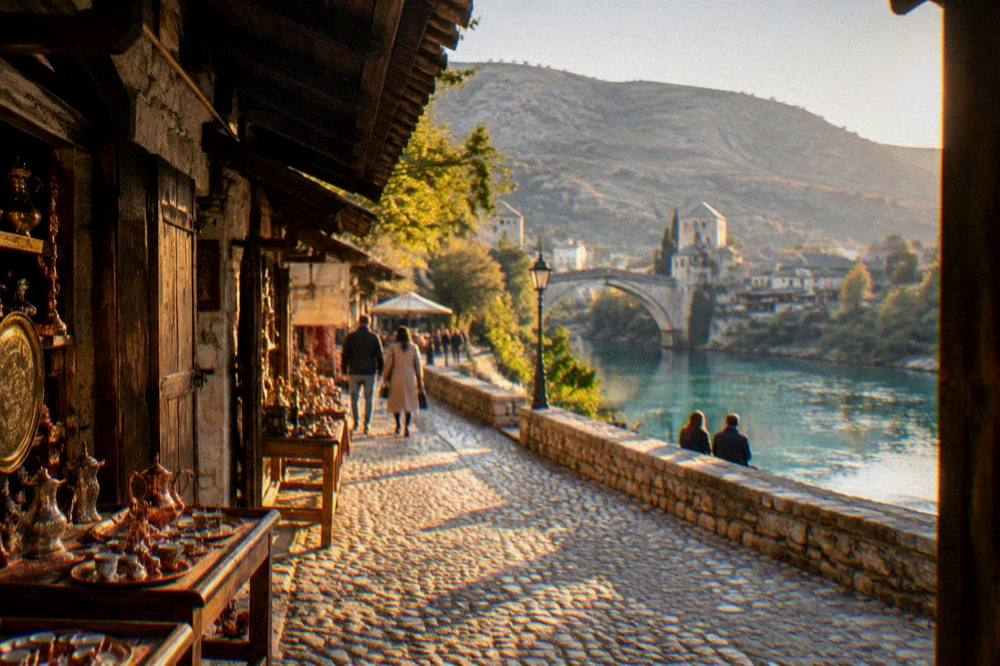
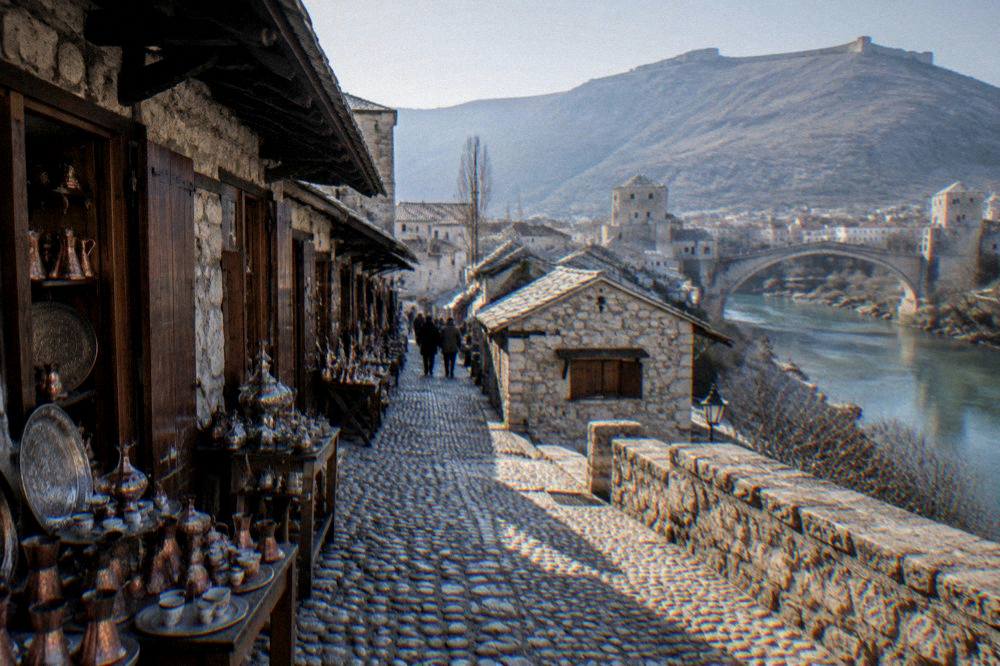
From the bridge, drop into Kujundžiluk, the cobbled bazaar street that runs along the east bank. It is a public street, free to wander, lined with coppersmiths, souvenir stalls and small cafés, and it is the commercial descendant of the Ottoman market that gave the old town its shape. The Kujundžiluk guide maps the street and its side lanes in detail.
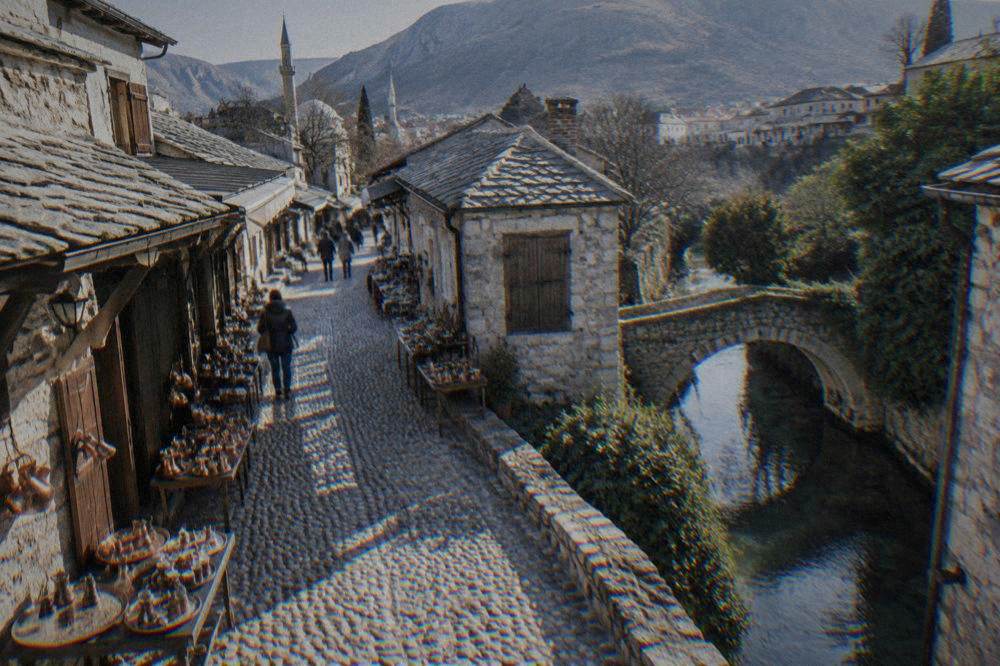
Two streets inland from the bazaar sits Kriva ćuprija, the Crooked Bridge, a small single-arch stone bridge over a side channel of the Neretva. It is public and free, and because it sees less foot traffic it is often the spot where the old quarter feels most like itself. The Crooked Bridge page has the details.
Then work the riverbank. The terrace of the Koski Mehmed-pašina džamija looks straight down the river at the bridge, and the small shingle beaches below the old town give the classic upstream view back toward the arch. The Neretva is fast, green and cold even in August, fed by karst springs, which is exactly why the divers' jumps look as dramatic as they do.
| Stop | What it is | Entry status |
|---|---|---|
| Stari Most (Old Bridge) | Stone arch bridge completed 1566, rebuilt and reopened July 2004 | Free, public, open around the clock |
| Kujundžiluk | Ottoman-era bazaar street on the east bank | Free, public street |
| Kriva ćuprija (Crooked Bridge) | Small stone arch bridge over a side channel | Free, public |
| Koski Mehmed-pašina džamija | Riverfront mosque with a terrace view of the bridge | Small cash fee at the door, more for the minaret, confirm on site |
| Old Bridge Museum (Tara tower) | Museum at the bridge's west end | Small fee reported, confirm on site |
| Partisan Memorial Cemetery | Hillside monument by Bogdan Bogdanović, inaugurated 1965 | No ticket, no staffed hours; condition is fragile, so go in daylight |
If the first walk leaves you wanting the deeper layer, two mosques reward the climb of their minarets and two Ottoman houses, Bišćević House and Muslibegović House, open as museums with a small cash fee each. The Bišćević House and Muslibegović House pages list what to expect inside, and both are a short walk from the bazaar.
How Long Does A Mostar Walking Tour Take, And When Should You Start?
Walking tours in Mostar occupy the middle of a single morning or afternoon: the short Old Town circuits are brief by tour standards, the general city walks run roughly half a morning, and the themed history walks sit between the two. Every duration you will see quoted comes from the operator's live listing, so treat the listing, not a round number in an article, as the figure to plan around. What matters more than length is start time: the old town changes character completely between morning and mid-afternoon.
The reason timing matters is a practical one. Mostar's summer heat is real: the FHMZ Mostar station table, 1961 to 1990, shows a July mean temperature of 24.7 C with an absolute maximum of 41.2 C, and modelled ERA5 reanalysis, 1991 to 2020, puts the mean daily high at 29.9 C in July and 30.5 C in August, with the valley floor running hotter than that in practice. A walk that starts at nine and finishes by eleven is a different experience from one that crosses the unshaded bridge stones at two in the afternoon.
Early morning also buys you the bridge and the bazaar before the day-trippers arrive from the coast. Mostar is a fixture on day itineraries out of Dubrovnik and Split, and those groups land in the old town in the middle of the day. An early start or a late-afternoon start puts you ahead of or behind that wave, and the light on the river is better at both ends anyway.
| Month | Mean temp (FHMZ 1961-1990) | Precipitation mm (FHMZ 1961-1990) | Mean daily high (ERA5 1991-2020) |
|---|---|---|---|
| April | 13.3 C | 127.3 | 17.7 C |
| May | 17.9 C | 102.1 | 22.3 C |
| June | 21.5 C | 77.9 | 26.8 C |
| July | 24.7 C | 42.9 | 29.9 C |
| August | 24.2 C | 73.7 | 30.5 C |
| September | 20.4 C | 96.3 | 24.5 C |
| October | 15.3 C | 150.6 | 19.5 C |
That table also answers the season question. July is the driest row on the station table at 42.9 mm against November's 200.0 mm, but it is also the warmest. May, June and September give the most comfortable combination of warmth, daylight and dry streets for a walking visit, and October still works with a layer for the evening.
What Can You See In Mostar For Free Without Any Tour At All?
Mostar gives away its headline layer: the Old Bridge crossing, the Kujundžiluk bazaar, the Crooked Bridge, the riverbanks and beaches along the Neretva, Spanish Square and the west bank streets are all public and free, with no ticket, no gate and no hours. A self-guided visitor with a map and a little reading can walk the entire postcard circuit for the price of a coffee. What a paid walk adds is the story, not the access.
Be specific about what sits behind the free line. The bridge is a public right of way. The bazaar is a street. The Spanish Square end of the city, the square and its surrounding Austro-Hungarian-era facades, is an open public space. The Partisan Memorial Cemetery on the hill above the Boulevard is unstaffed and unticketed, though its condition is fragile: over 700 of its stone memorial markers were destroyed in 2022, and Europa Nostra's 2026 report calls for urgent protection and revitalisation of the site, so visit in daylight and treat it with care.
The paid layer is thin and cheap. The mosque terraces, the minaret climbs, the two Ottoman houses and the Old Bridge Museum charge small cash fees, typically a few marks each, and you should confirm the current figure at the door rather than plan around a number read online. Carry cash in convertible marks for exactly this reason: the currency of Bosnia and Herzegovina is the mark (KM, BAM), pegged to the euro at 1 EUR = 1.95583 KM, and while euro cash is often accepted in tourist areas, the rate is usually rounded and the small heritage sites want marks.
If you are building your own route rather than booking one, the free things to do overview on this site lists the no-cost layer in full, and the Mostar viewpoints guide covers where to get the elevated views over the old town and the river without paying a terrace fee.
Is Mostar Easy To Walk Around, And Is It Safe On Foot?
Mostar is a genuinely walkable city: the old town, the west bank, the Boulevard and Spanish Square all connect on foot, distances between the headline sights are short, and no transport is needed inside the central area. The two caveats are surface and season: the old town's cobbles and stone steps are worn and slippery when wet, and the summer heat turns midday walking into an endurance exercise, so pace and footwear matter more than distance does.
On safety, the short answer for the central city is that it behaves like any busy regional tourist town: normal urban caution applies after dark, and the is it safe to walk around Mostar at night page addresses that question directly. The one Herzegovina-wide rule that actually matters concerns the countryside, not the city: rural areas of the region carry suspected mine contamination from the war, and the national mine-action centre BHMAC maintains the suspected-area data, so the standing advice is to stay on marked paths and roads when you leave town on foot. Inside the built-up area of Mostar this is not a live concern.
Surface is the real practical point. Kujundžiluk and the streets off it are rounded river-stone cobbles, the bridge itself is a polished stone ramp that slopes, and good shoes beat sandals on any route that crosses the old quarter. The climb to any minaret terrace is a narrow spiral staircase, and the Partisan Memorial Cemetery involves an uphill approach, so build your route around your knees rather than a map's straight lines.
Getting to the start of a walk is rarely a problem: Mostar's bus and train stations sit a short, inexpensive taxi ride or a manageable walk from the old town, and the getting around Mostar guide covers the local bus lines, taxis and airport transfer options in detail.
When Is The Best Time Of Day To Photograph The Old Bridge On A Walk?
The Old Bridge photographs best in the early morning and the late afternoon: morning light hits the east-bank facades and the river runs its deepest green before boats and swimmers stir the view, while late afternoon warms the west bank and puts a low glare across the arch. Midday is the worst slot on two counts, harsh top-down light on pale stone and the thickest crowds of day-trippers, so plan photography at the ends of the day and the tour in the middle.
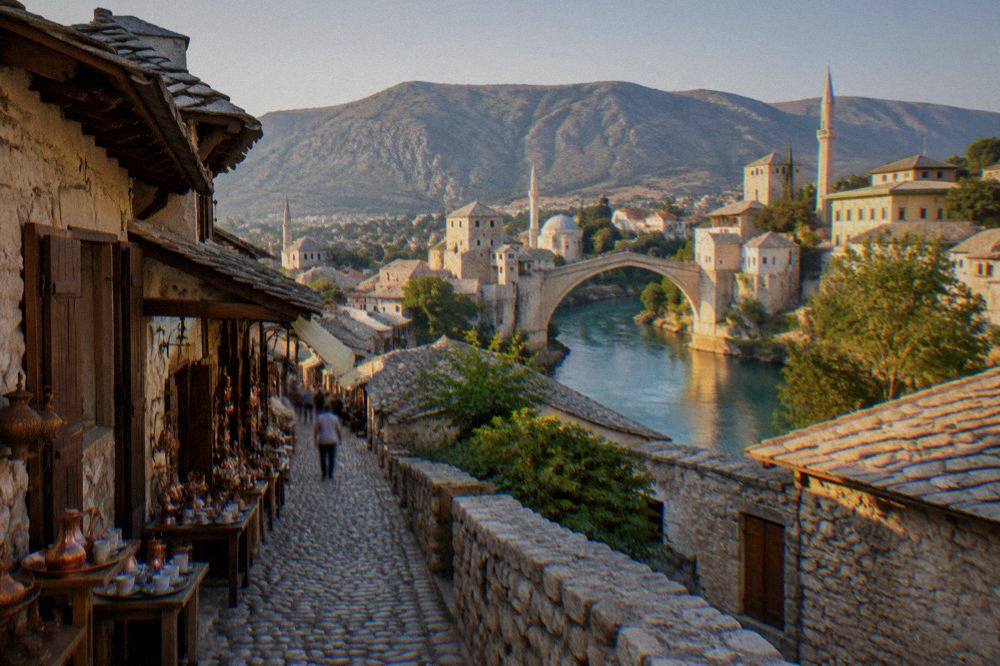
The viewpoint geometry is simple. From the east-bank side, downstream of the bridge, the Koski Mehmed-pašina džamija terrace frames the arch with the river bending in front of it. From the west bank, the terraces above the old town look back at the east-bank silhouette, which is where the classic golden-hour shot lives. The shore path below the bazaar gives the low, water-level version. All three are free to reach; only the mosque terrace charges its door fee.
One seasonal note: in late July the bridge hosts events, the traditional diving competition and the Red Bull Cliff Diving World Series round, which added platforms at 21 metres for women and 27 metres for men in 2026. During those days the old town is packed and photography is a contact sport, so if your dates overlap the late-July window and you want quiet frames, go at dawn.
For a longer route after your walk, the street art on the west bank and the routes described in the wider Mostar walking tour options section of this site give the second-day itinerary, and the war-focused walks listed under the war history guide cover what the standard sightseeing routes skip.
Should You Combine A Walking Tour With A Day Trip From Mostar?
Combining a walking tour with a Herzegovina day trip is the standard two-day pattern: day one on foot inside Mostar, day two by road to Blagaj, Počitelj and Kravica waterfall, all of which sit within an hour's drive of the Old Bridge.
Blagaj Tekke is 13.7 km and about 19 minutes away by road, Počitelj is 30.0 km and about 31 minutes, and Kravica waterfall is 55.2 km and about 54 minutes in free-flow traffic, so a single loop reaches all three comfortably in a day.
The pairing works because the city and the countryside answer different questions. The walk gives you the bridge, the bazaar and the layered story of a city on one river; the day trip gives you the Dervish tekke at the Buna spring in Blagaj, the fortified village of Počitelj above the Neretva, and the wide karst waterfall at Kravica, where entry is 20 KM for an adult all year, with children under 7 free, and the park opens daily with hours that stretch to 22:00 in the June to September window. Swimming is possible in the designated pool area in summer, with no lifeguard reported, so check the park's rules on arrival.
| Day-trip stop | Road distance from Stari Most | Free-flow drive time | Entry |
|---|---|---|---|
| Blagaj Tekke | 13.7 km | about 19 min | Small fee, confirm on site |
| Stjepan-grad fortress | 13.9 km | about 20 min | Outdoor site |
| Počitelj | 30.0 km | about 31 min | Village free; small optional fees |
| Stolac | 36.8 km | about 47 min | Varies by site |
| Kravica waterfall | 55.2 km | about 54 min | 20 KM adult, all year |
| Konjic | 69.0 km | about 80 min | Old town free; ARK D-0 by booked tour |
If your base is Mostar itself, note that many of the day tours that reach the city depart from Dubrovnik, Split or Sarajevo; if you are already sleeping in Mostar you want the tours that start here, which this site's things to do in Mostar hub separates out. For the further-flung stops, the Stolac and Konjic pages cover two directions worth the extra kilometres.
How Much Should You Budget For A Day Of Walking In Mostar?
A walking day in Mostar can cost almost nothing or a modest day-budget depending on three lines: the walk itself, whose price and duration render from the operator's live listing; the small cash entry fees at the mosque terraces, minarets, Ottoman houses and the Old Bridge Museum, a few marks each and confirmable at the door; and food and coffee, which the site's restaurant guide covers as ranges rather than promises. The bridge, the bazaar, the riverbanks and the viewpoints all remain free.
The currency rule matters when you budget. Prices in Mostar are set in convertible marks, not euros, and the peg is fixed at 1 EUR = 1.95583 KM. Paying in euro cash is common in the tourist core but the conversion is usually rounded, so withdrawing or exchanging marks for a day of small cash fees works out cleaner. Cards are accepted at larger restaurants and shops, while the small heritage sites, market stalls and cafés prefer cash.
For the food layer between walks, the best restaurants in Mostar guide covers the city's grill houses, bakeries and café culture, and burek, the rolled pastry that anchors Bosnian snacking, is cheap by any standard. The burek page on this site even covers a short hands-on class where you roll and bake one yourself, a good rainy-day swap for a second walking tour.
Common Questions About Mostar Walking Tours
Do you need a guided walking tour in Mostar?
You do not need one to see the sights: the bridge, the bazaar and the riverbanks are public and free. A guide adds the history, from the 1566 bridge and its 2004 reopening to the story of the 1990s, which the stones do not explain on their own. Many visitors walk the circuit alone on day one and book a themed walk for day two.
How long is a Mostar walking tour?
Durations vary by product and are printed on each operator's live listing, which is where you should check before planning. As a group, the walks occupy a morning or an afternoon rather than a full day, leaving the rest of the day for viewpoints, the riverbanks or a day trip.
Is the Old Bridge free to cross?
Yes. Stari Most is a public pedestrian route, open around the clock, with no ticket. The paid sights nearby are the mosque terraces, the minaret climbs, the Ottoman houses and the Old Bridge Museum, each with a small cash fee you confirm at the door.
Can tourists jump off the Old Bridge?
No. Jumps are made by members of the Mostari diving club, who train for years before diving from the roughly 21 to 24 metre height, and there is no pay-to-jump option for visitors. You can watch, and you can tip a diver who is preparing to jump.
Is Mostar's Old Town walkable for everyone?
The old town is compact but its surfaces are worn cobbles, sloping stone ramps and steps, so firm footwear is the main requirement. Summer midday heat is the other constraint, with modelled mean daily highs near 30 C in July and August, so morning starts are the comfortable choice.
What is the best time of year for a walking tour in Mostar?
May, June and September combine warmth with the drier rows of the station rainfall table, and October remains pleasant with a layer for evenings. July and August bring the diving events and the heat; November is the rainiest month in the FHMZ 1961 to 1990 table at 200.0 mm against July's 42.9 mm.
Common Questions About Booking And Planning
Where do Mostar walking tours start?
Meeting points cluster around the Old Town and the west bank, all within a short stroll of the bridge. The exact point for each walk is on the operator's live listing; do not plan around a meeting spot read elsewhere.
Should you book a Mostar walking tour in advance?
Small-group and private walks have capped numbers, so booking ahead secures a place in the July and August peak, when day-trip traffic fills the old town. Free cancellation on the featured options means an early booking carries little risk.
What should you wear on a walking tour in Mostar?
Firm shoes for the cobbles, sun protection for the exposed bridge and riverbanks, and shoulders covered if you plan to enter a mosque, where wraps are usually provided at the entrance regardless. Carry water in summer; the heat is the hardest part of the route.
Can you do a walking tour and a day trip on the same day in Mostar?
It is possible but tight, since day trips to Blagaj, Počitelj and Kravica waterfall run most of the day by road. The cleaner pattern is a walk on arrival day, with the countryside loop, 55.2 km to Kravica waterfall at the far end, on the following day.
The short version: pick a small-group walk for the headline layer, add a themed history walk if the 1990s context is why you came, keep your mornings for the bridge and your afternoons for shade, and carry marks for the small doors. The Old Town is small, the story is not, and the right walk is the one that closes that gap.