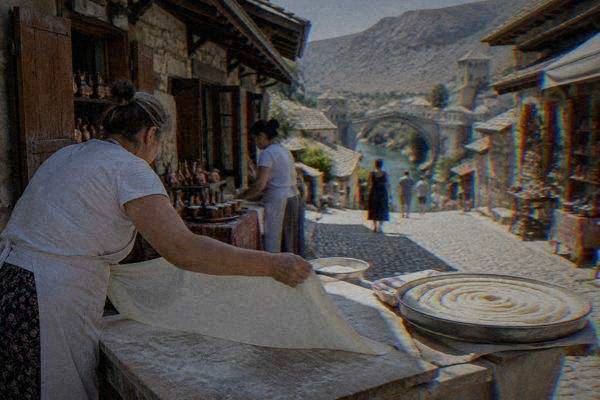
Best Restaurants In Mostar, Old Town And Beyond
Mostar's food scene runs from the stone lanes of Kujundžiluk to the grill smoke of Donja Mahala, and the dishes that matter here are grilled, rolled, slow-cooked and served with Bosnian coffee. This guide covers what to order, where in the city to look for it, and how the practical details of eating out in Bosnia and Herzegovina actually work.
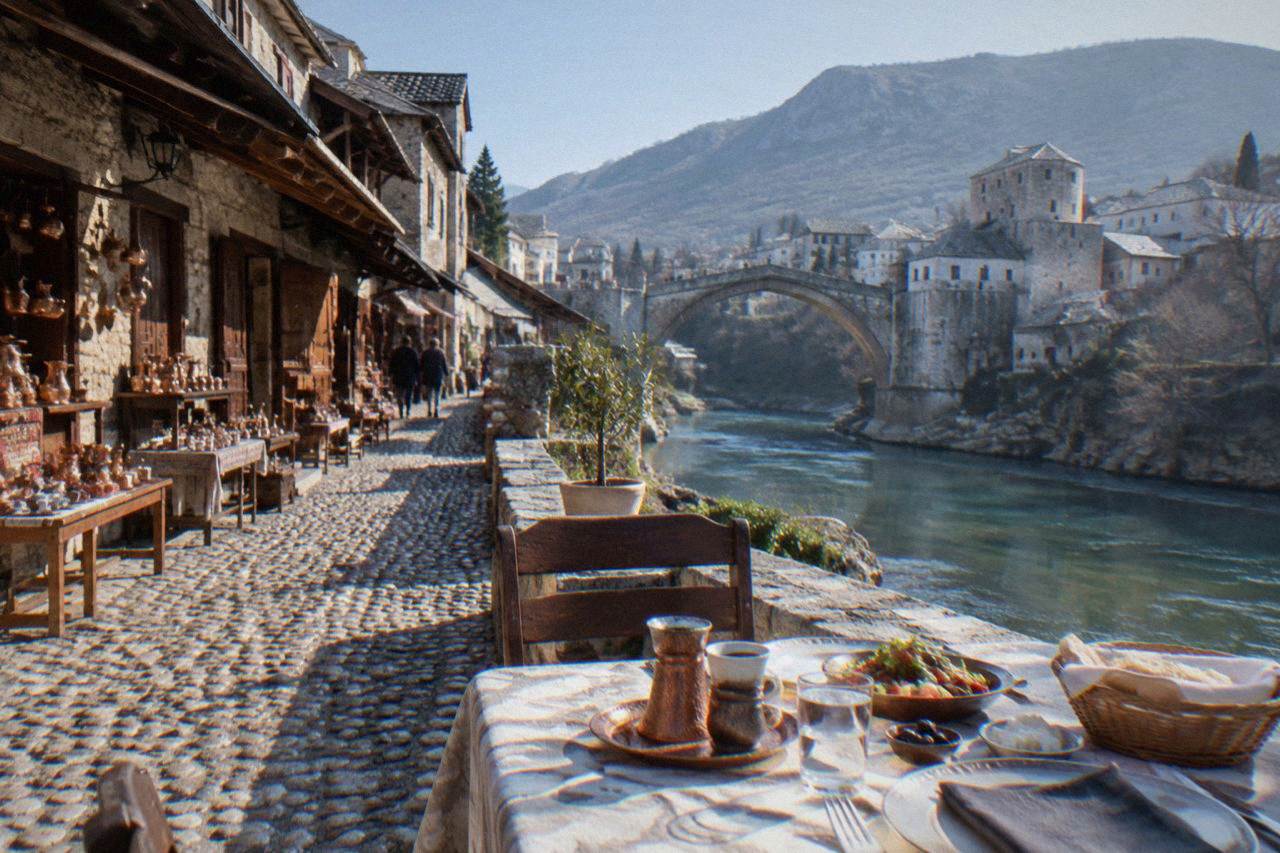
Mostar's restaurant scene centres on Bosnian and Herzegovinian cooking: ćevapi, burek, slow-cooked dishes under a sač lid, river trout and lamb, followed by Bosnian coffee and rakija. The Old Town around Kujundžiluk and the streets west of Stari Most carry the highest concentration of places to eat, and the city is compact enough to walk between them. Prices are in convertible marks, cards are accepted in larger places, and cash is still king at smaller kitchens.
Mostar sits inland on the Neretva river in Herzegovina, and its food reflects that position: mountain lamb and river fish rather than seafood, Ottoman-era grills and pastries rather than coastal plates. The restaurant scene is small, walkable and concentrated in a handful of areas around the Old Bridge. Eating here is less about chasing a single celebrated address and more about knowing the dishes, the neighbourhoods and the customs of the table, from the order of the coffee ritual to why the bill arrives in convertible marks. This guide from the Mostar Travel Guide editorial desk covers all of it.
Restaurant addresses, hours and menus in Mostar change often and are best confirmed on arrival or at your hotel. What follows instead is a working map of the food itself, the districts where each kind of cooking clusters, and the practical rules of paying, tipping and ordering that make every meal easier.
What Should You Order At Mostar Restaurants?
The core Mostar order is ćevapi in somun bread with raw onion, a rolled burek or a meat-filled pita, a slow-cooked dish from under the sač, river trout or Neretva frog legs where offered, and a Bosnian coffee to finish, with rakija or a local Herzegovina wine if the table wants it. These are the dishes the region's kitchens are built around, and they appear on menus across the city, from Kujundžiluk to the boulevards west of the Old Town.
Ćevapi are small hand-rolled minced-meat kebabs, grilled and served in a pocket of somun flatbread with chopped raw onion and, usually, a side of kajmak, a thick cultured cream. Burek is pastry rolled around a filling, most classically minced meat, though spinach, cheese and potato versions appear everywhere; it is sold by weight or by the piece and eaten at any hour, breakfast included. Both are everyday food here, not special-occasion dishes.
Slow cooking is the other pillar. Under a sač, a heavy metal lid buried in embers, kitchens bake lamb, veal and vegetables for hours, and the result is the celebration dish of Herzegovina: tender meat in its own juices. River fish from the Neretva basin, above all trout, and lamb from the Herzegovinian karst hillsides are the two ingredients the region is proudest of, and menus state their provenance when they can. For the stories behind the plates, the companion Bosnian food overview on this site sets out the wider cuisine.
| Dish | What It Is | How It Is Served |
|---|---|---|
| Ćevapi | Hand-rolled minced-meat kebabs | In somun bread with raw onion, kajmak on the side |
| Burek | Rolled pastry around a filling | By weight or the piece, eaten hot, any hour |
| Sač dishes | Lamb or veal slow-cooked under an ember lid | In its own juices, ordered ahead at many kitchens |
| River trout | Farmed and wild trout from the Neretva basin | Grilled, usually whole |
| Begova čorba | Chicken soup thickened with okra | As a first course |
| Bosnian coffee | Unfiltered coffee from a copper džezva | With rahat lokum, slowly |
| Rakija | Fruit brandy, often šljivovica or lozovača | As a welcome or a digestif |
| Herzegovina wine | Local whites and reds from Žilavka and Blatina grapes | By the glass or bottle |
Where Are The Best Areas To Eat In Mostar?
The main eating areas of Mostar are Kujundžiluk and the lanes immediately around Stari Most in the Old Town, the streets just west of the bridge across to Spanish Square, the Donja Mahala district on the left bank north of the Old Town, and the line of restaurants along the Neretva west of the centre. Each has a different register, from courtyard terrace to bakery counter, and all sit within walking distance of each other.
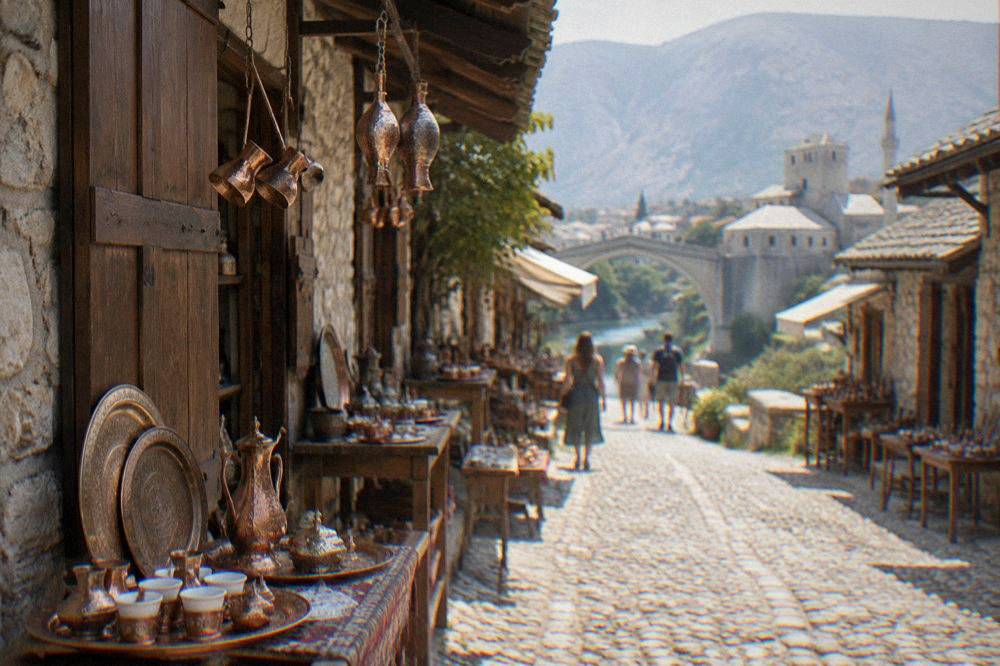
The Old Town is the postcard setting. Kujundžiluk, the old bazaar street, runs along the Neretva below the bridge, and its stone workshops now share the lane with grills, bakeries and terrace tables facing the water. Expect the highest concentration of visitors, the widest menus and the best views, including direct sightlines to the bridge divers' platform. A quiet detour is Kriva ćuprija, the small crooked bridge a few minutes north, whose surrounding lanes hold smaller kitchens. Spanish Square anchors the western end of the walk.
West of the bridge the city turns Austro-Hungarian and modern: wider streets, café terraces, patisseries and a spread of restaurants running from the Old Town edge toward Spanish Square and the university quarter. This is where locals eat their long lunches. Donja Mahala, across the river and north, is the fast-moving end of the spectrum, bakeries and grill counters turning out burek and ćevapi through the day. A Mostar walking tour is a reliable way to learn the geography before dinner.
| Area | Character | What To Expect |
|---|---|---|
| Kujundžiluk and the bridge lanes | Ottoman bazaar streets | Terraces over the Neretva, grills, bakeries, bridge views |
| Streets toward Spanish Square | Austro-Hungarian core | Café terraces, patisseries, longer menus |
| Donja Mahala | Left-bank neighbourhood | Bakery counters, fast grills, local trade |
| Neretva riverbank west of the centre | Riverside line | Fish kitchens and lamb specialists |
| Around the Rondo and boulevards | Modern city | Everyday restaurants and pizzerias |
How Does Bosnian Coffee Work In Mostar?
Bosnian coffee in Mostar is unfiltered coffee brewed in a small copper pot called a džezva, poured into tiny cups and drunk slowly, usually with a cube of rahat lokum, and it is a seated ritual rather than a takeaway habit. Ordering it is the standard end to a meal and the standard reason to occupy a terrace table for an hour. It is not the same drink as a Turkish coffee and locals will tell you so: the grind, the pot and the pour are the local markers.
The ritual has a sequence. The tray arrives with the džezva, the cup, sugar and sometimes a lokum. You wait for the grounds to settle, pour a thin stream without stirring the pot, and drink. Asking for it strong is understood everywhere. The companion pages on Mostar viewpoints and on rakija go deeper on both drinks; the short version for restaurant purposes is that coffee closes the meal, and nobody will hurry you off the table afterwards.
Espresso culture coexists with it. Most terraces serve both, and the espresso machine is standard in the modern quarter. But the džezva remains the thing Mostar does its own way, and it is the cheapest possible way to occupy a stone terrace above the Neretva for as long as you like. If the mostar money mechanics of paying puzzle you, carry small marks for café tables.
| Coffee Order | What You Get |
|---|---|
| Bosanska kafa | Džezva-brewed unfiltered coffee, small cup, slow pace |
| Espresso | Standard modern shot, everywhere in the new quarter |
| Domaća kafa | Same ritual as Bosnian kafa, alternate name |
| Kafa s mlekom / s mjekom | Coffee with milk, the regional name varies |
Rakija follows the same logic of the table. Šljivovica, plum brandy, and lozovača, grape brandy, are poured in small glasses, offered as a welcome in many family-run places and taken as a digestif after dinner. Herzegovina, with its limestone hills and long growing season, is also wine country: the local whites are made from Žilavka and the reds from Blatina, both indigenous to the region, and restaurant wine lists lean on them. Ordering a local bottle is the easiest food decision you will make in Mostar.
What Food Experiences Can You Book In Mostar?
The bookable food experiences in Mostar are a burek baking masterclass where you roll and bake the pastry yourself, a Bosnian cooking class built around burek, lunch and drinks, and wine-oriented tastings in the Herzegovina countryside outside the city, plus food-adjacent walking tours of the Old Town. They are the one category of Mostar eating where a reservation genuinely matters, because class sizes are small.
The burek masterclass is the most direct of these: you learn the roll, the stretch and the bake, and then eat the result. It turns a dish you will see in every bakery window into something you understand from the inside, which changes how every later burek stop in Bosnia and Herzegovina reads. Check availability for the Burek Masterclass in Mostar if the class fits your dates.
A broader option is a full cooking class with lunch and drinks included, covering more of the table than pastry alone.
And for a day built around countryside cooking rather than the city kitchen, a Herzegovina day tour pairs Blagaj's riverside restaurants at the Buna spring with the fortified village of Počitelj and Kravica waterfall, where the swimming hole sits 55.2 km by road, about 54 minutes free-flow, from the Old Bridge. Herzegovina's lamb kitchens cluster in exactly these villages.
How Do You Pay For Meals In Mostar?
Meals in Mostar are paid in convertible marks, KM, the currency of Bosnia and Herzegovina, pegged to the euro at 1 EUR = 1.95583 KM, and while euro cash is often accepted in tourist areas at a rounded rate of about 2 KM to the euro, that rounding works against you on small bills, so marks are the better money. Cards are taken at hotels, larger restaurants and supermarkets, but smaller kitchens, bakeries and market stalls expect cash, and the safe habit is to carry both.
The rate is fixed by a currency board, so there is no volatility to worry about, only the rounding. A bill worked out at an even two marks to the euro quietly costs you a little over two percent. Bankomats, as ATMs are called here, are common around the Old Bazaar and the boulevards; choosing to be charged in KM rather than euro at the machine avoids an extra fee layer. Tipping is appreciated but not obligatory: rounding up the bill, or leaving roughly ten percent at a proper restaurant, is the local register.
One more line item: a tourist tax, reported at 3 KM per person per night in the Herzegovina-Neretva Canton from 1 January 2026, is normally collected through your accommodation rather than at the restaurant table. Confirm it at booking. Bosnia and Herzegovina is not in the EU and not in Schengen, which matters if a food-focused itinerary hops the nearby Croatian border for the day.
| Payment Situation | What To Do |
|---|---|
| Larger restaurants, hotel dining | Card usually fine, marks preferred |
| Bakeries, market stalls, small grills | Cash in KM |
| Euro cash offered | Often accepted, rounded rate; confirm before ordering |
| ATMs | Widely available; choose to be charged in KM |
| Tipping | Round up, or about ten percent at restaurants |
When Is The Best Time Of Year To Eat Out In Mostar?
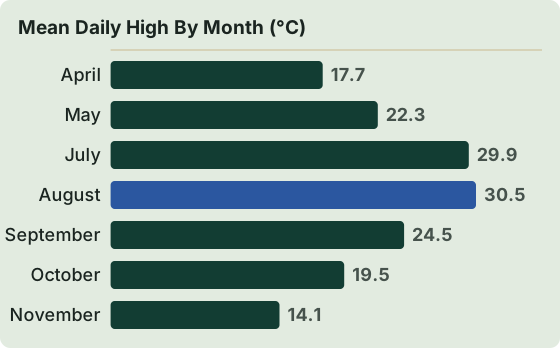
The outdoor-eating season in Mostar runs roughly from April into October, when terrace tables along the Neretva are the default, while July and August bring the heat, with modelled mean daily highs of 29.9 C and 30.5 C, ERA5 reanalysis 1991-2020, and a lunch-and-shade rhythm to the day. Winter eating moves indoors, and November's rainfall of 200.0 mm against July's 42.9 mm, FHMZ 1961-1990, sets the terrace calendar.
Herzegovina's climate is why the region eats the way it does: long hot summers ripen the grapes, the figs and the vegetables, and winter rain feeds the karst springs. For restaurant planning the practical read is that summer dinners start late and stretch, autumn is the comfortable middle, and winter is when the sač dishes and hearty stews make the most sense. The FHMZ Mostar station, 1961 to 1990, puts the July mean temperature at 24.7 C with an absolute recorded maximum of 41.2 C, so August lunches are for shade.
| Month | Mean Daily High (ERA5 1991-2020) | Eating Weather |
|---|---|---|
| April | 17.7 C | Terraces reopening |
| May | 22.3 C | Prime outdoor season |
| July | 29.9 C | Late dinners, shade at lunch |
| August | 30.5 C | Peak heat, eat late |
| September | 24.5 C | Comfortable, harvest time |
| October | 19.5 C | Last terrace weeks, rain returning |
| November | 14.1 C | Indoors, slow-cooked dishes |
The timing of a visit also lines up with the food calendar of events. Mostarsko ljeto ran 25 June to 7 August in 2026, the Mostar Blues & Rock Festival ran 24 and 25 July with free entry, and the 460th traditional Old Bridge diving competition ran on 26 July 2026, a day on which the restaurants around the bridge fill from mid-afternoon. The best time to visit Mostar page carries the fuller reasoning if food is your main filter.
Which Food Day Trips Work From Mostar?
The strongest food day trips from Mostar are Blagaj, 13.7 km and about 19 minutes by road from Stari Most, where riverside restaurants sit at the Buna spring below the Blagaj Tekke; the fortified village of Počitelj, 30.0 km and about 31 minutes; and the lamb country around Ljubuški near Kravica waterfall, 55.2 km and about 54 minutes free-flow. Each is close enough to eat lunch out and be back in Mostar for dinner, and organised day tours cover the whole loop.
Blagaj is the classic table of the region: trout from the Buna, tables literally over the cold spring water, and the tekke, the Dervish lodge, above it with entry reported at 10 KM and shoulders and knees covered for interior visits. Počitelj adds a fortified Ottoman hillside where the village itself is free to wander. Further afield, Konjic, 69.0 km and about 80 minutes, sits on its own stretch of the Neretva with its own fish kitchens, and Trebinje, 116.5 km and about 142 minutes, pairs an old town with the vineyards of the far south. A full-day tour that strings Blagaj, Počitelj and Kravica together is the simplest version.
| Food Day Trip | Road Distance From Stari Most | Free-Flow Drive Time |
|---|---|---|
| Blagaj Tekke and the Buna spring | 13.7 km | about 19 min |
| Stjepan-grad fortress above Blagaj | 13.9 km | about 20 min |
| Počitelj | 30.0 km | about 31 min |
| Kravica waterfall, Ljubuški area | 55.2 km | about 54 min |
| Konjic | 69.0 km | about 80 min |
| Trebinje | 116.5 km | about 142 min |
What Are The Unwritten Rules Of Eating Out In Mostar?
The unwritten rules of Mostar tables are simple: bread arrives first and is eaten with everything, rakija may be offered before you have ordered anything, the coffee afterwards is not a hint to leave, and splitting a single burek or a small ćevapi order is completely normal rather than frowned upon. Service is unhurried by design, and you ask for the bill, račun, because it will not arrive unbidden.
A few habits save awkwardness. In family-run places the menu may be recited rather than printed, and the daily dish, the meni of the day, is often the best thing in the kitchen. Water is generally served without asking. If a table by the bridge is what you want in summer, arriving before the divers gather, or booking ahead where a kitchen takes bookings, is the way to get it, since the bridge area fills on event days like the July diving competitions. And when a meal runs long, that is the local pace, not slow service.
Practical safety notes stay in the background but are worth one line each: the emergency number in Bosnia and Herzegovina is 112, and if a food pilgrimage turns into walking rural paths around Blagaj or above Počitelj, stay on marked routes because suspected mine areas remain in rural Herzegovina. In the city itself, the eating districts are compact and walkable, and the guidance on where to stay in Mostar places the dining quarters within an easy walk of every part of town.
Eating in Mostar, in the end, is a walkable subject: one bridge, two banks, a handful of dishes done seriously, and a coffee ritual that sets the pace for the whole afternoon. Order what the region grows and grills, carry some marks, linger over the džezva, and the restaurant question answers itself one terrace at a time.
Common Questions About Mostar Restaurants
What food is Mostar known for?
Mostar is known for ćevapi in somun with onion and kajmak, rolled burek, slow-cooked lamb and veal from under a sač, Neretva river trout, Bosnian coffee from a džezva, rakija, and Herzegovina wine from the Žilavka and Blatina grapes.
Is it expensive to eat out in Mostar?
Eating out in Mostar is generally modest by European standards, with bakery items the cheapest option and riverside terraces the priciest.
Do Mostar restaurants take credit cards?
Larger restaurants, hotels and supermarkets take cards, while bakeries, small grills and market stalls expect cash in KM. Euro cash is often accepted in tourist areas at a rounded rate; confirm the rate before ordering.
What is Bosnian coffee and how is it served?
Bosnian coffee is unfiltered coffee brewed in a small copper džezva, served on a tray with a tiny cup, sugar and often a piece of rahat lokum. You let the grounds settle, pour slowly and drink it at leisure; it closes meals rather than accompanying them.
Where should I eat near the Old Bridge in Mostar?
The lanes of Kujundžiluk below Stari Most and the streets running west from the bridge toward Spanish Square hold the densest concentration of restaurants, grills and cafés, many with river or bridge views. This page deliberately names no individual venue; ask at your accommodation for current local favourites.
Can you do a food tour or cooking class in Mostar?
Yes. A burek masterclass, a Bosnian cooking class with lunch and drinks, and Herzegovina day tours with riverside meals in Blagaj are all bookable from the city, and small class sizes make advance booking worthwhile.