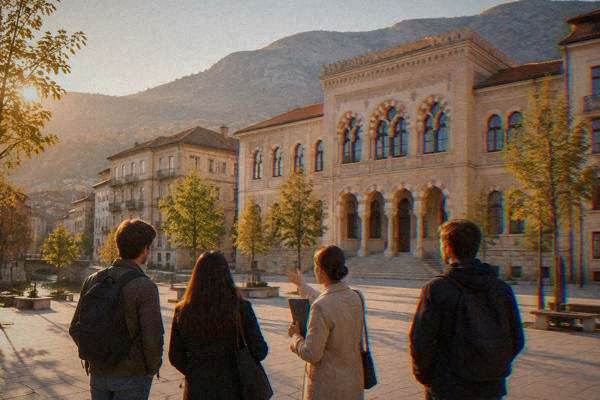
Spanish Square And The Old Gymnasium
Spanish Square is the central public square of Mostar, the main city of Herzegovina, an inland city on the Neretva river. This guide covers what the square is, how it connects to the Old Town, and what to plan around a visit.
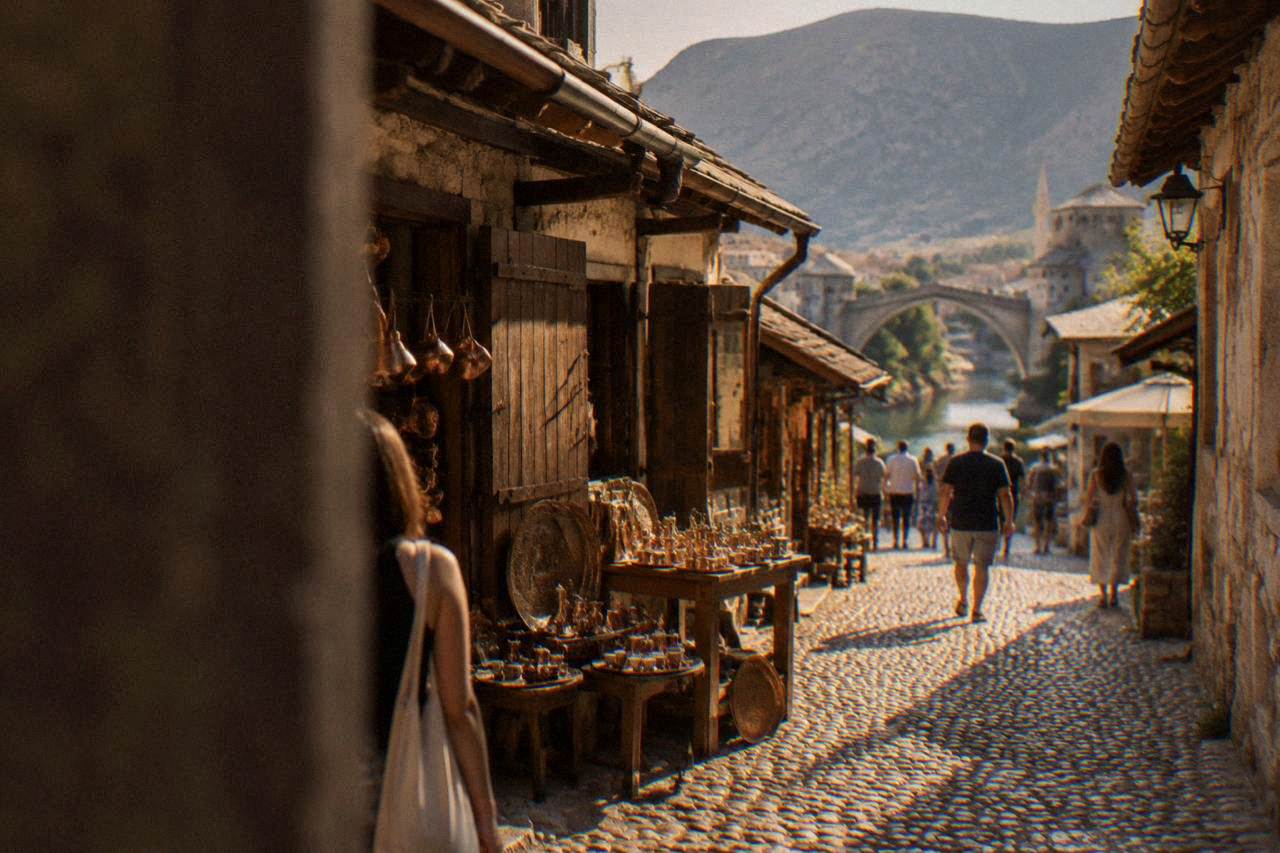
Spanish Square is Mostar's central square, a free, open public space in the modern centre that sits between the Old Gymnasium building and the road down to the Old Bridge. It costs nothing, it never closes, and it works well as the practical starting point for a walk through the city.
Spanish Square is the central square of Mostar, the main city of Herzegovina in Bosnia and Herzegovina, an inland city on the Neretva river with no sea coast. It is a free, always-open public space in the modern centre, and the Old Gymnasium building stands at its edge, one of the recognisable institutional buildings of the city. From the square, the Old Bazaar and the Old Bridge Area of the Old City of Mostar, the UNESCO World Heritage property inscribed in 2005, lie a short walk away downhill toward the river. This page from Mostar Travel Guide explains what the square is, how it fits into a visit, and what sits around it.
What Is Spanish Square In Mostar?
Spanish Square is the main central square of Mostar, a paved, open public space in the modern city centre that functions as its principal gathering point, framed by institutional buildings including the Old Gymnasium. It is public ground, free to enter and never closed, and it sits in the newer part of the city rather than inside the UNESCO-listed Old Bridge Area, which lies a short walk downhill. The square works as the hinge between modern Mostar and the Ottoman old town.
That hinge role matters for planning. The Old Bridge Area of the Old City of Mostar, UNESCO property 946, inscribed under criterion (vi), covers a compact 7.60 hectares with a 48 hectare buffer zone, and it is all reachable on foot from the centre. Spanish Square belongs to the administrative and commercial city that grew up around that core, a layer of Austro-Hungarian-era and later architecture that gives central Mostar its two distinct characters: the stone, river-level bazaar quarter around Stari Most, and the wider streets, institutions and cafes of the modern centre around the square.
The name honours Spain, whose soldiers served with the international force in Bosnia and Herzegovina after the war, and the square's naming is part of a wider pattern of central Mostar's public spaces carrying names from that period. Dates and names are what the record supports here, and they are what a visitor needs: this is a named, mapped, central square, not a ticketed attraction. Nothing about it requires booking, and no fee, opening hour or guided access applies.
Practically, the square is where the city's public life is easiest to observe: people passing between the bus-side of the centre and the old town, cafe terraces, students from the schools nearby, and the comings and goings around the Gymnasium. For a first-time visitor it answers the simplest question, where is the middle of Mostar, better than any map marker, because everything else in the centre is oriented from it.
How Far Is Spanish Square From The Old Bridge In Mostar?
Spanish Square sits a short, level-to-downhill walk from the Old Bridge: the square marks the start of the modern centre, and Stari Most stands at the heart of the old town just below it, a walk measured in minutes rather than any form of transport. The bridge itself is free to cross, open around the clock, and needs no ticket, so the route between square and bridge costs nothing at any hour of the day.
There is a reason this pairing is a standard walking route in the city: one of Mostar's established free walking tours is literally routed from Spanish Square to the Old Bridge, a pay-what-you-want walk of an hour and a half on the GuruWalk platform that connects the two ends of the centre. A tour route is a decent proxy for walkability, and central Mostar is compact enough that the square, the bazaar street of Kujundžiluk, the Crooked Bridge and Stari Most form one continuous pedestrian chain. No bus, taxi or ticket is needed for any of it.
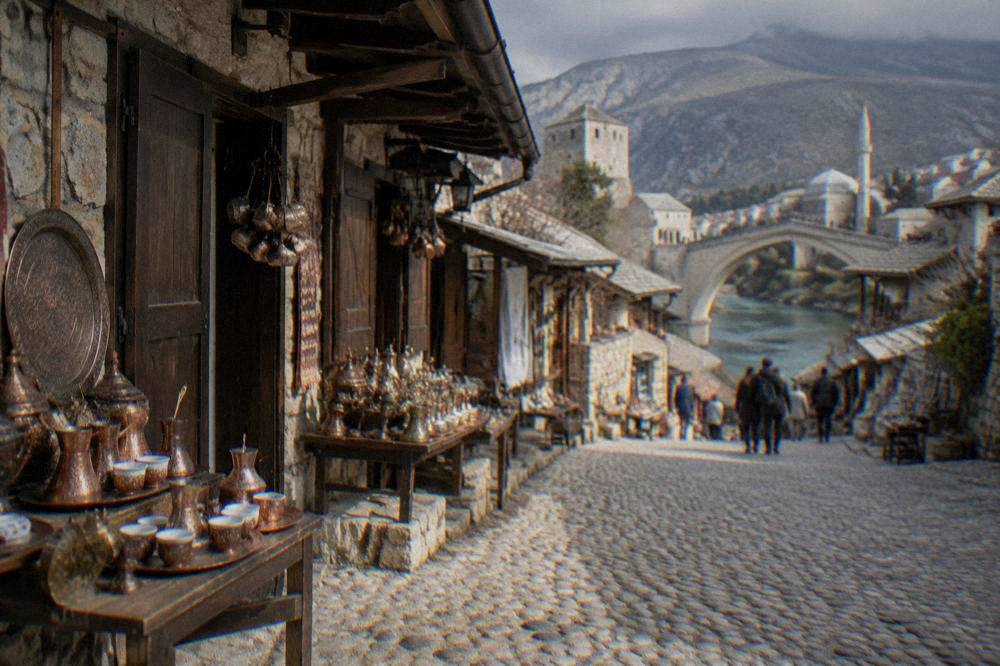
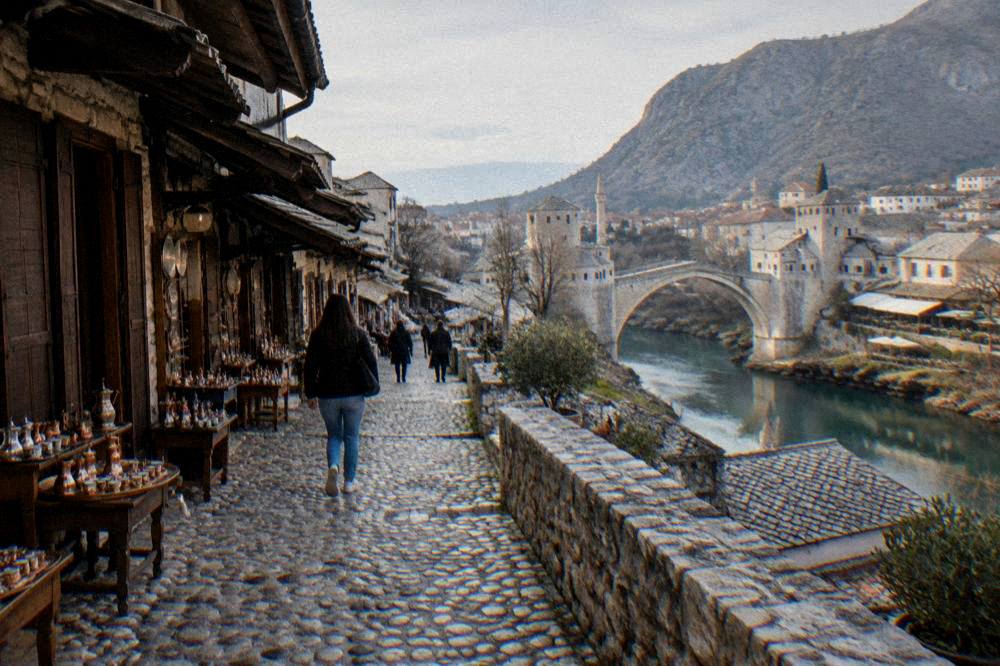
The walk passes through the two faces of the city in sequence. Leaving the square and its institutional buildings, the streets narrow, stone appears, and the gradient drops toward the Neretva, whose water stays cold even in August, fed by karst springs. The bridge itself, completed in 1566 to the design associated with the architect Hajruddin, was destroyed on 9 November 1993 during the war and rebuilt and reopened in July 2004; its height above the river is about 21 to 24 metres depending on the water level. Crossing it is the single free act that anchors any visit to the city.
For orientation, the whole set of central sights clusters inside this corridor. The Old Town area guide covers the bazaar quarter in detail, and the museum in the Tara tower beside the bridge adds context to the reconstruction, with a reported admission of about 10 KM and reported daily hours of 08:00 to 16:00 from 1 April to 1 November; confirm both on site before counting on them.
What Can You See Within Walking Distance Of Spanish Square In Mostar?
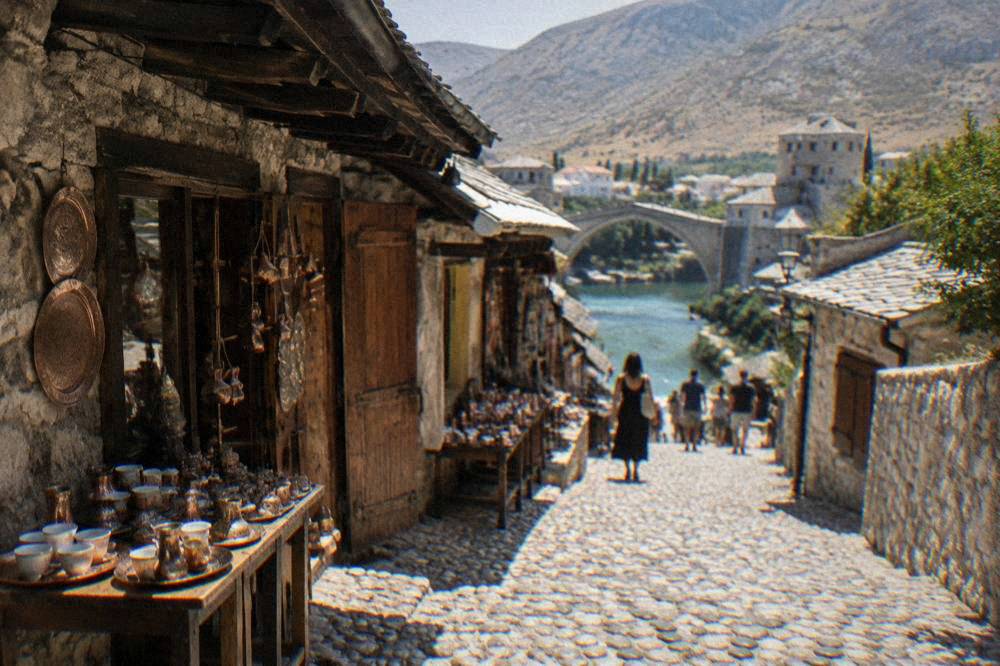
Almost everything central Mostar is known for sits within a short walk of Spanish Square: Stari Most and the Kujundžiluk bazaar below it, the Crooked Bridge, the Koski Mehmed-pašina džamija with its minaret view, the Ottoman courtyard houses open as museums, and the riverside path along the Neretva. The square is the sensible base point because every one of these is reachable on foot, several are free, and the paid ones each carry only a small local fee.
The table below gathers the central sights with what is known about access. Where a figure is reported rather than official, it is marked as reported, and the rule for all of them is to confirm the current price at the door.
| Sight | Distance From The Square | Admission | Notes |
|---|---|---|---|
| Stari Most (Old Bridge) | Short walk downhill | Free, open 24/7 | Public pedestrian crossing |
| Kujundžiluk bazaar | Short walk downhill | Free | Open street and shopfronts |
| Kriva ćuprija (Crooked Bridge) | Short walk | Free | Public structure |
| Koski Mehmed-pašina džamija | Short walk, old town | Small cash fee, reported; more with the minaret | Reports vary, confirm on site |
| Old Bridge Museum (Tara tower) | At the bridge | About 10 KM, reported | Reported hours 08:00-16:00, 1 Apr to 1 Nov |
| Muslibegović House | Walkable | About 8 KM, reported | Ottoman house museum |
| Bišćević House | Walkable | About 4 KM, reported | Ottoman house museum |
| Partisan Memorial Cemetery | Beyond the centre on foot | No ticket, no staffed hours | Inaugurated 1965, Bogdan Bogdanović |
Three of these deserve a little more context. The Koski Mehmed-pašina džamija, whose full page covers it in depth, is the old town's principal mosque, and reports of its fee vary between roughly 10 KM for the mosque alone and around 18 KM with the minaret climb, figures to confirm on arrival. The two Ottoman houses, Bišćević House and Muslibegović House, are both courtyard homes from the Ottoman period turned museums, each with a small reported entry fee. The Partisan Memorial Cemetery, designed by Bogdan Bogdanović and inaugurated in 1965, stands on the hillside beyond the centre; Europa Nostra reported in 2026 that over 700 of its stone memorial markers were destroyed in 2022 and listed the site among Europe's most endangered heritage, so go expecting a memorial in poor condition, not a polished monument.
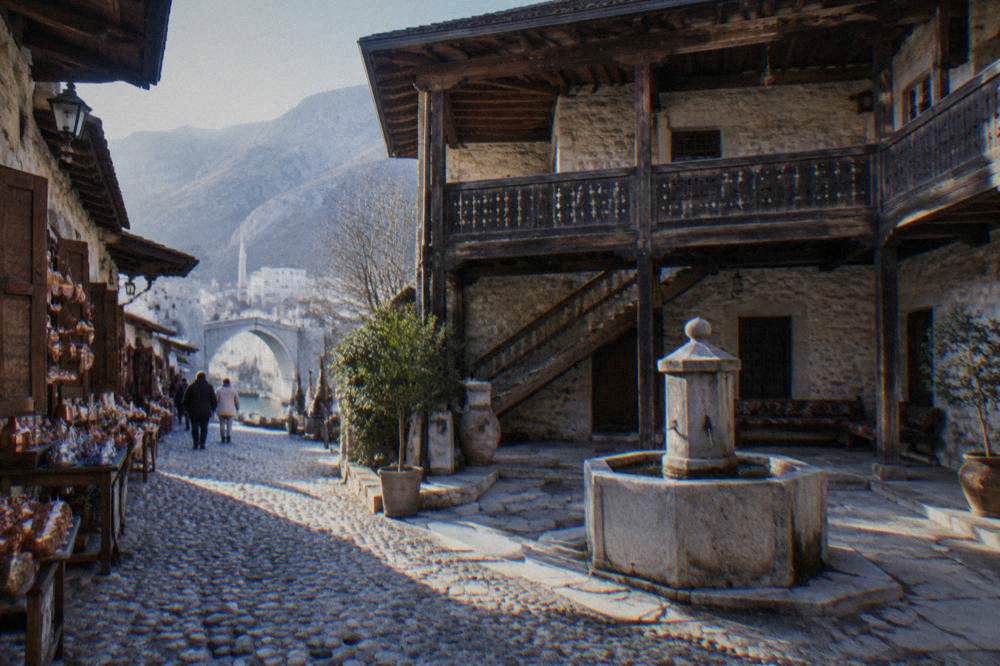
For visitors who want the square's surrounding layer explained rather than just found, a guided walk is the efficient option, and the related pick below starts from exactly this kind of central orientation before dropping into the old town.
The private walking tour above covers the central city and the old town with a guide, and dates, prices and ratings render live from the listing. If a group format suits better, the Mostar walking tour overview compares the formats available in the city.
Is Spanish Square A Good Starting Point For Exploring Mostar?
Spanish Square is one of the two natural starting points for exploring Mostar, the other being the Old Bridge itself, and the square has the advantage of showing the modern city before the old one: from it you walk downhill through the whole urban sequence, ending at the river, rather than starting at the landmark and backtracking. It is free, central, and connected on foot to everything in the historic core.
The direction of the walk is the whole argument. Starting high at the square, you pass the Gymnasium, the commercial streets, then the narrowing stone lanes, then Kriva ćuprija, then the bazaar, then the bridge: the city in chronological layers, Ottoman at the bottom, modern at the top. Done in reverse it still works, but the square-first order builds context instead of starting with the payoff, and it ends at the Neretva, whose cold water and bridge divers, when the Mostari club members jump between May and October, close the walk at river level. Jumps are made by trained club members only; there is no pay-to-jump option for visitors, and the bridge competition's 460th edition ran on 26 July in 2026.
For travellers with only a few hours, the one day in Mostar itinerary shows how the square, the old town and a viewpoint fit together, while those with longer can add a day trip; the road distances below are computed from Stari Most and exclude border queues. Two cautions apply to any walking plan in Herzegovina: summer afternoons are seriously hot, with modelled July and August mean daily highs of 29.9 and 30.5 C (ERA5 reanalysis, 1991-2020), so walk early; and outside the city, stay on marked paths because of suspected mine areas, which matter in rural Herzegovina, not on the paved central streets.
What Role Does The Old Gymnasium Play Beside Spanish Square In Mostar?
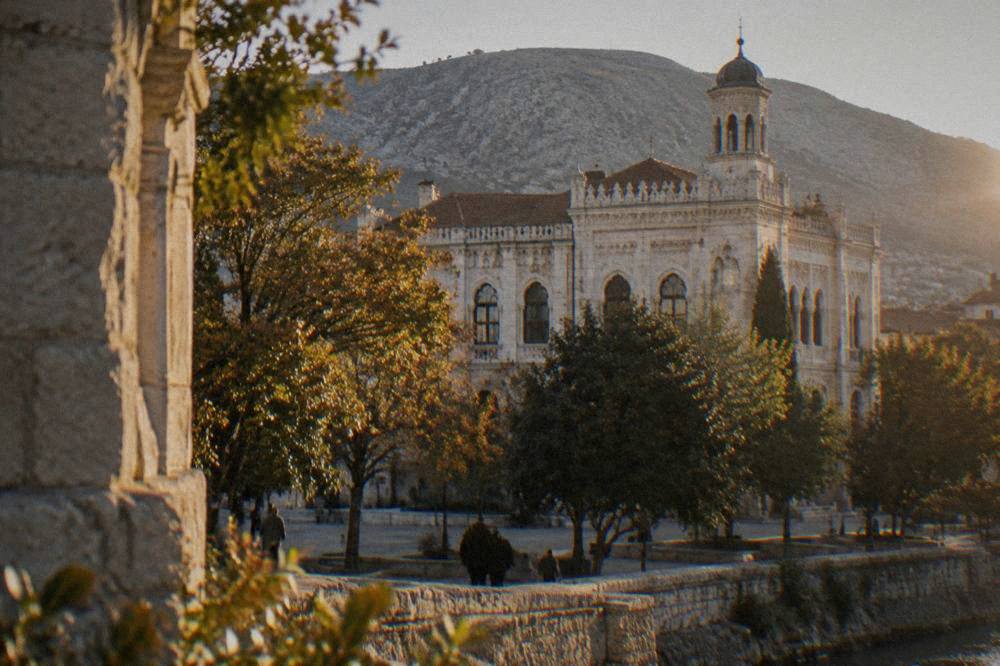
The Old Gymnasium is the principal historic school building of central Mostar, standing at the edge of Spanish Square, and it anchors the square's identity as the educational and institutional heart of the modern city rather than its tourist one. The building is a landmark of the Austro-Hungarian layer of the city's architecture, that 1878 to 1918 period when Mostar developed as an administrative and educational centre, and it still reads as a school precinct today.
That educational inheritance is a real part of the city's character. Mostar grew from a settlement first mentioned by name in a document of 1474, derived from "mostari", the keepers of the bridge, into the main city of Herzegovina with a population of about 105,000 at the 2013 census. The Gymnasium belongs to the later, institutional phase of that growth, and its position beside the main square is typical of how Austro-Hungarian city centres were arranged: school, square, administration, commerce, all within a few minutes' walk. No tour or ticket applies to the building itself; it is architecture to see in passing, and the square in front of it is the place to see it from.
The square and the Gymnasium together also mark the line where a visitor's mental map of Mostar should switch. Below this line lies the heritage core, dense and walkable. Above and around it lies the living city: the boulevard, the viewpoints on Hum hill and the Fortica side, and the residential slopes. A good plan uses the square as the border crossing between the two, and the viewpoints guide picks out the elevated spots reachable on foot or by the cable car side of the city.
What Events And Festivals Fill Central Mostar Around Spanish Square?
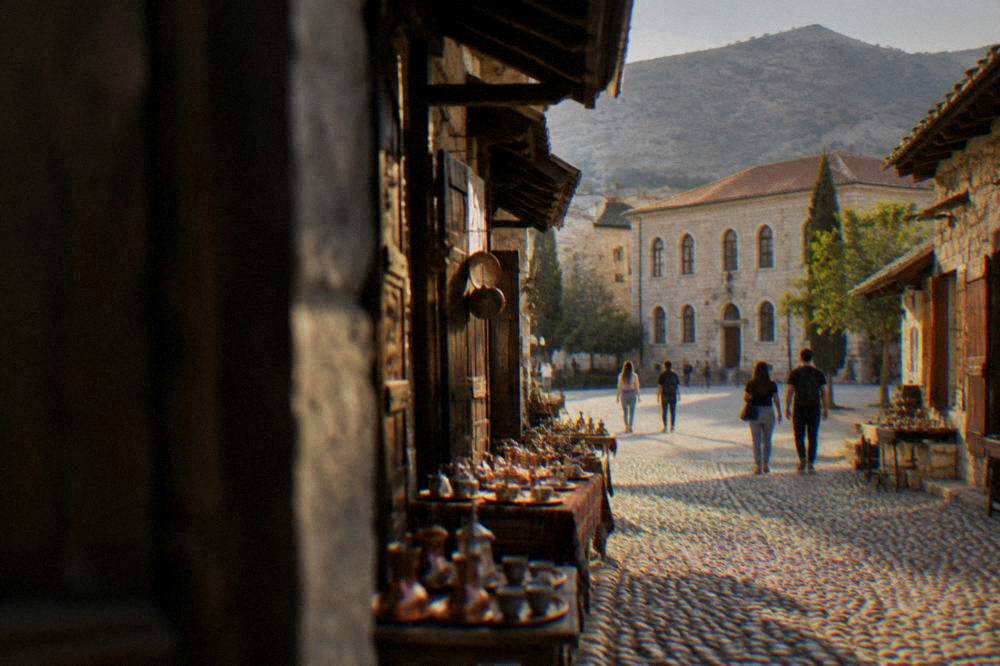
Central Mostar runs a concentrated summer festival season, with Mostarsko ljeto spanning 25 June to 7 August in 2026, the Mostar Summer Fest on 2 to 4 July, the Blues and Rock Festival on 24 and 25 July, free to enter, and the Jazz Fest from 23 to 25 August, plus the bridge diving tradition on 26 July and the Red Bull Cliff Diving round from 30 July to 1 August. The square, as the city's central public space, sits inside this circuit of venues spread across central institutions.
The 2026 season, the latest on record, looked like this:
| Event | 2026 Dates | Notes |
|---|---|---|
| Mostarsko ljeto | 25 Jun to 7 Aug | Cultural programmes across city institutions |
| Mostar Summer Fest | 2 to 4 Jul | Concert programme, SC Kantarevac |
| Traditional bridge diving competition | 26 Jul | 460th edition, Mostari diving club |
| Mostar Blues and Rock Festival | 24 and 25 Jul | 24th edition, free entry |
| Red Bull Cliff Diving World Series | 30 Jul to 1 Aug | 10th Mostar stop, women 21 m, men 27 m |
| Mladifest, Međugorje | 1 to 6 Aug | Youth festival, 37th edition, 28.3 km away |
| Mostar Jazz Fest | 23 to 25 Aug | Concerts at various venues |
These are 2026 facts, not a permanent calendar: dates for later years are not published, so check each festival's own channels before planning a trip around one. What is stable is the shape of the season, July above all, which coincides with both the driest weather, July averages just 42.9 mm of rain against November's 200.0 mm (FHMZ Mostar station, 1961 to 1990), and the peak of the bridge diving tradition. Anyone in the city in late July will feel the two diving events, the traditional club competition first, then the international series with its added platforms above the river.
For visitors whose interest runs to the table rather than the stage, Herzegovina's food culture reaches Mostar through its grills, burek and wine, and the restaurant guide covers where the city eats; a cooking class is another way in, and the pick below builds a burek from scratch with lunch included.
What Is The Weather Like Around Spanish Square Through The Year?
Mostar has a hot Mediterranean-continental climate with a marked winter rainfall maximum: mean temperatures run from 4.8 C in January to 24.7 C in July (FHMZ Mostar station, 1961 to 1990), modelled summer mean daily highs reach about 30 C in July and August (ERA5 reanalysis, 1991-2020), and annual precipitation totals 1,515.4 mm, with November at 200.0 mm against July's 42.9 mm. The square, being open and unshaded in parts, is a place for mornings in summer and middays in winter.
| Month | Mean Temp C (FHMZ 1961-1990) | Precip mm (FHMZ 1961-1990) | Mean High C (ERA5 1991-2020) |
|---|---|---|---|
| Jan | 4.8 | 164.7 | 8.4 |
| Feb | 6.6 | 151.1 | 9.7 |
| Mar | 9.6 | 150.1 | 13.4 |
| Apr | 13.3 | 127.3 | 17.7 |
| May | 17.9 | 102.1 | 22.3 |
| Jun | 21.5 | 77.9 | 26.8 |
| Jul | 24.7 | 42.9 | 29.9 |
| Aug | 24.2 | 73.7 | 30.5 |
| Sep | 20.4 | 96.3 | 24.5 |
| Oct | 15.3 | 150.6 | 19.5 |
| Nov | 10.1 | 200.0 | 14.1 |
| Dec | 6.2 | 178.7 | 9.3 |
Two readings of that table help with planning. First, the rain is seasonal in a way that surprises visitors expecting Balkan summer damp: the wet months are November through February, and the summer is genuinely dry, July recording on average only 5 days with more than 1 mm of rain. Second, heat is the real constraint, not weather closures: the absolute maximum on record for July is 41.2 C, and while the modelled mean daily high is 29.9 C, the valley floor runs hotter than the model grid suggests. Sightseeing around the square and the old town is best done before midday from June to September, with the afternoon given to shade, the river bank or a drive to the waterfalls.
Winter, by contrast, is quiet, occasionally white, snow cover has reached 37 cm in the record, and entirely workable: the square, the bridge and the bazaar stay open, and the winter guide covers the cold-season city in detail.
What Day Trips Can You Reach From Central Mostar?
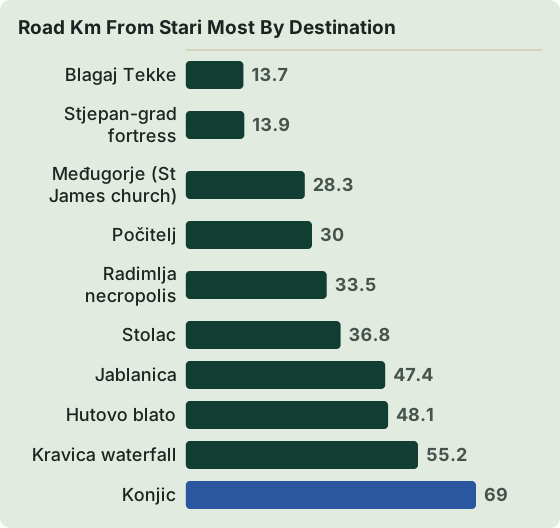
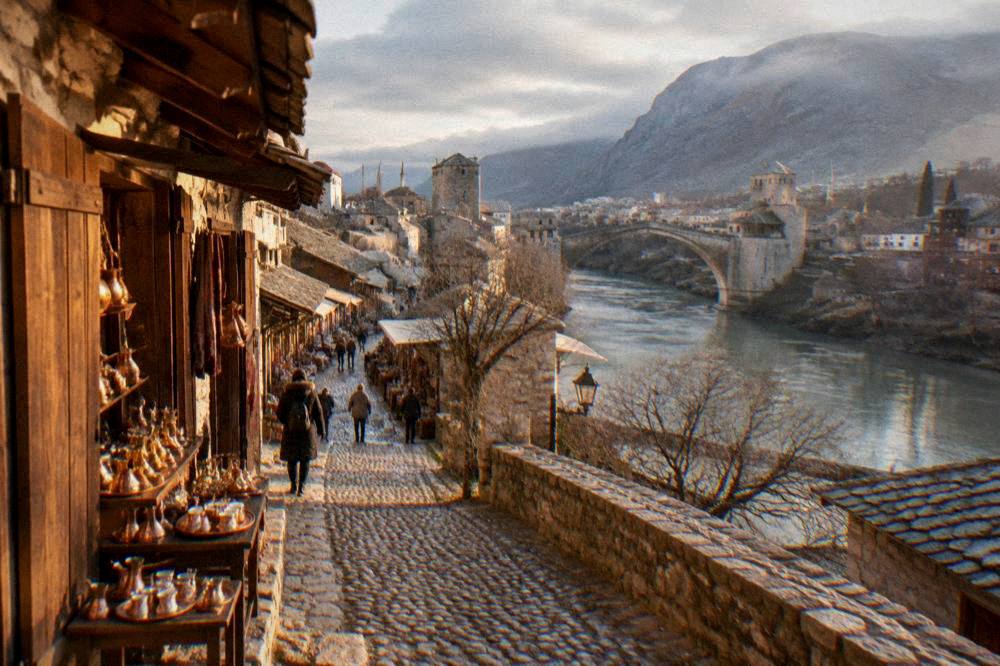
Central Mostar is the natural hub for Herzegovina day trips: Blagaj and its Tekke at the Buna spring sit 13.7 km and about 19 minutes away by road, Počitelj 30.0 km and about 31 minutes, Kravica waterfall 55.2 km and about 54 minutes, and Konjic 69.0 km and about 80 minutes, all computed free-flow times from Stari Most with border queues excluded. Organised day tours from the city cover the Blagaj, Počitelj and Kravica circuit in a single loop.
| Destination | Road km From Stari Most | Free-Flow Minutes |
|---|---|---|
| Blagaj Tekke | 13.7 | 19 |
| Stjepan-grad fortress | 13.9 | 20 |
| Međugorje (St James church) | 28.3 | 40 |
| Počitelj | 30.0 | 31 |
| Radimlja necropolis | 33.5 | 42 |
| Stolac | 36.8 | 47 |
| Jablanica | 47.4 | 57 |
| Hutovo blato | 48.1 | 62 |
| Kravica waterfall | 55.2 | 54 |
| Konjic | 69.0 | 80 |
| Trebinje | 116.5 | 142 |
| Sarajevo (Baščaršija) | 127.1 | 134 |
| Dubrovnik (Stradun) | 145.5 | 150 |
The three nearest stops reward the shortest drives. Blagaj's Tekke at the Buna spring carries a reported entry of 10 KM with reported hours of 08:00 to 22:00 from April to October and 09:00 to 17:00 from November to March, and shoulders and knees must be covered inside, with wraps provided. Počitelj's fortified village is free to wander. Kravica waterfall charges 20 KM for an adult all year, 10 KM for residents of Bosnia and Herzegovina, with children under 7 free, and it is open all year with hours that shift by month, 07:00 to 22:00 from June to September, 07:00 to 17:00 in the depths of winter; swimming is allowed in summer in the designated pool below the falls, with no lifeguard reported, so check the park's rules on arrival.
Further out, Stolac pairs with the Radimlja necropolis, whose medieval stećci tombstones were inscribed on the UNESCO list in 2016 as part of property 1504, entry reported at 8 KM, and Konjic adds the ARK D-0 bunker, visited by guided tour only with booking required and closed Mondays, at a reported 40 KM for foreign visitors. Cross-border trips to Dubrovnik run 145.5 km and about 150 minutes free-flow plus the border, and the Croatian land border has carried full checks since 1 January 2023, with reported waits of up to about 30 minutes and longer at summer peaks; confirm times on the day.
For travellers who would rather not drive, guided day tours from Mostar handle the circuit, and the trio below covers the formats, from private versions to small-group loops.
What Practical Facts Should You Know Before Visiting Spanish Square In Mostar?
Spanish Square costs nothing and never closes, the currency is the convertible mark (KM), pegged at 1 EUR = 1.95583 KM, Bosnia and Herzegovina is not in the EU or Schengen, and a tourist tax reported at 3 KM per person per night applies across Herzegovina-Neretva Canton, a figure to confirm at booking. Visa-exempt visitors may stay up to 90 days in a six-month period from first entry, and the emergency number is 112.
The money point is the one that catches people. Prices in Mostar are set in KM, not euro, though euro cash is often accepted in tourist areas at a rounded rate of about 2 KM to 1 EUR, which is less favourable than the official peg, so paying in KM is the better default. Cards work at hotels and larger venues; small vendors and market stalls want cash. The border point matters for anyone combining the city with Dubrovnik or Split: the Croatian line is a Schengen external border with passport checks, and ETIAS is not in operation, so no pre-authorisation is currently needed for visa-exempt travellers.
The rest of the practical layer is simple. Taxis in the city are a short, inexpensive ride when needed. Tap water is treated and generally safe. Plugs are type C and F at 230 V. In rural Herzegovina, on any walk beyond town, stay on marked paths because of suspected mine areas; on the paved streets around the square and the old town this is not a concern. And the summer sun is real: carry water and plan the square-to-bridge walk for the morning, because the modelled August mean daily high is 30.5 C (ERA5 reanalysis, 1991-2020) and the record for the valley stands at 41.2 C.
How Does Spanish Square Fit Into The Story Of Modern Mostar?
Spanish Square belongs to the modern, post-Ottoman layer of Mostar, the city that grew around schools, administration and commerce and then lived through the war of 1992 to 1995, in which the Old Bridge was destroyed on 9 November 1993, and through the reconstruction that followed, with the bridge reopened in July 2004 and its surroundings inscribed by UNESCO in 2005. The square is where that modern city gathers, and several of the city's history tours route through or near it.
For visitors who want the modern story told with structure, the war-history walks are the format that does it, and the pick below is one of the two focused on the breakup of Yugoslavia and the siege years, run as a guided city walk:
The fuller background, the city's foundation, the 1566 bridge, the 1993 destruction and 2004 reconstruction, is covered in the site's Mostar history guide, and the memorial sites, from the Partisan Memorial Cemetery to the War Photo Exhibition, each have their own pages. What the square adds to that story is the civic frame: this is where the contemporary city holds its public life, between the Gymnasium that has educated generations and the old town that draws the world's visitors, and standing in it puts the two halves of Mostar in one view.
Common Questions About Spanish Square In Mostar
Is Spanish Square in Mostar free to visit?
Yes. It is a public open space with no ticket, no gate and no closing time, and it can be crossed or lingered in at any hour. Nothing on the square itself is ticketed.
How do you get from Spanish Square to the Old Bridge?
On foot, downhill through the modern centre into the old town. The route is a standard city walk, it costs nothing, and the bridge itself is free to cross at any hour.
What is the Old Gymnasium in Mostar?
The principal historic school building of central Mostar, standing beside Spanish Square, from the period when the city developed as an administrative and educational centre between 1878 and 1918. It is a working school landmark seen in passing, not a ticketed attraction.
Are there guided tours that start near Spanish Square?
Yes. Private and small-group walking tours of the city cover the central square and the old town in one loop, and free, pay-what-you-want walks routed from the square to the Old Bridge run on the GuruWalk platform.
When is the best time of day to see Spanish Square?
Early morning in summer, when the air is cooler, the light is low and the walk down to the river is comfortable; midday or early afternoon in winter, when the square catches whatever sun is available and the cafes are at their busiest.
Can you reach Blagaj and Kravica waterfall from central Mostar?
Yes. Blagaj Tekke is 13.7 km and about 19 minutes by road from Stari Most, and Kravica waterfall is 55.2 km and about 54 minutes free-flow. Guided day tours from Mostar cover both plus Počitelj in a single loop, and driving yourself is straightforward on Herzegovina's main roads.