Koski Mehmed-Pasha Mosque: The Minaret View Of The Bridge
Koski Mehmed-pašina džamija stands a few steps from Stari Most on the Kujundžiluk side, and its minaret platform is one of the closest elevated views of the Old Bridge in Mostar. This page covers the reported entry fee, what the visit involves, and how to fit it into a day in the Old Town.
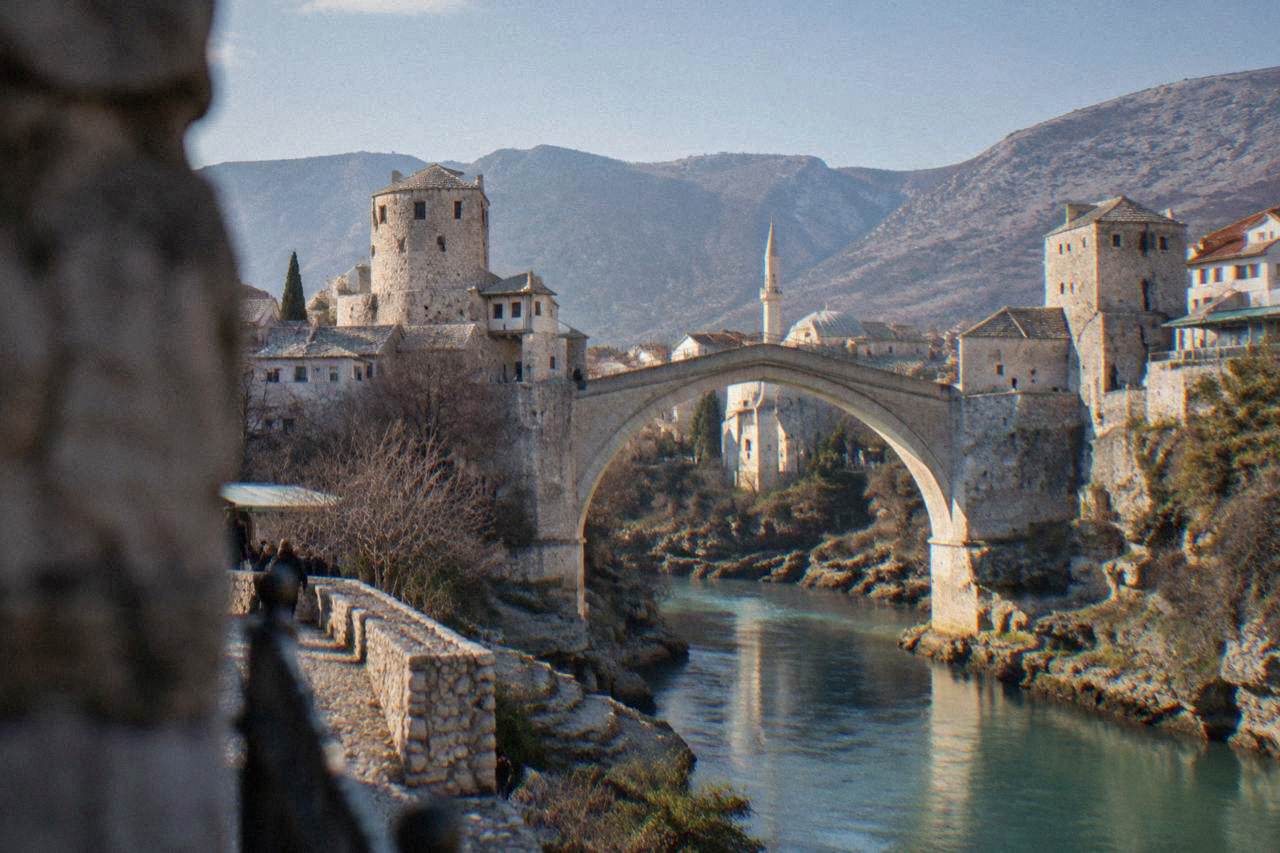
Koski Mehmed-pašina džamija is an Ottoman mosque on the Neretva bank about a minute's walk from Stari Most. A small reported cash fee covers the prayer hall, more with the minaret, and the minaret platform gives a direct view along the river to the Old Bridge.
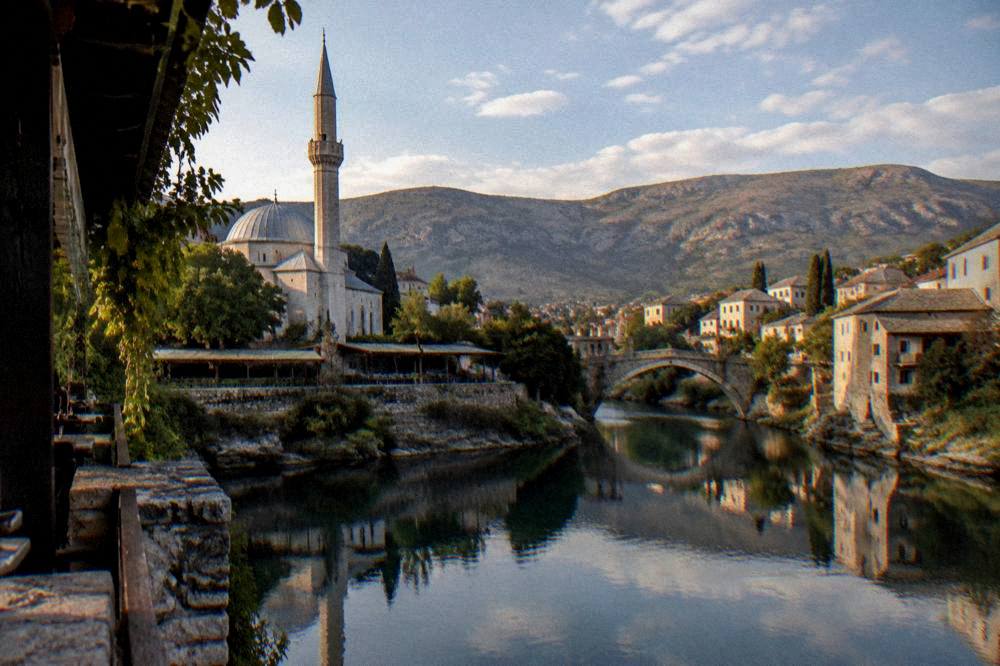
Koski Mehmed-pašina džamija, the Koski Mehmed Pasha Mosque, is the riverside Ottoman mosque that appears in almost every photograph of Stari Most taken from the water. It stands on the Kujundžiluk, the Old Bazaar street, on the east bank of the Neretva river in Mostar, the main city of Herzegovina in Bosnia and Herzegovina, an inland city with no sea coast. The mosque sits close enough to the Old Bridge that the two are usually visited in the same ten minutes, and its minaret platform is one of the nearest elevated viewpoints looking directly along the river toward the arch.
What Is The Koski Mehmed-Pasha Mosque In Mostar?
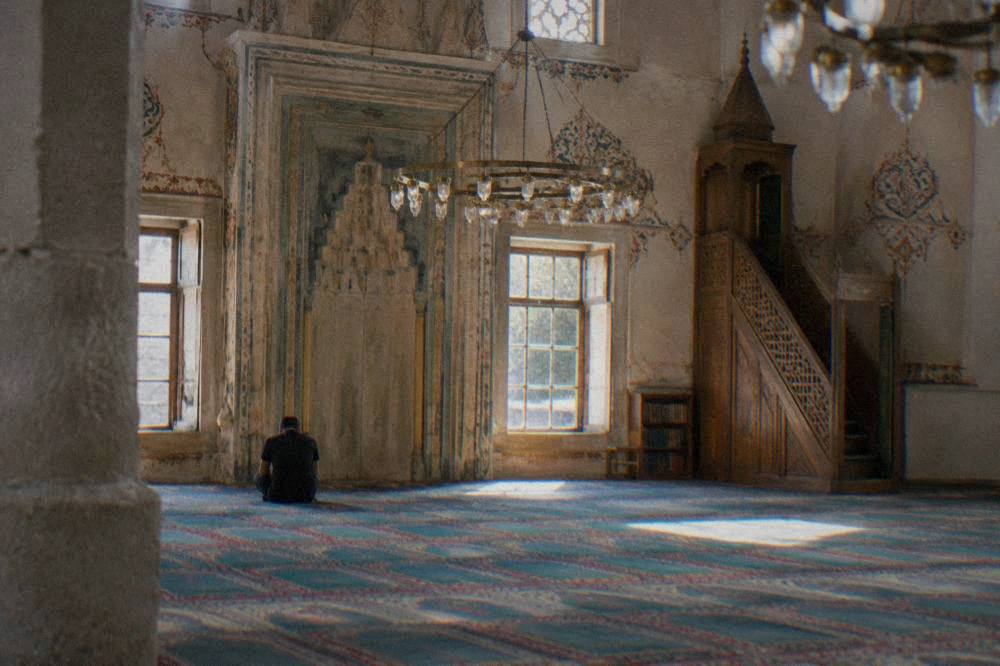
Koski Mehmed-pašina džamija is an Ottoman-era mosque on the east bank of the Neretva river in Mostar's Old Town, standing at the end of the Kujundžiluk bazaar street a short walk from Stari Most. Its stone terrace sits directly over the turquoise water, and it is a working mosque as well as a monument, sitting inside a protected UNESCO townscape. The building gives its name to the whole bend of the river here, and its stone terrace sits directly over the turquoise water. It is a working mosque as well as a monument, so the visiting experience is built around respect for prayer times rather than a fixed museum schedule, and the interior is a small, single-space prayer hall rather than a large sight.
The Old Bridge Area of the Old City of Mostar, which surrounds the mosque, was inscribed as a UNESCO World Heritage property in 2005 under criterion (vi). The bridge at the centre of that property was completed in 1566 under Suleiman the Magnificent, designed by mimar Hajruddin following the design approach of his master Sinan, according to the UNESCO description. It was destroyed on 9 November 1993 and rebuilt and reopened in July 2004. The mosque sits inside the same protected townscape, and the view between the minaret and the bridge is the reason many people climb it.
What the visit amounts to is three parts: the terrace over the river, the prayer hall inside, and the narrow minaret staircase. The terrace alone is worth a pause, because it looks straight down the Neretva toward Kriva ćuprija, the Crooked Bridge, upstream. The interior is modest in size and dressed in the colour and calligraphy you expect of a Herzegovinian mosque. The minaret is the tightest part, a spiral stair of small steps, and it delivers the payoff view of the bridge from above the rooftops of the bazaar.
How Much Does The Koski Mehmed-Pasha Mosque Cost To Enter?
Entry is reported at about 10 KM in cash for the mosque, with a combined ticket reported at about 18 KM when the minaret climb is included, and reports vary between roughly 14 and 18 KM for that option, so confirm the posted amount at the door. The fee is charged at the door, paid in cash, and confirmed on arrival, because no official price page is published online for the mosque. Crossing Stari Most itself remains free at any hour, so the mosque is one of the few paid stops inside the Old Town core.
The currency throughout Bosnia and Herzegovina is the convertible mark (KM, BAM), pegged at 1 EUR = 1.95583 KM. Euro cash is often accepted in tourist areas at a rounded rate of about 2 KM to the euro, but that is a convenience, not an official rule, so confirm the rate before paying. Cards are fine at hotels and larger shops, while small cash fees like this one are paid in cash, usually KM.
For planning, here is how the paid sights around the Old Bridge compare, with each figure reported rather than official, so treat the amounts as a range to expect rather than a promise:
| Sight | Reported entry | Notes |
|---|---|---|
| Stari Most (Old Bridge) | Free | Public crossing, open around the clock |
| Koski Mehmed-pašina džamija | About 10 KM | Cash at the door, confirm on arrival |
| Same, with minaret climb | About 14 to 18 KM | Reports vary, confirm the combined ticket |
| Old Bridge Museum (Tara tower) | About 10 KM | Reported 08:00 to 16:00 daily, 1 April to 1 November |
| Muslibegović House | About 8 KM | Ottoman house museum |
| Bišćević House | About 4 KM | Ottoman house museum on the river |
For context on the wider area: Kravica waterfall charges 20 KM for an adult all year, with 10 KM for residents of Bosnia and Herzegovina, children under 7 free, and school groups aged 7 to 18 at 10 KM, per the park's own visitor page. Those figures show the scale of sight pricing in Herzegovina, and the mosque sits at the low end of it.
If a guided visit appeals, the private option below covers the Old Bridge, the Old Bazaar and the riverside quarter in one walk:
Can You Climb The Minaret At The Koski Mehmed-Pasha Mosque?
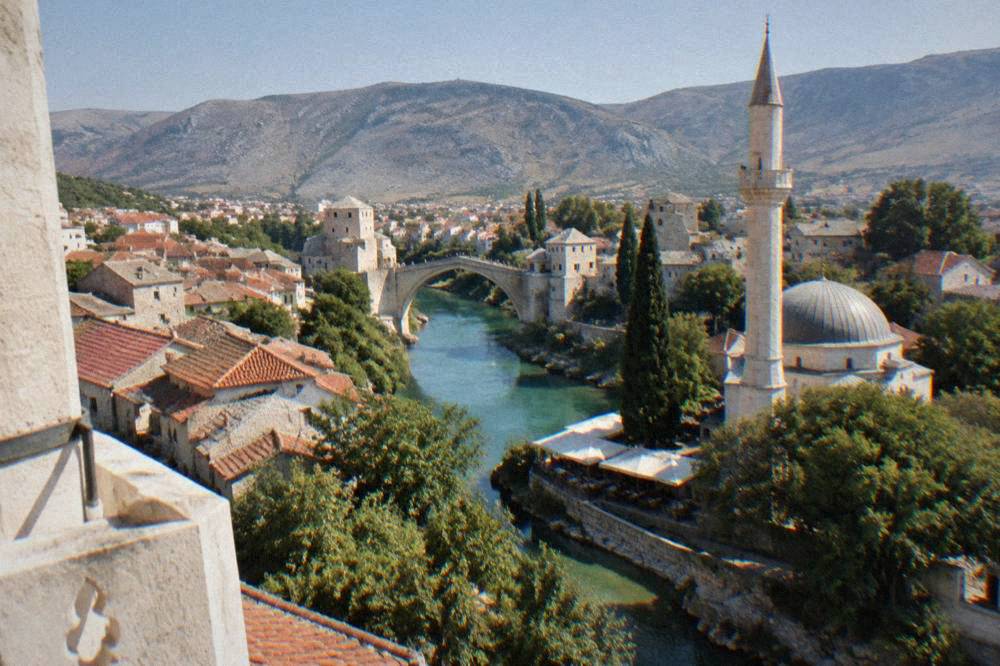
Yes, the minaret is open to visitors who pay the reported combined ticket, and the climb is a narrow spiral stone staircase with small steps that ends on a balcony platform enclosing the top of the tower, with no lift and no relaxed width anywhere on the route. It is a tight single-file climb, and anyone uncomfortable in enclosed stairs should stay on the terrace instead. From the platform the Old Bridge appears downstream over the red roofs of the bazaar, framed by the Neretva on both sides.
The balcony rail is waist height and solid, and the platform turns a full circle, so the view is not only of the bridge. Upstream you look toward Kriva ćuprija and the line of the old mill buildings, downstream the river bends away below the bridge, and the hills on both sides of the city, including Hum, close the horizon. The bridge itself stands about 21 to 24 metres above the river depending on the water level, with a span of about 29 metres, so from the minaret you see it from slightly above its own crown on the bazaar side.
Access inside a working mosque pauses for prayer times, and worship can stop visits at short notice, so build slack into the schedule rather than a minute-precise plan. Modest dress applies: shoulders and knees covered, shoes off on the carpet, and quiet voices inside the hall. In the heat of July and August, when modelled daily highs run at 29.9 C and 30.5 C respectively (ERA5 reanalysis, 1991 to 2020), the stone interior is noticeably cooler than the bazaar street, and the climb itself is short enough that summer heat is manageable with water.
What Can You See From The Koski Mehmed-Pasha Mosque Terrace?
From the river terrace you see the Neretva running turquoise directly below, the upstream bend toward Kriva ćuprija, the Crooked Bridge, and the rooftops of Kujundžiluk rising toward Stari Most one arch away, all included with the basic entry fee. The terrace is the part of the visit everyone gets, so it is the fallback for anyone who skips the climb. Photographers value the spot most in the morning and late afternoon, when the sun angle lights the bridge face rather than flattening it.
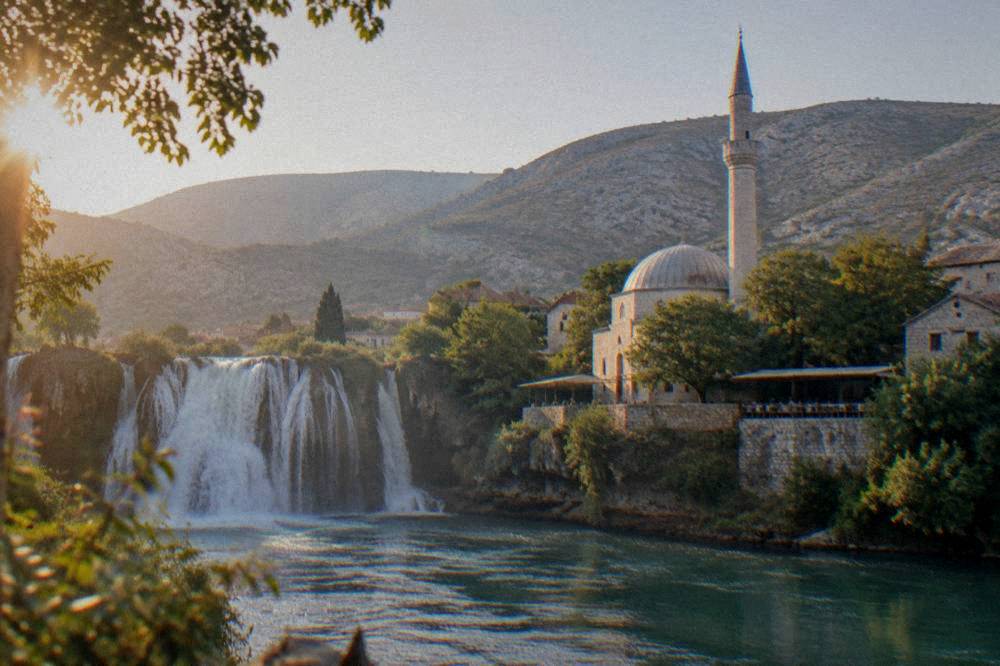
The river's colour is not a filter trick. The Neretva is karst-fed and stays cold even in August, which is also why swimming from this stretch is not the done thing, and why the water reads so blue against the pale stone. Downstream of the bridge the river widens past the old divers' ledges, and members of the Mostari diving club jump from the bridge itself in the warmer months, roughly between May and October. Tourists do not jump: the leaps belong to club members who train for years, and no pay-to-jump option for visitors is on offer. The traditional diving competition reached its 460th edition on 26 July in 2026.
For a fuller sweep of viewpoints across the city, from Hum hill to the Fortica side, the Mostar viewpoints guide lists the climbs and what each one frames. The minaret belongs on that list as the only elevated perch inside the UNESCO core itself, everything else looks at the Old Town from outside it.
How Does The Mosque Compare With The Karadžoz-Bey Mosque?
Karađoz-begova džamija, the Karađoz Bey Mosque, is the larger of Mostar's two landmark Ottoman mosques, standing uphill from the bazaar rather than on the riverbank, while Koski Mehmed-pašina džamija trades size for its position directly beside the Neretva. The two are within an easy walk of each other, and visiting both gives you the two halves of Ottoman Mostar: the monumental mosque at the centre of the old commercial district, and the small riverside mosque that guards the bridge approach.
No entry fee or opening hours are published for Karađoz-beyova džamija, so check on arrival there and treat it as a free-will visit unless told otherwise. For Koski Mehmed-pašina džamija, the reported figures in the table above apply. The comparison in one line: go to the Karađoz Bey Mosque for scale and interior decoration, go to the Koski Mehmed Pasha Mosque for the river terrace and the minaret view of the bridge.
Both mosques sit on the same walking line, which runs from the Old Bridge down Kujundžiluk and up again. Add the Old Bridge Museum in the Tara tower and you have covered the four core stops of the UNESCO area in a compact loop.
When Is The Best Time Of Day To Visit The Mosque In Mostar?
Early morning and late afternoon are the practical windows: summer midday heat in Mostar pushes modelled daily highs to 29.9 C in July and 30.5 C in August (ERA5 reanalysis, 1991 to 2020), and the minaret staircase is at its most comfortable before and after that peak. The station record puts Mostar's absolute maximum at 41.2 C in July (FHMZ Mostar station, 1961 to 1990), which tells you how hot the stone bazaar can become, and the prayer-time pauses mean midday timing carries the added risk of a closed door.
The climate shape of the city is Mediterranean with a winter rainfall maximum. The FHMZ 1961 to 1990 table gives November as the month with the highest mean rainfall total, 200.0 mm, against 42.9 mm in July, so winter visits are cooler and wetter but far quieter. A selection from the station table:
| Month | Mean temperature C | Precipitation mm | Days over 1 mm |
|---|---|---|---|
| January | 4.8 | 164.7 | 11 |
| April | 13.3 | 127.3 | 11 |
| July | 24.7 | 42.9 | 5 |
| August | 24.2 | 73.7 | 6 |
| November | 10.1 | 200.0 | 11 |
Morning light falls on the west-facing bazaar side and lights the bridge from the mosque's angle, while late afternoon warms the stone of Kujundžiluk and sends shadows across the river. Either works; the hours to avoid in summer are the middle of the day, and in all seasons the safest habit is to arrive expecting a short wait if a prayer is in progress. Everything else covered here is indexed on Mostar Travel Guide.
How Does The Mosque Fit Into A Mostar Old Town Walk?
The mosque sits at the natural turning point of an Old Town walk: down Kujundžiluk from the bridge, out onto the river terrace, then either up to Karađoz-begova džamija or across Kriva ćuprija, the Crooked Bridge, and into the quiet lanes beyond. The whole loop, bridge to mosque to Crooked Bridge and back, is a walk of minutes rather than hours, which is why the Old Town rewards a slow pace with coffee stops more than a fast checklist. The Crooked Bridge page covers that small upstream crossing in detail.
A sensible half-day order looks like this:
| Order | Stop | What it adds |
|---|---|---|
| 1 | Stari Most | The arch itself, free to cross at any hour |
| 2 | Old Bridge Museum, Tara tower | Reported 10 KM, the bridge's story in one tower |
| 3 | Koski Mehmed-pašina džamija | River terrace and the minaret view of the bridge |
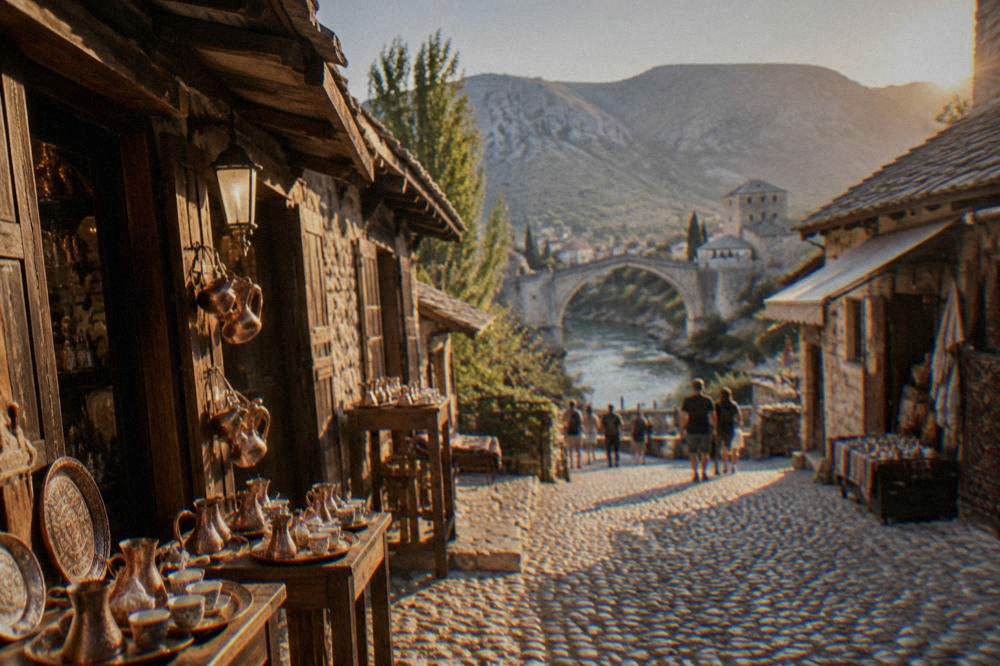
| 4 | Kujundžiluk bazaar | Cobbled craft street, free to wander |
| 5 | Kriva ćuprija | The small crooked bridge upstream, free |
| 6 | Karađoz-beyova džamija | The large dome mosque uphill from the bazaar |
If you prefer a guide to structure that loop, a small-group Old Town walk covers the same ground with the history attached:
For a longer stay, the two days in Mostar itinerary places the Old Town on day one and Herzegovina's countryside on day two, which is the split that suits the geography: everything in the table above sits within a few minutes' walking, while Kravica waterfall, Blagaj and Počitelj are drives of half an hour to an hour away.
What Should You Know Before Visiting A Working Mosque In Mostar?
Dress modestly with shoulders and knees covered, remove shoes before stepping onto the carpet, keep voices low inside the prayer hall, and expect the door to pause visits during the five daily prayer times, with no fixed published timetable for those pauses. Scarves and wraps are usually available at mosque entrances in Herzegovina for visitors who arrive without cover, but the reliable habit is to bring your own light layer, especially in summer when the walk between sights is hot and the clothing is not.
Photography inside the hall is generally tolerated outside prayer times, but the safest rule is to ask at the door when paying, and never to photograph during worship or of people at prayer. The minaret stair is a working piece of the building, not an attraction built for traffic, so give way on the steps and let anyone coming down pass first. Children can manage the climb, but slowly, and the terrace is the better stop for anyone with mobility limits, since the stairs are steep, narrow and unforgiving.
A few practical facts for the wider visit: Bosnia and Herzegovina is not in the EU and not in Schengen, so crossing to or from Croatia involves full border checks, with waits reported at up to about 30 minutes and longer at summer peaks. Emergency numbers are 112 for general use, 122 police, 123 fire and 124 ambulance. Plugs are type C and F at 230 V. A tourist tax in Herzegovina-Neretva Canton is reported at 3 KM per person per night from 1 January 2026, confirm the amount at booking. In rural Herzegovina, stay on marked paths because of suspected mine areas, though the Old Town itself carries no such concern.
Can You Combine The Mosque With Herzegovina Day Trips From Mostar?
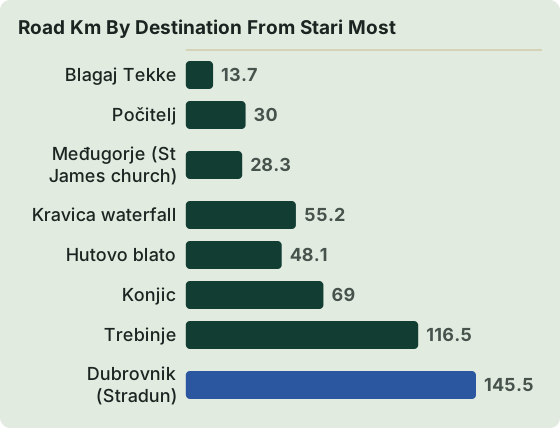
Yes, easily: the mosque sits inside the Old Town, so the standard pattern is a morning at the bridge and bazaar followed by an afternoon loop to Blagaj, Počitelj and Kravica waterfall, all of which sit between about 14 and 55 road kilometres from Stari Most. The distances are short and the roads are ordinary two-lane routes, so the pairing of city morning and countryside afternoon is the most common shape of a day in the region. Free-flow driving times, border queues excluded:
| Destination from Stari Most | Road km | Approximate minutes |
|---|---|---|
| Blagaj Tekke | 13.7 | 19 |
| Počitelj | 30.0 | 31 |
| Međugorje (St James church) | 28.3 | 40 |
| Kravica waterfall | 55.2 | 54 |
| Hutovo blato | 48.1 | 62 |
| Konjic | 69.0 | 80 |
| Trebinje | 116.5 | 142 |
| Dubrovnik (Stradun) | 145.5 | 150 |
Kravica waterfall is open all year with hours that change by month, 07:00 to 22:00 from June to September, 07:00 to 20:00 in May, and 07:00 to 17:00 in November, December, January and February, per the park's own visitor page. Swimming is allowed in the pool below the falls in summer in the designated area, with no lifeguard reported, so check the park's rules on arrival. Blagaj Tekke at the Buna spring is reported at 10 KM entry with hours of 08:00 to 22:00 from April to October and 09:00 to 17:00 from November to March, and shoulders and knees covered, with wraps provided.
The two guided day tours below run that exact triangle from Mostar, and both reach Kravica:
For trips further out, the Konjic day trip guide covers the ARK D-0 bunker, reported at 40 KM for foreign visitors with booking required and Monday closures, and the Trebinje day trip guide covers the far southeast of Herzegovina. Closer to the city, the Jablanica day trip pairs the ruined bridge on the Neretva with a small war museum whose official page prints two inconsistent price lists, so expect an entry of only a few KM.
Why Is The Mosque's Position Beside The Old Bridge So Photographed?
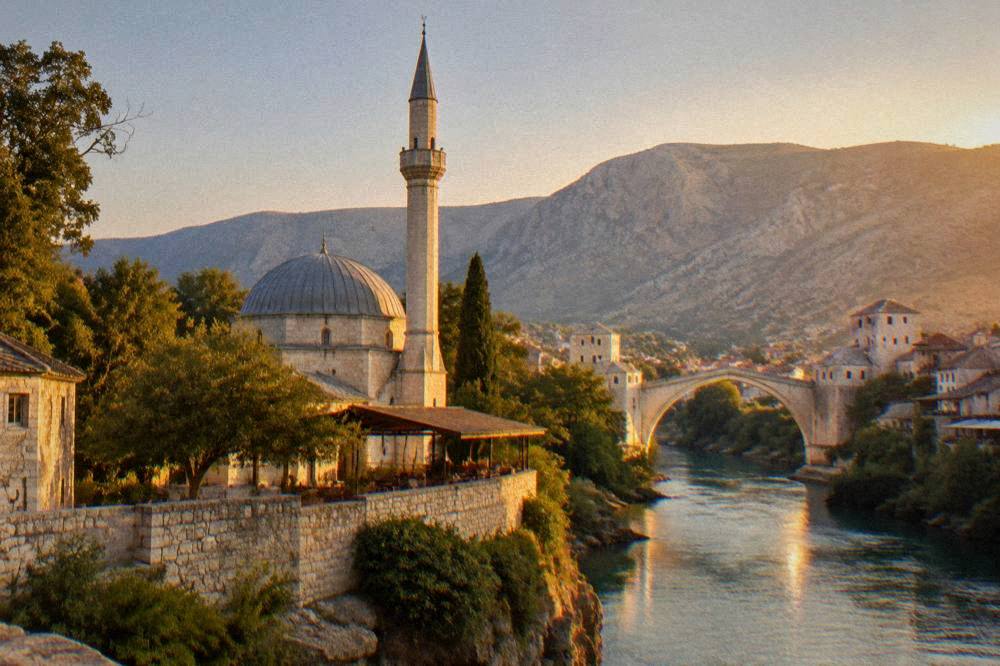
The mosque's minaret and the bridge arch share a single frame from several points on the Neretva's east bank, and that pairing, minaret, river, arch, is the composition that defines Mostar's skyline in photographs worldwide. It works because the bridge, completed in 1566, and the mosque at its approach were built for the same townscape, so the view reflects the original Ottoman street plan, not an accident of angles. The view works because the two structures were built for the same townscape: the bridge completed in 1566 and the mosque standing at its approach, so the composition is not an accident of angles but the original Ottoman street plan still doing its job. The pairing repeats in paintings, postcards and tour brochures for exactly that reason.
The bridge's fame rests on its story as much as its stone, and the why is the Mostar bridge so famous page covers that in full. In brief: a single-arch stone bridge of about 29 metres span, destroyed on 9 November 1993 during the war, rebuilt with original materials and techniques and reopened in July 2004, then inscribed with its surrounding Old Town as a UNESCO World Heritage property in 2005. The why was the Mostar bridge destroyed and has the Mostar bridge been rebuilt pages carry the dates and the reconstruction detail.
From the mosque terrace and minaret, the photographers' angles run like this:
| Vantage point | What it frames | Included with |
|---|---|---|
| Mosque river terrace | Neretva bend, Kriva ćuprija upstream | Basic entry |
| Mosque minaret platform | Stari Most over the bazaar rooftops | Combined ticket |
| East bank below the mosque | Minaret and bridge arch in one frame | Free, public path |
| Tara tower (Old Bridge Museum) | The bridge from its north side | Museum ticket |
Is The Koski Mehmed-Pasha Mosque Worth The Entry Fee?
For anyone with an interest in the Old Bridge, yes: the combined ticket buys the only elevated platform inside the UNESCO area that looks along the Neretva to the arch, and the river terrace alone justifies the basic fee for the quiet it offers above the water. For a visitor with limited time or a tight budget, the free version of the experience is the public path below the mosque, which delivers the minaret-and-arch frame without paying, while the paid version adds the interior, the terrace and the climb.
Balance that against the other paid stops in the Old Town. The Old Bridge Museum carries the bridge's own story, the house museums of Bišćević House and Muslibegović House show Ottoman domestic life, and the mosque is the religious counterpart to all three. None of these charges is large, and together they fund the upkeep of buildings that survive on visitor income.
If your day is short, a structured city walk covers the bridge, the mosque's street and the wider Old Town in one guided sweep, which suits first-time visitors who want the context delivered on site:
For a lower-commitment orientation, a city walk hits the same core sights in a shared small group:
What Else Is Within Walking Distance Of The Mosque?
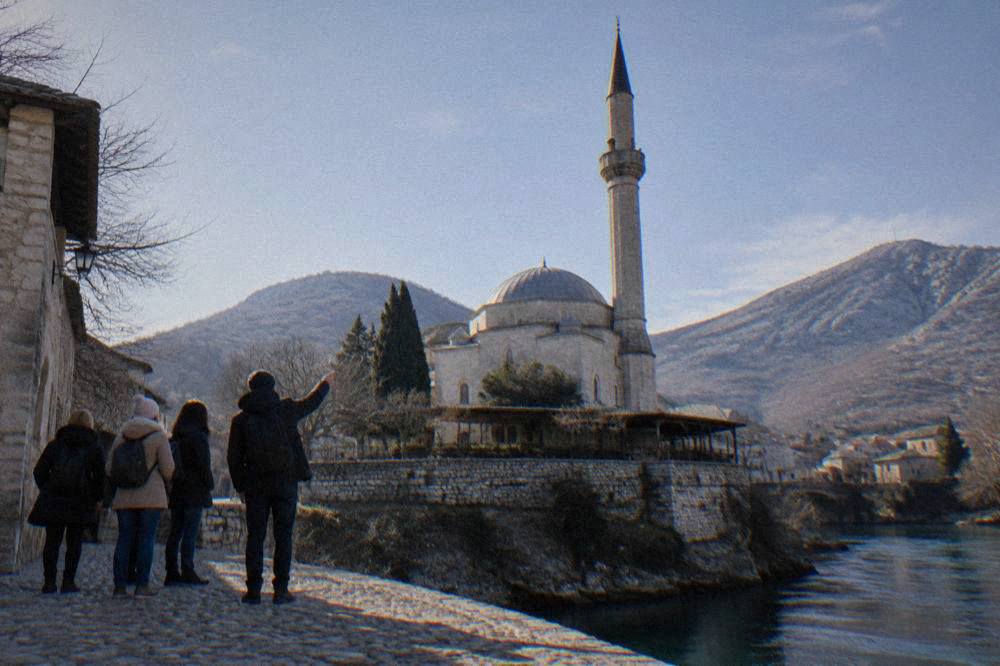
Within ten minutes on foot the mosque reaches Kriva ćuprija, the Crooked Bridge, the Tara tower museum, the Donja Mahala quarter on the far bank, and the whole length of Kujundžiluk, so the Old Town's entire sight list sits around it. That density is the practical argument for basing a Mostar visit in or near the Old Town: the paid sights, the river, the cafés and the bazaar all sit inside a few blocks, and everything beyond, from Spanish Square to the Partisan Memorial Cemetery, is a longer but easy walk.
Across the bridge, Donja Mahala is the quieter bank, with the Bišćević House garden and the riverside walk under the cliffs. Uphill from the bazaar, the larger Karađoz Bey Mosque rounds out the Ottoman pair. For recent history, the War Photo Exhibition and the Partisan Memorial Cemetery, inaugurated in 1965 to the design of Bogdan Bogdanović and listed by Europa Nostra among Europe's most endangered heritage after over 700 of its stone markers were destroyed in 2022, sit within the wider city walk described in the Mostar history guide.
The pedestrian core needs no car and no timetable. Park wherever the Old Town edge allows, walk in, and let the bridge, the bazaar and the mosque organize the day themselves, the sequence the things to do in Mostar page lays out stop by stop.
Common Questions About The Koski Mehmed-Pasha Mosque
How much does it cost to visit the Koski Mehmed-Pasha Mosque?
Entry is reported at about 10 KM in cash for the mosque, with the combined ticket including the minaret reported at about 18 KM and reports ranging from roughly 14 to 18 KM. The amounts are not published on an official page, so confirm at the door before paying.
Can you see the Old Bridge from the mosque minaret?
Yes. The minaret platform looks directly downstream over the rooftops of Kujundžiluk to Stari Most, roughly a minute's walk away, and it is the closest elevated viewpoint to the bridge inside the UNESCO area.
Is the Koski Mehmed-Pasha Mosque open during prayer times?
Visits pause during the five daily prayers, and no fixed visitor timetable is published. Arrive expecting a possible short wait, and check at the door when you pay the entry fee.
What should you wear to visit the mosque in Mostar?
Shoulders and knees covered, shoes removed on the carpet, and quiet voices inside the prayer hall. Bring a light layer in summer, since bazaar clothing rarely meets the dress expectation on its own.
Which is better, the Koski Mehmed-Pasha Mosque or the Karadžoz-Bey Mosque?
They serve different purposes: Koski Mehmed-pašina džamija offers the riverside terrace and the minaret view of the bridge, while Karađoz-begova džamija is the larger monumental mosque uphill from the bazaar. Both sit on one easy walking loop, so choosing is rarely necessary.
The mosque earns its place on any Mostar list for one simple reason: it is the spot where the city's two most photographed structures, minaret and arch, meet in a single frame, and the small fee, paid in cash at the door, buys the quiet terrace and the narrow climb that make that frame yours.
