Trebinje: Plane Trees, Wine And The Arslanagić Bridge
Trebinje sits 116.5 km by road southeast of Mostar, a drive of about 142 minutes free-flow, and it pairs an Ottoman old town with the vineyards of Herzegovina's far south.
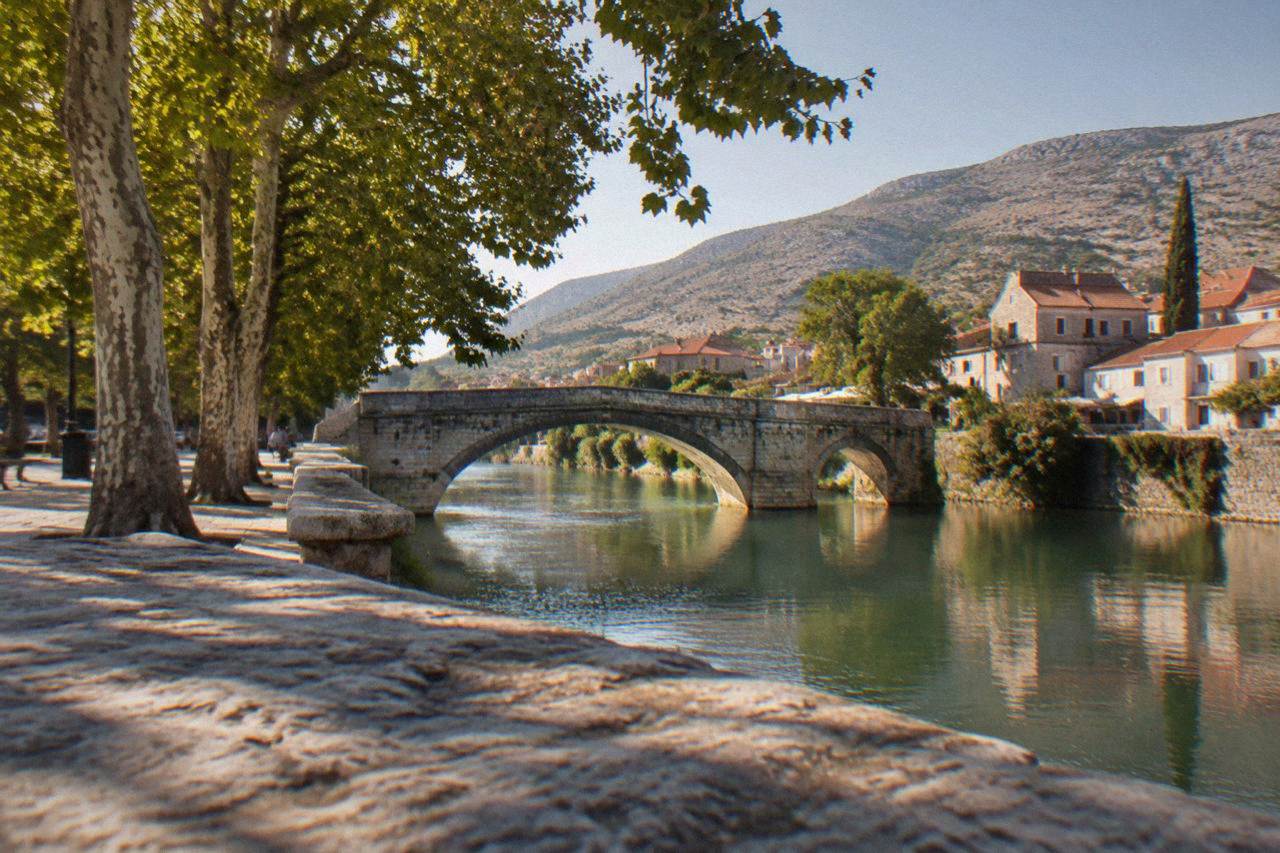
Trebinje is 116.5 km and about 142 minutes by road from Stari Most in Mostar. Its old town, the Arslanagić Bridge and the hilltop Hercegovačka Gračanica church are the headline sights, and entry is free or donation-based at the main sites, according to visitor reports.
Trebinje is the far-south option on the Mostar day-trip map, 116.5 km and about 142 minutes by road from Stari Most in Herzegovina, Bosnia and Herzegovina, an inland city on the Neretva with no sea coast of its own. Where Blagaj, Počitelj and Stolac sit inside a one-hour ring around Mostar, Trebinje belongs to a second tier: close enough for a full day, far enough that the landscape changes on the way, limestone hills giving way to vineyards and, eventually, the hills above the Adriatic. The town is built along the Trebišnjica river, shaded by old plane trees, and its old town, bridges and monastery churches are reported to be free or donation-based to enter.
The comparison that matters when planning is time. A day spent on Blagaj and the Buna spring costs under 20 minutes of driving each way; Počitelj is 30 km out. Trebinje asks for more than two hours each way, which reshapes the whole day around one destination rather than a chain of stops. That trade, a deep single stop instead of several shallow ones, is what this page works through, alongside the sights, the wine question and the practicalities of the drive south. For the wider picture of the city you depart from, start with the root guide to things to do in Mostar.
Where Is Trebinje, And How Far Is It From Mostar?
Trebinje lies 116.5 km by road southeast of Stari Most in Mostar, a drive of about 142 minutes in free-flow traffic, computed from routing data with no border or works delays included. The town sits in the far south of Herzegovina near the border with Montenegro and Croatia, on the Trebišnjica river. It is the farthest stop in the regular Mostar day-trip set.
The route south runs through the same corridor that carries traffic toward Dubrovnik for part of the way, past Stolac, before turning east. Stolac itself is 36.8 km and about 47 minutes from Stari Most, which makes it the natural halfway pause on a Trebinje day, and the Radimlja stećci necropolis, a UNESCO-listed medieval tombstone site inscribed in 2016, sits at 33.5 km and about 42 minutes. Stringing Stolac and Trebinje into one day is a common shape for the drive, because the distances stack cleanly rather than zig-zagging.
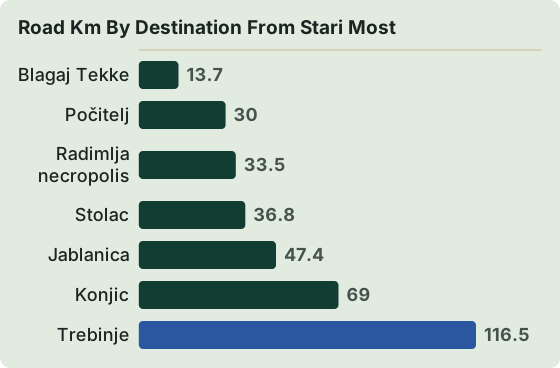
What the raw drive time does not include is roadworks. The Corridor Vc motorway project around Mostar has ongoing works, with a south bypass section and a rerouted Mostar North to Mostar South stretch involving a new tunnel, all reported in 2026. None of that sits on the Trebinje road directly, but leaving Mostar at a busy hour can add time at either end of the day. The figures below are the computed free-flow numbers from Stari Most.
| Destination from Stari Most | Road km | About minutes |
|---|---|---|
| Blagaj Tekke | 13.7 | 19 |
| Počitelj | 30.0 | 31 |
| Radimlja necropolis | 33.5 | 42 |
| Stolac | 36.8 | 47 |
| Jablanica | 47.4 | 57 |
| Konjic | 69.0 | 80 |
| Trebinje | 116.5 | 142 |
What Are The Best Things To See In Trebinje On A Day Trip From Mostar?
The core sights are the old town with its market square and plane trees, the Arslanagić Bridge over the Trebišnjica, and the Hercegovačka Gračanica church on the hill above the town, with the Tvrdoš monastery a short drive out in the vineyards. All are reported to be free or donation-based to visit, with no ticketed entry at the main sites.
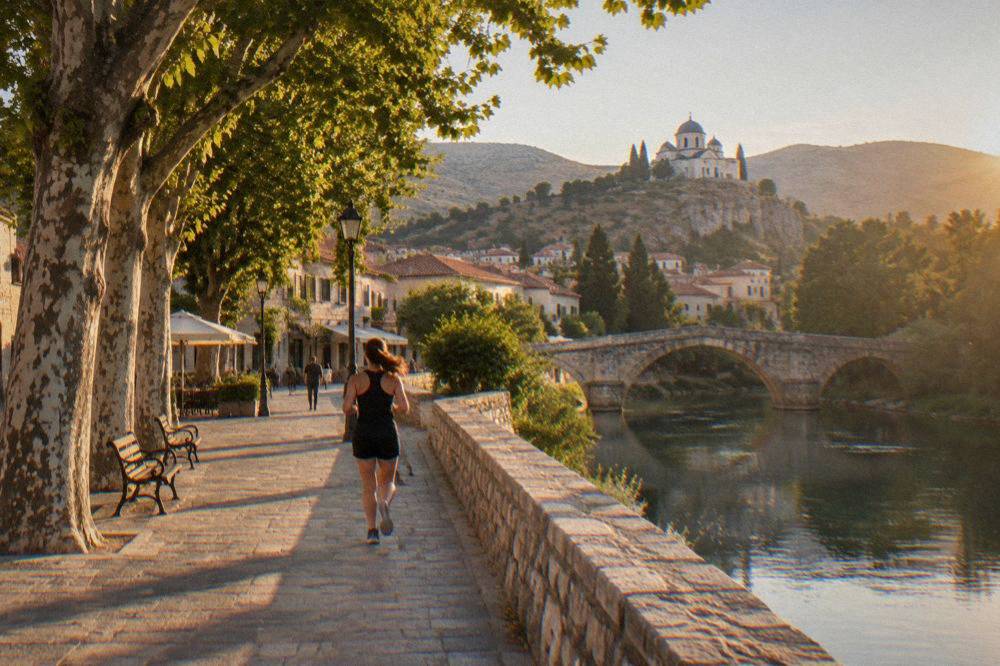
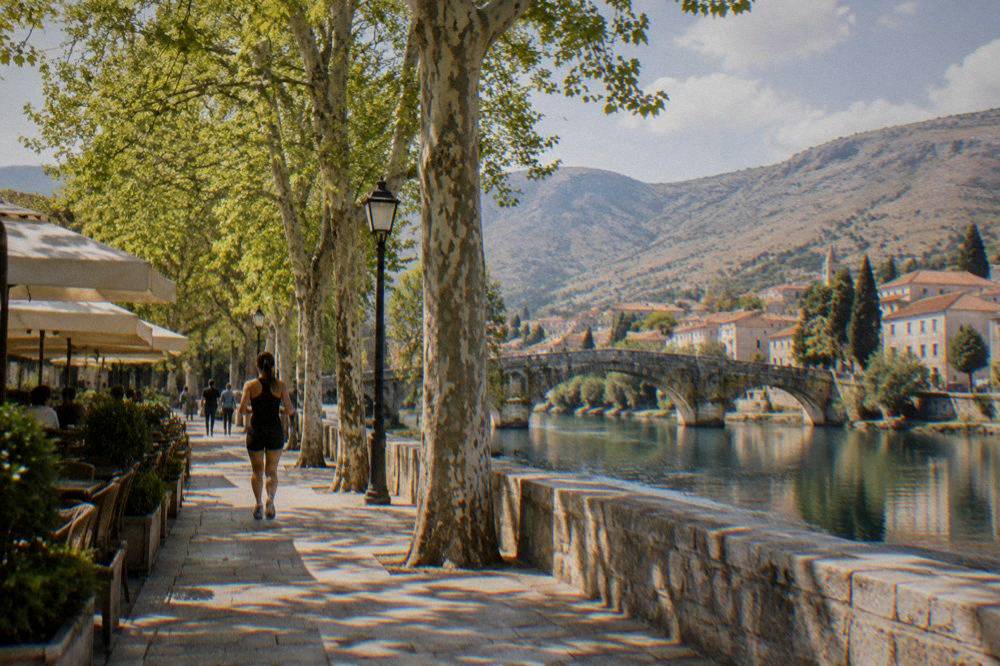
The old town is compact and walkable, a walled core of stone lanes around a square lined with the plane trees the town is known for. Unlike the bazaar streets around Stari Most, which sit inside a UNESCO World Heritage property inscribed in 2005, Trebinje's old town carries no inscription and no entry system at all: it is simply a lived-in street grid. Reports on the town's sites describe an open, walk-up experience, and that is the honest planning assumption, with details to confirm on arrival.
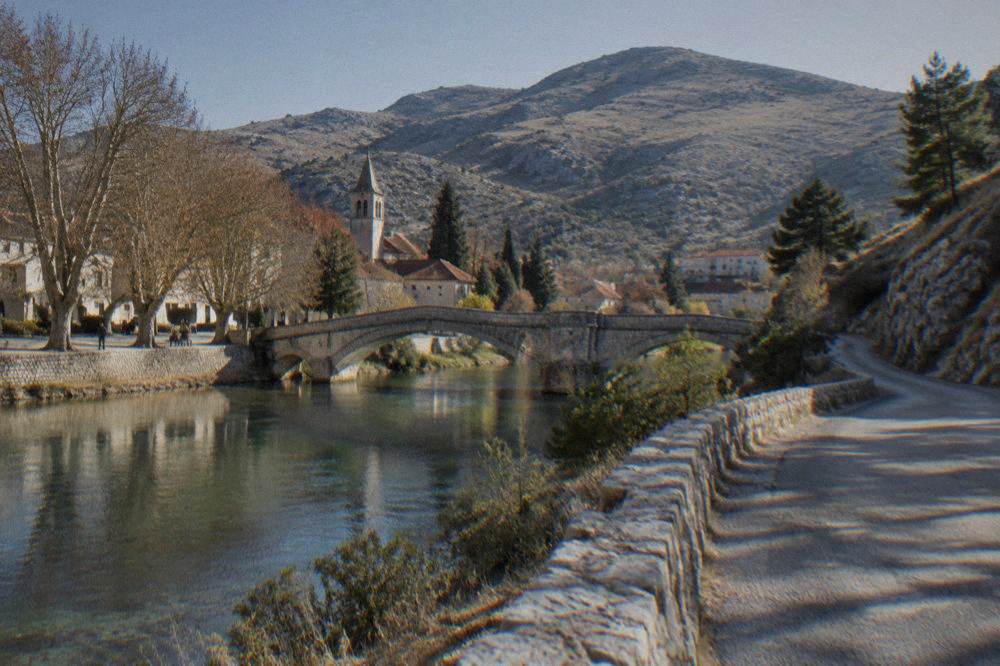
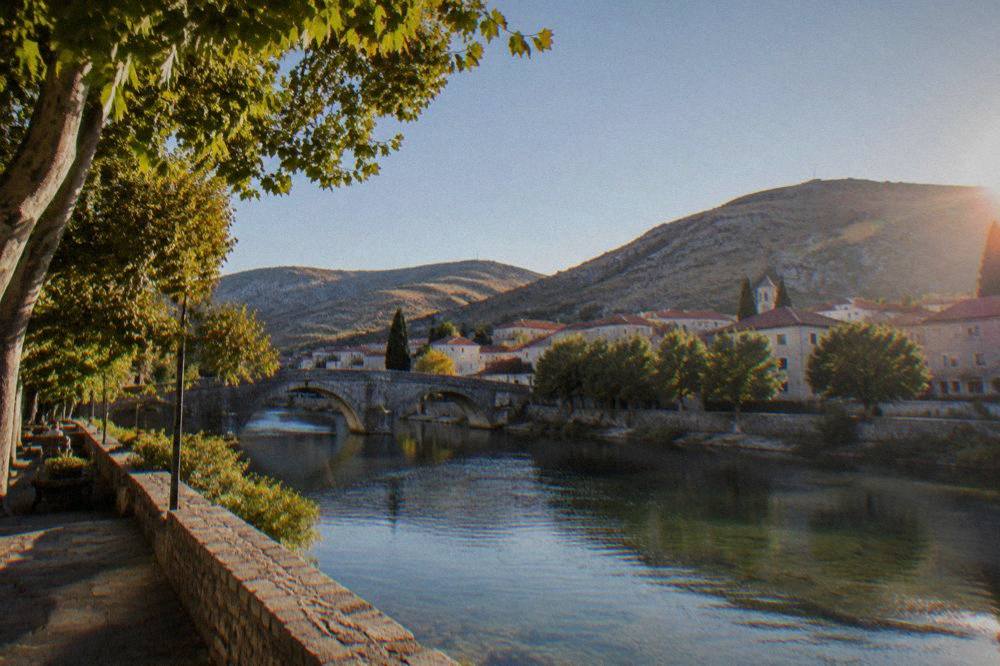
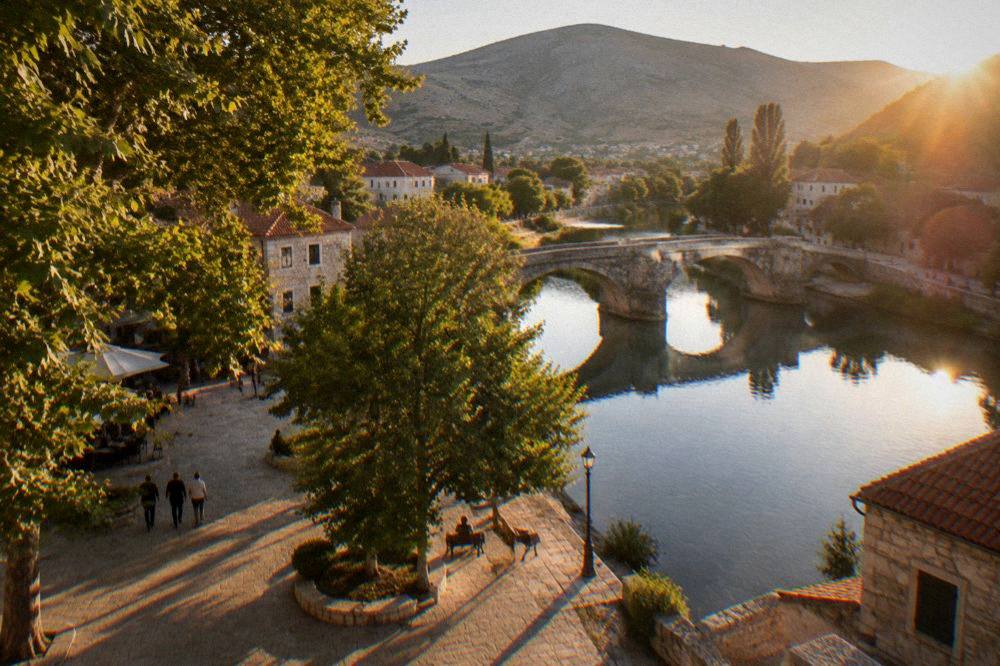
The Arslanagić Bridge is the town's single-arch stone bridge over the Trebišnjica, built in the Ottoman period and relocated stone by stone upstream when a hydro scheme flooded its original site. It stands a short walk from the old town. The Hercegovačka Gračanica church sits on Crkvina hill above the town and doubles as its viewpoint, looking out over the rooftops toward the hills that roll down toward Dubrovnik. Tvrdoš monastery, in the vineyards outside town, is the fourth stop that turns a walking day into a wine day.
| Sight in Trebinje | What it is | Entry reported |
|---|---|---|
| Old town and market square | Walled Ottoman-era core with plane trees | Free, open streets |
| Arslanagić Bridge | Relocated Ottoman stone arch bridge | Free, public |
| Hercegovačka Gračanica | Hilltop church and viewpoint above the town | Free or donation |
| Tvrdoš monastery | Monastery in the vineyards outside town | Free or donation |
| Trebišnjica riverbanks | Plane-tree-lined promenades | Free, public |
Confirm details locally on the day. For the departure city's own food culture, the general guide to Bosnian food and Herzegovina wine covers what to expect on plates and in glasses across the region.
How Do You Get From Mostar To Trebinje Without A Car?
Driving is the practical way to reach Trebinje from Mostar, 116.5 km and about 142 minutes free-flow each way, because the road is the only mode with a direct published route for this journey. There is no train line south of Čapljina, so rail is not an option for Trebinje at all. Bus services exist in the wider region, but timetables should be checked directly with operators before planning around them.
The rail point is worth stating plainly, because the Sarajevo to Mostar line is the only rail corridor in this part of the country. Regular trains between Sarajevo and Čapljina via Mostar resumed on 15 October 2026 after a suspension that had begun in early September following a fire along the corridor, with two trains a day each way. Nothing in that network runs east toward Trebinje. A day-tripper without a car is choosing between a bus, checking current timetables with the operators that serve the route, a private transfer, or a guided day tour.
For drivers, the practical notes are the border and the fuel. Trebinje sits near both the Croatian and Montenegrin borders, and a loop that touches Dubrovnik, 145.5 km and about 150 minutes from Stari Most by road, crosses into Croatia, which has been a Schengen external border with full checks since 1 January 2023. Bosnia and Herzegovina is not in the EU and not in Schengen, so passports travel in the car and wait times at the main crossings near Mostar run up to about 30 minutes, longer at summer peaks. Check the live queue before committing to any cross-border loop. The currency throughout is the convertible mark (KM, BAM), pegged at 1 EUR = 1.95583 KM, and euro cash is often accepted in tourist areas at a rounded rate, with the advice to confirm before paying.
One planning caution applies to all rural walking in Herzegovina, including riverbanks and hill paths around Trebinje: stay on marked paths because of suspected mine areas, and follow local signage.
If the self-drive day feels like more logistics than you want, the Herzegovina loop tours that run from Mostar cover the closer cluster of Blagaj, Počitelj and Kravica waterfall instead, and the old town walk in Mostar itself fills a rest day between drives. Both options are carded below alongside a hands-on cooking option.
The burek masterclass in the first card deserves a note, because it is the site's featured pairing for this page: a hands-on class in rolling and baking burek in Mostar, useful the evening before the Trebinje drive or the evening after it. Details and live pricing render on the tour's own page.
Is Trebinje Worth The Drive Compared With Blagaj And Počitelj From Mostar?
Trebinje earns its drive when the day's goal is one unhurried town rather than four photo stops, because its one-way distance of 116.5 km dwarfs the 13.7 km to Blagaj and the 30.0 km to Počitelj, and the return leg doubles all three. Blagaj's tekke, about 10 KM to enter with shoulders and knees covered, and Počitelj's free village are quicker wins, while Trebinje trades speed for a slower, fuller day.
The arithmetic frames it. Blagaj Tekke is 13.7 km and about 19 minutes from Stari Most; Počitelj is 30.0 km and about 31 minutes; the standard trio day that chains Blagaj, Počitelj and Kravica waterfall spends its driving inside a single hour of total wheel time. Trebinje sits at the far end of the scale, a long single leg there and the same leg back, which means close to five hours behind the wheel across the day. That is not an argument against it, it is the reason to pick it deliberately: a Trebinje day has room for one long lunch, an unhurried riverbank walk and a hilltop sunset viewpoint, things a four-stop loop day cannot hold.
The deciding factors are simple. With one full day and a car, Trebinje works, ideally with a Stolac or Radimlja stop threaded in. With one day and no car, the closer cluster wins on cost and simplicity, and guided Herzegovina day tours from Mostar cover it in a fixed window. With two days in the region, the honest answer is to do both, and the two-day Mostar itinerary shows how the closer loop slots into day one with Trebinje or a Konjic run saved for day two. Travellers weighing Mostar against the capital can also spread the reading across the wider Herzegovina road trip plan.
| Day-trip choice from Mostar | One-way road km | About minutes one way | Best when you want |
|---|---|---|---|
| Blagaj Tekke | 13.7 | 19 | Shortest trip, river spring, tekke interior |
| Počitelj | 30.0 | 31 | Fortress views, quick stop |
| Stolac and Radimlja | 36.8 | 47 | UNESCO stećci, old fortified core |
| Jablanica | 47.4 | 57 | Neretva bridge ruins, museum |
| Konjic | 69.0 | 80 | ARK D-0 bunker, old stone bridge |
| Trebinje | 116.5 | 142 | A slow full day, wine, riverside town |
What Does Trebinje's Old Town Look Like Beside Mostar's Old Town?
Trebinje's old town is a small, walled, low-rise quarter of stone lanes and a plane-tree-shaded square beside the Trebišnjica, more compact and quieter than Mostar's Kujundžiluk bazaar street, which runs directly at the UNESCO-inscribed Stari Most. Both are free, open street networks with no ticket or gate, walkable at any hour.
Mostar's old town wraps around a single monument: the Old Bridge, completed in 1566 under Suleiman the Magnificent, destroyed on 9 November 1993 and rebuilt and reopened in July 2004, about 21 to 24 metres above the river depending on its level, crossed free of charge around the clock. The bazaar street, Kujundžiluk, and the lanes of the old town carry that heritage weight, and the diving tradition of the Mostari club is part of the bridge's summer life, with the 460th traditional competition held on 26 July in 2026.
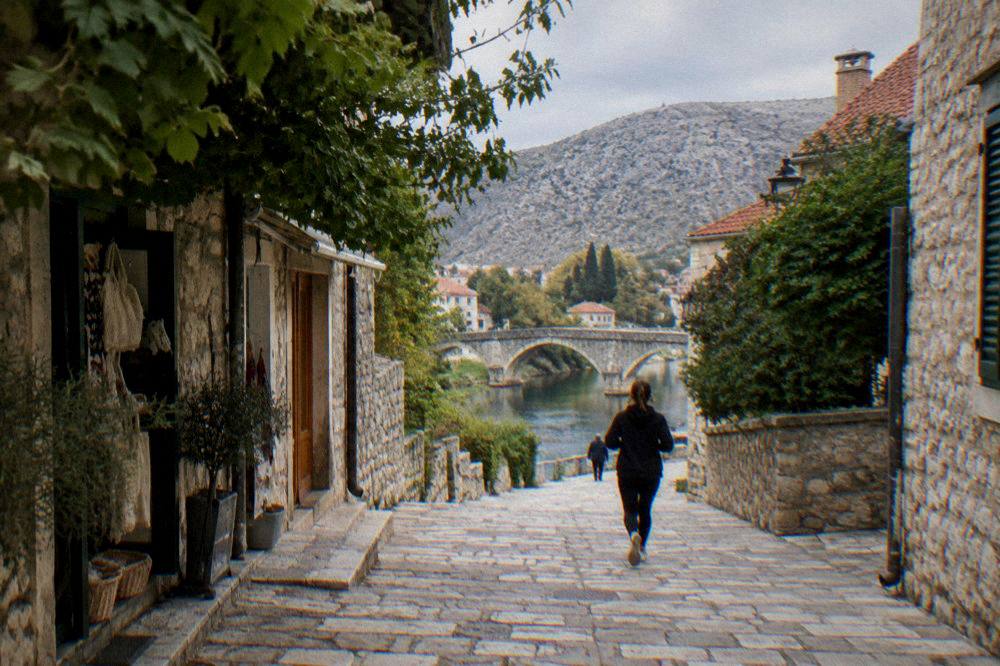
Trebinje's core is a different register. The square's plane trees are the signature, old and tall enough to shade the whole plaza, with cafe tables beneath them in the warmer months. The stone walls of the old town enclose a grid small enough to cross in minutes, which is why the town rewards lingering rather than touring. Together the two old towns make a useful contrast for a single trip: Mostar for the monumental bridge and bazaar energy, Trebinje for shade, stillness and the river walk out to the Arslanagić Bridge. Visitors who want the bridge story in depth can follow up on why the Mostar bridge is so famous and why it was destroyed.
Where Does Wine Fit Into A Trebinje Day Trip From Mostar?
Wine is Trebinje's second act: the hills around the town and the Tvrdoš monastery area form one of Herzegovina's vineyard zones, and tastings are part of the town's visitor offering, so arrangements should be confirmed directly. Herzegovina wine generally means dry reds and native whites from limestone soils, and the region's rakija, fruit brandy, sits alongside them.
Herzegovina's wine culture runs on the same karst belt that carries Mostar's landscape, hot dry summers and limestone, and the general character of the region's wines, structured reds and fresh whites, is covered in the site's guide to Herzegovina wine. Trebinje's vineyards sit at the southern end of that belt, cooler-adjacent to the Adriatic influence without being coastal.
The practical fit matters more than the specifics. A wine afternoon anchors a Trebinje day to one place and slows it down, the same way a long lunch does, and it pairs naturally with the monastery stops rather than competing with them. If tasting is the priority, the order that works is old town and bridge in the morning, hilltop church at midday, then the vineyards in the afternoon before the drive back, daylight permitting. In Mostar itself, the burek masterclass carded on this page covers the food side of Herzegovina without any driving at all.
How Much Time Do You Need In Trebinje On A Day Trip From Mostar?
Plan a full day: about 142 minutes of driving each way from Stari Most leaves roughly six hours in and around Trebinje if you leave in the morning, enough for the old town, the Arslanagić Bridge, the hilltop church and one out-of-town stop such as Tvrdoš. A compressed half-day version cuts the out-of-town stops and still works, but it spends almost as long driving as standing still.
The six-hour figure is arithmetic, not opinion: a 10:00 arrival after a morning departure, with the return leg starting around 16:00, leaves that window before the drive home runs into evening. The old town and bridge together are a comfortable two hours at a walking pace; the hill adds an hour with the viewpoint time; a monastery or vineyard stop adds travel and visit time on top. Trebinje rewards the version of the day that keeps one blank hour for the plane-tree square, because that is the part of the town that cannot be rushed even on a tight schedule.
| Day shape from Mostar | Time in Trebinje | Fits |
|---|---|---|
| Full day, one out-of-town stop | About 6 hours | Old town, bridge, church, Tvrdoš or a vineyard |
| Full day with Stolac stop | About 4 to 5 hours | Old town, bridge, church |
| Half day, direct drive | About 3 hours | Old town and bridge only |
| Overnight | Evening plus a full morning | Everything, unhurried |
Season changes the arithmetic slightly through daylight, since December days run about 9 hours of light against about 15 in June in this latitude band. A November or December departure should start earlier and bank the driving before dark; a June departure can end with the viewpoint in evening light.
When Is The Best Time Of Year To Visit Trebinje From Mostar?
Late spring through early autumn is the working answer: July and August bring modelled daily highs around 30 C in the Mostar valley, ERA5 reanalysis 1991-2020 shows, while the FHMZ 1961-1990 table for Mostar records a July mean of 24.7 C and an absolute maximum of 41.2 C. May, June and September trade a few degrees for thinner crowds, and November is the rain trap, 200.0 mm on the station table against July's 42.9 mm.
The heat point deserves respect on this specific drive, because the departure city is one of the warmest in the region and the Trebinje road offers little shade at stopovers. The station record for Mostar, FHMZ 1961-1990, puts November at 200.0 mm of rain against July's 42.9 mm, a near five-fold spread, and the rain maximum sits in winter, which is why the shoulder months travel better than the deep-off-season ones. Trebišnjica-side walks and the hilltop viewpoint are the parts of a Trebinje day most exposed to weather; the old town lanes and cafe square are the shelter.
| Month | Mean temp C, FHMZ 1961-1990 | Rain mm, FHMZ | Mean daily high C, ERA5 1991-2020 |
|---|---|---|---|
| January | 4.8 | 164.7 | 8.4 |
| April | 13.3 | 127.3 | 17.7 |
| May | 17.9 | 102.1 | 22.3 |
| July | 24.7 | 42.9 | 29.9 |
| September | 20.4 | 96.3 | 24.5 |
| November | 10.1 | 200.0 | 14.1 |
Summer visitors should also weigh the summer event calendar in the departure city: Mostarsko ljeto ran 25 June to 7 August in 2026, the Mostar Blues and Rock Festival ran 24 and 25 July, and the Red Bull Cliff Diving round ran 30 July to 1 August, all of which tighten accommodation in Mostar on the nights around a Trebinje day. One cost note for any overnight in the canton: a tourist tax reported at 3 KM per person per night applies from 1 January 2026, and confirmation at booking is the safe course.
Common Questions About Trebinje From Mostar
How far is Trebinje from Mostar?
Trebinje is 116.5 km by road from Stari Most in Mostar, a drive of about 142 minutes in free-flow conditions, excluding any stops or delays.
Can you do Trebinje as a day trip from Mostar?
Yes. With about 142 minutes of driving each way, a morning departure gives roughly six hours in Trebinje, enough for the old town, the Arslanagić Bridge, the hilltop church and one out-of-town stop.
What is there to see in Trebinje?
The main sights are the walled old town with its plane-tree-shaded square, the Arslanagić Bridge over the Trebišnjica, the Hercegovačka Gračanica church and viewpoint on the hill above town, and the Tvrdoš monastery in the nearby vineyards. Entry is reported to be free or donation-based.
Is Trebinje close to Dubrovnik?
Trebinje sits inland near the southern borders of Bosnia and Herzegovina, and Dubrovnik is 145.5 km and about 150 minutes by road from Stari Most in Mostar. A loop combining both crosses the Croatian border, a Schengen external border with full passport checks since 1 January 2023.
Do you need a car for Trebinje from Mostar?
Driving is the practical option on this route, and there is no rail service toward Trebinje. Bus timetables for the route should be checked directly with operators, and a private transfer or guided day tour are the main alternatives.
What currency is used in Trebinje?
The convertible mark (KM, BAM), pegged at 1 EUR = 1.95583 KM. Euro cash is often accepted in tourist areas at a rounded rate, but confirm before paying, and cards are not guaranteed at small vendors.
The drive south is the commitment, and the plane trees are the reward: leave Mostar early, thread in Stolac or Radimlja on the way, and give the square the blank hour it deserves before the road home. For more on pairing this trip with the rest of Herzegovina, the Herzegovina road trip and Mostar viewpoints guides carry the planning forward, and this page sits alongside the site's wider coverage from Mostar Travel Guide.