Herzegovina Wine: Žilavka, Blatina And Cellars Near Mostar
Herzegovina wine begins with two local grapes, Žilavka and Blatina, grown on the dry karst limestone around Mostar. This guide covers what they taste like, which wine areas sit within a day trip of the city, and how a glass fits into a day of burek, bridges and bazaar streets.
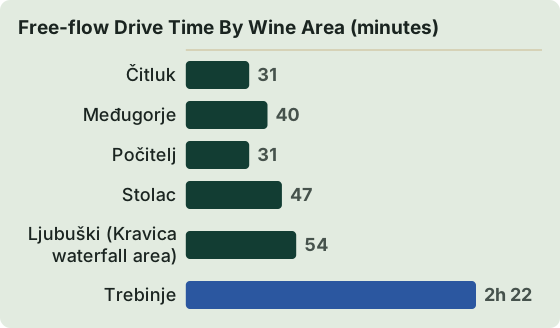
Herzegovina wine means the white Žilavka and the red Blatina grapes, grown on limestone soils in the hot, dry valley country around Mostar. The wine areas of Čitluk, Ljubuški, Stolac and Trebinje all sit within a day trip of the city, and a glass of local wine pairs naturally with the grilled and baked dishes of the Bosnian kitchen.
Herzegovina wine is the quiet half of a trip to Mostar, the inland city on the Neretva river in Herzegovina, Bosnia and Herzegovina, where the Old Bridge Area of the Old City holds UNESCO World Heritage status. The famous sights are stone and water: Stari Most, the Kujundžiluk bazaar, the green curve of the Neretva below. But the countryside around the city is wine country, dry karst limestone planted with two local grapes that appear on nearly every wine list between the coast and Sarajevo. This guide explains what those grapes are, where they grow, how the seasons shape them, and how a glass of local wine slots into a day of eating and walking in Mostar itself.
What Is Herzegovina Wine, And Where Is It Made Around Mostar?
Herzegovina wine is the wine of the dry limestone country of southern Bosnia and Herzegovina, centred on the valleys and hills around Mostar, and it is built on two native grape varieties: the white Žilavka and the red Blatina. The region grows on thin soils over karst limestone, with hot, dry summers and mild winters, and the same stone that shapes the Old Bridge shapes the vineyards.
Viticulture here is small-scale and family-run rather than industrial. The landscape dictates it. Karst limestone drains fast and holds little water, so vines dig deep, and the dry summers concentrate the fruit. The FHMZ Mostar station table, 1961 to 1990, records a July mean temperature of 24.7 C against only 42.9 mm of rain, while November carries 200.0 mm: a Mediterranean pattern with a winter rainfall maximum. Grapes ripen easily in a summer like that, and the harvest is early by northern European standards.
The wine is part of the table, not a ceremony. A glass of Žilavka beside grilled meat, or Blatina with a slow-cooked dish, is ordinary practice in Herzegovina, in the way rakija opens a meal and Bosnian coffee closes it. For more on that kitchen, read the companion guide to Bosnian food in Mostar, which covers the dishes that local wine is poured alongside.
What Do Žilavka And Blatina Taste Like?
Žilavka is a dry white: light to medium in body, with a mineral, stony character and restrained stone-fruit and citrus notes, reflecting the limestone it grows in. Blatina is a dry red: medium-bodied and soft, with dark fruit and a gentle spice, made from a variety that flowers unpredictably, so yields swing year to year and blends are common.
Those two sentences are the honest core of it. Žilavka, whose name relates to the word for the fine veins or fibres of the vine wood, is the variety Herzegovina is known for. It keeps acidity despite the heat, which is what separates it from many southern whites. Blatina, from a word for the dark, muddy soil it prefers, is a red that can lack pigment on its own, so winemakers traditionally co-ferment or blend it with companion varieties. Neither grape travels far in export terms, so tasting them means tasting them here.
Around them sit the supporting cast:
| Grape | Colour | General character | Typical style on the table |
|---|---|---|---|
| Žilavka | White | Mineral and stony, citrus and stone fruit, fresh acidity | Dry white, still |
| Blatina | Red | Medium body, dark fruit, soft tannins | Dry red, often blended |
| Bena | White | Local companion variety, lighter and softer | Blending partner for Žilavka |
| Trnjak | Red | Firmer and more tannic than Blatina | Blend component or standalone red |
| Plavac Mali crossover plantings | Red | Croatian variety also grown in the south | Occasional regional red |
Rakija deserves a word too, because the grape spirit of the region, including lozovača made from grape marc, opens meals and marks welcomes in the same cellars. The rakija guide covers that tradition separately. The practical point for a visitor: order by grape name. Asking for a Žilavka or a Blatina anywhere in Herzegovina gets you a local bottle, and the house pour is usually the safest order in a konoba-style kitchen.
Which Wine Areas Sit Within A Day Trip Of Mostar?
The wine country of Herzegovina lies south and east of Mostar, all of it reachable on a day trip: Čitluk and Međugorje at 22.9 and 28.3 km by road, Ljubuški near Kravica waterfall at about 55 km and 54 minutes, Stolac at 36.8 km, and Trebinje in the far southeast at 116.5 km and about two and a half hours free-flow.
Those distances are road figures from Stari Most, free-flow, with no border queues. The pattern they reveal: the closest vineyard country starts barely half an hour out, and it overlaps almost exactly with the classic Herzegovina day-trip circuit of Blagaj, Počitelj and Kravica waterfall. Wine tasting slots into that loop without adding much driving.
| Wine area | Road km from Stari Most | Free-flow drive time |
|---|---|---|
| Čitluk | 22.9 | about 31 min |
| Međugorje | 28.3 | about 40 min |
| Počitelj | 30.0 | about 31 min |
| Stolac | 36.8 | about 47 min |
| Ljubuški (Kravica waterfall area) | about 55 | about 54 min |
| Trebinje | 116.5 | about 142 min |
Čitluk, the municipality that includes Međugorje, is the heartland of Žilavka, with vines on the shelves of limestone above the town. Around Ljubuški the vineyards mix with the falls and rivers that draw visitors to Kravica. Stolac adds the Radimlja necropolis, a UNESCO-listed stećci site, and Trebinje in the far corner near the border with Montenegro is a wine town in its own right, with old cellars and a river setting, covered in the Trebinje day trip guide.
A practical way to combine the circuit without hiring a car is a guided day trip. One long-running option covers Blagaj, Počitelj and Kravica waterfall from Mostar, and the drive between stops passes straight through the vineyard belts:
Many travellers prefer to keep the tasting for the evening and the driving for the morning, which is easy: the same roads loop back into Mostar by mid afternoon, and the evening is for the Old Town. For help choosing a base for that rhythm, see where to stay in Mostar.
When Is The Best Season For Wine Around Mostar?
Grape harvest in Herzegovina runs from late summer into early autumn, and September and early October are the months when the vineyards are busiest and the weather still supports terrace tasting, with ERA5 reanalysis 1991-2020 showing September mean daily highs of 24.5 C. Spring is for blossom and green vines; July and August are hot and dry, with mean daily highs of 29.9 and 30.5 C.
The heat matters more than visitors expect. Mostar sits in one of the warmest corners of Bosnia and Herzegovina, and midsummer afternoons push sightseeing into mornings and evenings. Wine country follows the same clock: tastings move to shaded cellars at midday and terraces at sunset. The rainfall pattern helps planning too. The FHMZ 1961-1990 record gives July only 42.9 mm of rain over five days with more than 1 mm, against November's 200.0 mm over eleven days.
| Month | Mean daily high (ERA5 1991-2020) | Rain mm (ERA5 1991-2020) | Days over 1 mm rain (FHMZ 1961-1990) |
|---|---|---|---|
| May | 22.3 C | 116.1 | 9 |
| June | 26.8 C | 72.4 | 8 |
| July | 29.9 C | 45.4 | 5 |
| August | 30.5 C | 52.6 | 6 |
| September | 24.5 C | 142.0 | 6 |
| October | 19.5 C | 186.8 | 8 |
September is the quiet sweet spot: the harvest is underway, the summer crowds have thinned, the water of the Neretva is still cold even in August let alone September, and the evenings carry enough warmth to sit outside. The broader trade-offs, including event weeks such as Mostarsko ljeto, which ran 25 June to 7 August in 2026, are laid out in the guide to the best time to visit Mostar, with month-by-month detail in Mostar weather.
If you are already planning the eating half of the trip, a cooking experience in the city makes a good pairing with an evening of local wine:
How Does Wine Fit Into A Day Of Eating In Mostar?
Local wine belongs with the grilled and baked dishes of the Bosnian kitchen: Žilavka cuts through the fat of cevapi and burek, while Blatina stands up to slow-cooked meat and stews. In Mostar the natural rhythm is coffee in the morning, sightseeing at midday, and a glass of wine with dinner in or near the Old Town, where the day ends within sight of Stari Most.
The pairings are simple because the food is simple, in the best sense. Cevapi, the small grilled minced-meat fingers served in somun bread with raw onion, ask for a white with acid, which is exactly what Žilavka supplies. Burek, the rolled filled pastry, works with either colour depending on the filling. Heavier dishes, the meat-and-vegetable stews of the region, suit Blatina's soft red fruit.
| Dish | What it is | Natural wine match |
|---|---|---|
| Cevapi | Grilled minced meat fingers in flatbread with onion | Žilavka, for its acidity |
| Burek | Rolled pastry filled with meat, cheese, potato or spinach | Either, by filling |
| Bosnian coffee | Unfiltered coffee brewed in a copper pot, served with lokum | Not wine: this is the closer, not the pairing |
| Rakija (lozovača) | Grape spirit served in small glasses before a meal | A palate opener rather than a pairing |
| Grilled river fish | Fish from the Neretva basin prepared on the grill | Žilavka |
Note the shape of the day in that table. Rakija opens, wine accompanies, coffee closes. Nobody hurries any of the three. For the dishes themselves, the deep dives are at cevapi and burek, and the restaurant scene is mapped in the guide to eating out in Mostar, which explains how the Old Town and the streets beyond divide up.
Learning to roll a burek by hand, then eating the result, is one of the more direct ways into this kitchen, and it fits neatly before an evening glass.
What Should You Know About Money, Tax And Buying Bottles In Mostar?
The currency is the convertible mark (KM, BAM), pegged at 1 EUR = 1.95583 KM, and wine, like everything else in Mostar, is priced in KM. Euro cash is often accepted in tourist areas at a rounded rate of about 1 euro to 2 KM, but that is a convenience, not a rule, so confirm the rate. A tourist tax reported at 3 KM per person per night applies in the canton from 1 January 2026.
The peg is the useful fact. Because the mark is fixed to the euro, converting is mental arithmetic rather than a gamble, and paying in KM rather than euros generally avoids the rounding. Cash still matters at small cellars and market stalls; cards are fine at hotels, larger restaurants and supermarkets. The full picture, including ATM practice, is in the Mostar money guide.
Buying bottles to take home is straightforward. Declare nothing at the Bosnia and Herzegovina side, but check your home country's duty allowance, and remember that if you are driving to Croatia you are crossing a Schengen external border with full checks, a point covered in detail in the border crossing guide.
Two smaller practical notes. Driving between wineries on karst back roads is perfectly normal, but stay on marked paths when you step into rough ground in rural Herzegovina because of suspected mine areas, the standing advice from BHMAC. And the emergency number, if you ever need it, is 112.
Is A Guided Wine Or Food Experience In Mostar Worth Booking?
A guided experience earns its fee in three places: it puts a driver on the karst roads between cellar stops, it opens family cellars that do not publish hours or walk-in tasting, and it translates the stories behind Žilavka and Blatina. In the city itself, guided food and walking experiences cover the Old Town, the bridge and the kitchens within a short radius, leaving the evening free for a glass on your own.
The choice is really between a countryside day trip and a city experience. The countryside day covers Blagaj, Počitelj and Kravica waterfall and passes the vineyard belts on the way; the city option keeps you on foot around the UNESCO-listed Old Town, ending near the restaurants. Both rhythms work, and they stack well across two days, which is the pattern suggested in the itineraries at one day in Mostar and two days in Mostar.
For a small-group walk that ends with a tasting, this Old Town tour is the local fixture:
And if the decision is between booking ahead or deciding on arrival, booking ahead wins for anything in high summer, when the July and August means of 29.9 and 30.5 C push everyone indoors at midday and evening tables fill early.
How Do You Plan A Wine Trip To Mostar, Step By Step?
Plan it as a city base with loop days: fly into Sarajevo or Dubrovnik, reach Mostar by bus or train, use the city for evenings and take one or two loop days through Blagaj, Počitelj, Čitluk and Kravica waterfall, tasting where the road passes a cellar. Two nights is the minimum, three gives a relaxed version, and a fourth lets you push east to Stolac or Trebinje.
Getting in is the first decision. Arrival is usually via Sarajevo or Dubrovnik: the road from Sarajevo is about 127 km and the train, which runs twice a day each way between Sarajevo and Čapljina via Mostar after resuming on 15 October 2026, takes about two hours. From Dubrovnik it is about 146 km with a border crossing on the way. The full options are broken down in how to get to Mostar, with the airport itself covered separately at Mostar airport.
| Trip shape | Nights | Wine rhythm | Suits |
|---|---|---|---|
| Quick break | 2 | One Herzegovina loop day with a cellar stop, city evenings | First-time visitors |
| Standard | 3 | Loop day plus a free evening or a Trebinje push | Relaxed couples and small groups |
| Slow | 4 to 5 | Two loop days, Stolac, Trebinje, a second city day | Food and wine travellers |
Once in the city, everything worth seeing on foot is close together, a point made in detail in getting around Mostar; hiring a car only pays off if you want the wineries at your own pace, which is weighed in the car rental guide. For the wider framing, the Bosnia and Herzegovina itinerary places the wine region in a national route.
Finally, look up before you leave. The terraces above the Neretva, the viewpoint platforms around the Old Town and the hills across the river all repay the ten minutes at golden hour, and the Mostar viewpoints guide maps them. Wine tastes better with the bridge in the frame, and the bridge is why the evening light in this city draws photographers to the banks every single night.
Common Questions About Herzegovina Wine Near Mostar
What wine is Herzegovina known for?
Two native grapes: Žilavka, a dry mineral white, and Blatina, a soft medium-bodied red. Both are grown on the limestone soils around Mostar and appear on wine lists across the region. Asking for either by name is the simplest way to drink local.
Can you visit wineries from Mostar?
Yes. The wine areas of Čitluk, Međugorje, Stolac, Ljubuški and Trebinje all sit within a day trip of the city, from about 31 minutes by road to about two and a half hours for Trebinje. Family cellars generally prefer a call ahead, so confirm before setting out.
What does Žilavka taste like?
Dry, light to medium in body, with a stony mineral core, citrus and stone fruit, and fresh acidity that survives the hot Herzegovina summer. It is the region's signature white and pairs naturally with grilled dishes.
Is wine expensive in Mostar?
The currency is the convertible mark, pegged at 1 EUR = 1.95583 KM, so conversion is simple arithmetic.
When is grape harvest in Herzegovina?
Late summer into early autumn, with September the heart of it. September also brings mean daily highs of about 24.5 C per the ERA5 reanalysis 1991-2020, making it a comfortable month for terrace tasting.
Does Herzegovina wine pair with Bosnian food?
Yes, and the pairings are simple: Žilavka with cevapi and grilled fish, Blatina with slow-cooked meat and stews, rakija before the meal and Bosnian coffee after it.
Herzegovina wine is the reason to slow the evening down in Mostar: a white from limestone, a red from the dark valley soils, and a table of grilled things between them. Start with the Mostar Travel Guide homepage for everything else the city and its wine country have on offer.
Before you go, the pick for this guide:
Small Group, Wine Tasting
★ 4.7 131 reviews · From $20
Check availability →