Ćevapi: Mostar's Grilled Staple And Where To Order It
Ćevapi are the grilled minced-meat rolls that anchor everyday eating in Mostar, in Herzegovina, an inland city on the Neretva river with no sea coast. This page explains what the dish is, how a standard order arrives at the table in Bosnia and Herzegovina, and how a grill stop fits into a day around Stari Most and the Old Bazaar of Kujundžiluk.
Ćevapi in Mostar are hand-rolled minced-meat fingers, grilled over charcoal and served in a warm somun flatbread with raw onion and, often, kajmak clotted cream. Orders arrive counted in fives or tens, with no cutlery required.
Ćevapi are the grilled minced-meat rolls that anchor everyday eating in Mostar, the main city of Herzegovina, in Bosnia and Herzegovina, an inland city on the Neretva river with no sea coast. Walk any street between Spanish Square and the Old Bazaar of Kujundžiluk and the smell of charcoal finds you before the menu does. This page covers what the dish actually is, how a standard order arrives, what to eat alongside it, and how a grill stop fits into a day built around Stari Most and the Old Town. For the wider table, start with the companion page on Bosnian food in Mostar.
What Is Ćevapi And Why Does Mostar Eat So Much Of It?
Ćevapi are small, finger-shaped rolls of minced meat, grilled over charcoal and served inside a soft somun flatbread rather than on a plate with cutlery. A standard order in Mostar is counted in pieces, five or ten being the usual building blocks, and the dish is eaten with the hands, onions and all. It is everyday food in Bosnia and Herzegovina, served from morning until late across Herzegovina.
The name travels. Across the Balkans the same basic idea appears under cousin names, and every town guards its own ratio of beef and lamb, its own grind, its own charcoal. Bosnia and Herzegovina did not invent grilled minced meat, and nothing on this page claims it did. What is safe to say is that in Mostar the dish is not a tourist product, it is lunch. Bakeries, grill houses and market stalls sell it at a pace that makes it a fixture of the local week.
Why it suits this city is partly geography. Herzegovina is hot in summer: the FHMZ station table for Mostar, 1961 to 1990, records a July mean temperature of 24.7 C and an absolute maximum of 41.2 C, and the ERA5 reanalysis, 1991 to 2020, puts modelled July highs at 29.9 C. Charcoal grills live outdoors, a somun wraps everything into one portable package, and a plate of ćevapi with raw onion works as well at a shaded table at noon as it does late in the evening. For more on the climate, see Mostar weather and the seasons.
The dish also fits the rhythm of the Old Town. Kujundžiluk, the Ottoman-era bazaar street that runs down toward Stari Most, is narrow, busy and built for walking and snacking rather than long sit-down meals. A ten-minute stop for a wrapped order of grilled meat is a natural part of moving through it. The bridge area around it has been a UNESCO World Heritage property since 2005, inscribed under criterion (vi), and the street pattern that makes grazing easy is part of what makes the quarter feel the way it does.
How Is Ćevapi Served In Mostar?
A standard order in Mostar arrives as five or ten grilled meat rolls tucked into a warm somun, a soft flatbread, with chopped raw onion on the side and often a spoonful of kajmak, a rich clotted cream, spread inside the bread. No sauce is poured over the top, no cutlery is brought, and the whole thing is designed to be eaten with the hands, straight from the paper or tray.
The anatomy of the order matters more than visitors expect, because the components are fixed enough to be predictable anywhere in the country. The table below breaks down what a plate usually carries, so nothing on the table comes as a surprise.
| Component | What It Is | Role In The Order |
|---|---|---|
| Ćevapi | Grilled finger-shaped minced-meat rolls, beef and lamb in common use | The core of the dish, counted in pieces |
| Somun | Soft flatbread, dimpled and warmed, often grilled at the edges | Holds the meat and soaks the juices |
| Raw onion | Chopped or sliced, sometimes spring onion | Sharpness against the fat of the meat |
| Kajmak | Clotted dairy spread, salty and dense | Added richness, by request |
| Somun dimples | Small pockets pressed into the bread before baking | Catch fat and juice during eating |
Kajmak deserves its own sentence. It is a clotted-cream style spread with a salty edge, and whether it belongs inside a somun with ćevapi or beside it is the kind of question locals answer with their order rather than an argument. If you have never had it, ask for it once and decide for yourself. Grilled or raw onion is the other dividing line: raw is the traditional partner, and it is not optional in spirit even if it is on paper.
Eating technique is genuinely part of the experience. The somun is folded around the meat, the onion is pressed in, and the package is eaten from the top down. Asking for a knife and fork will get you somewhere, eventually, but the dish predates that habit by a long way and is built around the hand. Condiments, where they exist, sit on the table and are added piece by piece rather than across the whole order at once.
Timing matters too. Grill houses fire up for lunch and run through the evening, and charcoal needs its lead time, so the first rolls of the day are not instant. During the deep heat of a Herzegovina afternoon, shaded tables beat sunny ones by a wide margin. The practical pages on getting around Mostar cover how the city centre is walked, and the centre is compact enough that a grill stop never requires a detour of more than a few minutes.
Where Do You Order Ćevapi In Mostar?
In Mostar, ćevapi are ordered at grill houses, bakeries and takeaway counters across the centre, with the densest cluster in and around Kujundžiluk and the streets feeding Spanish Square. No single venue is endorsed here as a recommendation, and no addresses or hours are printed on this page, so the practical move is to walk the bazaar street, read the charcoal smoke and the queue of locals, and order at the counter.
What can be said is structural: the Old Bazaar runs downhill toward Stari Most, the grill smoke marks the spots, and a busy counter at midday is the oldest quality signal in the grilled-meat business. Counter service is normal. You say the number of pieces you want, five or ten, say whether kajmak and onion go in, and pay at the till or the hand. The wider set of guides lives on Mostar Travel Guide.
The other reliable route into the city's food culture is a guided one. A walking tour of the Old Town with a local guide folds the bazaar, the bridges and the food stops into one loop, and the small-group Old Town guided tour pairs the walk with a tasting. If cooking appeals more than walking, the burek masterclass below teaches the rolling and baking hands-on, and it makes a natural half-day complement to a grill-heavy evening.
Between the walking tours and the cooking classes, the food-and-drink side of Mostar has more depth than a single dish suggests. The trio below covers the hands-on option, the Old Town walk and a full Herzegovina day trip for the day you want to eat your way past the city limits.
What Do You Drink With Ćevapi In Mostar?
The classic drinks beside ćevapi in Mostar are a small glass of Bosnian coffee afterward, a bottle of still water or a sparkling soda during, and, where served, a small pour of rakija fruit brandy or a glass of local Herzegovina wine. Water is not an afterthought in this climate, coffee marks the end of the meal, and neither beer nor wine is hard to find in the centre of the city.
Bosnian coffee is its own ceremony, boiled in a small copper pot and poured into a cup the size of an egg, and it follows food rather than accompanying it. It deserves its own slow half hour, which the companion page on Bosnian coffee covers in full. Rakija, the fruit brandy of the region, appears in small pours, often homemade, and Herzegovina wine country sits close enough to Mostar that local lists carry regional whites and reds. The Herzegovina wine guide frames the vineyard side of that story.
Practical ordering notes apply. The currency of Bosnia and Herzegovina is the convertible mark, KM, pegged at 1 EUR = 1.95583 KM, not the euro, though euro cash is often accepted in tourist areas at a rounded rate, so confirm before paying. A tourist tax is reported at 3 KM per person per night in the canton from 1 January 2026, charged through accommodation rather than restaurants, and should be confirmed at booking. The full picture sits on the Mostar money guide.
| Practical Item | Figure | Note |
|---|---|---|
| Currency | Convertible mark (KM, BAM) | Legal tender, not the euro |
| Peg | 1 EUR = 1.95583 KM | Fixed by the currency board |
| Euro cash | Often accepted in tourist areas | Rounded rate, confirm before paying |
| Tourist tax | 3 KM per person per night | Reported, from 1 January 2026, confirm at booking |
| Emergency number | 112 | General, nationwide |
Ćevapi Or Burek: How Do You Choose In Mostar?
Ćevapi are the grilled choice and burek is the baked choice: burek is rolled, spiral pastry filled with meat, cheese, potato or spinach, baked in a round tray and sold by weight or by the piece, while ćevapi are charcoal-grilled meat in flatbread. In Mostar the two coexist rather than compete, and a serious eating day can honestly hold both, one at midday and one in the evening.
The distinction matters because visitors sometimes treat Balkan pastry counters as one thing. They are not. Burek, strictly, is the meat-filled roll, and other fillings carry their own names, a distinction locals keep with a straight face. The rolling technique is the shared spine, and it is genuinely skilled work, which is why the hands-on burek session in the city is worth considering for anyone whose interest in the food goes past eating it.
Beyond burek and ćevapi, the wider table of Bosnia and Herzegovina runs to slow-cooked stews, grilled vegetables, pitas of every filling and sweets soaked in syrup. The general Bosnian food guide maps it. The honest planning advice for a short visit is simpler: eat the grilled thing once, the baked thing once, and drink the coffee both times.
| Dish | How It Is Cooked | How It Is Served | How It Is Eaten |
|---|---|---|---|
| Ćevapi | Charcoal-grilled minced-meat rolls | In somun flatbread with onion, kajmak by request | With the hands |
| Burek | Rolled pastry baked in a round tray | By the piece or weight, often with yogurt beside | With a fork or hands |
| Bosnian coffee | Boiled in a small copper pot | In a tiny cup with a sugar cube and water | Sipped slowly, after food |
| Herzegovina wine | Regional vineyards around the city | By the glass on local lists | Alongside or after the meal |
How Does A Ćevapi Stop Fit Into A Day Around Mostar?
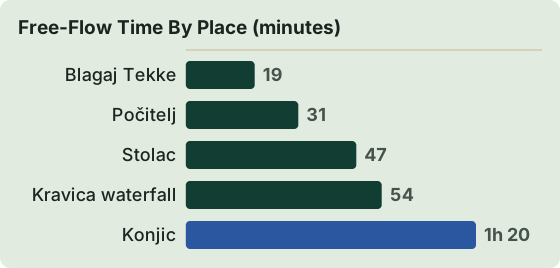
A grill stop slots naturally into a Mostar day because the eating is concentrated in the walkable centre: cross Stari Most, browse Kujundžiluk, eat at midday, then spend the afternoon at a nearby sight such as Blagaj at 13.7 km and about 19 minutes by road, Počitelj at 30.0 km and 31 minutes, or Kravica waterfall at 55.2 km and about 54 minutes, all measured free-flow from Stari Most with no border queues.
The shape of the day is the point. Mostar's sights sit in two rings: the walkable Old Town core, and a ring of Herzegovina day trips reachable by road in under an hour and a half. A plate of ćevapi is the hinge between them. Eat in the centre before a afternoon drive, or return to the centre at dusk and let the grill houses close the day.
| Place | Road Distance | Free-Flow Time |
|---|---|---|
| Blagaj Tekke | 13.7 km | about 19 min |
| Počitelj | 30.0 km | about 31 min |
| Stolac | 36.8 km | about 47 min |
| Kravica waterfall | 55.2 km | about 54 min |
| Konjic | 69.0 km | about 80 min |
Guided options compress the logistics. A private Herzegovina day tour covers the waterfall, Blagaj and Počitelj in one loop, and the Sarajevo departures bundle the same region for travellers based in the capital, covered on the Sarajevo to Mostar guide. Arriving from the coast instead changes the sequence, not the logic: the Dubrovnik to Mostar and Split to Mostar pages cover those corridors, including the Croatian border, a Schengen external border with full checks since 1 January 2023, where waits of up to about 30 minutes are reported and longer at summer peaks.
For a fuller account of the city itself, the root page on things to do around the city is the site's main planning hub, and where to stay in Mostar settles the neighbourhood question. Season matters as well: the best time to visit Mostar page lays out the weather trade-offs, from the November rainfall of 200.0 mm against July's 42.9 mm in the FHMZ 1961 to 1990 table to the modelled August highs of 30.5 C in the ERA5 reanalysis, 1991 to 2020.
What Should You Know Before Your First Ćevapi Order In Mostar?
Order by number, expect the food in under fifteen minutes from a hot grill, eat with your hands, and pay in convertible marks, not euros, though euro cash is often accepted at a rounded rate you should confirm first. A five-piece order with onion is a light meal, a ten-piece order is a full one, and kajmak is the one addition worth trying at least once. None of this needs booking, and none of it needs a plan beyond hunger.
A few closing pieces of context help. Bosnia and Herzegovina is not in the EU and not in Schengen, so the currency, the border formalities and the payment habits differ from Croatia next door. Tap water is generally treated and safe. Tipping is appreciated but not mandatory, with rounding up the common form. And the city you are eating in holds about 105,000 people by the 2013 census, small enough that the walk from any grill house to the Neretva riverbank takes minutes.
For travellers stacking the day higher, the food theme extends outward. The cooking class below turns the eating into doing, with lunch and drinks included, and it pairs cleanly with an Old Town walk on the same visit.
And for the day you want the waterfall, the tekke and the fortress town as well as the grill, the same trio from earlier still applies, from the hands-on kitchen to the full private loop through Herzegovina.
Common Questions About Ćevapi In Mostar
What exactly are ćevapi?
Ćevapi are small finger-shaped rolls of minced meat, typically beef and lamb, grilled over charcoal and served in a soft somun flatbread with raw onion and often kajmak clotted cream. They are eaten with the hands and ordered by the piece, five or ten being standard.
Can you drink alcohol with ćevapi in Mostar?
Yes. Beer, wine and rakija are served in Mostar's restaurants and bars, and Herzegovina wine country sits close to the city. Alcohol-free ordering is equally normal, and a small Bosnian coffee after the meal is the traditional close.
Do you pay in euros for ćevapi in Mostar?
The currency is the convertible mark, KM, pegged at 1 EUR = 1.95583 KM. Euro cash is often accepted in tourist areas at a rounded rate, but confirm before paying, and expect change in marks.
Is ćevapi the same everywhere in the Balkans?
The idea of grilled minced meat in flatbread is shared across the region under various names, but the meat mix, the size of the rolls and the accompaniments vary by place. This page describes the dish as it is served in Bosnia and Herzegovina and does not adjudicate origins.
How many ćevapi should you order?
A five-piece order in a somun is a light meal, and a ten-piece order is a full one. Onion comes standard, kajmak is by request, and ordering twice is easier than ordering too much at once.
Are ćevapi spicy?
No. The standard version is not hot, seasoning is simple, and heat, where wanted, comes from condiments on the table rather than from the meat itself.
One last practical note: the grill houses of Mostar run on their own clock, and hours change with the season, so confirm opening times locally on the day. Eat slowly, drink the coffee, and let the Old Bridge wait the extra twenty minutes.