What To Eat In Mostar: Bosnian And Herzegovinian Dishes
Bosnian food in Mostar runs on grilled meat, slow-cooked stews, filo pastry and strong coffee, served in a city on the Neretva river in Herzegovina. This guide explains each dish, what it is made of and how it fits into a day of eating.
Start with cevapi and burek, drink Bosnian coffee slowly, and treat rakija and Herzegovina wine as the local pours. Dishes are simple, meat-forward and cheap by regional standards, with the Old Bazaar at the centre of eating life.
Mostar sits on the Neretva river in Herzegovina, an inland city with no sea coast, and its food reflects that position: grilled meats from the Balkan interior, Ottoman-era pastries and slow stews, wine from Herzegovina's sunbaked karst hills, and coffee brewed the long way. Bosnian food is not fussy. It is built on a short list of dishes done well, served in generous portions, and eaten at a pace the coffee culture enforces on its own.
This guide walks through the dishes one by one: what is in them, how they are served, and how they fit into a day of eating in the city. For the wider picture of the city itself, start with things to do around Mostar, then come back hungry. If deep history is the appetite, the Mostar history guide covers the Old Bridge and the Old Bazaar neighbourhoods where much of this food is eaten.
What Is Bosnian Food, And What Defines It In Mostar?
Bosnian food is a Balkan and Ottoman-inherited kitchen built on grilled minced meat, filo pastry, slow-cooked stews in clay pots, fresh vegetables, dairy and strong coffee, and in Mostar it carries a Herzegovinian accent: more lamb, more wine and more rakija than the kitchens further north. Portions are large, seasoning is modest and the point of a meal is the company as much as the plate. The Old Bridge Area of the Old City of Mostar, a UNESCO World Heritage property since 2005, contains the Kujundžiluk bazaar, where food stalls, bakeries and grill houses sit inside the historic street plan.
The clearest way into the kitchen is to group it by technique. Grilling produces cevapi and pljeskavica. Pastry work produces burek and its siblings. The clay pot, the sač lid and the slow oven produce stews that cook for hours. Dairy produces kaymak, a thick cultured cream that appears beside grilled meat, and the soft white cheeses that open most restaurant bread baskets.
A useful planning table for a first visit:
| Course Or Moment | Typical Dish | What It Is |
|---|---|---|
| Breakfast | Burek with yogurt | Rolled filo pastry with meat, cheese or potato, eaten warm |
| Lunch | Cevapi | Grilled minced meat fingers with flatbread and raw onion |
| Slow meal | Bosanski lonac | Mixed meat and vegetable stew cooked in a clay pot |
| Soup | Begova čorba | Chicken soup thickened with okra and root vegetables |
| Dessert | Baklava, hurmašica | Syrup-soaked pastry sweets |
| Drinks | Bosnian coffee, rakija, Herzegovina wine | Slow-brewed coffee, fruit brandy, local red and white wine |
Dietary expectations matter here. The kitchen is meat-heavy, and vegetarian options exist mostly in the pastry family, cheese and potato fillings chief among them, plus grilled vegetables and stews in season. Nothing on this page requires a special occasion: this is everyday eating, and the bakery next to the bazaar is as legitimate a stop as any restaurant.
Which Dishes Should You Try First In Mostar?
Try cevapi first, then burek, then a slow stew such as bosanski lonac or a lamb dish, with begova čorba as the starter and a syrup pastry as the sweet, and Bosnian coffee as the constant at every table in the city. That short list covers the four techniques of the kitchen, grilling, pastry, slow cooking and brewing, and none of it requires working through a long menu. The dedicated cevapi guide covers the grilled side in more depth, and the burek guide does the same for pastry.
A few dishes deserve a sentence each before the table. Pljeskavica is a grilled minced meat patty, the burger-shaped cousin of cevapi, often served with kaymak. Japrak are vine leaves stuffed with rice and meat. Sogan-dolma is onion stuffed the same way. Tarana is a hand-rolled pasta dough dropped into soup. Slatko is preserved fruit served in a small spoonful to guests, a hospitality ritual more than a dessert.
| Dish | Type | What Is In It |
|---|---|---|
| Cevapi | Grilled | Minced meat fingers, flatbread (somun), raw onion |
| Pljeskavica | Grilled | Minced meat patty, often with kaymak |
| Burek | Pastry | Rolled filo with meat; siblings use cheese, potato or spinach |
| Bosanski lonac | Stew | Layers of meat and vegetables slow-cooked in a clay pot |
| Begova čorba | Soup | Chicken, okra, root vegetables |
| Japrak | Stuffed | Vine leaves, rice, minced meat |
| Hurmašica | Sweet | Dense syrup-soaked pastry |
Two practical notes. Bread arrives with meals as a matter of course, and kajmak, the cultured cream, is worth asking for by name wherever grilled meat is served. Portions run large; ordering one dish per person plus a soup to share is a reasonable first-evening strategy, and no menu translation is needed for most of this list because the dish names travel across Bosnian, Croatian and Serbian, the country's main languages.
Food experiences around the city go beyond restaurant tables. If a hands-on morning appeals, the Burek Masterclass in Mostar: Roll, Bake, Eat session teaches the pastry from the dough outward, and the cooking class with burek, lunch and drinks in Mostar covers a fuller meal. For combining food with sightseeing, Blagaj, Počitelj and Kravica waterfall tours from Mostar pair a day in the Herzegovina countryside with the chance to eat trout near the Buna spring, a regional speciality of the Blagaj area.
What Is Burek, And How Is It Served In Mostar?
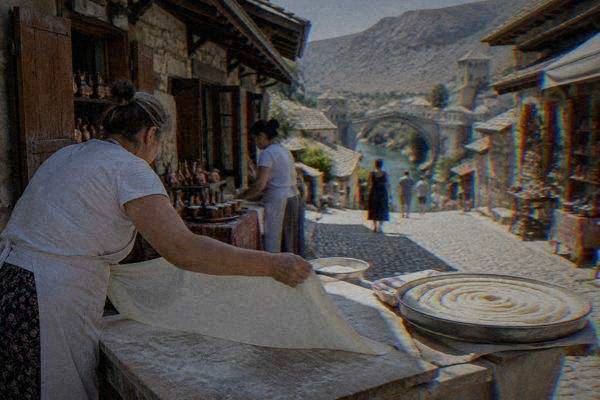
Burek is filo pastry rolled around a filling, traditionally minced meat, wound into a spiral and baked until the outside is crisp and the inside is dense and moist, and in Mostar it is sold by weight from bakeries and eaten at any hour, breakfast included, often with a glass of yogurt on the side. The sibling pastries, sirnica with cheese, krompiruša with potato and zeljanica with spinach, carry the same shape with different fillings, and a strict local convention keeps the name burek for the meat version alone.
The craft is in the rolling. The dough is stretched thin, brushed with fat, layered, rolled into a log and coiled, so that the finished cross-section shows rings of pastry and filling rather than a sealed pocket. A good spiral bakes evenly, holds its shape when cut, and releases steam rather than oil when lifted. Bakeries bake in trays and sell from the counter by the piece or by weight, and the pastry is best within a couple of hours of the oven.
The best way to understand the difference between a spiral and a factory product is to make one. The burek masterclass in Mostar walks participants through the rolling and baking with the eating at the end, and bookings can be checked and cancelled flexibly: Check availability.
| Pastry | Filling | When It Is Eaten |
|---|---|---|
| Burek | Minced meat | Breakfast, lunch, any time |
| Sirnica | Cheese | Breakfast |
| Krompiruša | Potato | Breakfast, meat-free choice |
| Zeljanica | Spinach, sometimes cheese | Meat-free choice |
| Sudžukica | Small seasoned sausage | Less common, meat-filled |
Ordering is simple: point or name the filling, say whether it is to stay or go, and take the yogurt if it is offered. The full dish-by-dish background sits in the burek guide, including how the spiral is built layer by layer.
What Is Bosnian Coffee, And How Is It Served In Mostar?
Bosnian coffee is finely ground coffee boiled in a small copper pot called a džezva, poured unfiltered into a small cup, and drunk slowly with a lump of sugar or a bite of rahat lokum, the gelatin sweet, on the side. It is closer in method to Turkish coffee than to espresso, but it is its own ritual: the pot arrives on a tray with the cup, the sugar and sometimes the sweet, and the drinker waits for the grounds to settle before pouring. The pace is the point, and a single coffee can legitimately occupy half an hour of conversation.
The mechanics matter to the taste. Water is heated first, the ground coffee is added off the heat, the mixture is stirred and returned briefly to the heat until the foam rises, and it is poured without straining. The result is thick, unfiltered and strong, with the grounds left in the bottom of the cup. Ordering "coffee" in Mostar gets this by default; espresso drinks exist in the same cafes for those who ask.
The Bosnian coffee guide covers the full ritual, the vocabulary and the cafe culture. In short form:
| Item | Role |
|---|---|
| Džezva | Copper pot the coffee is boiled in |
| Šećer | Sugar cube, often held in the mouth while drinking |
| Rahat lokum | Gelatin sweet served beside the cup |
| Kahvenjača | Traditional low seat for long coffee sessions |
Coffee hours are unhurried and stretch across the whole day, morning through late evening, and the cafe table is where the city socialises. Nobody rushes a džezva, and no visitor is expected to.
What Is Rakija, And What About Herzegovina Wine?
Rakija is a fruit brandy, most often distilled from plums but also from quince, apricot, pear or grapes, served in small glasses at the start or end of a meal, and in Herzegovina the dominant styles are lozovača, made from grape pomace, and travarica, infused with herbs. It is strong, served neat and offered as a gesture of welcome rather than a drink to be raced. Herzegovina wine is the quieter headline: the region around Mostar grows wine grapes on limestone soil under long summer heat, and local varieties, red and white, appear on restaurant lists at modest prices.
The wine story is regional. Herzegovina's karst hills and hot, dry summers, the same climate that makes Mostar warm year-round, suit grape growing, and the vineyard belt runs through the hills south and west of the city, with tasting rooms scattered through villages reachable on the same roads as Blagaj and Počitelj. The Herzegovina wine guide and the rakija guide cover both drinks in detail.
| Drink | Base | How It Is Served |
|---|---|---|
| Šljivovica | Plum | Small glass, neat, at meals and welcomes |
| Lozovača | Grape pomace | Small glass, neat |
| Travarica | Grape brandy with herbs | Digestive, small glass |
| Kruškovača | Pear | Sweetish, small glass |
| Herzegovina red | Local red varieties | Wine glass, with grilled meat |
A caution worth printing plainly: rakija is a spirit, not a liqueur, and it is poured in small glasses for a reason. Sipping is the convention, and refusing a welcome glass is not a crisis, a polite acknowledgement does the job.
Where Should You Eat In Mostar, And What Should You Expect To Pay?
Eat in and around the Kujundžiluk bazaar and the streets climbing from Stari Most for the historic setting, in the Rondo and Bulevar area for everyday grill houses and bakeries, and in the Donja Mahala side across the river for smaller local kitchens, and expect to pay in convertible marks (KM), the national currency, not euros.
The currency point deserves emphasis because it catches visitors out. Bosnia and Herzegovina uses the convertible mark (KM, BAM), pegged to the euro at 1 EUR = 1.95583 KM. Euro cash is often accepted in tourist areas, usually at a rounded rate, so confirm the rate before paying, and prefer marks for smaller amounts. The Mostar money guide covers cards, ATMs and exchange in full.
A tourist tax also applies to overnight stays, reported at 3 KM per person per night in the canton from 1 January 2026, usually folded into the accommodation bill rather than the restaurant one; confirm at booking. For the sit-down side of eating in the city, the restaurants guide lays out how to choose a table by neighbourhood and dish rather than by name.
| Setting | What It Does Best | Payment Note |
|---|---|---|
| Bazaar bakery | Burek and sibling pastries by weight | Cash in marks preferred |
| Bazaar terrace | Grilled meat, trout, coffee with a view | Cards often taken, cash safer |
| Bulevar grill house | Cevapi, pljeskavica, everyday prices | Cash and cards |
| Countryside, near Blagaj | Trout from the Buna river area | Cash in marks |
Tipping is appreciated rather than obligatory: rounding up the bill or leaving roughly a tenth at a sit-down meal is the local habit.
How Does Bosnian Food Fit Into A Day Of Sightseeing Around Mostar?
Bosnian food slots into sightseeing naturally because the eating follows the walking: a bakery burek before the Old Bridge at its quietest, cevapi at midday between the Kujundžiluk bazaar and the mosque terraces, coffee in the afternoon pause, and a slow lamb or trout dinner to close, with day trips into Herzegovina adding Blagaj trout and village kitchens to the same week. The compact Old Town puts all of the city-side eating within a short walk of Stari Most, and no restaurant booking is needed for the bakery end of the day.
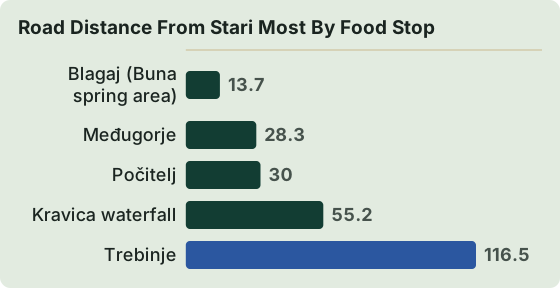
Day trips widen the menu. Blagaj, 13.7 km and about 19 minutes by road from Stari Most, sits at the Buna spring and is the trout stop. Počitelj, 30 km and about 31 minutes, is a fortified village where the food is simple and rural. Kravica waterfall, 55.2 km and about 54 minutes free-flow, costs 20 KM for an adult entry all year and pairs a swim in the designated summer pool area with a long outdoor lunch. Međugorje, 28.3 km and about 40 minutes, rounds out the circuit. A guided day covers all of the driving: the Kravica waterfall, Blagaj and Počitelj tour from Mostar runs that exact loop, and live dates can be checked here: Check availability.
| Food Stop | Road Distance From Stari Most | Free-Flow Drive Time |
|---|---|---|
| Blagaj (Buna spring area) | 13.7 km | about 19 min |
| Međugorje | 28.3 km | about 40 min |
| Počitelj | 30.0 km | about 31 min |
| Kravica waterfall | 55.2 km | about 54 min |
| Trebinje | 116.5 km | about 142 min |
For travellers arriving from the coast, food-and-sightseeing days run in the other direction too. A Mostar and Kravica tour from Split brings the Croatian coast to the bazaar and the falls in one organised day: Check availability.
Can You Learn To Cook Bosnian Food In Mostar?
Yes, and the practical options in Mostar are a burek-focused pastry class that teaches rolling, baking and eating the spiral, and a broader cooking class built around burek with a full lunch and drinks at the table, both bookable in the city itself rather than only from the coast. Learning one dish well beats a tasting menu of half-learned ones, and the pastry class in particular teaches a technique that travels home: the stretched dough, the spiral and the oven timing are the whole skill.
The longer class suits visitors who want the meal, not just the pastry: it builds a Bosnian lunch around what the group cooks, drinks included, which makes it a reasonable afternoon for families and small groups. Both options are walkable from the Old Town area, and neither requires prior kitchen experience.
Pairing a cooking session with a walking day works well because the class occupies a fixed block while the city sightseeing flexes around it. The Mostar walking tour guide covers the city-side itinerary, and the best time to visit Mostar guide helps with season choice, since summer heat pushes cooking and eating toward the mornings and evenings.
Common Questions About Bosnian Food In Mostar
These are the short answers to the questions visitors ask most about eating in Mostar, covering vegetarian options, coffee strength, drinking water, meal timing and what to bring home, each answered plainly from the local food culture rather than from any single establishment. Full detail on each topic sits in the sections above and in the linked guides.
Is Bosnian food spicy?
No. Bosnian food is seasoned with paprika, pepper, onion and herbs rather than chilli heat. Dishes that taste warm, such as stews and grilled meats, get depth from long cooking and onion, not spice. Hot sauce is not a table standard, though restaurants will usually find something if asked.
Can vegetarians eat well in Mostar?
Reasonably well, with limits. Cheese and potato pastries, spinach-filled zeljanica, grilled vegetables, soups and salads carry a vegetarian through the day, and dairy is everywhere in the form of kaymak and white cheeses. Protein variety is narrower than in larger capitals, and vegan options are fewer again.
What is kaymak?
Kaymak is a thick cultured cream, somewhere between clotted cream and soft butter in texture, served beside grilled meat and spread on warm bread. It is a standard side order at grill houses and one of the distinctive dairy tastes of the region.
Is the tap water safe to drink in Mostar?
The municipal supply is treated and generally reported as safe, though infrastructure advice varies and some travellers stick to bottled water as a precaution. Bottled water is cheap and available everywhere, so the choice costs little either way.
Do I need to tip in Mostar restaurants?
Tipping is appreciated rather than compulsory. Rounding up the bill or leaving roughly a tenth at a sit-down meal is the local habit, and small change at cafes is normal. Nothing is added automatically to the bill for service.
What food makes a good souvenir from Mostar?
Coffee sets travel well: a copper džezva with its cup is the classic. Rakija in a sealed bottle, jars of honey from Herzegovina, dried herbs and boxed rahat lokum are the other reliable picks, all sold in the bazaar shops. Check customs limits for alcohol before flying home with a bottle.
Eating is one of the simpler pleasures Mostar offers, and one of the reasons to give the city a full day or two rather than a fast pass through. This Mostar Travel Guide home page collects the rest: sights, day trips, weather and the practical pages that turn a food itinerary into a whole visit. Come hungry, order by dish name, and let the coffee set the pace.