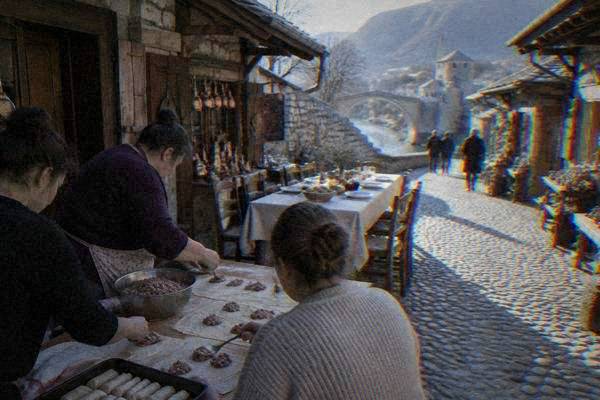
Bosnian Coffee In Mostar: How It Is Served And Where To Sit
Bosnian coffee in Mostar arrives unboiled in a copper pot with a small cup, sugar and a sweet, and it is drunk slowly. Here is how the ritual works and where to sit for it.
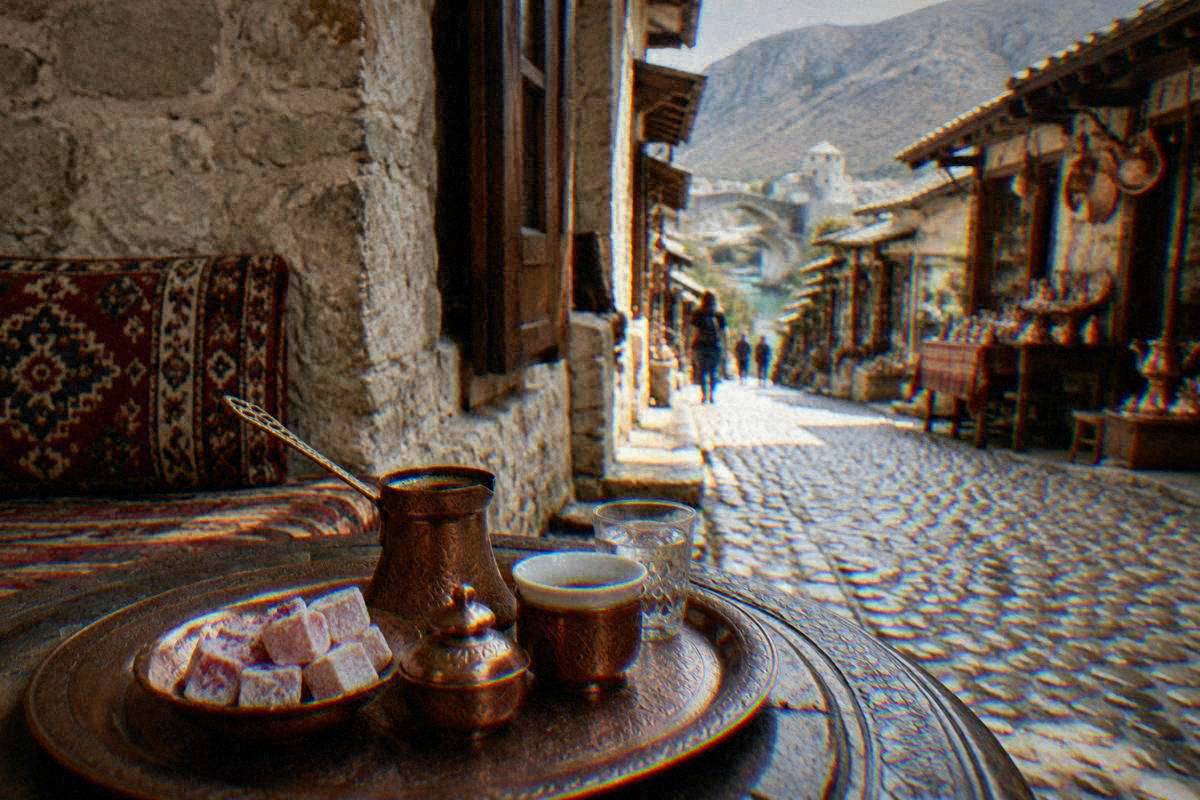
Bosnian coffee in Mostar is unfiltered coffee brewed in a small copper pot called a džezva and served on a tray with a demitasse cup, sugar, a glass of water and usually a square of rahat lokum. You wait for the grounds to settle, pour slowly, and sip. It is a sitting-down ritual rather than a takeaway drink, and the Old Bazaar around Stari Most is the classic place for it.
Mostar sits inland on the Neretva river in Herzegovina, and no building captures the city like Stari Most, the single-arched stone bridge completed in 1566, destroyed on 9 November 1993 and rebuilt and reopened in July 2004. Around it spreads Kujundžiluk, the Old Bazaar, where coppersmiths still hammer the small pots that brew one of the defining drinks of Bosnia and Herzegovina: Bosnian coffee. This page explains what that coffee is, how it is brewed and served, how to order and drink it, and where to sit while you do, all in the context of a city that treats a cup as an event rather than a caffeine delivery system.
What Is Bosnian Coffee In Mostar?
Bosnian coffee is an unfiltered, slowly brewed coffee made in a small long-handled copper pot called a džezva, served on a tray with a demitasse cup, a glass of water, sugar and usually a piece of rahat lokum, a gelatin sweet dusted with sugar. The grounds stay in the pot and settle before you pour, the cup is small, and the whole point is to sit.
In Mostar it is a daily ritual rather than a tourist performance, and it is served all over the city, from Kujundžiluk to Spanish Square.
The word for it is kahva, and ordering "bosanska kahva" gets you the full tray described above. The drink shares a family with the coffees brewed across the Balkans and Turkey, all of them made by heating very finely ground coffee with water and sugar in a pot set directly on heat or hot sand. What distinguishes the Bosnian serving is the presentation: the džezva arrives on the tray beside the cup, so the last stage of the ritual, the pour, happens at your table. Nothing is strained, nothing is pressed, and nothing goes into a paper cup with a lid.
The grind matters. It has to be powder-fine, finer than espresso grind, because the grounds must sink rather than float. Roast is generally dark, and the flavour runs strong, thick on the tongue and slightly sediment-backed at the very end of the cup. That last mouthful of grounds is normal; a finished cup is simply set down when the sediment reaches the rim of what is drinkable.
A cup of Bosnian coffee also carries a social code. It is ordered to anchor a conversation, a chess game, a long morning or a business matter. Nobody hurries a džezva. If your plan for the city is a packed checklist, the things to do in Mostar page maps the sights; this page is about the pause between them.
How Is Bosnian Coffee Brewed And Served In Mostar?
Bosnian coffee is brewed by heating water in a džezva, adding finely ground coffee off the heat or at a simmer, letting it foam once or twice without boiling over, then resting the pot so the grounds settle. It is served on a tray with the empty cup, sugar, water and a sweet, and you pour yourself. The whole process from order to first sip runs longer than an espresso because the foam must rise and fall and the grounds must settle before the cup is filled.
The steps, in the order they happen, are fixed enough to be worth a table:
| Step | What Happens | What You Do |
|---|---|---|
| 1. Water heated | Cold water goes into the džezva and is brought just to a boil | Nothing yet |
| 2. Coffee added | Powder-fine grounds and sugar go in, off the heat or at a bare simmer | Nothing yet |
| 3. Foam rises | The pot returns to heat until a foam crown rises, once or twice | Watch, do not stir hard |
| 4. Resting | The pot sits so the foam drops and the grounds sink | Wait one to two minutes |
| 5. Serving | The tray arrives: pot, cup, sugar, water, sweet | Pour slowly along the cup wall |
| 6. Drinking | Sipped hot, in small mouthfuls | Stop before the sediment |
Two details catch first-timers. First, the foam, called kajmak in coffee slang though it shares nothing with the dairy cream of the same name, is treated as the sign of a well-made pot, and a rushed boil destroys it. Second, sugar in Bosnia and Herzegovina is traditionally offered as a cube held in the mouth while you sip, a habit older than the spoon-and-stir routine, though stirring is perfectly normal and nobody will comment on either approach.
The water glass is not decoration. It is drunk first, or between sips, to cleanse the palate and temper the strength. The sweet, most often rahat lokum, is eaten alongside rather than after. Setting the tray up this way, so that each element has a slot in the sequence, is what turns a two-minute drink into a fifteen-minute ritual.
If the food side of Herzegovina interests you as much as the drink, a guided table is a shortcut to both. The Bosnian cooking class with burek, lunch and drinks rolls dough, bakes, and lays out a full spread with coffee as part of the meal, and the listing shows current dates and prices.
For context beyond the table, the siege history walking tour explains the 1990s through the city's own buildings, dates and physical facts, a pairing of coffee and context that many travellers find gives the cup a deeper setting.
Where To Sit For Bosnian Coffee In Mostar?
The classic seat for Bosnian coffee in Mostar is Kujundžiluk, the stone-flagged Old Bazaar that runs beside the Neretva toward Stari Most, where low tables sit against workshop fronts and coppersmiths a few doors away still make the džezvas themselves. The second is the Rondo and Spanish Square side, where cafés are larger and the pace is local. The third is any terrace with a view of the river or the bridge, where the coffee is the excuse and the view is the point.
Kujundžiluk is the sensory version. The lane is narrow, the shops spill coppers and rugs onto the cobbles, and the coffee you drink was probably served in a pot from the same street. Sitting here puts you inside the UNESCO-inscribed Old Bridge Area of the Old City of Mostar, inscribed in 2005, so the history is literally around the table. Expect shade in the morning on one side of the lane and in the afternoon on the other.
The west side and the squares are the everyday version. Around Spanish Square and the boulevards, the café terraces fill with students and office hours, the menus lean longer, and the coffee arrives faster. This is where the ritual looks most ordinary, which is its own recommendation. The where to stay in Mostar guide maps which neighbourhoods put you walking distance from each scene.
| Seating Scene In Mostar | Character | Best For |
|---|---|---|
| Kujundžiluk bazaar lane | Narrow, workshop fronts, copper everywhere | First cup, atmosphere, photographs |
| Neretva riverside terraces | Water views, bridge sightlines from some seats | A slow hour with the river below |
| Spanish Square and Rondo side | Larger terraces, local pace, longer menus | People-watching, a second cup |
| Donja Mahala, east bank | Quieter, more residential cafés | Escaping the busiest lanes |
| Viewpoint cafés on the hillsides | Heights over the city, stair climb involved | Sunset with the tray |
Riverside terraces split the difference. The Neretva runs cold and jade-green year-round, and a table near the water turns a coffee into a front-row seat for the divers of the Mostari club, who jump from Stari Most in the warmer months. The Mostar bridge diving guide explains who jumps, when the tradition runs and why visitors do not.
Timing changes the experience more than the address. Morning is for the bazaar before the lanes fill, afternoon shade is for the west side, and evening, when the bridge floodlights come on, belongs to the terraces. Season matters too: July and August are the busy, warm months, with mean daily highs around 30 C in the ERA5 reanalysis for 1991 to 2020, so a shaded table and the water glass earn their keep. The best time to visit Mostar guide breaks the year down month by month.
How Do You Order Bosnian Coffee In Mostar?
You order it by name, "bosanska kahva" or simply "kahva", and the full tray arrives: džezva, cup, sugar, water and a sweet. If you want it sweet, say "sa šećerom" or use the sugar on the tray; if you want it plain, "bez šećera". "Kafa s mlijekom" brings it with a small jug of hot milk, and a "macchiato" or "espresso" gets you the standard European drinks instead, so the word kahva is the one that triggers the ritual.
The vocabulary is short and forgiving, and a small table covers everything a visitor is likely to need at the counter:
| Phrase | Meaning | What Arrives |
|---|---|---|
| Bosanska kahva | Bosnian coffee | Full tray with džezva |
| Kahva | Coffee, understood as Bosnian | Full tray |
| Bez šećera / sa šećerom | Without sugar / with sugar | Sugar on the side either way |
| Kafa s mlijekom | Coffee with milk | Tray plus a small jug of hot milk |
| Espresso, macchiato | Standard espresso drinks | Espresso machine drinks |
| Čaša vode | A glass of water | Usually already on the tray |
One practical note that saves confusion: strength is dialled by the pour, not the order. Because the grounds stay in the džezva, the first pour is the strongest and later pours run lighter as the pot level drops over the grounds. Pouring a short cup first and topping up later stretches one order across a long sit. The cup is meant to be refilled from the pot, which is why a single kahva can outlast two espressos.
Payment runs on the convertible mark (KM, BAM), the country's currency, pegged at 1 EUR = 1.95583 KM. Euro cash is often accepted in tourist areas at a rounded rate, so confirm before paying, and carry marks for smaller tables. The Mostar money guide covers cards, cash machines and the peg in detail.
What Should You Eat With Bosnian Coffee In Mostar?
The classic pairing is rahat lokum, the sugar-dusted gelatin sweet that shares the tray, followed by anything from the pastry family: burek and its filled relatives, hurmašice and other syrup-soaked cakes, and in the morning a slice of bread with kajmak, the thick cultured cream. Bosnian coffee is strong and slightly bitter, so the pairings lean sweet or rich, and the tray sweet exists precisely to take the edge off the first sip.
Sweets first, because they are part of the service. Beyond rahat lokum, syrup cakes such as hurmašice and tufahija, a poached apple filled with walnut cream, appear on café counters across the city. All of them are described here in general terms; the Bosnian food guide widens the menu well past the coffee table.
Then the savoury side. Burek, the rolled filled pastry, is the heavyweight: a slice with yoghurt is a full stop of a meal, and the burek guide covers the family, from the meat-filled original to the potato, cheese and spinach relatives. Ćevapi, grilled minced meat in flatbread with raw onion, belongs to the ćevapi tradition and pairs with coffee only in the sense that one follows the other. For something stronger after the cup, Herzegovina's rakija tradition, covered in the rakija guide, offers grape and herb brandies that close a meal rather than accompany it.
| Pairing | Type | Why It Works With Kahva |
|---|---|---|
| Rahat lokum | Sugar-dusted gelatin sweet | Softens the first bitter sip |
| Hurmašice | Syrup-soaked semolina cakes | Sweet against the dark roast |
| Tufahija | Poached apple, walnut filling | Rich dessert for a long sit |
| Burek slice | Filled rolled pastry | Turns coffee into a meal |
| Kajmak on bread | Thick cultured cream | A breakfast pairing |
| Rakija, after | Grape or herb brandy | Closes the table, not the coffee |
The full food-and-coffee table is easiest to reach through a guided kitchen, and the cooking class above is built exactly around it. Checking availability through the listing shows the current calendar, the meeting details and the cancellation terms before you commit. Everything else covered here is indexed on Mostar Travel Guide.
How Does Bosnian Coffee In Mostar Differ From Espresso Drinks?
Bosnian coffee differs from espresso in the machine, the filtering and the timing: it is brewed in a copper pot over direct heat with no machine and no filter, the grounds stay in the drink and settle in the pot, and it is poured by you over several minutes rather than pulled in seconds and served finished. Espresso arrives as a ready cup; Bosnian coffee arrives as a process, and the last third of the experience, the pour and the pace, belongs to the drinker.
The comparison is worth a table because the two drinks sit side by side on the same menus:
| Aspect | Bosnian Coffee | Espresso |
|---|---|---|
| Brewing vessel | Copper or brass džezva on heat | Machine at pressure |
| Grind | Powder-fine, finer than espresso | Fine |
| Filtering | None, grounds settle | Full filtration in the portafilter |
| Who pours | The drinker, from the pot | The barista, finished cup |
| Volume | One small cup, refillable from the pot | Fixed 25 to 40 ml shot |
| Typical time at table | Ten to twenty minutes | One to five minutes |
| Sediment | Expected at the end | None |
Strength is the misleading part. A cup of Bosnian coffee tastes stronger than an espresso because the extraction runs long and the body carries suspended fines, but the caffeine per sip is moderated by how slowly it is drunk. The ritual self-limits: a tray for one is a measured amount of coffee, stretched over conversation.
What Are The Rules Of Coffee Etiquette In Mostar?
The etiquette is simple: wait for the grounds to settle before pouring, pour slowly along the side of the cup so the sediment stays down, drink in small sips with the water glass and sweet alongside, and stop when the sediment reaches the top of what is drinkable. Do not stir the pot, do not ask for it to go, and do not rush, because the džezva is served for the table, not the pavement. Takeaway versions exist, but the tray is the tradition.
A few specifics help. The sugar-cube-in-the-mouth habit mentioned above is old-fashioned and optional; holding the cube on the tongue for the first sips sweetens the coffee without stirring. The water glass is drunk first or between sips, never ignored. The sweet is eaten during, not after. And when the cup is done, it is set down with the grounds visible in the bottom, a perfectly finished Bosnian coffee cup.
Refusal is also part of the code. If someone offers you a coffee and you cannot stay, a short explanation and a rain-check is normal; accepting and drinking half while standing is the only genuinely awkward version. Coffee in Mostar is an invitation to sit, and the invitation is the social unit.
What Practical Facts Should A Coffee Break In Mostar Know?
A coffee break in Mostar runs on the convertible mark, pegged at 1 EUR = 1.95583 KM, with euro cash often accepted at a rounded rate you should confirm first; the emergency number is 112; plugs are type C and F at 230 V; and a tourist tax reported at 3 KM per person per night applies in the canton from 1 January 2026, so confirm it at booking. Tap water is generally treated, and card payment is common at larger cafés while small vendors prefer cash.
The essentials in one place:
| Item | Figure |
|---|---|
| Currency | Convertible mark (KM, BAM), pegged 1 EUR = 1.95583 KM |
| Tourist tax | Reported 3 KM per person per night from 1 January 2026, confirm at booking |
| Emergency numbers | 112 general, 122 police, 123 fire, 124 ambulance |
| Electricity | Type C and F plugs, 230 V |
| Tap water | Generally treated; bottled is widely sold if you prefer |
| EU and Schengen status | Bosnia and Herzegovina is in neither |
Getting to the table is covered elsewhere on this site: the how to get to Mostar guide covers train, bus and air routes, and the Mostar weather page tells you whether your coffee will be taken inside or on the terrace.
Can You Make Bosnian Coffee At Home From Mostar?
Yes, and the only equipment you need is a small džezva, ideally the hammered copper one sold all over Kujundžiluk, powder-fine coffee, cold water and low heat: heat the water, add the coffee and sugar, let the foam rise once without boiling over, rest the pot a minute, and pour slowly into a small cup. The pot is the souvenir that keeps working, and coppersmiths in the bazaar sell džezvas in every size from single-cup to family.
The common failure points are all on the heat. Boiling the pot over drives the foam out and scorches the grounds; skipping the rest means drinking them. Low heat, one foam rise, patience. Sugar goes in the pot, not the cup, if you want it dissolved properly, and the ratio is roughly a heaped teaspoon of coffee per small cup of water, adjusted to taste.
Packing the pot home is the easy part; the Bosnia and Herzegovina travel tips guide covers border rules, including that the country is outside the EU and Schengen, and that the Croatian land border is a Schengen external border with full checks since 1 January 2023, which matters if your route home runs through Dubrovnik or Split.
And if the pot outlives the memory of the trip, the rest of Herzegovina is one bus or tour away. Blagaj, Počitelj and Kravica waterfall make a classic triangle from the city, and a guided day trip handles the driving while you digest.
Common Questions About Bosnian Coffee In Mostar
Is Bosnian coffee the same as Turkish coffee?
The brewing family is shared: finely ground coffee, water and sugar heated in a small pot with no filtering. The Bosnian serving differs in presentation, with the džezva arriving on the tray so the drinker pours, and in the accompanying glass of water and sweet. Names and rituals vary across the region, and origin disputes are best left alone over the cup itself.
How long does a cup of Bosnian coffee take?
Count on ten to twenty minutes from tray to empty cup. The grounds need a minute to settle after brewing, the pour is done by the drinker in stages, and the pace is the point. Ordering kahva signals a sit, not a stop.
Is Bosnian coffee stronger than espresso?
It tastes stronger, because the long extraction and the fine suspended particles give it a heavier body, but the caffeine per cup depends on the amount of coffee used, which is small. The slow pace of drinking spreads the dose over a longer sitting than a quickly finished espresso.
Do you drink the grounds in Bosnian coffee?
No. The grounds settle in the džezva and stay there if you pour slowly along the side of the cup. A little fine sediment in the last sip is normal, and the cup is simply set down when the sediment reaches the top of what is drinkable.
Can you get Bosnian coffee with milk?
Yes, ordered as kafa s mlijekom, which brings the tray with a small jug of hot milk on the side. The milk is added to the cup, not the pot, so the džezva keeps its strength for later pours.
Where is the best place in Mostar to try Bosnian coffee?
Kujundžiluk, the Old Bazaar lane running toward Stari Most, is the classic setting, with coppersmiths selling the very pots the coffee is brewed in. Riverside terraces add the Neretva view, and the squares on the west side give the everyday local version. Names and hours are best confirmed on the spot.
Mostar Travel Guide covers the city one table at a time, and the coffee tray is where the city sits longest: order the kahva, wait for the grounds to settle, and let the bridge wait for you.