Bosnia And Herzegovina Travel Tips For A Mostar Trip
Mostar sits inland on the Neretva river in Herzegovina, and almost every practical question a trip raises, currency, borders, trains, weather and safety, has an answer that surprises people who only know the Croatian coast.
Bosnia and Herzegovina is not in the EU or Schengen, uses the convertible mark (KM) rather than the euro, and checks passports fully at the Croatian border. Mostar is reached in about 2 hours by train from Sarajevo or about 2.5 hours by road from Dubrovnik, and the city itself is compact and walkable.
Mostar is an inland city on the Neretva river in Herzegovina, the southern region of Bosnia and Herzegovina, and it rewards travellers who arrive knowing a handful of country-level rules that the Croatian coast two hours away does not share. The currency is the convertible mark, not the euro. The border from Croatia carries full passport checks. The train from Sarajevo runs twice a day and was suspended for five weeks in autumn 2026 before resuming on 15 October. And the Old Bridge Area of the Old City, centred on Stari Most, has been a UNESCO World Heritage property since 2005. This guide gathers the practical facts, borders, money, transport, weather, safety and day trips, in one place, with the Mostar Travel Guide covering the city itself in depth elsewhere.
What Should You Know About Bosnia And Herzegovina Before Visiting Mostar?
Bosnia and Herzegovina is a sovereign country outside the EU and outside Schengen, with its own currency, the convertible mark (KM, BAM), pegged at 1 EUR = 1.95583 KM under a currency board arrangement. Mostar lies in Herzegovina, the southern region, on the Neretva river, roughly 127.1 km by road from Sarajevo and 145.5 km from Dubrovnik. The official languages are Bosnian, Croatian and Serbian.
Those four facts, country status, currency, region and languages, clear up the questions that catch out day-trippers crossing from Croatia. Because the country is not in the EU, the border is a real international frontier, covered below. Because the mark is pegged to the euro at a fixed rate, converting is simple, but paying in euro cash is a courtesy shops extend, not a rule, and the rate offered is usually rounded. Herzegovina itself is a karst landscape of limestone hills, dry in summer and crossed by cold rivers, and Mostar is its administrative and cultural centre, a city of about 105,000 people at the 2013 census.
The name of the city first appears in a document from 1474, and it comes from "mostari", the bridge keepers who guarded the wooden crossing that preceded the stone arch completed in 1566. The Old Bridge was destroyed on 9 November 1993 during the war and rebuilt and reopened in July 2004, and the surrounding Old City was inscribed on the World Heritage List in 2005 under criterion (vi). For the fuller story, see the site's Mostar history guide.
A few practical basics follow the same pattern as the rest of the Balkans. Plugs are type C and F, 230 V, the same as most of continental Europe. The general emergency number is 112, with 122 for police, 123 for fire and 124 for ambulance. A tourist tax reported at 3 KM per person per night applies in the Herzegovina-Neretva Canton from 1 January 2026, usually collected through accommodation: confirm the amount at booking.
Do You Need A Visa To Enter Bosnia And Herzegovina For Mostar?
Visa-exempt visitors, including holders of EU, UK, US, Canadian and Australian passports, may stay up to 90 days within a six-month period from the date of first entry, with no visa arranged in advance. Bosnia and Herzegovina is not in the EU and not in Schengen, so a stay in Croatia does not count towards, or exhaust, that allowance. ETIAS, the EU travel authorisation, is not in operation and no applications are collected.
Two consequences follow. First, passports are stamped or scanned at entry, so passports should be valid for the whole stay, and border officers may ask about accommodation or onward travel, the same as at any external frontier. Second, the 90-day allowance is separate from time spent in Croatia, which means a combined Dubrovnik-Mostar-Sarajevo route does not create an overstay problem in either country for short trips.
The detailed crossing mechanics, which checkpoints sit closest to Mostar and how long the queues run, are covered next. For the country-level entry rules, the Bosnia safety guide adds context on practical security questions.
Is The Croatian Border Crossing Into Bosnia Difficult On A Mostar Trip?
The land border between Croatia and Bosnia and Herzegovina has carried full checks since 1 January 2023, when Croatia joined Schengen, so every crossing means a passport check in both directions. The main crossings near Mostar are Doljani-Metković and Bijača-Nova Sela, where waits are reported at up to about 30 minutes, and longer at summer peaks. Build the buffer into any same-day itinerary.
The queues are the reason many travellers on a tight schedule book a guided trip rather than drive themselves. A tour absorbs the wait, handles parking in Mostar and pairs the city with Herzegovina stops such as Počitelj or Kravica waterfall on the same drive.
One structural note for drivers: since the Pelješac Bridge opened in 2022, traffic between Split and Dubrovnik can stay inside Croatia and bypass the Bosnian Neum corridor entirely. Mostar-bound travellers still cross into Bosnia and Herzegovina properly, usually at Bijača if coming from the Dubrovnik side or at Doljani from the Metković side. Rental cars need the company's advance permission to cross, and insurance documents should be checked before departure. The site's border crossing guide walks through the paperwork, and the car rental guide covers driving in the country.
What Money Do You Need For Mostar, And Is The Euro Accepted?
The currency of Bosnia and Herzegovina is the convertible mark (KM, BAM), fixed to the euro at 1 EUR = 1.95583 KM. Euro cash is often accepted in Mostar's tourist areas, typically at a rounded rate close to 2 KM to the euro, but that is a shop courtesy, not an official rule: confirm the rate before paying. Cards work at hotels, larger restaurants and museums, while small vendors, markets and some taxis want cash.
The practical approach is to withdraw marks from a bank ATM, widely available around the Old Bazaar and the main boulevards, and to choose "charge in KM" when the machine offers a conversion. Paying in euro cash works in a pinch but the rounding goes against the buyer on small purchases. Prices at sights are quoted in KM, so the mental conversion is simply "two marks to the euro, minus a fraction".
| Item | Figure | Notes |
|---|---|---|
| Currency | Convertible mark (KM, BAM) | Sole legal tender |
| Fixed rate | 1 EUR = 1.95583 KM | Currency board peg |
| Euro cash in shops | Often accepted, rounded near 2 KM to 1 EUR | Confirm the rate first |
| Cards | Widely accepted at hotels and larger restaurants | Cash preferred at small vendors |
| Tourist tax | Reported 3 KM per person per night in the canton | From 1 January 2026, confirm at booking |
For the deeper money picture, ATM choice, tipping habits and how much a Mostar day costs, see the Mostar money guide and the Mostar budget guide.
How Do You Get To Mostar: Plane, Train, Bus Or Car?
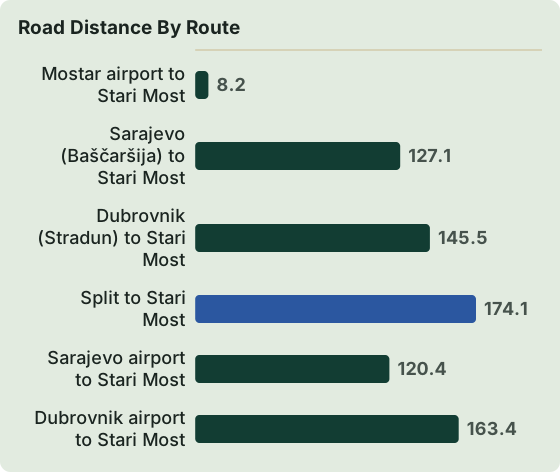
Mostar is reached by two daily trains each way from Sarajevo, a journey of about 2 hours, after service resumed on 15 October 2026 following a five-week suspension; by frequent buses from Sarajevo, Dubrovnik and Split; and by road, 145.5 km and about 150 minutes free-flow from Dubrovnik's Stradun plus border time. Mostar airport is 8.2 km and 12 minutes from Stari Most, with a small route list.
The train is the scenic choice: the line follows the Neretva through Jablanica and Konjic, and the schedule, two departures a day each way between Sarajevo and Čapljina via Mostar, is thin enough that the timetable should be checked the day before travel. The fire-related suspension of September and October 2026 showed how quickly the corridor can change, so a backup bus is worth knowing about; buses to Sarajevo run several times daily. Fares and current times are on the operators' own pages before any booking.
| Route | Road distance | Free-flow time |
|---|---|---|
| Mostar airport to Stari Most | 8.2 km | 12 min |
| Sarajevo (Baščaršija) to Stari Most | 127.1 km | 134 min |
| Dubrovnik (Stradun) to Stari Most | 145.5 km | 150 min |
| Split to Stari Most | 174.1 km | 131 min |
| Sarajevo airport to Stari Most | 120.4 km | 125 min |
| Dubrovnik airport to Stari Most | 163.4 km | 172 min |
Border queue time is excluded from those figures, and on the Dubrovnik and Split routes it can add a meaningful margin in July and August. The site has dedicated pages for getting to Mostar, Mostar airport, Dubrovnik to Mostar, Split to Mostar, Sarajevo to Mostar and getting around.
What Is The Weather Like In Mostar Through The Year?
Mostar has a Mediterranean-continental climate with hot summers and mild, wet winters: the FHMZ Mostar station, 1961 to 1990, records a July mean of 24.7 C against a January mean of 4.8 C, an annual rainfall of 1,515.4 mm with a winter maximum, and an absolute maximum of 41.2 C. ERA5 reanalysis, 1991 to 2020, models mean daily highs of 29.9 C in July and 30.5 C in August.
Rain is the number that shapes itineraries. November averages 200.0 mm against July's 42.9 mm on the FHMZ station table, roughly a fivefold difference, and the valley floor in high summer runs hotter than the modelled normals suggest. Two practical readings follow: spring and autumn are the comfortable walking seasons, and midday in July and August is for shade, river time or a drive to the hills rather than stone streets. The Neretva itself stays cold even in August, fed by karst springs, which is exactly why it looks so turquoise.
| Month | Mean temp C (FHMZ 1961-1990) | Rain mm | Modelled high C (ERA5 1991-2020) |
|---|---|---|---|
| January | 4.8 | 164.7 | 8.4 |
| April | 13.3 | 127.3 | 17.7 |
| July | 24.7 | 42.9 | 29.9 |
| August | 24.2 | 73.7 | 30.5 |
| October | 15.3 | 150.6 | 19.5 |
| November | 10.1 | 200.0 | 14.1 |
For month-by-month planning, see the best time to visit Mostar and the Mostar weather guides.
Which Day Trips From Mostar Are Worth Booking?
The classic Herzegovina loop from Mostar takes in Blagaj Tekke, 13.7 km and about 19 minutes away, Počitelj at 30.0 km, and Kravica waterfall at 55.2 km and about 54 minutes, all reachable in one eight-hour day with a tour or a hire car. Further out, Konjic, Jablanica and the Radimlja necropolis near Stolac extend the radius, and Sarajevo itself is 127.1 km north.
Kravica is the headline stop and the one with the firm figures: entry is 20 KM for an adult all year, 10 KM for residents of Bosnia and Herzegovina, children under 7 free, and the park is open every month with hours that stretch to 07:00-22:00 from June to September. The "summer only, 10 euro" claims that circulate online are wrong on both counts. Swimming is allowed in summer in the designated pool area, with no lifeguard reported, so the park's rules on arrival are the ones that count.
| Month | Kravica opening hours |
|---|---|
| January-February | 07:00-17:00 |
| March-April | 07:00-18:00 |
| May | 07:00-20:00 |
| June-September | 07:00-22:00 |
| October | 07:00-19:00 |
| November-December | 07:00-17:00 |
Blagaj pairs a dervish tekke at the Buna spring with a fortress hill above, Počitelj is a walled Ottoman village above the Neretva, and both sit directly on the southern road out of Mostar, which is why nearly every Herzegovina day tour bundles them. The site's dedicated guides cover Blagaj, Počitelj and Kravica waterfall in detail, and the Herzegovina road trip guide covers the longer loop through Stolac, Trebinje and beyond.
Active options round out the week. The Neretva and its lakes sit close to the city, and water-based trips run through the warmer half of the year.
Food is the other half of the country's character. A burek session, rolling and baking the pastry rather than just eating it, is a short city activity that pairs well with a market morning, and the Bosnian food guide maps the plates worth knowing.
Is Bosnia And Herzegovina Safe Around Mostar?
Mostar's Old Town and central streets are public, walkable and busy through the day and evening, and the general emergency number is 112. The one rule with real consequences applies outside the city: rural Herzegovina still carries suspected mine areas, so walkers should stay on marked paths and respect warning signs, using the BHMAC suspected-area data as the reference. Ordinary city precautions, as anywhere, are enough for a visit.
The mine warning is not a reason to avoid the countryside, it is a reason not to freelance in it. Marked trails around Blagaj, Počitelj and the established viewpoints are fine; wandering off-path across unmapped karst ground is not. Inside Mostar the practical hazards are ordinary ones, heat in July and August, slippery stone when it rains, and traffic on the boulevards that ring the pedestrian core.
For history visitors, the 1990s are part of what Mostar is, and the city documents them plainly: the Old Bridge was destroyed on 9 November 1993 and reopened in July 2004, and the war history guide and bridge diving guide cover the record, including the Mostari diving club whose members jump from the parapet, about 21 to 24 metres above the river depending on its level. Visitors do not jump.
What Small Practical Tips Make A Mostar Trip Easier?
Carry marks in cash for small purchases, plug adapters type C or F at 230 V, use 112 for emergencies, expect a 3 KM per night reported tourist tax on stays, and time the Old Town for morning or late afternoon in high summer, when ERA5 reanalysis, 1991 to 2020, models mean daily highs of about 30 C. Tap water is treated and generally safe.
A few smaller items earn their place in a packing list. Comfortable shoes matter more than in a coastal resort, because the Old Town is cobbled and the viewpoints involve stairs. A scarf or cover-up is needed for mosque interiors, including Koski Mehmed-pašina džamija by the bridge, where wraps are typically provided but shoulders and knees must be covered. Sun protection is not optional from June to September. And because tour prices and sight opening hours shift seasonally, the current figures on the operator's live listing or the official ticket page are the ones to trust before booking.
| Practical item | Detail |
|---|---|
| Emergency numbers | 112 general, 122 police, 123 fire, 124 ambulance |
| Plugs and voltage | Type C and F, 230 V, 50 Hz |
| Currency | Convertible mark (KM), 1 EUR = 1.95583 KM fixed |
| Languages | Bosnian, Croatian, Serbian; English is common in tourism |
| Rural walking | Stay on marked paths, respect mine warning signs |
| Mosque visits | Shoulders and knees covered, wraps usually provided |
For deeper planning, the site's things to do in Mostar page is the full root guide, and where to stay in Mostar maps the neighbourhoods. Travellers pairing the city with Croatia can start from the Mostar day trip from Dubrovnik or the Mostar day trip from Split itineraries, or the Dubrovnik guide for the Croatian side of the border.
Common Questions About Bosnia And Herzegovina Travel Tips For Mostar
Is Bosnia and Herzegovina in the EU or Schengen?
No, it is in neither. The border with Croatia has carried full passport checks since 1 January 2023, when Croatia joined Schengen, so a Mostar trip involves a real international crossing each way.
Can I pay with euros in Mostar?
The currency is the convertible mark (KM), pegged at 1 EUR = 1.95583 KM. Euro cash is often accepted in tourist areas at a rounded rate near 2 KM to the euro, but confirm the rate before paying, and expect cash in marks to be needed at small vendors.
Do I need a visa for Bosnia and Herzegovina?
Visa-exempt visitors, including EU, UK, US, Canadian and Australian passport holders, may stay up to 90 days within a six-month period from first entry. ETIAS is not in operation.
How long is the border wait coming from Croatia to Mostar?
At the main crossings near Mostar, Doljani-Metković and Bijača-Nova Sela, waits are reported at up to about 30 minutes, and longer at summer peaks. Check live conditions on travel days in July and August.
Is the train from Sarajevo to Mostar running?
Yes. Service resumed on 15 October 2026 after a suspension that began on 8 September 2026, with two trains a day each way between Sarajevo and Čapljina via Mostar, a journey of about 2 hours. Check the operator's timetable before travelling.
Is Mostar safe for tourists?
The city centre is public and walkable, and 112 is the general emergency number. The one firm rule applies to the countryside: rural Herzegovina retains suspected mine areas, so stay on marked paths and respect warning signs.