What A Trip To Mostar Costs In 2026
Mostar prices run in convertible marks, not euros, and the city's core sights cost a few marks or nothing at all. Here is what each part of a trip actually costs in 2026.
Mostar is an affordable destination by regional standards: the Old Bridge and the Kujundžiluk bazaar are free to walk, major sight entries run from about 4 to 20 KM, the Kravica waterfall charges 20 KM all year, and a reported 3 KM per night tourist tax applies in the canton.
Mostar, the main city of Herzegovina on the Neretva river, is one of the more affordable destinations on the Adriatic side of the Balkans, and the reason starts with the currency. Bosnia and Herzegovina uses the convertible mark (KM, BAM), pegged to the euro at 1 EUR = 1.95583 KM under a currency board, and prices at the sights are set in marks. The Old Bridge itself, the centrepiece of a UNESCO World Heritage property inscribed in 2005, is a free public crossing at any hour. What follows is a plain breakdown of the costs that shape a trip here in 2026: sight entries, tours, transport, day trips and the small traps that quietly raise a bill.
Is Mostar Expensive To Visit Compared To Croatia?
No, Mostar is noticeably cheaper than the Croatian coast for comparable sightseeing, because entries are in convertible marks and the headline sights are free to walk. Crossing Stari Most costs nothing at any hour, Kujundžiluk bazaar is a public street, and the biggest single entry fee in the wider region is Kravica waterfall at 20 KM for an adult, applied all year.
A reported tourist tax of 3 KM per person per night applies in Herzegovina-Neretva Canton from 1 January 2026, and hotels, hostels and apartment rates are not published in any official price list here.
The comparison with Croatia is structural, not just a feeling. Croatia is in the European Union and the euro zone; Bosnia and Herzegovina is in neither, and it is not in Schengen either. The Croatian land border is a Schengen external border with full passport checks, and crossing it adds time rather than money. Costs inside Herzegovina are quoted and paid in KM, and while euro cash is often accepted in tourist areas at a rounded rate of roughly 1 euro to 2 marks, that rounding works against you on small purchases, so paying in marks is the value play. The details of cards, ATMs and exchange are covered on the Mostar money guide.
One structural saving is the walkability of the centre. The Old Bridge, Kujundžiluk, Kriva ćuprija, Spanish Square and the riverside mosques are all within a short walk of each other, so a city visit needs no taxis or buses at all. Getting around is covered on the getting around Mostar guide, and the practical entry rules, border questions and plug types are collected in the Bosnia and Herzegovina travel tips guide.
What Are The Entry Prices For Mostar's Main Sights?
The core of Mostar costs nothing to see: Stari Most is a free public crossing, Kujundžiluk and Kriva ćuprija are open streets, and the Partisan Memorial Cemetery has no ticket or staffed hours. Paid entries are modest and in cash: the Old Bridge Museum is reported at 10 KM, Koski Mehmed-pašina džamija at a small fee with more for the minaret, Bišćević House at about 4 KM and Muslibegović House at about 8 KM, figures to confirm on arrival.
Treat the house and museum figures as close approximations and carry cash. The mosque fee is the one that varies most in reports, roughly 10 KM for the mosque interior and more with the minaret climb; worship can pause access at prayer times. Fees for Karađoz-begova džamija, Kajtaz House, the War Photo Exhibition and the Franciscan bell tower are not published anywhere official, so confirm on the spot.
| Sight | Entry | Notes |
|---|---|---|
| Stari Most (Old Bridge) | Free | Public pedestrian route, any hour |
| Kujundžiluk bazaar | Free | Open street, no admission |
| Kriva ćuprija (Crooked Bridge) | Free | Public structure |
| Partisan Memorial Cemetery | No ticket | Unstaffed, no set hours |
| Old Bridge Museum (Tara tower) | Reported 10 KM | Reported hours 08:00 to 16:00, 1 April to 1 November |
| Koski Mehmed-pašina džamija | Small cash fee, more with minaret | Reports vary; confirm on site |
| Bišćević House | About 4 KM | Ottoman house museum |
| Muslibegović House | About 8 KM | Ottoman house museum |
The free tier is what makes a Mostar day cheap. The bridge, the bazaar, the river banks and the viewpoints from Hum hill and Fortica's approach cost nothing, and the free things to do in Mostar list is long before any ticket is bought. For depth, a guided walk changes the arithmetic: the history walks on this site are covered below, and the sieges and reconstruction are explained properly on the Mostar war history guide.
Which Tours In Mostar Give The Best Value?
The two free, tip-based walking tours on GuruWalk are the cheapest way into the city's story, and paid walks start from the price of a lunch. Mostar All in One and From the Spanish Square to the Old Bridge: Mostar Uncovered are both free with pay-what-you-want tips, while paid walking tours on the roster run from about 20 to about 90 dollars per person depending on length and privacy. A cooking class with lunch and drinks sits higher but replaces a meal.
GuruWalk must be named here because both free walks are on that platform: Mostar All in One, and From the Spanish Square to the Old Bridge: Mostar Uncovered. Both are free at booking and you tip the guide what the walk was worth. Paid options range wider: the small-group Old Town walk with wine tasting, the street art walk, and private tailored walks for travellers who want the history at their own pace.
The tailored private history walk is the one this site features, because Mostar rewards context. A guide can trace the 1474 first written mention of the name, the 1566 completion of the bridge, its destruction on 9 November 1993 during the war and its reopening in July 2004, facts that a free first page of search results rarely assembles in one place. Check availability on the operator's live listing.
Food experiences deserve their own line in the budget. A burek masterclass and a full Bosnian cooking class with lunch and drinks are both on the roster, and a cooking class that ends in a shared meal effectively covers a restaurant visit. The food culture itself, from ćevapi to Bosnian coffee, is mapped on the Bosnian food guide, where the dishes worth ordering are explained without any invented price list.
How Much Does Getting To Mostar Cost?
The train from Sarajevo is the anchor figure: about 14 KM one way in second class, reported, on a service that resumed on 15 October 2026 after a suspension following a fire along the corridor. Buses from Sarajevo are reported at roughly 20 to 35 KM one way depending on operator, and cross-border buses from Dubrovnik and Split are quoted in euros or dollars by the operators. Bosnia and Herzegovina is not in the EU, so nothing here prices in a rail pass or an EU scheme.
Two trains a day run each way between Sarajevo and Čapljina via Mostar, a journey of about two hours. Bus coverage is broader, with several daily departures toward Sarajevo, Dubrovnik and Split, and fares that move with the season. The route options, including the airport picture, are laid out on the how to get to Mostar guide, with the three main corridors covered on the Dubrovnik to Mostar, Split to Mostar and Sarajevo to Mostar pages.
| Route | Reported fare | Notes |
|---|---|---|
| Sarajevo to Mostar by train | About 14 KM one way | Two trains daily each way; service resumed 15 October 2026 |
| Sarajevo to Mostar by bus | Roughly 20 to 35 KM one way | Varies by operator and timing |
| Mostar to Dubrovnik by bus | Quoted around 28 to 40 US dollars | About 3 to 4 daily departures |
| Mostar airport taxi to centre | A short, inexpensive taxi ride | Airport is 8.2 km, about 12 minutes from Stari Most |
Flying in makes sense only within a narrow route list. Mostar International Airport (OMO) sits 8.2 km and about 12 minutes by road from Stari Most, with reported Croatia Airlines flights to Zagreb and Eurowings to Stuttgart, the latter extended through the 2026/27 winter. Arrivals overwhelmingly come through Sarajevo or Dubrovnik airports instead, and the Mostar airport guide compares the options honestly.
What Do Day Trips From Mostar Cost To Enter?
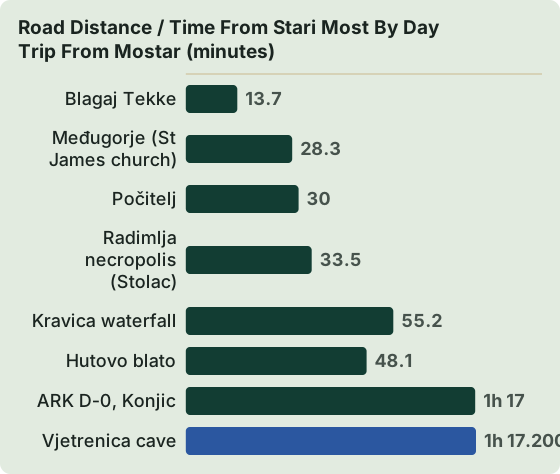
Day trips from Mostar are priced by entry fees, and every major one is known in advance: Kravica waterfall is 20 KM for an adult all year with children under 7 free, Blagaj Tekke is about 10 KM, Radimlja near Stolac is 8 KM, and ARK D-0 at Konjic is 40 KM for foreign visitors with booking required. Počitelj village and the Međugorje sites are free, and Hutovo blato charges about 5 KM with boat trips extra.
The waterfall figure is the one blogs get wrong. Entry to Kravica is 20 KM for an adult in every month, not a summer-only euro price, with 10 KM for residents of Bosnia and Herzegovina, 10 KM for school groups aged 7 to 18, and free entry for children under 7. The park is open all year with hours that shift by month: 07:00 to 17:00 in January, February, November and December, 07:00 to 18:00 in March and April, 07:00 to 20:00 in May, 07:00 to 22:00 from June to September, and 07:00 to 19:00 in October. The drive is 55.2 km and about 54 minutes free-flow from Stari Most, not a 15-minute hop. The rest of the planning pages sit on Mostar Travel Guide.
| Day trip from Mostar | Road distance / time from Stari Most | Entry fee |
|---|---|---|
| Blagaj Tekke | 13.7 km, about 19 min | About 10 KM, reported |
| Međugorje (St James church) | 28.3 km, about 40 min | Free sites |
| Počitelj | 30.0 km, about 31 min | Village free, small optional fees reported |
| Radimlja necropolis (Stolac) | 33.5 km, about 42 min | 8 KM individual, 5 KM groups and BiH citizens |
| Kravica waterfall | 55.2 km, about 54 min | 20 KM adult all year, under 7 free |
| Hutovo blato | 48.1 km, about 62 min | About 5 KM, boat trip about 20 KM |
| ARK D-0, Konjic | 77.0 km, about 93 min | 40 KM foreign visitors, booking required |
| Vjetrenica cave | 77.2 km, about 104 min | About 20 to 25 KM, guided, seasonal |
Swimming at Kravica is allowed in summer in the designated pool area below the falls, with no lifeguard reported, so check the park's rules on arrival. The Buna spring at Blagaj asks for covered shoulders and knees inside the tekke, with wraps provided at the entrance. For planning the whole loop, the Herzegovina road trip itinerary strings these together, and individual places are covered on the Kravice, Blagaj and Počitelj pages of this site.
Organised day tours change the arithmetic by folding transport and sometimes entry fees into one price. Trips from Mostar to Blagaj, Počitelj and Kravica run all year, and travellers already based in Croatia can reach the same country on the Mostar day trip from Dubrovnik or the Mostar day trip from Split itineraries, remembering that the border carries full checks either way.
Where Does Money Go Wrong In Mostar?
The three traps are the rounded euro rate, the ATM currency prompt and the unbooked bunker tour. Paying in euro cash gets you a rounded 1 euro to 2 marks conversion instead of the true 1.95583, ATMs offer to charge your card in euros at a marked-up rate you should decline, and ARK D-0 at Konjic requires advance booking, so arriving unannounced wastes the 77 km drive.
A reported 3 KM per person per night tourist tax is added to accommodation bills from 1 January 2026, so confirm it at booking.
Choose "charge in KM" at every cash machine and every card terminal that offers the choice. That single button press is worth more than any currency exchange trick, because the peg means the true rate never moves. Cash still matters at the small sights, the bazaar stalls and rural entry kiosks, where card terminals are rare.
| Trap | What happens | The fix |
|---|---|---|
| Rounded euro rate | Tourist areas take euros at about 1 to 2 | Pay in KM, confirm the rate first |
| ATM dynamic conversion | Machine offers to bill your card in euros | Choose charge in KM |
| Tourist tax | Reported 3 KM per person per night from 1 January 2026 | Confirm at booking |
| Unbooked bunker visit | ARK D-0 requires advance booking | Reserve ahead, closed Mondays |
One cost that does not exist: tap water is treated and generally safe, so buying bottles all day is optional. The emergency number is 112 if something does go wrong, with 122 for police and 124 for ambulance, and in rural Herzegovina the standing advice is to stay on marked paths because of suspected mine areas.
What Does A Cheap Day In Mostar Actually Look Like?
A full day in Mostar can run on almost no entry fees at all: cross Stari Most at dawn before the crowds, walk Kujundžiluk and Kriva ćuprija, climb to the viewpoints above the Old Town, and put the day's only spending into one paid walk and coffee. The bridge and bazaar are free at any hour, the riverside paths cost nothing, and the single best-value spend is a tip-based GuruWalk tour, which you price yourself.
Start early for two reasons: light on the bridge is better and the July and August afternoons are seriously hot. ERA5 reanalysis for 1991 to 2020 puts the modelled mean daily high at 29.9 C in July and 30.5 C in August, and the FHMZ station table for 1961 to 1990 records an absolute maximum of 41.2 C. The best time to visit Mostar guide and the Mostar weather guide work out the seasons, and November's 200.0 mm of average rainfall against July's 42.9 mm tells the practical story of when the streets are driest.
| Time of day | Free activity | Notes |
|---|---|---|
| Early morning | Stari Most and the river banks | Quiet crossing, morning light |
| Morning | Kujundžiluk and Kriva ćuprija | Bazaar lanes, free streets |
| Midday | GuruWalk free tour | Free, tip based, about 90 minutes |
| Afternoon | Spanish Square and riverside walk | Free, shaded in parts |
| Evening | Viewpoint above the Old Town | Sunset over the Neretva valley |
The diving tradition belongs on any budget day, watched rather than joined. Members of the Mostari diving club jump from the bridge, which stands about 21 to 24 metres above the river depending on the water level, and there is no pay-to-jump option for visitors. The 460th traditional competition ran on 26 July 2026, and the Red Bull Cliff Diving round followed from 30 July to 1 August 2026 from platforms at 21 m for women and 27 m for men. The story is on the Mostar bridge diving guide.
How Do Mostar Prices Change With The Seasons?
Sight entry prices in Mostar do not change with the seasons, but availability does: Kravica keeps its 20 KM adult fee in every month, the Old Bridge Museum's reported season runs 1 April to 1 November, and Vjetrenica cave and Hutovo blato operate seasonal calendars. The weather does the real seasonal pricing work, because November averages 200.0 mm of rain against July's 42.9 mm, FHMZ 1961 to 1990, which shapes when day trips are pleasant at all.
Winter is the quiet-value window. January's modelled mean daily high is 8.4 C, ERA5 1991 to 2020, cold but walkable, and the free core of the city never closes. Summer inverts the equation: long light, swimming at Kravica in the designated area, and heat that moves sightseeing to the morning. The seasonal pages, Mostar in summer and Mostar in winter on this site, unpack the trade-offs.
Accommodation pricing moves with demand in the usual way, and no official nightly rates exist to quote here; the practical guidance, including the reported tourist tax, is on the where to stay in Mostar guide. Booking ahead for July matters more than any fee negotiation, because the diving events and the festival calendar, from Mostarsko ljeto on 25 June to the Jazz Fest on 23 to 25 August in 2026, fill the centre.
Common Questions About Mostar Prices
Is Mostar expensive to visit?
Mostar is affordable by regional standards. The Old Bridge, Kujundžiluk and Kriva ćuprija are free, paid sight entries run from about 4 KM at Bišćević House to 20 KM at Kravica waterfall, and a reported 3 KM per person per night tourist tax applies in the canton from 1 January 2026.
Do I need euros in Mostar?
No. The currency is the convertible mark (KM, BAM), pegged at 1 EUR = 1.95583 KM. Euro cash is often accepted in tourist areas at a rounded rate of roughly 1 to 2, but paying in marks is the better deal. Confirm the rate wherever euros are offered.
How much does Kravica waterfall cost?
Entry is 20 KM for an adult all year, 10 KM for residents of Bosnia and Herzegovina, 10 KM for school groups aged 7 to 18, and free for children under 7. The park is open every month, with hours from 07:00 to 22:00 between June and September.
How much is the train from Sarajevo to Mostar?
About 14 KM one way in second class, reported, on a service that resumed on 15 October 2026 after a suspension. Two trains run each way daily between Sarajevo and Čapljina via Mostar, a journey of about two hours.
Are the walking tours in Mostar free?
Two English walks on GuruWalk are free and tip based: Mostar All in One and From the Spanish Square to the Old Bridge: Mostar Uncovered. Paid walks and private tailored tours also run, and their live prices are on each operator's listing.
What is the tourist tax in Mostar?
A tourist tax of 3 KM per person per night is reported for Herzegovina-Neretva Canton from 1 January 2026, with a lower reported rate for day visitors. It is normally collected through accommodation, and the amount should be confirmed at booking.
The honest summary of Mostar prices in 2026: the city's best sights cost nothing, the paid tier is a handful of marks, the one big fee in the region is Kravica's 20 KM, and the traps are avoidable with marks in your pocket and bookings made ahead. A trip here costs what you decide it should cost, which is more than can be said for the coast next door.