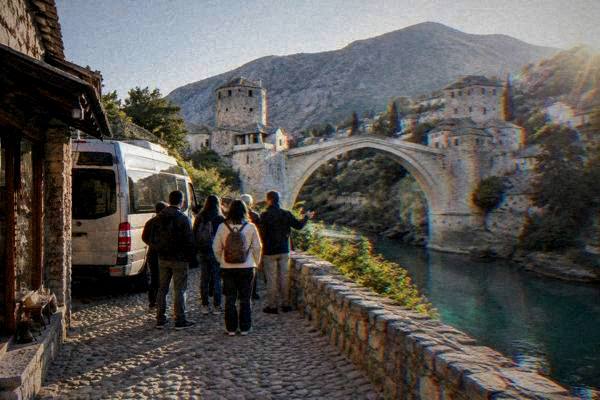
A Day Trip To Mostar From Dubrovnik: How The Day Runs
Mostar sits 145.5 km by road from Dubrovnik's Stradun, about two and a half hours free-flow plus a border, which makes it one of the few Bosnian cities that genuinely works as a day trip from the Croatian coast.
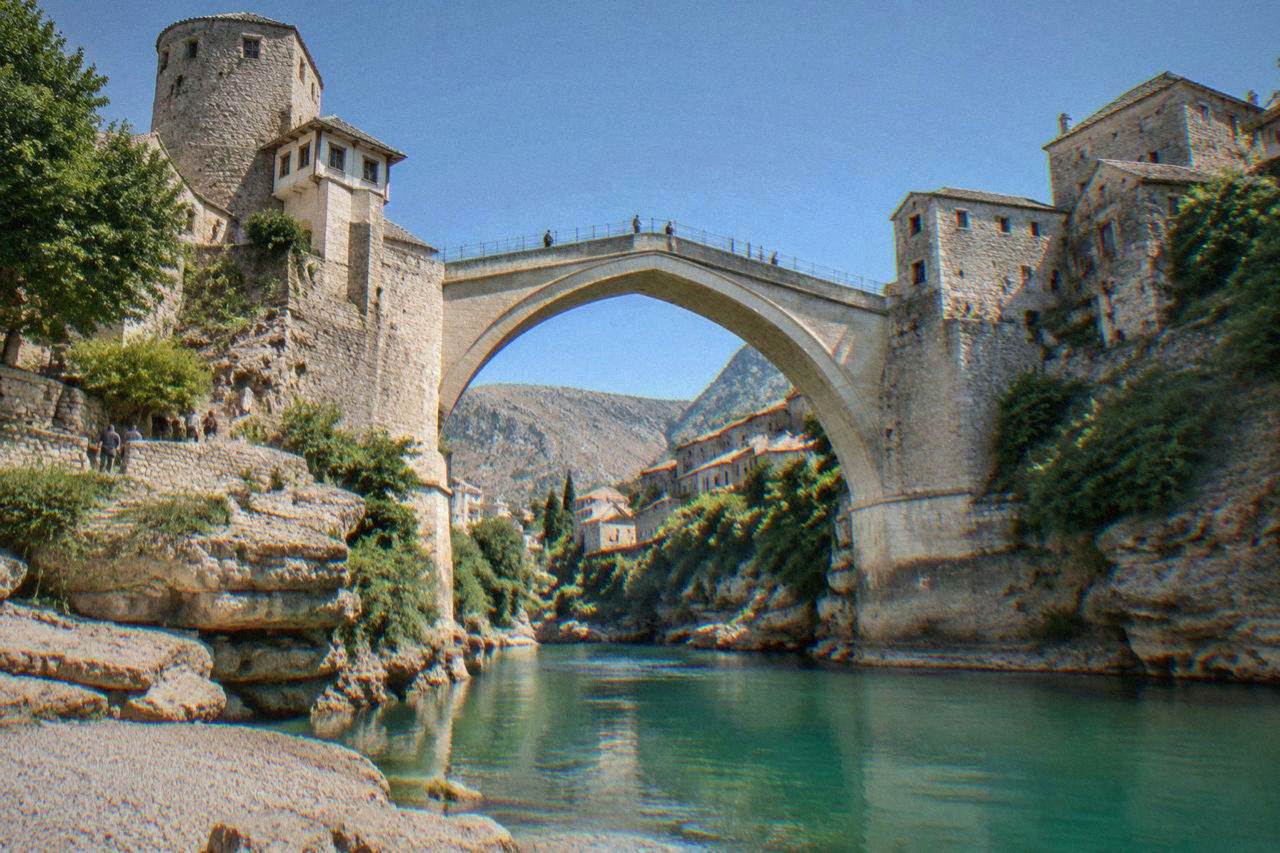
A day trip from Dubrovnik to Mostar works because the road distance is 145.5 km, about 150 minutes without queues, with two border checks each way. Expect roughly three to four hours in Mostar for the Old Bridge, Kujundžiluk and a viewpoint, with Kravica waterfall and Počitelj as the usual add-ons.
Mostar is an inland city on the Neretva river in Herzegovina, the southern region of Bosnia and Herzegovina, and it lies 145.5 km by road from the Stradun in Dubrovnik, about 150 minutes of free-flow driving each way. That distance, plus two international border crossings, is what shapes the whole day: leave early, cross twice, and spend the middle of the day walking a compact UNESCO-listed Old Town that takes twenty minutes to cross at a stroll. This page lays out how the day actually runs, what the border involves, what is realistic to see in Mostar itself, and whether to add Kravica waterfall, Blagaj or Počitelj on the way.
Is A Day Trip From Dubrovnik To Mostar Realistic?
Yes, a day trip is realistic and it is how a large share of visitors see Mostar: the road distance is 145.5 km, about 150 minutes each way without queues, and the day hinges on the two border crossings on the route. Bosnia and Herzegovina is not in the EU or Schengen, so the Croatian land border carries full passport checks in both directions, with waits of up to about 30 minutes typically, longer at summer peaks.
That border fact is the single biggest variable in the day. Croatia joined Schengen on 1 January 2023, which turned its land border with Bosnia and Herzegovina into a Schengen external frontier with systematic checks. The main crossings on the Dubrovnik to Mostar route are Doljani-Metković and Bijača-Nova Sela, and waits at both are typically up to about 30 minutes for cars, stretching longer at summer peaks. Coach tours get processed as a group, which is one reason a booked day trip can feel smoother than driving yourself in peak weeks.
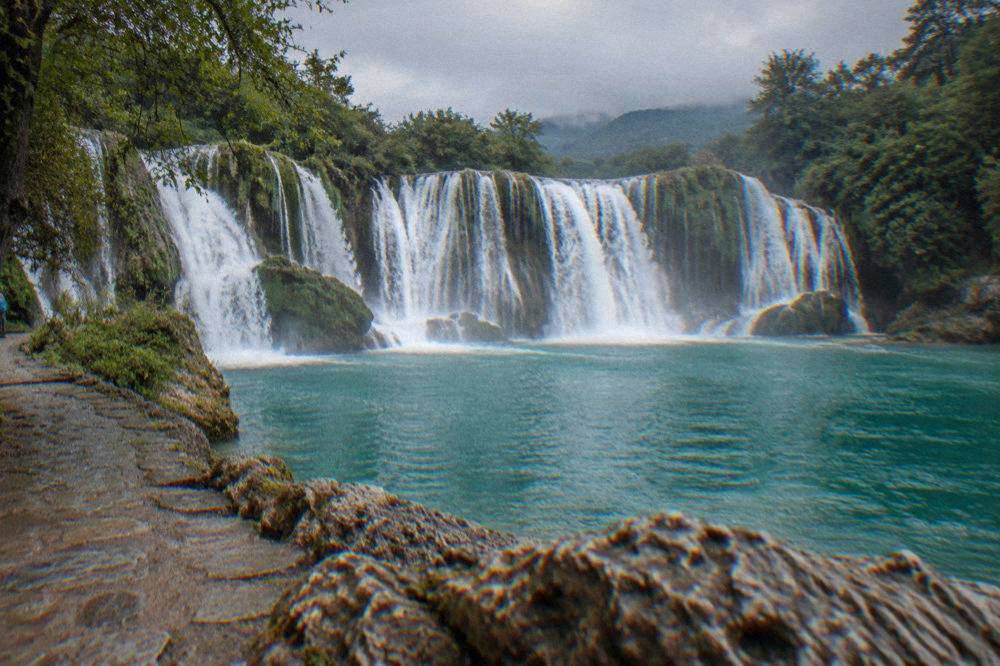
The second variable is what you want from the middle of the day. Mostar's Old Town is small. The Old Bridge, the Kujundžiluk bazaar, the Crooked Bridge and the riverside mosques all sit within a ten-minute walk of each other, so three to four hours in the city covers the core sights at an unhurried pace. Trips that add Kravica waterfall and Počitelj trade city time for countryside, and the standard shape becomes roughly ninety minutes in Mostar, an hour at the falls and a short stop in Počitelj.
The third variable is the season. July and August mean heat, the ERA5 reanalysis for 1991 to 2020 puts mean daily highs at 29.9 C in July and 30.5 C in August, and the FHMZ station record for 1961 to 1990 shows an absolute maximum of 41.2 C. Shoulder months mean fewer coaches, but November is also the rainiest month in the station record at 200.0 mm against July's 42.9 mm, so a wet-day backup plan matters outside summer. For a fuller picture of the city across seasons, see the guide to the best time to visit Mostar on this site, and for the full border mechanics, the page on the Croatia Bosnia border crossing.
How Long Is The Drive From Dubrovnik To Mostar?
The drive from the Stradun in Dubrovnik to Stari Most in Mostar is 145.5 km and about 150 minutes of free-flow driving, before any border queue is added. You cross the Bosnia and Herzegovina border and back into Croatia on the same road corridor, and waits are typically up to about 30 minutes per crossing, longer at summer peaks, so a realistic door-to-door budget is closer to four hours each way in July and August.
Two route choices change the drive. The classic corridor runs inland via Metković and Doljani, the most direct line to Mostar. The alternative swings wider and uses the Pelješac Bridge, opened in 2022, which lets traffic between Split and Dubrovnik avoid the Bosnian Neum corridor entirely, but for a Dubrovnik to Mostar trip the inland corridor is the one that matters, because Mostar is the destination, not an obstacle. If you are planning the journey in the other direction too, the companion page on getting from Dubrovnik to Mostar breaks the route down turn by turn.
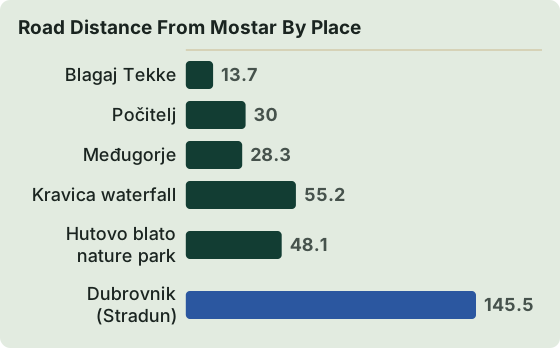
Distances that matter once you are over the border, all measured by road from Stari Most:
| Place | Road distance from Mostar | Free-flow time |
|---|---|---|
| Blagaj Tekke | 13.7 km | about 19 min |
| Počitelj | 30.0 km | about 31 min |
| Međugorje | 28.3 km | about 40 min |
| Kravica waterfall | 55.2 km | about 54 min |
| Hutovo blato nature park | 48.1 km | about 62 min |
| Dubrovnik (Stradun) | 145.5 km | about 150 min |
Those figures are free-flow road times without border queues, and they explain the standard shape of a combined day. Kravica sits 55.2 km from Mostar, roughly the same again as Blagaj and Počitelj combined, which is why tours that include the falls give Mostar a shorter city stop. The Herzegovina road trip page covers the full circuit if you would rather spread these places over several days.
For anyone weighing the drive against the train or the bus: there is no rail line on this corridor at all, and the train that does reach Mostar runs from Sarajevo, two departures a day each way, which is a different itinerary entirely, covered on the Sarajevo to Mostar page.
The practical alternative to driving is a booked day trip, which handles the border, the parking and the timing in one package. The three options below are the strongest current departures from Dubrovnik and the other two cities that feed this route.
What Does A Typical Day-Trip Itinerary Look Like?
A typical Dubrovnik day trip departs between 06:00 and 08:00, crosses the border within the first ninety minutes, reaches Mostar around mid-morning, spends two to four hours in the city, then adds one or two Herzegovina stops before the afternoon border crossing back into Croatia, returning to Dubrovnik in the evening. The single fixed constraint is the border: everything else flexes around it.
A realistic hour-by-hour shape, with city time prioritised, looks like this:
| Time | Where | What happens |
|---|---|---|
| 06:30 to 07:30 | Dubrovnik | Hotel pickup or meeting point |
| 08:00 to 09:00 | Border | Passport checks, up to about 30 min |
| 09:30 to 10:00 | Mostar | Arrive, park, walk into the Old Town |
| 10:00 to 13:00 | Mostar | Old Bridge, Kujundžiluk, lunch |
| 13:00 to 14:00 | Drive south | Road to Kravica, about 54 min |
| 14:00 to 15:30 | Kravica waterfall | Entry 20 KM, swim in the designated pool |
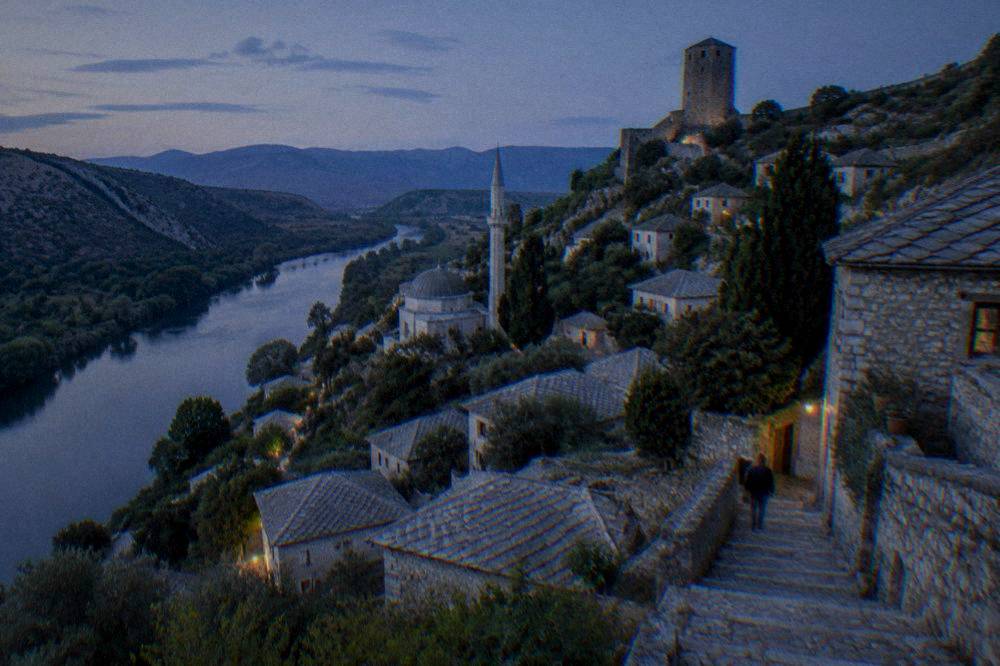
| 16:00 to 16:30 | Počitelj | Short stop in the fortified village |
| 17:30 to 18:30 | Border | Checks back into Croatia |
| 19:00 to 20:00 | Dubrovnik | Drop-off |
Trips that skip Kravica invert the ratio: four unhurried hours in Mostar, an optional coffee stop in Blagaj by the Buna spring, and a later, calmer border crossing. Trips that add both the falls and Blagaj are long days, and the standard Dubrovnik departures that carry them run eleven hours or more, which is worth knowing before you book anything with a firm evening plan back in Dubrovnik.
If you would rather not compress the city into a single morning, the case for staying over is laid out plainly in how many days in Mostar is enough, and the one day in Mostar itinerary shows what a full, unhurried day inside the city looks like without the drive at both ends.
What Should You Actually See In Mostar In A Few Hours?
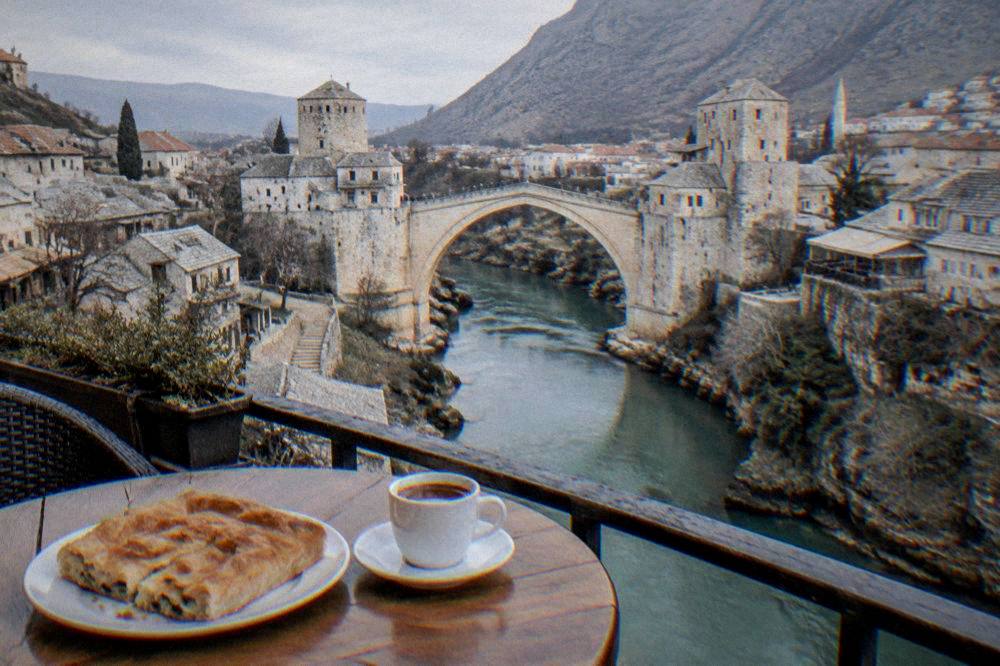
The core of Mostar is Stari Most, the Old Bridge, a single stone arch completed in 1566 and rebuilt after its destruction on 9 November 1993, reopening in July 2004; the surrounding Old Bridge Area is a UNESCO World Heritage property inscribed in 2005. Everything worth seeing on a first visit sits within a fifteen-minute walk of it: Kujundžiluk, the Ottoman bazaar street, the Crooked Bridge, Koski Mehmed-pašina džamija and the riverside viewpoints.
Start on the bridge itself. Crossing it is free and open at any hour, and the arch stands about 21 to 24 metres above the Neretva depending on the river level. Members of the Mostari diving club jump from it through the warmer months, collecting spectator contributions before each dive; jumps are a club tradition, not something a visitor can pay to try, and the 460th traditional competition ran on 26 July 2026. The full story is on the Stari Most page, including the Red Bull Cliff Diving series that followed in the same week from platforms at 21 m for the women and 27 m for the men.
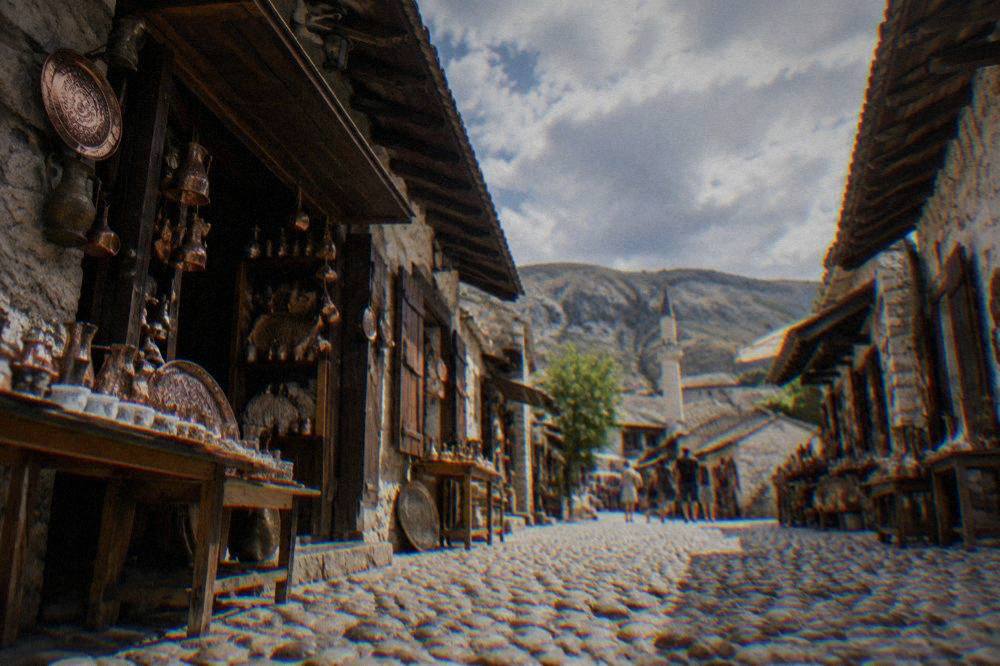
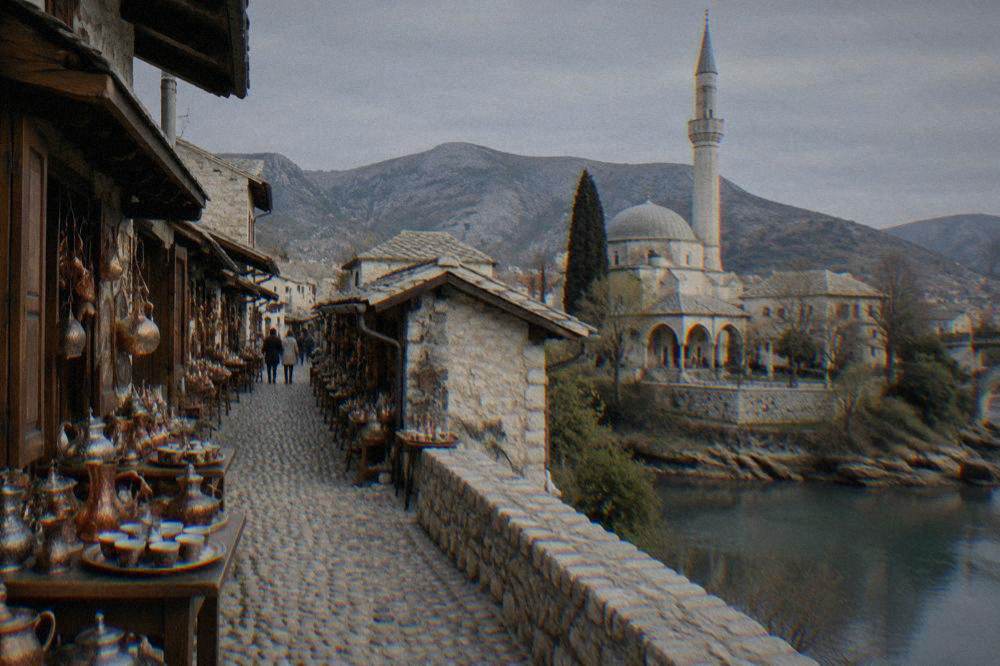
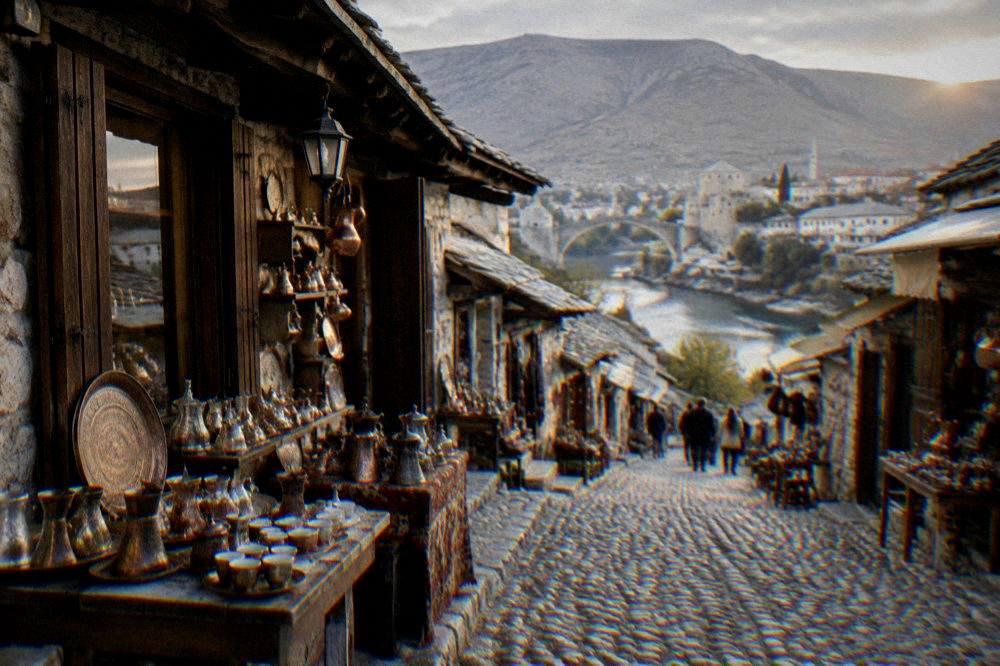
From the bridge, drop into Kujundžiluk, the cobbled bazaar street that runs along the east bank, then loop to Kriva ćuprija, the Crooked Bridge, a small single-arch prototype of its larger sibling a few minutes upstream. Koski Mehmed-pašina džamija sits at the end of the bazaar with a terrace directly over the river; a small cash fee covers the mosque, with a higher combined rate for the minaret climb, and worship can pause access, so confirm the current arrangement at the door. The Kujundžiluk and Koski Mehmed-paša mosque pages carry the detail.
With the loop done, the remaining hours divide by interest. The Old Bridge Museum in the Tara tower, the Ottoman houses such as Bišćević House, and a viewpoint on the west bank all reward an extra hour; the things to do in Mostar root page indexes the lot. If the day turns wet, and November averages 200.0 mm of rain against July's 42.9 mm, the Mostar in the rain itinerary keeps the day intact indoors.
A short walk with a local guide compresses the history efficiently, and a private version is the one conversion block below.
Is It Better To Drive Yourself Or Book A Tour?
Driving yourself gives full control of the schedule and is straightforward on good roads, but a booked tour removes the two things that consume a self-drive day: the border queue, which coach groups clear as a unit, and Old Town parking, which is limited and unmarked on any official price list. A tour also bundles Kravica, Počitelj and sometimes Blagaj into a single timed itinerary with entry logistics already handled.
The money question is simpler than it looks. Entry to Kravica waterfall is 20 KM for an adult all year round, 10 KM for residents of Bosnia and Herzegovina, and free for children under 7; Blagaj Tekke is about 10 KM with shoulders and knees covered; Počitelj village costs nothing. A self-drive day therefore carries fuel, parking of unknown cost, and those entries, against a single per-person price on a booked trip that often includes at least some of them. The falls run on fixed monthly hours, 07:00 to 22:00 from June to September and 07:00 to 17:00 in the depths of winter, so a late-season self-drive needs to watch the clock.
| Option | Control of timing | Border handling | Parking | Best for |
|---|---|---|---|---|
| Own car | Full | Queue as individual vehicle | Limited near Old Town | Repeat visitors, photographers |
| Booked coach tour | Fixed | Group processing | Handled | First visits, one-day-only travellers |
| Private transfer or tour | High | Handled | Handled | Families, tight schedules |
One warning that applies to any independent exploring in Herzegovina: stay on marked paths in rural areas because of suspected minefields, a legacy of the war that the national mine-action centre still maps. It is a real constraint off-road, not a city concern, but it is the reason shortcuts around Kravica or the hills above Blagaj are a bad idea. The Bosnia and Herzegovina travel tips page collects the rest of the practicalities, from plugs to emergency numbers.
For a mid-range decision, the semi-private departure below trades the big coach for a smaller vehicle while keeping the border and entry handling.
And if the falls alone are the draw, a shorter dedicated option exists from Mostar itself, which suits anyone splitting the itinerary into an overnight stay plus a half-day excursion.
How Much Does The Day Cost Beyond The Tour Price?
The two certain out-of-pocket costs are Kravica waterfall at 20 KM per adult, charged all year, and Blagaj Tekke at about 10 KM, while everything inside Mostar's Old Town core, the bridge crossing, Kujundžiluk, Kriva ćuprija and Počitelj village, is free. The currency is the convertible mark (KM), pegged at 1 EUR = 1.95583 KM, and euro cash is often accepted in tourist areas at a rounded rate, so confirm before paying.
A cost table for the standard stops:
| Stop | Entry cost | Notes |
|---|---|---|
| Stari Most crossing | Free | Public pedestrian route, any hour |
| Kujundžiluk and Kriva ćuprija | Free | Public streets |
| Koski Mehmed-pašina džamija | Small cash fee, more with minaret | Confirm at the door |
| Kravica waterfall | 20 KM adult, under 7 free | All year; 10 KM BiH residents |
| Blagaj Tekke | About 10 KM | Shoulders and knees covered |
| Počitelj | Free | Optional small fees at individual sites |
| Međugorje sites | Free | Open sites, modest dress at the church |
Two smaller costs sit in the fine print. A tourist tax of 3 KM per person per night is reported in the Herzegovina-Neretva Canton from 1 January 2026, which day visitors generally never encounter but overnight guests should confirm at booking. And lunch matters more than people expect: the day trips that reach Mostar around midday build in a food stop, and Bosnian café food is cheap by Croatian standards, so a sit-down lunch in the bazaar rarely strains a budget. The Mostar budget page does the full arithmetic for longer stays.
Cards work at hotels, larger restaurants, supermarkets and museums, while small vendors, markets and some buses want cash, so carry KM notes rather than relying on a card for the waterfall kiosk or a bazaar coffee. Withdraw in KM, not euro, and decline any offer to be charged in another currency at an ATM.
What Are The Alternatives If You Have Two Days Instead Of One?
With two days the whole calculus changes: stay the night in Mostar, give the city a full unhurried day, and spend the second day on Kravica, Blagaj, Počitelj and Međugorje as a loop, which drops the border crossings to two in total instead of four. The overnight version also unlocks the farther corners of Herzegovina, from the stećci necropolis at Radimlja to Vjetrenica cave and Trebinje, none of which a single day out of Dubrovnik can reach.
The classic two-day version of this exact route is laid out in the two days in Mostar itinerary, and three days adds Konjic, Jablanica or Hutovo blato.
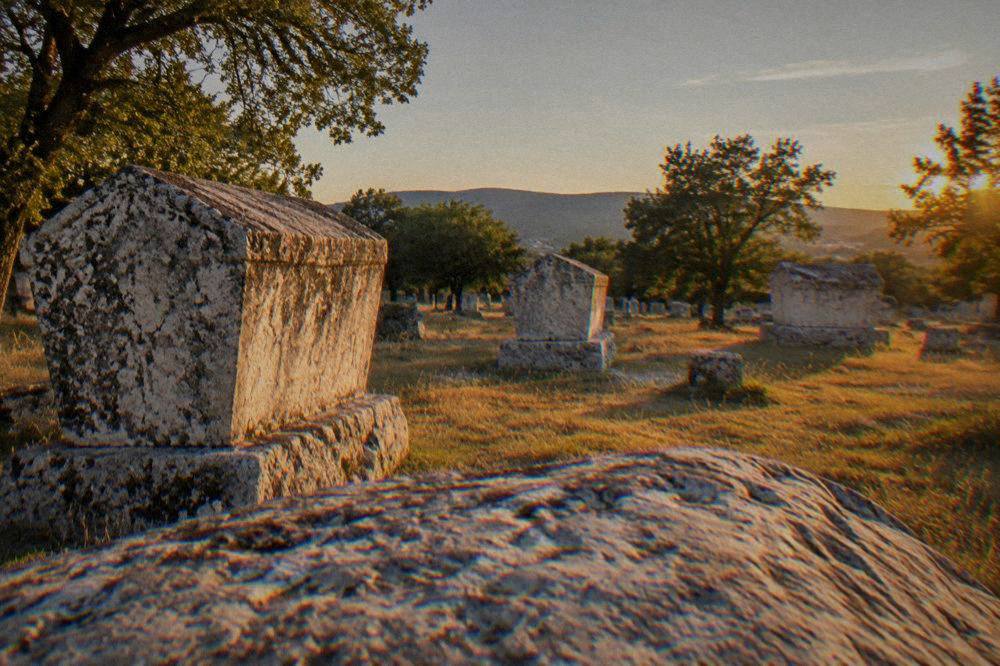
The overnight option also unlocks the parts of Herzegovina that a Dubrovnik day trip cannot reach. Radimlja's stećci necropolis near Stolac, a UNESCO-listed medieval tombstone site inscribed in 2016, is 33.5 km from Mostar, about 42 minutes, with entry around 8 KM. Vjetrenica cave is 77.2 km away, over an hour and three quarters, with guided entry at roughly 20 to 25 KM. Trebinje is 116.5 km, about two hours and twenty minutes, and rewards a full afternoon rather than a dash. All of these appear in the three days in Mostar and Bosnia and Herzegovina itinerary plans, and the wider-region options live on the Dubrovnik day trips page.
For travellers combining the whole coast-and-cities route, the Mostar day trip from Split page covers the longer northern drive, and the Balkans itinerary strings Dubrovnik, Mostar, Sarajevo and Kotor into one multi-week plan with the border crossings budgeted honestly.
The second comparison band below places the Dubrovnik departures beside the Sarajevo and Split versions of the same idea, which is the fastest way to see how departure city changes the day.
Common Questions About A Mostar Day Trip From Dubrovnik
Is a day trip from Dubrovnik to Mostar worth it?
Yes, if you accept the shape of the day. Mostar is 145.5 km and about 150 minutes of free-flow driving from Dubrovnik's Stradun, plus border checks of up to about 30 minutes each way, and in exchange you get a UNESCO World Heritage Old Town, a bridge of 1566 rebuilt in 2004 and optionally a waterfall, none of which exists on the Croatian coast.
Do you need a passport for the Mostar day trip from Dubrovnik?
Yes. Bosnia and Herzegovina is not in the EU or in Schengen, so you pass a full international border with passport checks in both directions. Croatia's land border has carried Schengen external checks since 1 January 2023, and ETIAS is not in operation, so no pre-travel authorisation is needed for visa-exempt nationals, who may stay up to 90 days within six months of first entry.
Can you use euros in Mostar?
Often, but not officially. The currency is the convertible mark (KM), pegged at 1 EUR = 1.95583 KM, and euro cash is commonly accepted in tourist areas at a rounded rate, typically close to 2 KM to the euro. Confirm the rate before paying, and prefer KM at small vendors, the waterfall kiosk and markets.
How many hours do you get in Mostar on a day trip?
Roughly two to four hours. Trips that include Kravica waterfall and a Počitelj stop give Mostar about ninety minutes to two hours; trips that go direct to the city give three to four. The Old Town core, the bridge, Kujundžiluk and the Crooked Bridge, fits comfortably in the shorter window, while museums and viewpoints need the longer one.
Is the Dubrovnik to Mostar drive difficult?
No. The road is paved and well signed the whole way, and the 145.5 km route takes about 150 minutes free-flow. The difficulties are administrative rather than technical: two border crossings with waits typically up to about 30 minutes, longer at summer peaks, and limited parking near the Old Town on arrival.
What is the best month for the trip?
May, June and September balance the three constraints best. July and August bring the highest mean daily highs, 29.9 C and 30.5 C in the ERA5 1991-2020 reanalysis, alongside peak border queues, while November averages 200.0 mm of rain against July's 42.9 mm in the FHMZ 1961-1990 station record, making late autumn the least reliable window.
The short version: a Dubrovnik to Mostar day trip is a border day, not a beach day. Plan the crossings, pick whether Kravica or city time wins the middle hours, and the route delivers a UNESCO Old Town, a rebuilt Ottoman landmark and a karst waterfall inside a single, very full loop out of Croatia. More of the planning detail, from weather to money to the border itself, sits across Mostar Travel Guide, including the kravice, Blagaj and Počitelj in one day plan for the Herzegovina half of the day on its own.