Mostar In The Rain: An Indoor Day
Mostar, in Herzegovina, is an outdoor city of stone bridges and open bazaars, but a rainy day still fills easily: museums, Ottoman houses, coffee houses and a food workshop carry the hours until the sky clears over the Neretva.
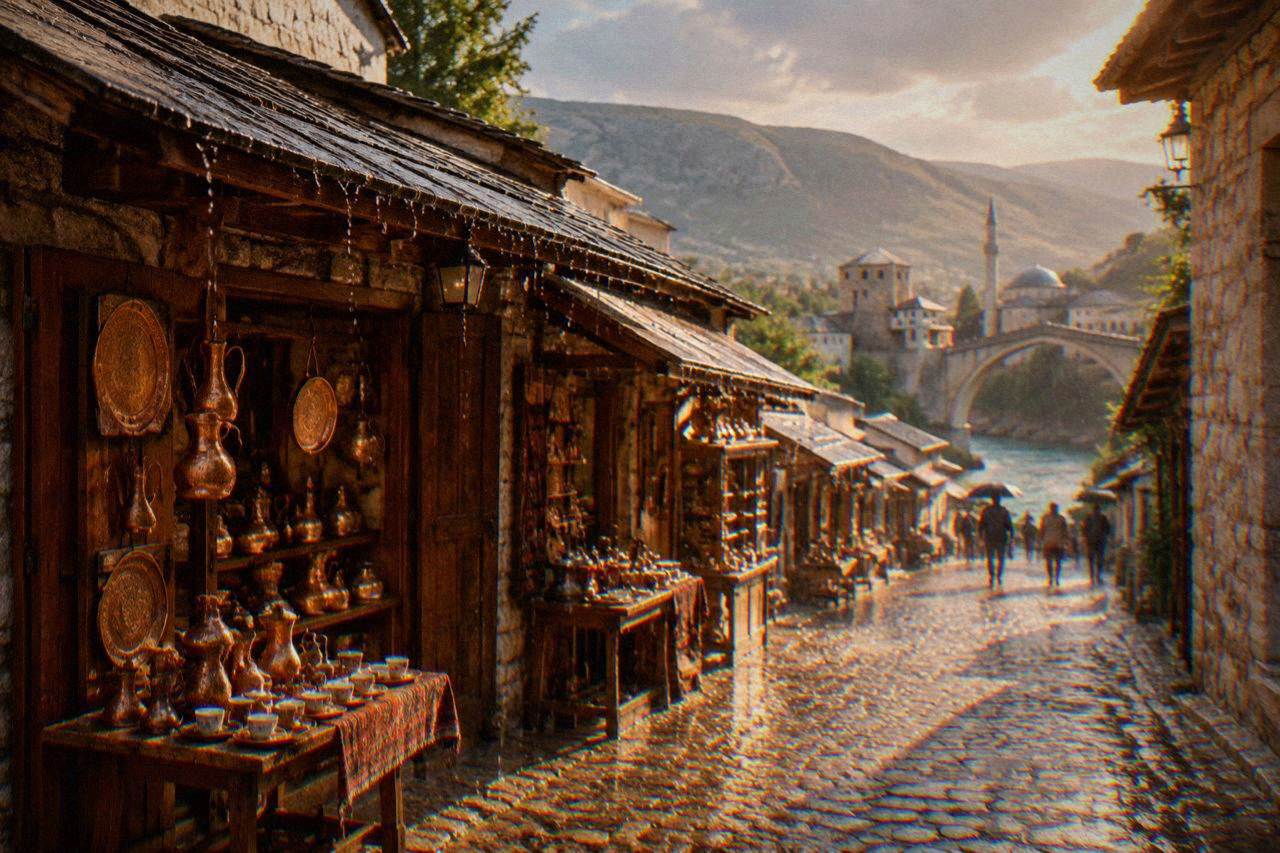
Spend a rainy day in Mostar indoors: the Old Bridge Museum and the Koski Mehmed-pašina džamija interior sit right at the river, the Ottoman courtyard houses of Bišćević and Muslibegović a short walk away, and a burek or Bosnian cooking workshop turns a wet afternoon into the day's highlight.
Rain in Mostar, the main city of Herzegovina on the Neretva river, tends to arrive in short, heavy winter bursts rather than all-day drizzle. The station record for the city (FHMZ 1961-1990) shows 1,515.4 mm of precipitation across a year, with a clear winter maximum: November averages 200.0 mm while July averages 42.9 mm. That pattern means a wet day is far likelier from November through March than in high summer, and it also means the rain usually comes with mild temperatures rather than a deep freeze. A rainy day in Mostar is not a lost day. The old core is compact, the indoor options sit within a few minutes' walk of one another, and the coffee culture of Bosnia and Herzegovina exists precisely for hours like these.
This plan walks through one full wet day: a morning under cover at the river, a museum or two at midday, a long coffee stop, an indoor food workshop in the afternoon, and the question of whether a day trip still makes sense when the valley is grey. The broader things to do in Mostar list covers the fair-weather half of the city; this page is the umbrella half.
What Can You Do In Mostar When It Rains?
A rainy day in Mostar fills with indoor stops that sit within easy walking distance of the Old Bridge: the Old Bridge Museum in the Tara tower, the interior and minaret viewpoint of Koski Mehmed-pašina džamija, the Ottoman courtyard houses of Bišćević and Muslibegović, the Museum of Herzegovina, and long coffee stops under the roofs of Kujundžiluk. None of these requires transport once you are at the river. The city centre is flat along the Neretva and the lanes of the old core are pedestrian, so rain mainly changes what you look at, not how far you walk. An umbrella and shoes with grip matter more than a plan B, because the polished stone on the bridge approaches turns slick when wet.
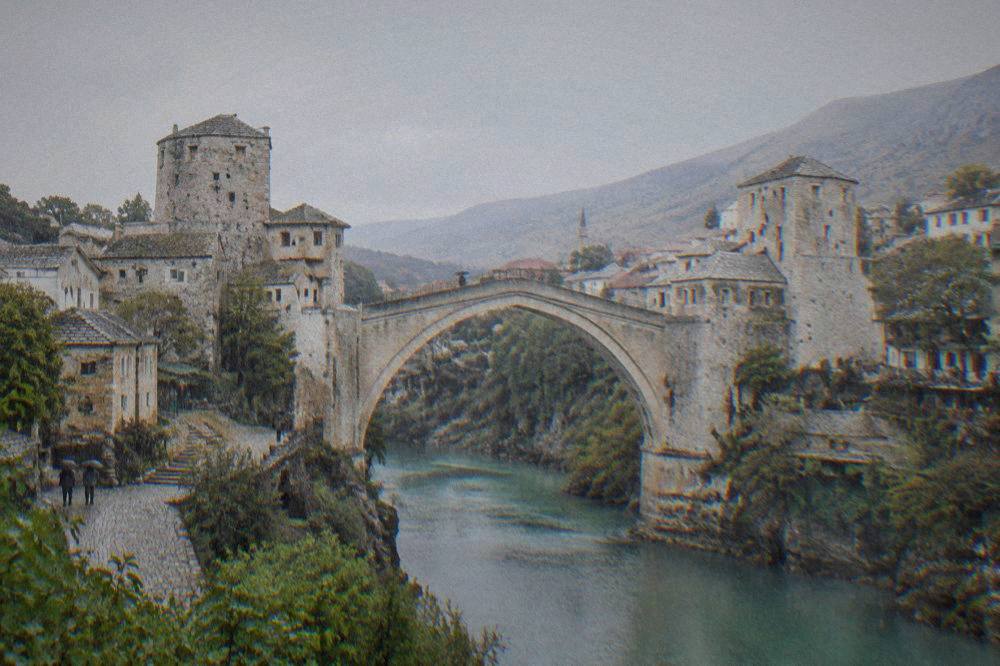
Start at the river anyway. The Old Bridge itself is a public pedestrian crossing, free and open around the clock, and a wet limestone arch over a green river is a genuinely different sight from the postcard version: fewer cameras on the parapet, the Neretva running louder after rain, and the stone darkened to the colour it must have carried for centuries before photography. The bridge was completed in 1566, destroyed on 9 November 1993 during the war, and rebuilt and reopened in July 2004; the Old Bridge Area of the Old City has been a UNESCO World Heritage property since 2005. You can stand under an eave at either end and take all of that in without getting soaked.
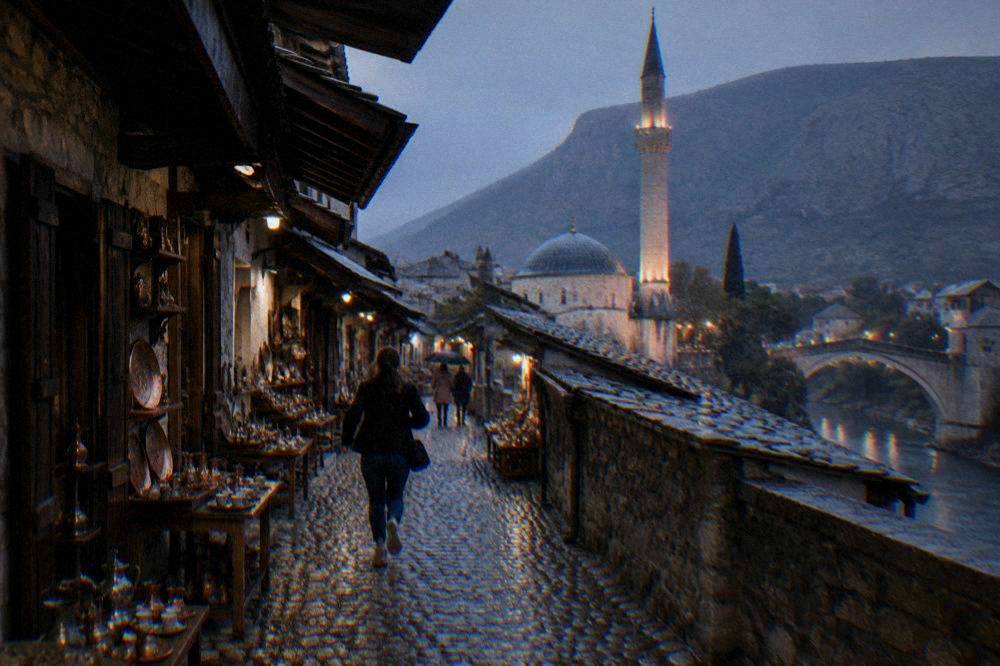
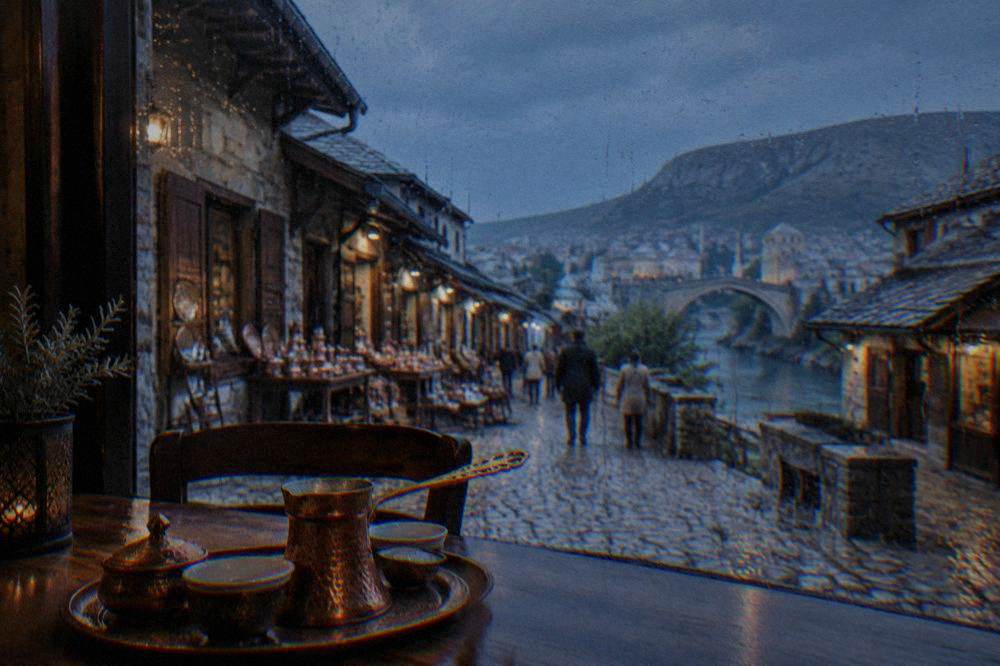
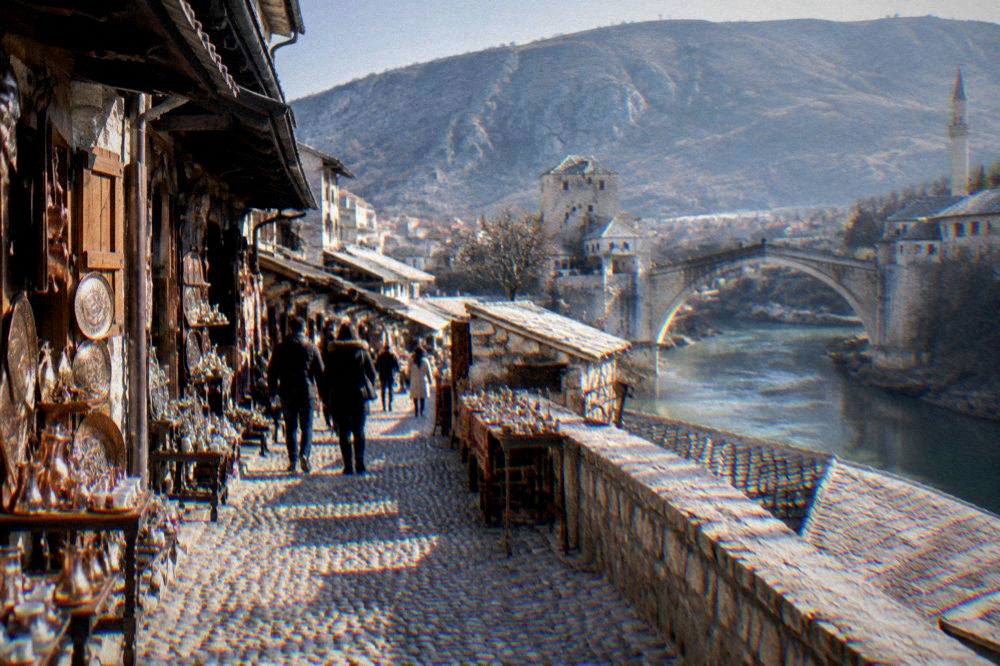
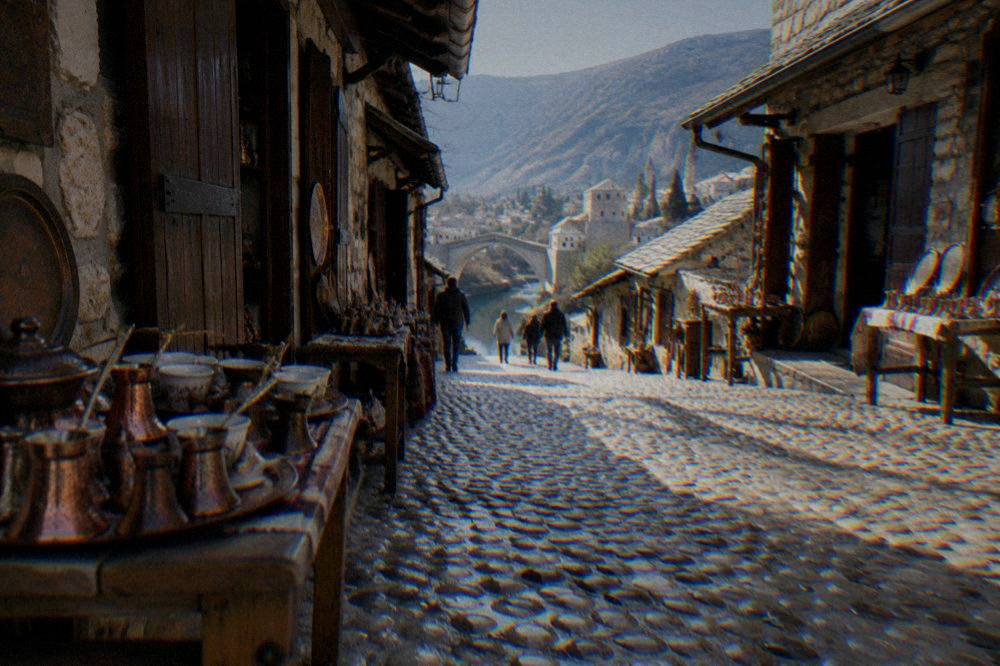
From the bridge, duck into the covered stalls of Kujundžiluk, the old bazaar street that runs along the left bank. Coppersmiths, souvenir stalls and small cafes line it, and the buildings overhang enough to keep a slow walk mostly dry. The bazaar is free, open as a public street, and it leads directly to most of the indoor stops below.
Which Indoor Sights In Mostar Fill A Wet Afternoon?
The core indoor sights in central Mostar are the Old Bridge Museum in the Tara tower (reported at 10 KM, open 08:00 to 16:00 daily from 1 April to 1 November), the interior of Koski Mehmed-pašina džamija (a small cash fee reported around 10 KM, more with the minaret climb), and the Ottoman houses Bišćević House and Muslibegović House (reported around 4 KM and 8 KM respectively), all within a short walk of the bridge. Fees at several of these come from visitor-site reports rather than official ticket pages, so carry cash in KM and confirm the figure at the door. The Koski Mehmed-pašina džamija sits at the river's edge at the end of the bazaar, which makes it the most convenient first stop of a wet circuit.
The mosque interior is small, carpeted and quiet, and it is one of the few places in the city where you can sit out a shower in an Ottoman-era riverside room with the Neretva running a few metres below the window. Visitors report a modest cash entry fee, with a higher combined ticket if you climb the minaret; worship can pause tourist access, so check the sign at the entrance. Shoulders and knees covered is the standard, as at any working mosque in Herzegovina.
The Ottoman courtyard houses are the emotional centre of a rainy afternoon in Mostar. Bišćević House and Muslibegović House are both furnished Ottoman-era homes built around interior courtyards, with rooms of carved wood, low divans and household objects. The point of these houses in wet weather is exactly what they were built for: an inward-facing architecture that turns its back on the street and the weather. A reported fee of a few KM buys you out of the rain and into the most domestic rooms the city keeps open.
The Museum of Herzegovina and the Museum of War and Genocide Victims complete the indoor circuit if the rain persists; hours and fees at the Herzegovina Museum vary between reports, so confirm the current schedule before committing the afternoon. A fuller sight-by-sight rundown, including the outdoor stops for the day the sky clears, is in the one day in Mostar itinerary.
Whether that indoor circuit is enough, or whether the rain should push you out into Herzegovina for the day, depends on how the rain is distributed across the year, which is the next question.
How Rainy Is Mostar, Month By Month?
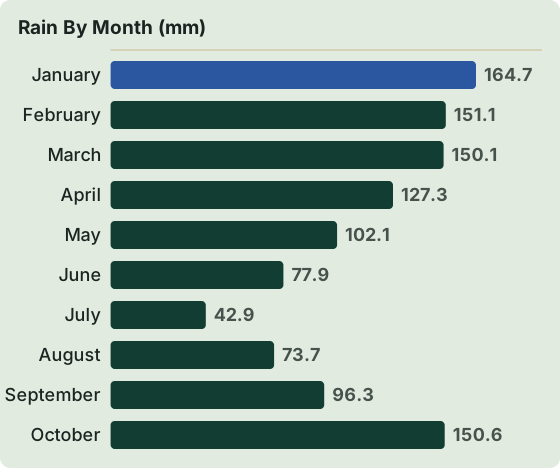
Rain in Mostar follows a Mediterranean-winter pattern: the station record (FHMZ 1961-1990) shows November as the rainiest month at 200.0 mm and July the driest at 42.9 mm, roughly a 4.7-to-1 ratio, with rain falling on about 11 days a month in the cold half of the year but only 5 to 6 days a month in summer. In practical terms, a traveller visiting between June and August is unlikely to lose a whole day to rain, while a November or December visit should carry a real indoor plan. Annual precipitation totals 1,515.4 mm, and 106 days a year record more than 1 mm of rain.
| Month | Rain (mm) | Days over 1 mm |
|---|---|---|
| January | 164.7 | 11 |
| February | 151.1 | 10 |
| March | 150.1 | 10 |
| April | 127.3 | 11 |
| May | 102.1 | 9 |
| June | 77.9 | 8 |
| July | 42.9 | 5 |
| August | 73.7 | 6 |
| September | 96.3 | 6 |
| October | 150.6 | 8 |
| November | 200.0 | 11 |
| December | 178.7 | 11 |
Figures are FHMZ Mostar station data, 1961 to 1990. Temperatures stay workable even in the wet months: the mean for January is 4.8 C and for July 24.7 C on the same station record, and modelled daily highs (ERA5 reanalysis, 1991-2020) put January at 8.4 C and August at 30.5 C. Winter rain in Mostar is therefore rarely snow-on-the-ground rain; snow cover in the city has historically peaked at 37 cm in March on the station record, but the usual winter visitor experience is grey, mild and damp rather than frozen.
| Month | Mean daily high C (ERA5 1991-2020) | Mean daily low C (ERA5 1991-2020) |
|---|---|---|
| January | 8.4 | 0.2 |
| April | 17.7 | 7.0 |
| July | 29.9 | 17.7 |
| October | 19.5 | 9.8 |
Because a rainy day can still end with a clear evening, a wet forecast in Mostar is often better treated as a reshuffle than a cancellation, and the organised options below all run in mixed weather.
Where Do You Eat And Drink In Mostar When It Pours?
A rainy meal day in Mostar runs on the city's covered cafe and bakery culture: long Bosnian coffee service under the roofs of Kujundžiluk, burek from any of the bakeries around the old core, and, for a structured afternoon, an indoor burek or Bosnian cooking workshop that turns two wet hours into the day's main event. The coffee tradition here is unhurried by design, a small copper pot and a square of rakija-softened sweetness stretched over an hour, and it exists as a social institution rather than a caffeine stop. On a wet day it is the single best value in the city, because the price of a coffee rents a dry table for as long as you want it.
The practical cafe advice is simple: stay in the old core and the streets just off the Spanish Square side, where roofed terraces and thick-walled interiors are the norm, and pay in KM. Euro cash is often accepted in tourist areas at a rounded rate of about 2 KM to the euro, but the convertible mark is the currency and the rounding is not an official rule, so confirm the rate or pay mark. Cards work at larger restaurants and hotels; small vendors and market stalls prefer cash.
For a wet afternoon with structure, a food workshop is the strongest indoor card in the city. The burek masterclass walks a small group through rolling, layering and baking the pastry, then eating the result, entirely under cover; the Bosnian cooking class adds a full lunch and drinks. Both run rain or shine, both sit in or near the centre, and neither depends on a view. Everything else covered here is indexed on Mostar Travel Guide.
Beyond the workshops, the food pages of this site cover the Bosnian coffee ritual, burek in its regional variations, and the wider Bosnian food table, including where ćevapi and Herzegovina wine fit into a day of bad weather.
Does The Old Town Work In The Rain, Or Should You Skip It?
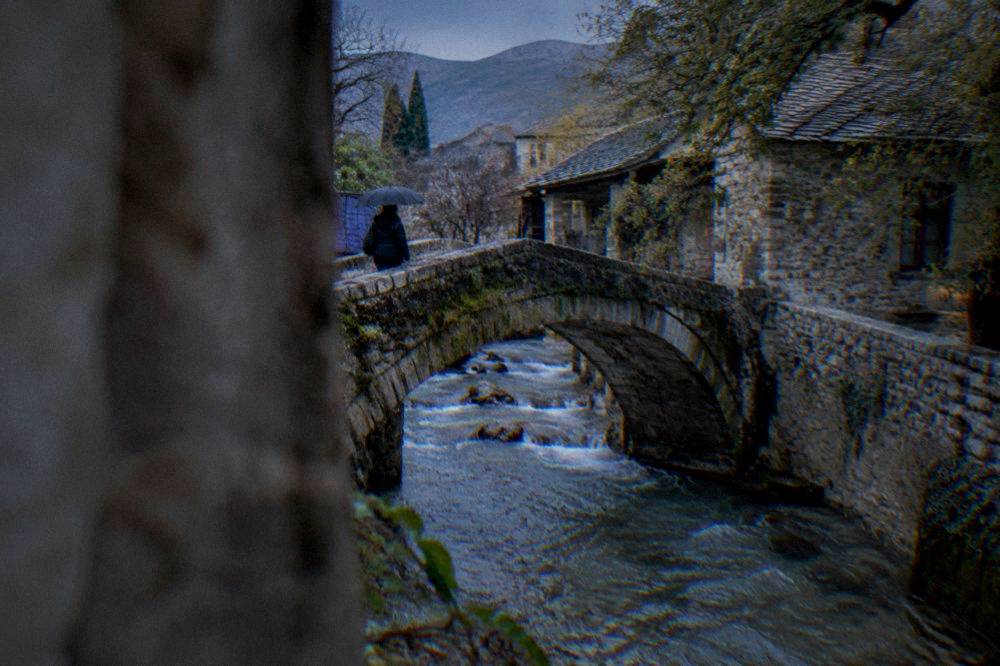
The old town of Mostar works well in rain precisely because it was built as a dense, walled-quarter fabric: the lanes are pedestrian, the sights are minutes apart, and the walking distances between the bridge, the bazaar, the mosque and the courtyard houses are short enough that exposure to the weather comes in bursts of a few minutes, not sustained soaks. Kriva ćuprija, the Crooked Bridge, is a two-minute walk upstream from Stari Most and sits in a quiet pocket of the old core that rain actually flatters, with the Radobolja stream running fast under the small stone arch. It is a public structure, free to see at any hour.
The honest caveat is stone. The approach ramps to the Old Bridge and the polished cobbles of Kujundžiluk become slippery when wet, and the bridge parapet is low, so walk the arch in the middle of the tread, not at the edges. River mist after heavy rain can also cut the view from the top of the arch to almost nothing for minutes at a time before it clears. None of this argues for skipping the old town; it argues for shoes with grip and for treating the bridge crossing as a short, deliberate walk rather than a photo op with an umbrella in one hand.
If the rain is the short, heavy type, use it as a timer: one shower equals one museum, one shower equals one coffee. The old core's indoor stops, listed above, alternate naturally with the outdoor connections between them, and a full loop of bridge, bazaar, mosque and two courtyard houses fills three to four hours at an unhurried pace.
Should You Take A Day Trip From Mostar In Wet Weather?
Day trips from Mostar still run in rain, and the standard Herzegovina circuit of Blagaj, Počitelj and Kravica waterfall is largely an in-and-out-of-a-vehicle itinerary, but one stop changes character completely: Kravica waterfall in rain is a bigger, louder wall of water with swimming conditions that depend on the season, and the park stays open all year with entry at 20 KM for an adult. The falls are 55.2 km and about 54 minutes by road from Stari Most in free-flow conditions, so the drive is short enough that a wet morning need not cancel the plan. Blagaj Tekke, the dervish lodge at the Buna spring, is an interior visit under a cliff overhang, which makes it one of the driest stops in Herzegovina.
The decision usually comes down to whether the rain is valley fog or a regional front. Herzegovina's karst landscape means weather can differ sharply between Mostar, Blagaj and the falls, and a grey city can sit under a clear pocket half an hour south. Tour operators cancel or adjust based on conditions, with free cancellation typically up to 24 hours ahead, so booking a day trip on a wet evening for the next day costs nothing if the forecast worsens.
The route itself, in kilometres and minutes from the bridge, looks like this in free-flow conditions.
| Stop on the Herzegovina circuit | Road distance from Stari Most | Free-flow drive time |
|---|---|---|
| Blagaj Tekke | 13.7 km | about 19 min |
| Počitelj | 30.0 km | about 31 min |
| Kravica waterfall | 55.2 km | about 54 min |
Kravica's own hours shift by month: 07:00 to 17:00 in January and February, 07:00 to 18:00 in March and April, 07:00 to 20:00 in May, 07:00 to 22:00 from June to September, 07:00 to 19:00 in October, and 07:00 to 17:00 in November and December. Entry is 20 KM for an adult all year, 10 KM for residents of Bosnia and Herzegovina, and free for children under 7. Swimming in the pool below the falls is allowed in summer in the designated area, with no lifeguard reported, and after heavy rain the current near the falls is stronger; check the park's rules on arrival. The full stop-by-stop plan for this route is in Kravice, Blagaj and Počitelj in one day.
For travellers based elsewhere, the same logic applies from the other direction: the Mostar day trip from Dubrovnik and the route covered under Sarajevo both cross into the Herzegovina valley, where the weather often differs from the coast or the mountain plateau. A rainy Dubrovnik morning can be a dry Mostar afternoon, and vice versa.
What Practical Tips Help On A Wet Day In Mostar?
Carry cash in KM, shoes with real grip, and a layer: cash because small museums, bakeries and market stalls prefer it, grip because the polished limestone of the bridge ramps and bazaar lanes turns slick within minutes of rain, and a layer because modelled January highs of 8.4 C (ERA5 reanalysis, 1991-2020) mean wet wind off the Neretva feels colder than the number suggests. The emergency number in Bosnia and Herzegovina is 112, with 122 for police and 124 for ambulance. Plugs are type C and F at 230 V, so chargers work for European visitors without an adapter.
A few specifics for this city. Taxis are metered and a ride across the centre is short and inexpensive; agree the meter or the price before setting off, as with anywhere in the region. A tourist tax reported at 3 KM per person per night applies in the canton from 1 January 2026, though it is normally folded into a hotel bill rather than collected on the street; confirm at booking. And if rain tempts you toward paths above the city, stay on marked routes in rural Herzegovina because of suspected mine areas, the standing advice of the national mine-action centre.
| Wet-day item | Why it matters in Mostar |
|---|---|
| Cash in KM (BAM) | Small museums, bakeries and stalls prefer cash; the mark is the currency |
| Shoes with grip | Polished limestone on the bridge ramps and bazaar lanes is slick when wet |
| Layer or windproof | Winter rain arrives with wind off the Neretva valley |
| Umbrella vs rain jacket | The lanes are narrow; a jacket beats an umbrella in gusts near the river |
If the rain settles in for two days rather than one, stretch the plan: the indoor circuit plus a long coffee morning fills day one, a Herzegovina day trip or the museums of the west side fill day two, and the two days in Mostar itinerary shows how the halves fit together.
Common Questions About Mostar Rainy Days
Does it rain a lot in Mostar?
Mostar averages 1,515.4 mm of precipitation a year on the FHMZ 1961-1990 station record, with a strong winter concentration: November averages 200.0 mm and July 42.9 mm. Summer visits rarely lose whole days to rain; November and December visits should carry an indoor plan.
Is the Old Bridge open in the rain?
Yes. Stari Most is a public pedestrian crossing, free and open around the clock, in all weather. The polished stone ramps are slippery when wet, so cross deliberately and hold the railing side rather than handling an umbrella at the top of the arch.
What is there to do indoors in Mostar?
The Old Bridge Museum in the Tara tower, the interior of Koski Mehmed-pašina džamija, Bišćević House, Muslibegović House, the Museum of Herzegovina, the covered stalls of Kujundžiluk, and food workshops such as a burek masterclass or a Bosnian cooking class. All sit in or beside the old core.
Does it snow in Mostar?
Snow does fall, but the city is mild for its latitude: the FHMZ 1961-1990 record shows a maximum measured snow cover of 37 cm in March, while mean January temperature is 4.8 C. Winter precipitation usually arrives as rain in the valley.
Do day trips from Mostar run when it rains?
Yes. The standard Blagaj, Počitelj and Kravica waterfall circuit is largely vehicle-based, and Blagaj Tekke is an interior visit under a cliff. Kravica stays open all year at 20 KM adult entry, with monthly hours published by the park; operators cancel or adjust for conditions, with free cancellation typically up to 24 hours ahead.
Can you swim at Kravica waterfall in the rain?
Swimming is allowed in summer in the designated pool area below the falls, with no lifeguard reported. After heavy rain the current near the falls is stronger and the falls run fuller; check the park's rules on arrival and stay in the designated area.
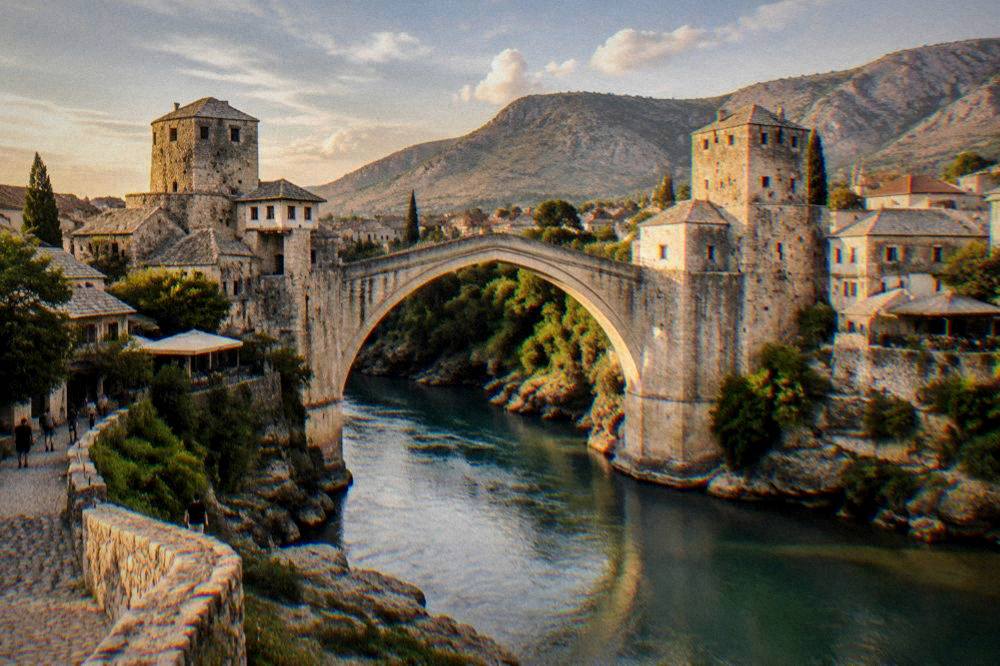
A last thought for the walk home: rain in Mostar usually ends as abruptly as it starts, and the hour after a shower, when the stone dries in patches and the Neretva runs high and green under the arch, is one of the best hours the city offers in any season.
