Burek And Pita: The Bosnian Pie Explained
Burek is the filo pie that anchors everyday eating in Mostar, in Herzegovina, and this guide untangles what the word means here, how it differs from pita, and how to eat and make it well.
In Mostar, burek strictly means a filo pie filled with minced meat, while pies with cheese, potato, spinach or pumpkin are called pita. It is sold by weight in bakeries across the city, eaten at any hour, and pairs with yoghurt or Bosnian coffee.
Burek is the filo-dough pie that anchors everyday eating in Mostar, the main city of Herzegovina, on the Neretva river, and few foods in Bosnia and Herzegovina carry as much quiet regional pride. In a Mostar bakery the word has a narrow meaning, and using it loosely marks you as a visitor faster than any camera. This guide explains the pie families, the fillings, the ordering customs, what to drink alongside, and how the whole subject connects to the rest of eating your way through the city, from Bosnian coffee to the grilled classics covered in Cevapi: The Bosnian Sausage Explained.
What Is Burek In Mostar, And Why Does The Word Matter?
Burek in Mostar, and in Bosnia and Herzegovina generally, is a hand-stretched filo pie filled with minced meat, baked in a round tray or rolled into a spiral, and sold by weight rather than by the piece. The word is reserved for the meat filling here, and calling a cheese or potato pie a burek is the classic visitor slip. Everything else in the family goes by the name pita.
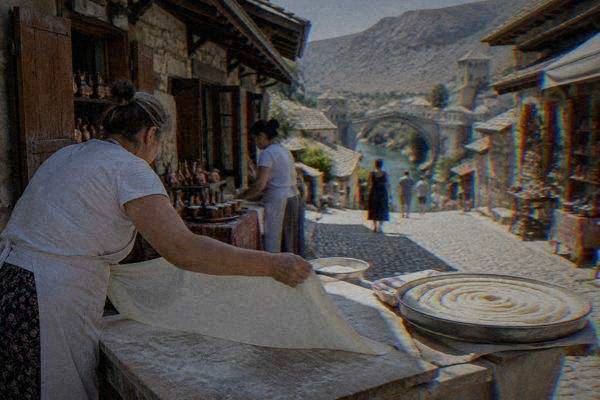
That distinction is not pedantry. Walk into a bakery in the Old Bazaar around Kujundžiluk or along the Bulevar and order a cheese burek, and the person behind the counter will usually understand you and quietly file you as a tourist. Order a sirnica and you have asked for the cheese pie in the local register. The dough itself is the shared foundation: paper-thin sheets stretched by hand over a wide table, brushed with fat, layered or rolled, and baked until the surface turns a deep gold and the bottom crisps.
The tradition travels with the Ottoman kitchen across the Balkans, and every country that inherited it now defends its own version. In Bosnia and Herzegovina the pie arrived with the Ottomans and stayed as everyday food, produced in bakeries called buregdžinicas that often sell nothing else. The craft is in the stretching: a properly rolled burek shows distinct layers when cut, and the spiral form, rolled from a single long rope of dough, is the shape you will see under the glass counter in Mostar.
Burek Or Pita: How The Pie Families Differ In Mostar
The pita family in Mostar covers every filo pie that is not meat burek: sirnica for cheese, krompiruša for potato, zeljanica for spinach and cheese, and tikvenjača for pumpkin. Burek stands alone with minced meat, usually beef or lamb, and it is typically the priciest member of the family because meat costs more than the vegetable fillings.
Ordering is by weight. You point at the tray, say how many hundred grams you want or how many people are eating, and the counter cuts a wedge or a length of spiral, weighs it, and quotes the price. A portion for one person often lands somewhere between a quarter and half a kilogram, depending on appetite and how many in the group are sharing. Bakeries bake in waves through the day, and a tray straight from the oven is a different experience from one that has sat under the lamp for hours, so timing matters more than address.
| Pie | Filling | Notes On The Mostar Version |
|---|---|---|
| Burek | Minced meat, usually beef or lamb | The only one that owns the name burek; sold as a spiral or in layers |
| Sirnica | Cheese, typically a soft white cheese | The everyday breakfast choice; often the first tray to sell out |
| Krompiruša | Potato, diced and seasoned | A common meatless option, especially on fasting days |
| Zeljanica | Spinach with cheese | The green member of the family; lighter than the rest |
| Tikvenjača | Pumpkin | Sweet-leaning and seasonal; the one visitors most often have never met |
The names matter when you are ordering, and they also matter when you are talking with locals about food, because the vocabulary is shared across Bosnia and Herzegovina and defended with humour. There is a long-running joke that everything is pita except burek, and the joke carries a real rule inside it. Learn the five names in the table and you can order anywhere in the country without pointing.
Rolling the dough by hand is the part that separates a buregdžinica from an ordinary bakery. The dough is stretched so thin you can read through it, then brushed, rolled and coiled. It looks effortless when a baker does it in thirty seconds, and it is not, which is exactly why a hands-on class is a worthwhile hour in a city where the food culture rewards understanding.
Where Burek Fits Into A Day Of Eating In Mostar
Burek in Mostar is an all-day food, but its strongest slots are mid-morning and late evening: it is a standard breakfast with yoghurt or Bosnian coffee, a cheap midday refill between sightseeing, and a late-night staple after the bars close. Unlike cevapi, which sits firmly in the lunch and dinner register, pie crosses every daypart.
A common rhythm for a first day in the city: coffee and a slice of sirnica in the morning near the Old Town, the Old Bridge and the bazaar through the middle of the day, a heartier grilled lunch, and then a wedge of burek in the evening when the tour groups have thinned and the Old Town becomes a local space again. The evening tray often comes out of the oven after dark, and the counter queues tell you which bakery pulled it fresh.
What you drink with it is not a small question. Yoghurt is the traditional companion, drunk from the glass rather than eaten with a spoon, and its coolness against the hot fat and flaky layers is the pairing locals grow up with. Bosnian coffee, served in a small copper pot with a lump of sugar on the side, is the other classic pairing, and it turns a slice of sirnica into a proper sitting-down breakfast. Sweetened soft drinks are the outsider choice and nobody will stop you, but the two traditional pairings are worth trying exactly once each.
| Moment Of The Day | What Works | Why |
|---|---|---|
| Breakfast | Sirnica or zeljanica with Bosnian coffee | Lighter fillings suit the morning; the coffee ritual slows the meal down |
| Mid-morning | A wedge of burek with yoghurt | The traditional pairing; filling enough to carry you to a late lunch |
| Afternoon walking break | Krompiruša, eaten on the go | Cheap, filling, and easy to eat by hand from a paper sleeve |
| Late evening | Fresh burek from the last tray of the day | Bakeries bake late; a hot spiral after dark is a local habit |
If you are planning a longer stay and want to budget for eating, the Mostar money guide covers the convertible mark, the fixed euro peg and how cash still rules at small counters, which is exactly the situation you meet at a bakery window. Bring small notes: the price of a wedge is quoted in marks, weighed on the spot, and rounded to the nearest coin.
Can You Learn To Roll Burek Yourself In Mostar?
Yes, and it is one of the more rewarding food activities in the city: a hands-on burek masterclass in Mostar walks you through stretching the dough, spreading the meat filling, rolling the spiral and baking it, and ends with eating what you made. The craft is genuinely harder than it looks, which is what makes the hour worthwhile.
The class covers the full sequence, from a soft ball of dough to a finished tray. Stretching is the heart of it: the dough has to be pulled thin enough to see through without tearing, a motion that takes bakers years to make look casual. Participants then spread the filling, shape the roll, coil it into the tray, and wait for the bake. The payoff is immediate, because lunch is the thing you just built.
For a fuller picture of the city's table, the masterclass pairs naturally with the general Bosnian food guide, which covers the broader table, from grilled meats to the coffee ritual. And if you want to cook as well as eat, there is also a wider Bosnian cooking class option in the city that builds a fuller lunch around the same traditions.
How Does Burek Compare With The Other Mostar Classics?
Burek and cevapi are the two poles of everyday eating in Mostar: burek is the baked, layered pie eaten at any hour and sold by weight, while cevapi is the grilled minced-meat sausage served in flatbread with raw onion, a firmly lunch-and-dinner dish ordered by portion. Both are cheap, both are everywhere, and a stay in the city usually alternates between them.
The differences are practical as well as culinary. Pie is faster: you point, it is cut, you pay and eat, sometimes standing on the street. Cevapi is a sit-down affair with smoke, a grill, and a plate arriving in its own time. Pie is also the vegetarian's friend, in a cuisine that leans heavily on grilled meat, because sirnica, krompiruša, zeljanica and tikvenjača carry no meat at all. Other pages covering the same trip are gathered on Mostar Travel Guide.
| Burek And Pita | Cevapi | |
|---|---|---|
| What it is | Hand-stretched filo pie, baked in a tray | Grilled minced-meat sausages in flatbread |
| How it is sold | By weight, cut from the tray | As a fixed portion, counted in pieces |
| When it is eaten | Morning to late night | Lunch and dinner |
| Meat-free options | Yes, four pita fillings at least | No |
| Traditional drink pairing | Yoghurt or Bosnian coffee | Sometimes a light beer |
The two foods also sit differently in the day of a visitor working through the city's main sights. A pie wedge is what you eat between the Old Bridge and the Crooked Bridge; cevapi is what you sit down for after the walking is done. The cevapi guide covers that half of the table in the same detail this page gives the pie.
What Should First-Time Visitors Know About Ordering Burek In Mostar?
Order by weight, expect to pay in cash in convertible marks, and ask for a fresh tray if the one under the glass looks tired, because burek in Mostar is cut to order at the counter and the difference between a fresh spiral and a reheated one is the whole experience. Saying kilogram amounts is normal, and half a kilo feeds two people comfortably.
A few customs smooth the transaction. Pointing is accepted everywhere, but the five filling names from the table above are better. If you are sharing, ask for it cut in half so two people can eat different fillings. If you want it to go, it goes into a paper sleeve or a box, and it is eaten warm rather than hot, which makes it a good walking food. Bakeries around the Old Town, the Bulevar and the market halls all run on the same system.
One practical note on the country itself, because it affects every counter transaction: Bosnia and Herzegovina uses the convertible mark, pegged at 1 EUR = 1.95583 KM, and it is not in the EU or Schengen. Euro cash is often accepted in tourist areas at a rounded rate, but a bakery window is a cash-in-marks environment, so carry small notes. The details are laid out in the money guide linked above.
Is Burek In Mostar Different From Burek Elsewhere In The Region?
The Mostar and Bosnian version is defined by the strict naming rule, meat means burek and everything else is pita, and by the spiral or layered filo form, while neighbouring countries use the word more loosely and often bake the same dough in different shapes, rolled cylinders in Serbia, thicker stacked trays elsewhere, and cheese or apple fillings that Mostar would call something else entirely.
The family argument runs along the old Ottoman trade routes. To the east, the word burek attaches to rolled cylinders, and cheese or even apple versions carry the name without anyone objecting. In Bosnia and Herzegovina the vocabulary is tighter and the buregdžinica is a dedicated shop. Turkey, where the tradition originates, has its own branches, and the diaspora has carried every variant further afield.
For a visitor the practical takeaway is simple: order by the local names and you will be understood anywhere in the country, while importing another country's vocabulary will get you a friendly correction. The correction itself is part of the fun, because food vocabulary is one of the places where the region's shared history and separate identities show up on the same counter.
Can Burek Travel: Eating Your Way Through Herzegovina Day Trips?
Yes, the pie family travels across Herzegovina better than almost any other food, because every town between Mostar, Blagaj, Počitelj and Stolac has its own bakery, and a wedge of pita is the standard road-trip lunch on a day tour. The distances are short enough that a morning bakery stop in Mostar and an afternoon slice somewhere on the road both fit in one day.
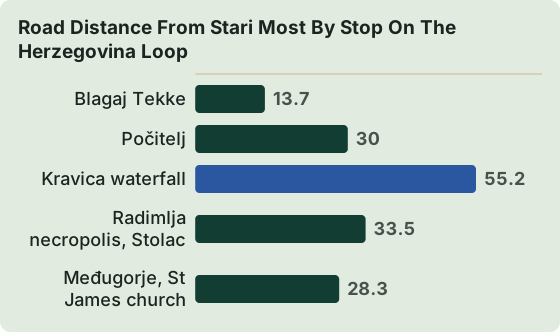
The classic Herzegovina loop runs through Blagaj, Počitelj and Kravica waterfall, and it is the single popular day trip out of the city. Blagaj Tekke sits at the Buna spring, 13.7 km and about 19 minutes by road from Stari Most. Počitelj, the stone fortified village on the Neretva, is 30.0 km and about 31 minutes. Kravica waterfall, the wide tufa cascade near Ljubuški, is 55.2 km and about 54 minutes, and entry there is 20 KM for an adult all year, with children under 7 free, per the park's own visitor page.
| Stop On The Herzegovina Loop | Road Distance From Stari Most | Free-Flow Drive Time |
|---|---|---|
| Blagaj Tekke | 13.7 km | about 19 min |
| Počitelj | 30.0 km | about 31 min |
| Kravica waterfall | 55.2 km | about 54 min |
| Radimlja necropolis, Stolac | 33.5 km | about 42 min |
| Međugorje, St James church | 28.3 km | about 40 min |
A guided version of the loop removes the parking questions entirely and usually builds in time at each stop, which matters at Kravica if you want to swim: the pool below the falls is open for swimming in summer in the designated area, with no lifeguard reported, and the water is cold karst water, so check the park's rules on arrival. The full loop is covered here, including the waterfall entry details.
Further out, the same bakery culture follows you to Konjic, Jablanica and Trebinje, and the pie vocabulary holds across all of it. Konjic is 69.0 km and about 80 minutes from Stari Most, Jablanica 47.4 km and about 57 minutes, and Trebinje 116.5 km and about 142 minutes, all free-flow road times without border queues. Wherever the road stops, a warm tray is rarely far.
How Does Burek Fit Into A Longer Stay In Mostar?
A stay of two or three days in Mostar is enough to eat through the whole pie family, take a rolling class, and still work in cevapi, coffee and a Herzegovina day trip, because the city is compact and the bakeries cluster around the Old Town and the Bulevar. Pie works as the filler between the set-piece meals rather than the set piece itself.
The itinerary pages break this down by length: one day in Mostar keeps the pie to a single breakfast, while two or three days leave room for a morning class, an evening tray, and a full day out to Blagaj and Kravica. Timing the city itself is covered in the best time to visit guide, and the Mostar weather page explains the summer heat that makes a midday bakery stop with yoghurt a genuinely sensible plan: the FHMZ 1961-1990 station table puts the July mean at 24.7 C, and modelled ERA5 1991-2020 daily highs reach 29.9 C in July and 30.5 C in August.
For a different angle on the city between meals, the history walks cover the 1990s and the bridge with dates and physical facts, and the Mostar history guide gives the longer arc, from the first written mention of the name in 1474 through the bridge's completion in 1566 to its destruction on 9 November 1993 and reopening in July 2004. Food and history are closer here than in many cities, because the bakery tradition and the stone Old Town come out of the same Ottoman centuries.
Common Questions About Burek In Mostar
Is burek in Mostar the same as pita?
No. In Bosnia and Herzegovina, burek means the minced-meat filo pie only, while the pies filled with cheese, potato, spinach or pumpkin are called pita by their own names: sirnica, krompiruša, zeljanica and tikvenjača.
What fillings does a Mostar bakery sell?
The standard five are minced meat (burek), cheese (sirnica), potato (krompiruša), spinach and cheese (zeljanica), and pumpkin (tikvenjača). Some bakeries add seasonal fillings, and the meat version is the one that owns the burek name.
How is burek sold in Mostar?
By weight. You ask for a portion in grams, the counter cuts a wedge or a length of spiral from the tray, weighs it, and quotes the price in convertible marks. Half a kilo comfortably feeds two.
What do you drink with burek?
Yoghurt is the traditional pairing, drunk from the glass, or Bosnian coffee, which turns a slice of sirnica into a full breakfast ritual.
Can vegetarians eat well at a buregdžinica?
Yes. Four of the five standard fillings, sirnica, krompiruša, zeljanica and tikvenjača, contain no meat, which makes the pie shop one of the easiest vegetarian stops in a grill-heavy cuisine.
Can I learn to make burek in Mostar?
Yes, there is a hands-on burek masterclass in the city that covers stretching the dough, spreading the filling, rolling and baking, and finishes with eating the result.
The pie counter is the cheapest possible education in how Mostar eats, and one correctly ordered slice of sirnica buys you more local goodwill than an hour of phrasebook practice. Start with the five names, add yoghurt, and the rest of the table, from cevapi to coffee, follows naturally.