Mostar History: From Ottoman Bridge Town To Today
Mostar, an inland city on the Neretva river in Herzegovina, grew from a chain of bridge keepers' towers into an Ottoman market town, lost its Old Bridge on 9 November 1993 and regained it in July 2004. This is the full arc, from the first written mention in 1474 to the UNESCO listing and the city of about 105,000 people today.
Mostar was first named in a 1474 Dubrovnik document, took its name from the keepers of an earlier wooden bridge, and rose around the stone Old Bridge completed in 1566 under Suleiman the Magnificent. The bridge was destroyed on 9 November 1993 during the war and reopened in July 2004, and the Old Bridge Area joined the UNESCO World Heritage list in 2005.
Mostar, the main city of Herzegovina in Bosnia and Herzegovina, sits inland on the Neretva river, and its whole story is written in stone and water. The name itself comes from the bridge: "mostari" were the keepers of an earlier wooden crossing, and the settlement that grew beside their towers took their title as its own. The stone Old Bridge completed in 1566 turned a river crossing into a market town, and the destruction of that same bridge on 9 November 1993, followed by its reopening in July 2004 and UNESCO World Heritage inscription in 2005, turned the city into a symbol recognised far beyond the Balkans. This page walks the full arc, using only what documented record supports.
Where Does The Story Of Mostar Begin?
The name Mostar appears in writing for the first time in a 1474 document of the Dubrovnik Republic, and the name itself comes from "mostari", the keepers who guarded an earlier wooden bridge over the Neretva. Before that, the settlement existed as a cluster of towers flanking the crossing on both banks, with the name recorded in 1452 sources as a bridge-and-towers site.
That etymology is the single most useful fact for understanding the city. Mostar did not begin as a fortress on a hill or a port on a coast; Herzegovina has no coast here, and the Neretva runs through a karst valley that funnels travel to a small number of crossing points. Whoever held the bridge held the road. The Ottoman administration that extended its rule over Herzegovina in the years after 1474 inherited a crossing point and decided to monumentalise it.
The town that grew around the bridge became a commercial hub for the region, with a bazaar, hammams and mosques accumulating on the left bank. UNESCO's listing for the Old Bridge Area notes the settlement developed as an Ottoman town around the bridge in the period before the stone arch replaced the wooden one. The street plan of today's Old Town, narrow lanes stepping down to the river, still follows that Ottoman logic of shade, water and trade. For the buildings that survive from that era today, see the Mostar Old Town area guide.
Who Built The Old Bridge, And Why Did It Define The City?
The Old Bridge, Stari Most, was completed in 1566 under the Ottoman Sultan Suleiman the Magnificent, designed and built by the architect mimar Hajruddin following the design approach of his master, the architect mimar Sinan. Its single stone arch spans about 29 metres and stands about 21 to 24 metres above the Neretva, depending on the river level.
The bridge is built of local tenelija limestone, and its arch was an engineering feat for its day: a single semi-circular span thrown across a fast, cold river with no scaffolding left in place. UNESCO's documentation describes the bridge as the work of Hajruddin, and the stone replaced the wooden crossing that the mostari had guarded. The crossing is free and open around the clock, and it remains a public pedestrian route, not a ticketed monument.
What the bridge did was concentrate an economy. The bazaar of Kujundžiluk, whose coppersmiths gave the street its name, lined the approach on the left bank, and the houses of merchants climbed the hillside above it. The Crooked Bridge, Kriva ćuprija, a smaller single-arched stone bridge over a side channel, is usually read as a prototype built before the great span. Both survive today: the full story of the great arch is in why the Mostar bridge is so famous, and the bazaar itself is covered in the Kujundžiluk guide.
A diving tradition grew around the bridge that is as much a part of its history as its masonry. Members of the Mostari diving club jump from the arch, training for years before a solo jump from a height of about 21 to 24 metres into water that stays cold even in August. The 460th traditional competition ran on 26 July 2026, and the Red Bull Cliff Diving World Series has stopped in the city ten times, with the 2026 round running 30 July to 1 August from added platforms, 21 metres for women and 27 metres for men. The bridge diving guide covers the tradition in full.
| Milestone | Year | What The Record States |
|---|---|---|
| First written mention of the name Mostar | 1474 | Dubrovnik Republic document |
| Stone Old Bridge completed | 1566 | Under Suleiman the Magnificent, by mimar Hajruddin |
| Bridge destroyed | 9 November 1993 | During the war |
| Bridge reopened | 23 July 2004 | Rebuilt with original techniques and materials |
| UNESCO inscription | 2005 | Property 946, criterion (vi) |
The Ottoman centuries also gave Mostar its religious architecture, and much of it stands today. The Koski Mehmed-pašina džamija sits directly on the riverbank below the bridge, its minaret leaning over the water; a small cash fee is reported for entry, more with the minaret climb, and the details are in the mosque guide. The Karađoz-begova džamija, a short walk up from the bazaar, is one of the grandest Ottoman mosques in Herzegovina; confirm visit arrangements on site. The domestic architecture of the era survives in the Bišćević House, the Muslibegović House and Kajtaz House, Ottoman courtyard residences open to visitors, with entry reported at a few KM each.
| Ottoman-Era Site In Mostar | What Survives | Reported Entry |
|---|---|---|
| Stari Most | Rebuilt stone arch, free to cross at any hour | Free |
| Kriva ćuprija | Small single-arch bridge over the Radobolja side channel | Free, public street |
| Koski Mehmed-pašina džamija | Riverside mosque with minaret, reported small cash fee | A few KM reported, more with the minaret |
| Bišćević House | Ottoman courtyard house, about 4 KM reported | About 4 KM reported |
| Muslibegović House | Ottoman residence and museum, about 8 KM reported | About 8 KM reported |
| Kajtaz House | Ottoman konak, confirm locally | Confirm on site |
What Did Austria-Hungary And Yugoslavia Leave Behind In Mostar?
Mostar passed under Austro-Hungarian administration in 1878 and developed as an administrative and educational centre for Herzegovina until 1918, a period that gave the city its grid of official buildings west of the Old Town, before the Yugoslav era added the industrial suburbs, the boulevard and the Partisan Memorial Cemetery inaugurated in 1965 to a design by the architect Bogdan Bogdanović.
The Habsburg decades changed the city's shape more than its soul. The administration built schools, banks and government offices in a European style, laid out on straighter streets west of the Ottoman core, and Mostar became the seat of Herzegovina's institutions. That split, a compact Ottoman old town on the river and an administrative quarter around it, is still the basic map of the central city today, and Spanish Square, the open plaza that anchors the western side, is the hinge between the two.
Yugoslavia brought industry and growth to the Neretva valley, and with them a second wave of construction. Jablanica, 47.4 km north by road, became the site of a hydroelectric dam and of the Museum Battle for the Wounded on the Neretva, which commemorates the Second World War operations in the valley. Konjic, 69 km north, gained its place in Cold War history when the ARK D-0 bunker was carved into a hillside nearby, a vast underground complex built to shelter the Yugoslav political and military leadership; visits are by guided tour with advance booking, closed Monday, and the fee is reported at 40 KM for foreign visitors. The Konjic day-trip guide covers getting there.
Bogdanović's Partisan Memorial Cemetery, inaugurated in 1965, is the most ambitious Yugoslav monument in the city: a hillside necropolis of stone markers arranged around a channel of running water, listed as a national monument. Its recent history is harder. Europa Nostra reports that over 700 of its stone memorial markers were destroyed in 2022, and the site now sits on the heritage organisation's list of the seven most endangered heritage sites in Europe, with a report presented in May 2026 calling for its revitalisation. There is no ticket and no staffed reception; approach it as a memorial site in poor condition, which the Partisan Memorial Cemetery page places in its wider context.
| Era | Years | What It Left In The City |
|---|---|---|
| Ottoman | To 1878 | Old Bridge (1566), bazaar, mosques, courtyard houses |
| Austro-Hungarian | 1878 to 1918 | Administrative quarter, schools, western grid, Spanish Square |
| Yugoslav | 1918 to 1992 | Industry, boulevards, Partisan Memorial Cemetery (1965) |
| Post-war | 1995 to today | Rebuilt bridge (2004), UNESCO listing (2005), restored Old Town |
What Happened To The Old Bridge In 1993, And How Was It Rebuilt?
The Old Bridge was destroyed on 9 November 1993 during the war, when artillery fire brought the arch into the Neretva, and it was rebuilt with original materials and techniques, supported by UNESCO and World Bank partners, reopening on 23 July 2004. The surrounding Old Town was heavily damaged in the same period and restored in the years that followed.
This site keeps to dates and physical facts on this subject, and there are enough of them. The bridge fell on 9 November 1993. The rebuilding effort that followed used stone quarried from the same tenelija seams and methods matching the Ottoman original, with debris recovered from the riverbed reincorporated into the reconstruction. The new bridge opened on 23 July 2004. UNESCO inscribed the Old Bridge Area of the Old City of Mostar on the World Heritage list in 2005 as property 946, under criterion (vi), which recognises the site's association with events and ideas of outstanding universal significance, in this case coexistence and reconciliation.
The wider story of the destruction and the reconstruction, including what the rebuilding involved and how the area was restored, is covered in the dedicated answers pages: why the Mostar bridge was destroyed and whether the bridge has been rebuilt. Visitors who want to go deeper on the ground can take a history-focused walk: the tailored private history tour covers the old town, the war years and the rebuilt bridge with a guide who adjusts the route to your interests, and you can Check availability at the operator's live listing.
For the war period specifically, two guided walks focus on the siege years and the break-up of Yugoslavia, visiting the front-line areas and the ruins that still stand in the suburbs. They are walking tours led by local guides who lived the period, and they complement rather than duplicate the bridge's own story.
How Did Mostar Become The City Visitors See Today?
Today's Mostar is a single city of about 105,000 people (2013 census) administered by one city council, whose 2020 local elections were the first held in twelve years, and whose economy and identity have rebuilt around the restored Old Bridge, the UNESCO-listed old town and a growing stream of day visitors arriving overland from Dubrovnik, Split and Sarajevo.
The recovery was physical before it was economic. The Old Bridge Area restoration returned the Kujundžiluk bazaar, the mosques and the courtyard houses to use, and the Museum of the Old Bridge in the Tara tower tells the story of the arch, the 1993 destruction and the rebuilding; its reported hours are 08:00 to 16:00 daily from 1 April to 1 November, with an adult fee of about 10 KM reported. Newer layers keep arriving: the Museum of the Holy Trinity Orthodox Cathedral opened in May 2025, adding a further chapter to the city's religious heritage.
The calendar now runs through a full cultural summer. Mostarsko ljeto ran 25 June to 7 August in 2026 across the city's institutions, the Mostar Summer Fest ran 2 to 4 July, the Blues and Rock Festival ran its 24th edition on 24 and 25 July with free entry, and the Jazz Fest closed the season on 23 to 25 August. Each is a recent fact, not a permanent fixture: next year's dates are announced by the organisers.
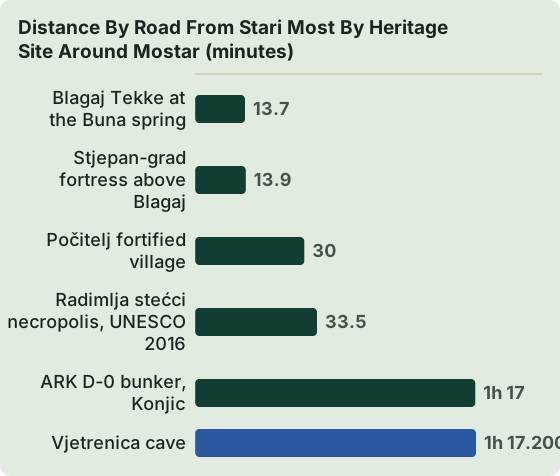
| Heritage Site Around Mostar | Distance By Road From Stari Most | Reported Entry |
|---|---|---|
| Blagaj Tekke at the Buna spring | 13.7 km, about 19 minutes | 10 KM reported |
| Stjepan-grad fortress above Blagaj | 13.9 km, about 20 minutes | Free, open ground |
| Počitelj fortified village | 30.0 km, about 31 minutes | Free, small optional fees reported |
| Radimlja stećci necropolis, UNESCO 2016 | 33.5 km, about 42 minutes | 8 KM individual reported |
| ARK D-0 bunker, Konjic | 77.0 km, about 93 minutes | 40 KM foreign visitors, booking required |
| Vjetrenica cave | 77.2 km, about 104 minutes | About 20 to 25 KM, guided |
Which Layers Of Mostar's Past Can You Actually Walk Through?
The walkable core of Mostar stacks five centuries of history within about fifteen minutes on foot: the Old Bridge and Kujundžiluk bazaar, the Ottoman mosques and courtyard houses, the Austro-Hungarian administrative quarter around Spanish Square, the Yugoslav boulevards, and the post-war restoration, with the Partisan Memorial Cemetery a steep walk above the centre and the front-line ruins still visible in the suburbs.
It is this density that makes the city rewarding for a history-minded visitor. Start at the bridge itself, free to cross at any hour, then descend the bazaar lane to the river level below Koski Mehmed-pašina džamija, where the terrace gives the classic upstream view of the arch. The Crooked Bridge and the courtyard houses fill an hour on their own; the two-day itinerary sequences all of it. For the view over the whole stacked city, climb to the viewpoints above the valley: the Mostar viewpoints guide ranks them, and the Stari Most page details the bridge itself.
West of the old core, the Austro-Hungarian quarter and Spanish Square tell the next chapter, and the Rondo roundabout and boulevards carry the Yugoslav one. A guided city walk strings these together efficiently, and the small-group Old Town guided tour covers the Ottoman core with a wine tasting at the end, while a private walking tour lets you set the pace and the emphasis, whether that is Ottoman trade, Austro-Hungarian administration or the 1990s. History-focused visits pair well with a look at the Mostar hammam and the Herzegovina Museum, where opening arrangements are confirmed on site.
Beyond the city, the history of the whole region is reachable on a day loop. Blagaj, where a Dervish tekke sits at the mouth of the Buna spring beneath the ruins of Stjepan-grad, carries the medieval and Ottoman story of Herzegovina. Počitelj, a short drive down the valley, is a fortified Ottoman village preserved almost entire. Radimlja near Stolac holds one of the densest collections of stećci, the medieval tombstones inscribed jointly on the UNESCO list in 2016. The Počitelj guide and the Trebinje guide extend the trail east, and the Kravica waterfall, Blagaj and Počitelj in one day article shows how the loop fits together for a first visit.
Which Dates Should Every Visitor To Mostar Know?
Five anchors hold the whole story: 1474, the first written mention of Mostar; 1566, completion of the Old Bridge; 9 November 1993, its destruction; 23 July 2004, the reopening of the rebuilt bridge; and 2005, the UNESCO World Heritage inscription of the Old Bridge Area of the Old City of Mostar as property 946 under criterion (vi).
Knowing these five changes how the city reads. The 1566 arch explains the bazaar, the mosques and the courtyard houses that cluster around it. The 1993 date explains the newness of so much of the "old" town, and the 2004 reopening explains the museum in the Tara tower. The 2005 inscription, under criterion (vi) alone, is unusual: the World Heritage Committee listed the area not for its architecture alone but for what the destroyed-and-rebuilt bridge came to stand for, a reading the UNESCO documentation states directly.
Two further dates reward attention. The Partisan Memorial Cemetery was inaugurated in 1965, so its 2025 anniversary marked sixty years, and its current endangered condition after the destruction of over 700 markers in 2022 is part of the site's present, not just its past. And the stećci graveyards of the region, including Radimlja, joined the World Heritage list in 2016, extending Mostar's documented history back past the Ottoman arrival into the medieval Herzegovina of the stećci carvers.
Common Questions About Mostar History
How old is Mostar?
The name appears in writing from 1474, in a Dubrovnik Republic document, and the settlement existed as a towers-and-bridge site earlier still, with the name Mostar derived from the "mostari", the keepers of the wooden bridge. The stone Old Bridge was completed in 1566.
When was the Old Bridge built?
The Old Bridge, Stari Most, was completed in 1566 under the Ottoman Sultan Suleiman the Magnificent, to the design of the architect mimar Hajruddin, following the approach of his master mimar Sinan. The arch spans about 29 metres and rises about 21 to 24 metres above the Neretva depending on the river level.
Why is the Old Bridge a UNESCO World Heritage Site?
The Old Bridge Area of the Old City of Mostar was inscribed on the World Heritage list in 2005 as property 946, under criterion (vi). The listing recognises the area's association with reconciliation and international cooperation after the bridge's destruction in 1993 and its reconstruction, completed in 2004.
When was the Old Bridge destroyed and rebuilt?
The bridge was destroyed by artillery fire on 9 November 1993 during the war. It was rebuilt using original materials and techniques, with support from UNESCO and World Bank partners, and reopened on 23 July 2004.
What did Austria-Hungary and Yugoslavia build in Mostar?
The Austro-Hungarian period from 1878 to 1918 gave Mostar its administrative and educational quarter west of the Old Town. The Yugoslav era added industry, the boulevards and the Partisan Memorial Cemetery, inaugurated in 1965 to the design of Bogdan Bogdanović.
Which historic buildings can you visit in Mostar today?
The Old Bridge (free, open around the clock), the Kujundžiluk bazaar, the Koski Mehmed-pašina džamija, the Crooked Bridge, the Ottoman courtyard houses of the Bišćević, Muslibegović and Kajtaz families, the Museum of the Old Bridge in the Tara tower, and the Partisan Memorial Cemetery, which has no ticket or staffed hours and is in poor condition.
The through-line of Mostar Travel Guide is that this small city on the Neretva compresses the whole history of Herzegovina into a walkable mile: a medieval crossing, an Ottoman masterpiece, a Habsburg grid, a Yugoslav monument and a rebuilt arch, each still standing and each legible to anyone who knows the dates. Start with the bridge, and the rest of the city explains itself.