Old Town: The Ottoman Quarter Around The Bridge
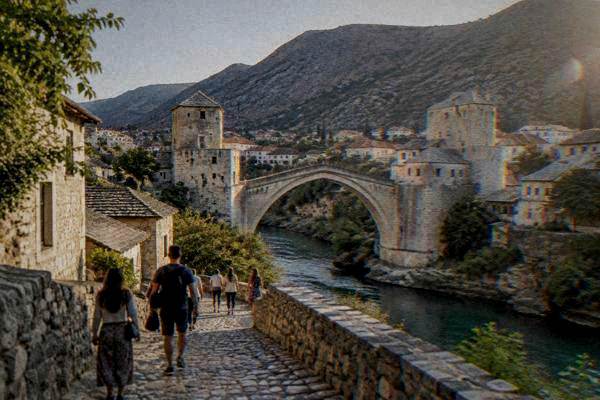
The Old Town of Mostar is the Ottoman quarter around Stari Most, a UNESCO World Heritage property since 2005, where coppersmith lanes, riverside mosques and stone houses sit within a few minutes' walk of each other.
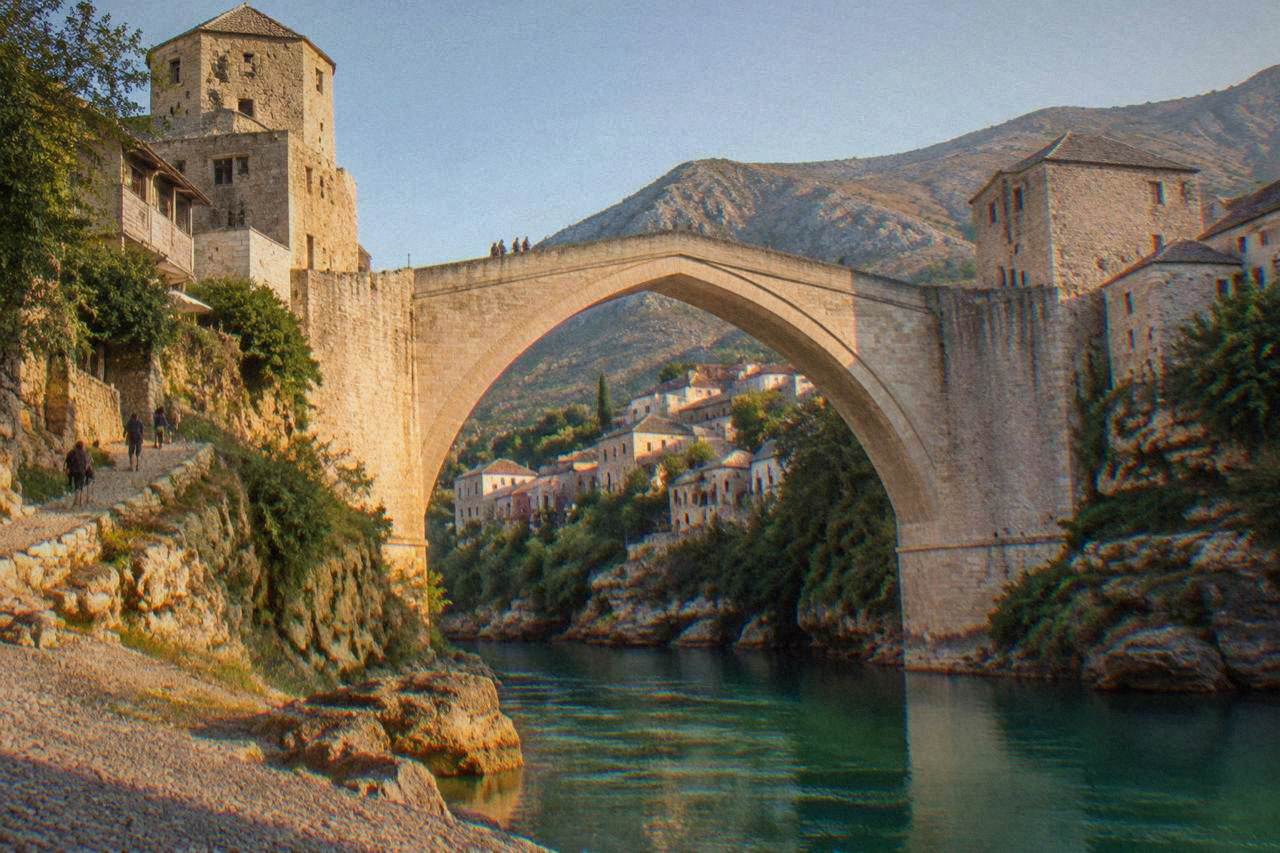
The Mostar Old Town is the historic Ottoman core on both banks of the Neretva around Stari Most, centred on the Kujundžiluk bazaar and inscribed by UNESCO in 2005. Crossing the bridge is free and the lanes are public streets, open at any hour; a first visit usually takes half a day.
The Old Town of Mostar is the Ottoman quarter that gathers around Stari Most on both banks of the Neretva river, in Herzegovina, an inland city in Bosnia and Herzegovina with no sea coast. The whole area, formally the Old Bridge Area of the Old City of Mostar, has been a UNESCO World Heritage property since 2005, inscribed under criterion (vi) as a symbol of coexistence and international cooperation after the bridge's reconstruction. The name of the city itself goes back to the bridge keepers, the "mostari", who guarded an earlier wooden crossing here; the first written mention of the name Mostar dates from 1474. What exists today is a compact district of cobbled lanes, riverside mosques and stone merchant houses that can be crossed on foot in well under an hour, yet rewards a full day of wandering.
What Is The Old Town Of Mostar?
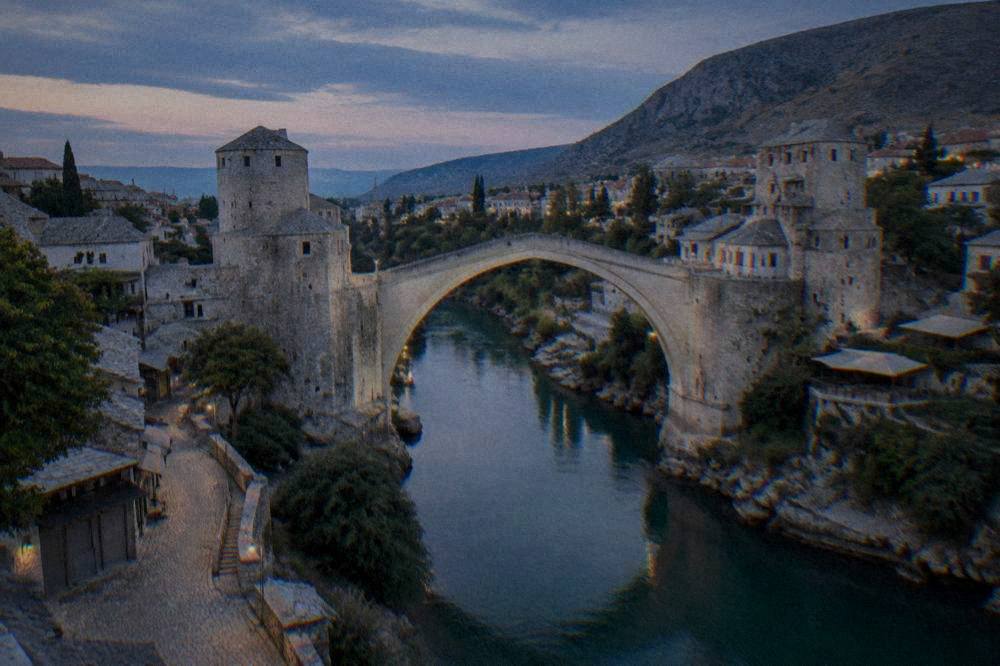
The Old Town of Mostar is the historic Ottoman core strung along both banks of the Neretva around Stari Most, a UNESCO World Heritage property since 2005, whose centrepiece bridge was completed in 1566, destroyed on 9 November 1993 and reopened in July 2004. The district is public city street, free to enter and walkable at any hour. Its two halves are linked by the bridge itself: Kujundžiluk, the old bazaar street on the east bank, and the quieter west bank. The inscribed UNESCO property covers 7.60 hectares with a 48-hectare buffer zone, a small footprint that holds nearly everything a first-time visitor comes to see.
The story of the quarter is told in dates more than in plaques. A settlement grew here from the 15th century around a wooden bridge; the stone arch followed in 1566, built under Suleiman the Magnificent by mimar Hajruddin, whose design followed that of his master, the architect mimar Sinan. The bridge spans about 29 metres and rises about 21 to 24 metres above the river depending on the water level. For the deeper history of the crossing, the story of the bridge itself and the question of why it is so famous are covered in their own pages.
The war reaches this district's story at one point, and the register is factual: the bridge was destroyed on 9 November 1993, and rebuilt with international support before reopening in July 2004. The wider narrative is on the Mostar history page and in why the bridge was destroyed. The Old Town around it was rebuilt in the same spirit, using local tenelija limestone and traditional techniques.
A short orientation table for the quarter's landmarks:
| Landmark | Bank | What It Is |
|---|---|---|
| Stari Most | Spans the river | Stone arch bridge completed 1566, rebuilt 2004, free to cross |
| Kujundžiluk | East | Ottoman bazaar street, public and free |
| Koski Mehmed-pašina džamija | West | Mosque close above the river, small cash entry, more with the minaret |
| Kriva ćuprija | East, upstream | Small stone "Crooked Bridge", public structure |
| Tara tower | East end | Tower housing the Old Bridge Museum, reported 10 KM entry |
| Bišćević and Muslibegović houses | East and west | Ottoman courtyard houses open as museums |
What To See In The Mostar Old Town?
The core sights are Stari Most itself, the Kujundžiluk bazaar street, the Koski Mehmed-pašina džamija by the river, the small Kriva ćuprija upstream, the Old Bridge Museum in the Tara tower and the Ottoman courtyard houses; all sit within a few minutes' walk of one another, and every one of them is either free or costs a few convertible marks. Start at the bridge, because everything else arranges itself around it. Crossing is free and open around the clock, and the view down the Neretva from the crest changes with the light and the water level, which varies because upstream dams control the flow.
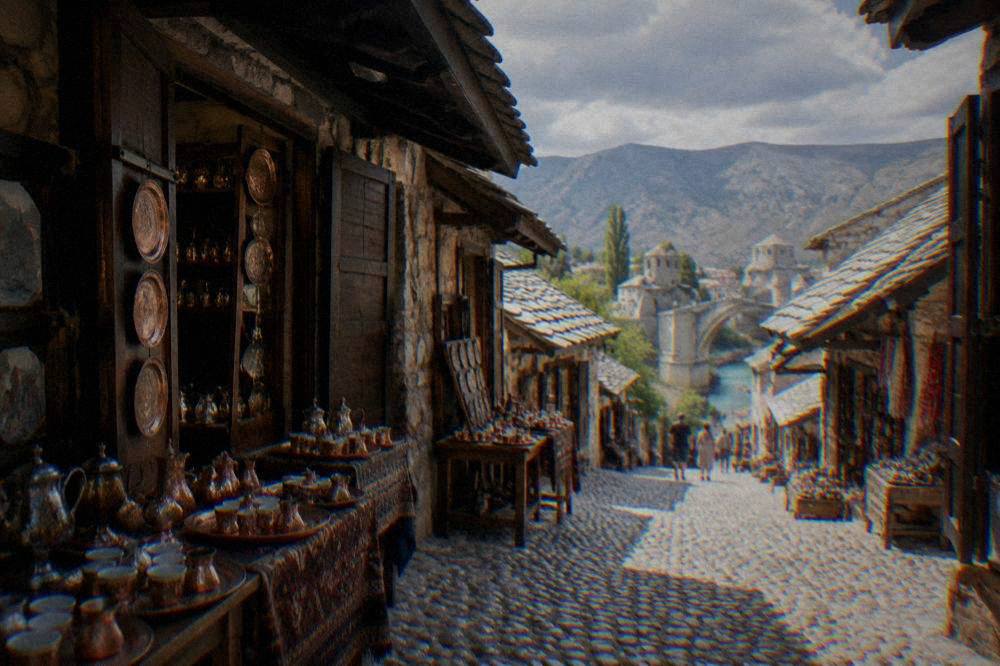
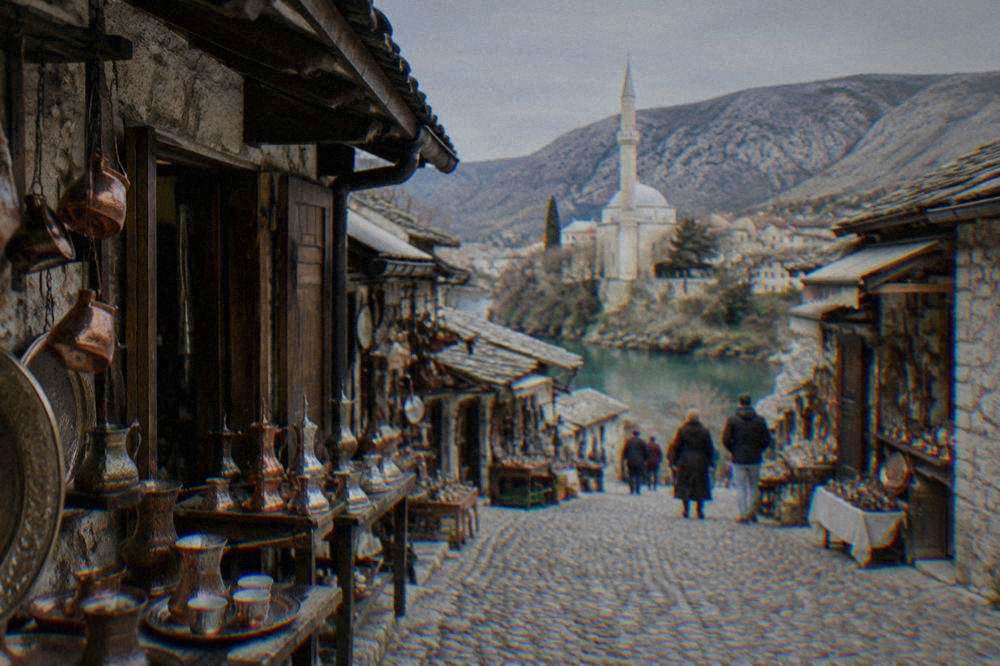
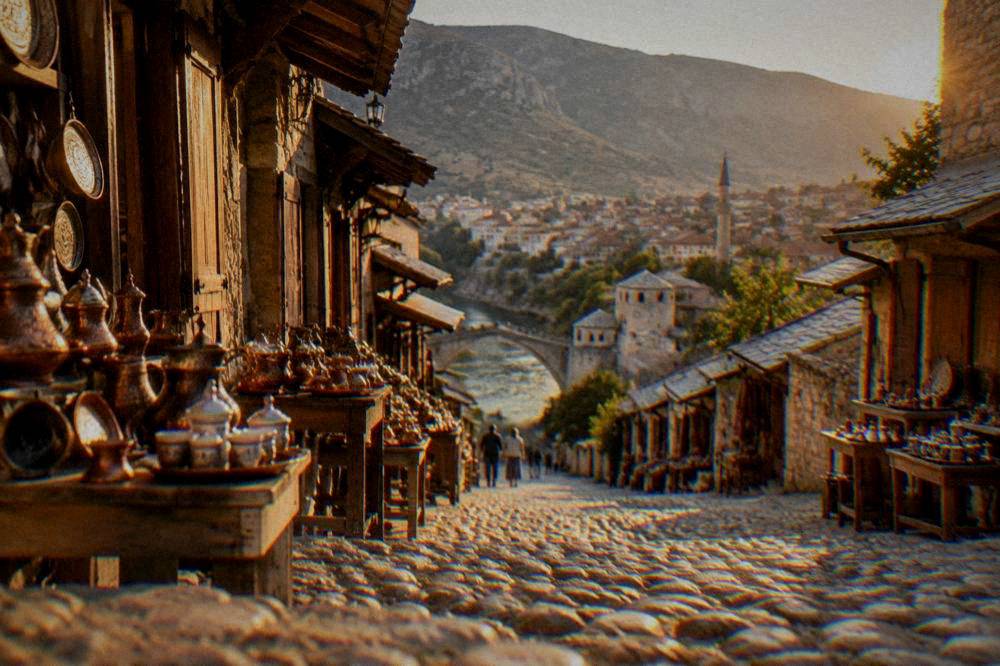
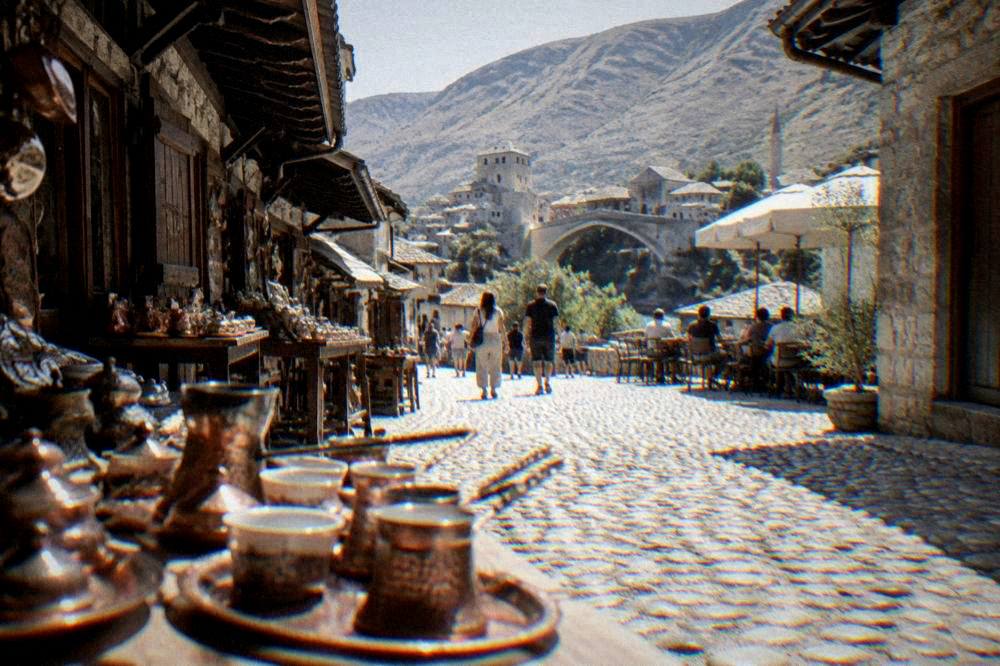
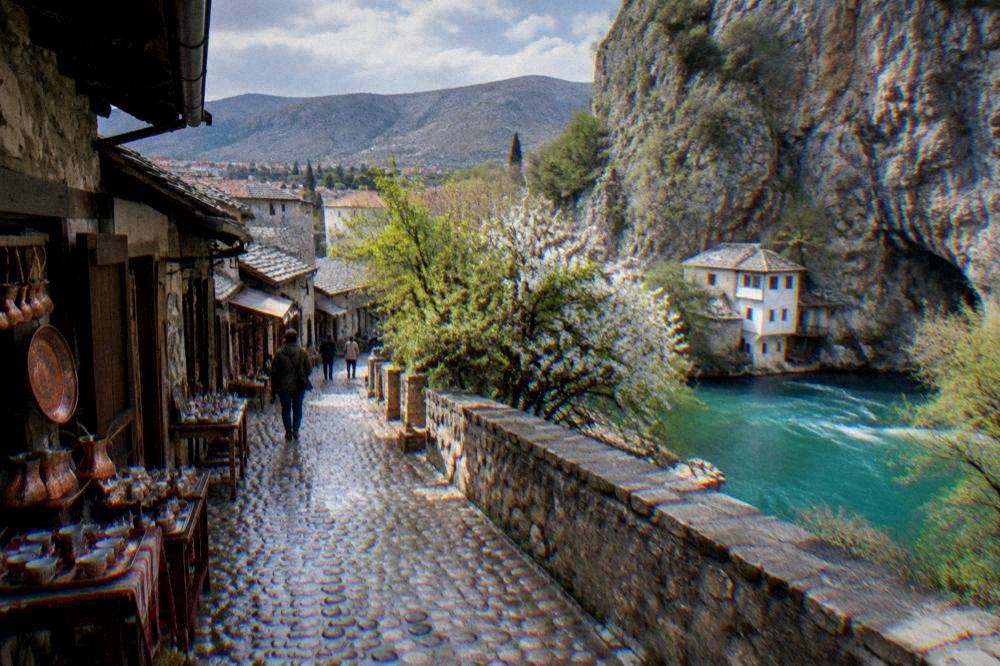
Kujundžiluk, the bazaar street on the east bank, is the old coppersmiths' lane, and some workshops still work metal by hand among the souvenir stalls. It runs downhill to the bridge and is a public street with no admission. The lane's own history and what to look for in the shops are gathered on the Kujundžiluk page. Halfway along, a side street leads up to Kriva ćuprija, the Crooked Bridge, a small single-arch stone crossing over a side channel that gives a quiet preview of its larger neighbour; it is a public structure with no ticket.
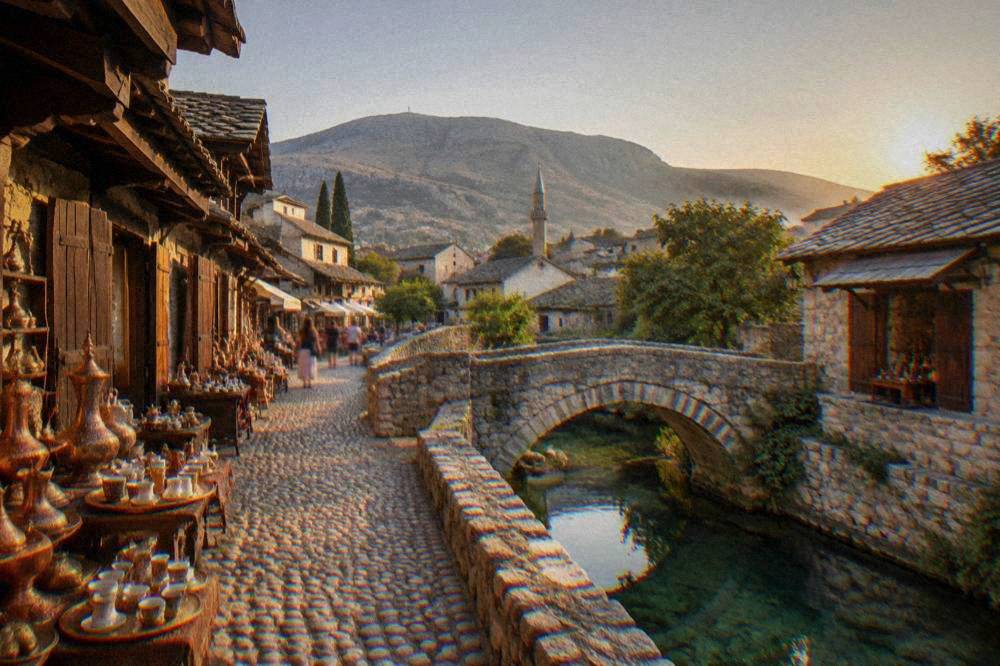
On the west bank, Koski Mehmed-pašina džamija sits so close to the Neretva that its foundations seem to stand in it. Entry is a small cash fee, higher if you climb the minaret, and modest dress applies; the details are on the mosque's own page. A few streets further, the courtyard houses show the domestic side of Ottoman Mostar: Bišćević House on the east bank and the Muslibegović House on the west, each open as a museum for a small fee, with reported entries of a few marks each, payable in cash. Confirm current fees at the door. The mosque is also an active place of worship, so access can pause for prayer times; checking the doorway notice on arrival avoids a wasted climb.
Two more stops complete the walk. The Tara tower at the bridge's east end houses the Old Bridge Museum, with entry reported at 10 KM and daily hours through the April-to-October season; see the museum page before going. And from the bridge itself, look down for the divers: members of the Mostari diving club jump from about 21 to 24 metres into cold water, a tradition with its own dedicated page on bridge diving. Visitors do not jump; the club's members train for years before diving solo.
How Much Time Do You Need In The Mostar Old Town?
Half a day covers the Old Town's core walk at an easy pace: the bridge, Kujundžiluk, the riverside mosque, the Crooked Bridge and one courtyard house, with time for coffee, fit into three to four hours. A full day adds the Old Bridge Museum, the viewpoints across the river and a proper lunch, while two days let you cross into the quieter streets beyond the bazaar. The district itself is small; the UNESCO property covers just 7.60 hectares. What stretches the visit is that everything invites a pause, from the workshop doorways to the riverside terraces.
Time of day matters more than total hours. Summer afternoons are hot, with modelled mean daily highs of 29.9 C in July and 30.5 C in August (ERA5 reanalysis, 1991-2020), and the valley floor can run hotter still. Early morning and late afternoon light also sit lower across the limestone, which is when the bridge photographs well. The viewpoints guide lists where to watch the quarter from above, including the west-bank terraces.
A simple timing guide:
| Visit Length | What Fits Comfortably |
|---|---|
| 2 hours | Bridge, Kujundžiluk, one riverside photo stop |
| Half day | Core walk plus the Crooked Bridge and a courtyard house |
| Full day | Core walk, Old Bridge Museum, viewpoints, unhurried meals |
| Two days | All of the above plus the west bank and Donja Mahala across the river |
Visitors staying longer can cross to Donja Mahala, the west-bank quarter where restaurants and bars spread along the water without the bazaar crowds, and follow the two-day itinerary that builds the Old Town into a wider stay. A private walking tour is another way to compress the quarter into a single guided loop: the Mostar walking tour page covers what a guided city walk includes, and a private group option focused on the bridge quarter can be checked via Check availability.
How Much Does The Mostar Old Town Cost To Visit?
Walking the Old Town costs nothing: the lanes, the bridge and both riverbanks are public streets and squares, open around the clock. The paid items inside the quarter are individual sights, each a few convertible marks: the Old Bridge Museum is reported at 10 KM, courtyard houses at roughly 4 to 8 KM reported, and the riverside mosque a small cash fee, more with the minaret climb. The currency is the convertible mark (KM, BAM), pegged at 1 EUR = 1.95583 KM; euro cash is often accepted in tourist areas at a rounded rate, but confirm before paying, and expect cash to be needed at the smaller sights.
Beyond the district's sights, the surrounding region's headline entry fee is Kravica waterfall, 20 KM for an adult all year per the park's own visitor page, about 55 km and 54 minutes by road from the bridge. Many visitors pair the Old Town morning with an afternoon in Herzegovina; the two countryside tours below show what that pairing looks like, and either can be checked for dates before you commit. The waterfall park keeps hours that shift by month, from 07:00 to 22:00 in the June-to-September stretch to 07:00 to 17:00 in the depths of winter, so a late start still works in summer. The wider set of guides lives on Mostar Travel Guide.
| Item | Cost | Notes |
|---|---|---|
| Stari Most crossing | Free | Public pedestrian route, open 24/7 |
| Kujundžiluk and lanes | Free | Public bazaar street |
| Old Bridge Museum (Tara tower) | 10 KM reported | Confirm on site |
| Koski Mehmed-pašina džamija | Small cash fee, more with minaret | Reported figures vary; modest dress |
| Bišćević House | About 4 KM reported | Cash, confirm at the door |
| Muslibegović House | About 8 KM reported | Cash, confirm at the door |
One more cost to know about: a tourist tax of 3 KM per person per night is reported in the canton from 1 January 2026, usually collected through accommodation. Confirm at booking, since day visitors staying elsewhere are not affected the same way as overnight guests.
When Is The Best Time To Walk The Mostar Old Town?
Late spring and early autumn give the Old Town its kindest walking weather: May averages 17.9 C and September 20.4 C as station means (FHMZ Mostar, 1961-1990), with rainfall of 102.1 mm in May against 200.0 mm in November, the rainier month of the two. July and August are hotter and busier but hold the bridge-diving season and the summer festivals. Winter is quiet and workable: January's station mean is 4.8 C, snow cover has reached 31 cm in the record, and the bridge stands free to cross in any weather.
The rain pattern matters when planning. Mostar's precipitation has a winter maximum, with November at 200.0 mm and December at 178.7 mm, against July's 42.9 mm (FHMZ 1961-1990). Summer days run long into the evening, which suits the late-afternoon walk; December daylight shrinks to about 9 hours. Whatever the month, the Neretva below the bridge stays cold, fed by karst springs, even in August.
| Month | Mean Temp C (FHMZ 1961-1990) | Rain mm | Character |
|---|---|---|---|
| March | 9.6 | 150.1 | Cool, quiet, changeable |
| May | 17.9 | 102.1 | Warm days, green valley |
| July | 24.7 | 42.9 | Hot, festivals, diving season |
| September | 20.4 | 96.3 | Warm, quieter lanes |
| November | 10.1 | 200.0 | Rainier, empty streets |
| December | 6.2 | 178.7 | Short days, occasional snow |
The event calendar is worth checking against your dates. The 460th traditional Old Bridge diving competition ran on 26 July in 2026, and the Red Bull Cliff Diving World Series stop ran 30 July to 1 August 2026, from platforms of 21 m for women and 27 m for men on the added structures. Mostarsko ljeto ran 25 June to 7 August 2026 and the Jazz Fest 23 to 25 August 2026. Treat these as the latest editions of annual events, and check the current year's programme when planning.
What Sits Just Beyond The Old Town Of Mostar?
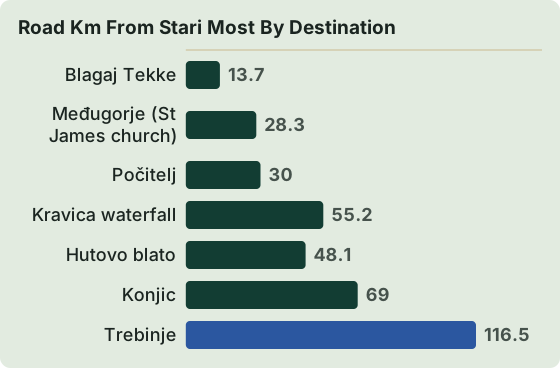
The Old Town is the anchor point for Herzegovina's day trips, and everything worth reaching sits within two hours by road: Blagaj Tekke at 13.7 km, Počitelj at 30 km, Međugorje at 28.3 km, Kravica waterfall at 55.2 km and Konjic at 69 km, all computed as free-flow road distances from Stari Most, with border queues excluded where Croatia is involved. Because the district is compact, the common pattern is an Old Town morning followed by a countryside afternoon or a second full day outward. The roads south run through karst hills and river valleys, so the drives themselves are part of the outing.
| Destination | Road Km From Stari Most | About Minutes |
|---|---|---|
| Blagaj Tekke | 13.7 | 19 |
| Međugorje (St James church) | 28.3 | 40 |
| Počitelj | 30.0 | 31 |
| Kravica waterfall | 55.2 | 54 |
| Hutovo blato | 48.1 | 62 |
| Konjic | 69.0 | 80 |
| Trebinje | 116.5 | 142 |
Each has its own page: Počitelj, Stolac, Trebinje and Konjic lay out the details. Getting between them without a car is covered in getting around Mostar, and the wider planning picture, including the full sight list beyond the Old Town, sits on the main things-to-do overview. Organised day tours run the same loop daily; the selection below shows two options that reach Blagaj, Počitelj and Kravica from Mostar.
How To Visit The Mostar Old Town With A Guide?
A guided walk suits the Old Town because nearly everything worth knowing is context rather than signage: the bridge dates, the bazaar trades, the divers' club and the rebuilding are all stories a guide carries, and a private group tour covering the bridge quarter can be booked from the button below with free cancellation if plans shift. Guided walks of the quarter run daily through the season. The paired option that fits a first visit is the private group city tour of Mostar and the Old Bridge, which concentrates on exactly this district; check live dates and pricing on the operator's listing.
For travellers who prefer to build outward from the city, the full-day Herzegovina circuit with Blagaj, Počitelj and the Kravica waterfall pairs naturally with an Old Town stay, as does the private-car version with a live guide. Either way, the pattern holds: the Old Town on foot, the countryside by road.
The private-car variant below covers the same region with a live guide and a smaller group; dates and pricing are on the live listing.
Common Questions About The Mostar Old Town
Is the Mostar Old Town free to enter?
Yes. The lanes, squares and both riverbanks are public streets, and crossing Stari Most is free at any hour. Only the individual sights inside the quarter, such as the Old Bridge Museum and the courtyard houses, charge entry.
How old is the Mostar Old Town?
The settlement grew from the 15th century around an earlier wooden bridge, with the city's name first written down in 1474. The stone bridge at its centre was completed in 1566, and the whole Old Bridge Area of the Old City of Mostar was inscribed by UNESCO in 2005.
What is the bazaar street in the Mostar Old Town called?
Kujundžiluk, the old coppersmiths' bazaar on the east bank of the Neretva. It is a public street running downhill to Stari Most, and some metalworking workshops still operate among the shops.
Can you see the Mostar Old Town in half a day?
Yes. The core walk, covering the bridge, Kujundžiluk, the riverside mosque and the Crooked Bridge, fits comfortably into three to four hours. A full day adds the museums, courtyard houses and viewpoints.
Is the Old Town of Mostar the same as the UNESCO site?
The inscribed property is the Old Bridge Area of the Old City of Mostar, covering 7.60 hectares with a 48-hectare buffer zone, inscribed in 2005 under criterion (vi). The walkable Old Town corresponds closely to this core.
Do I need cash in the Mostar Old Town?
Yes, carry some. The currency is the convertible mark (KM), pegged at 1 EUR = 1.95583 KM. Cards work in hotels and larger restaurants, but the smaller sights and market stalls prefer or require cash, and euro notes are often accepted at a rounded rate worth confirming first.
The Old Town rewards exactly the pace it was built for: a slow walk, a coffee above the Neretva, and the bridge crossed more than once. Plan the district for a morning or a full day, book the guided and countryside options that match your dates, and the quarter takes care of the rest.