Why Was The Mostar Bridge Destroyed?
The Old Bridge of Mostar, Stari Most, was destroyed on 9 November 1993 during the war and rebuilt in 2004. A factual account of what happened, when and what stands today.
Mostar's Old Bridge, Stari Most, stood over the Neretva river for more than four centuries before it was destroyed on 9 November 1993 during the war. The rebuilt bridge reopened in July 2004, and the Old Bridge Area of the Old City of Mostar entered the UNESCO World Heritage List in 2005 as property 946, inscribed under criterion (vi). What follows is the plain, dated record of what was lost, what replaced it and what a visitor walking across it today is actually standing on.
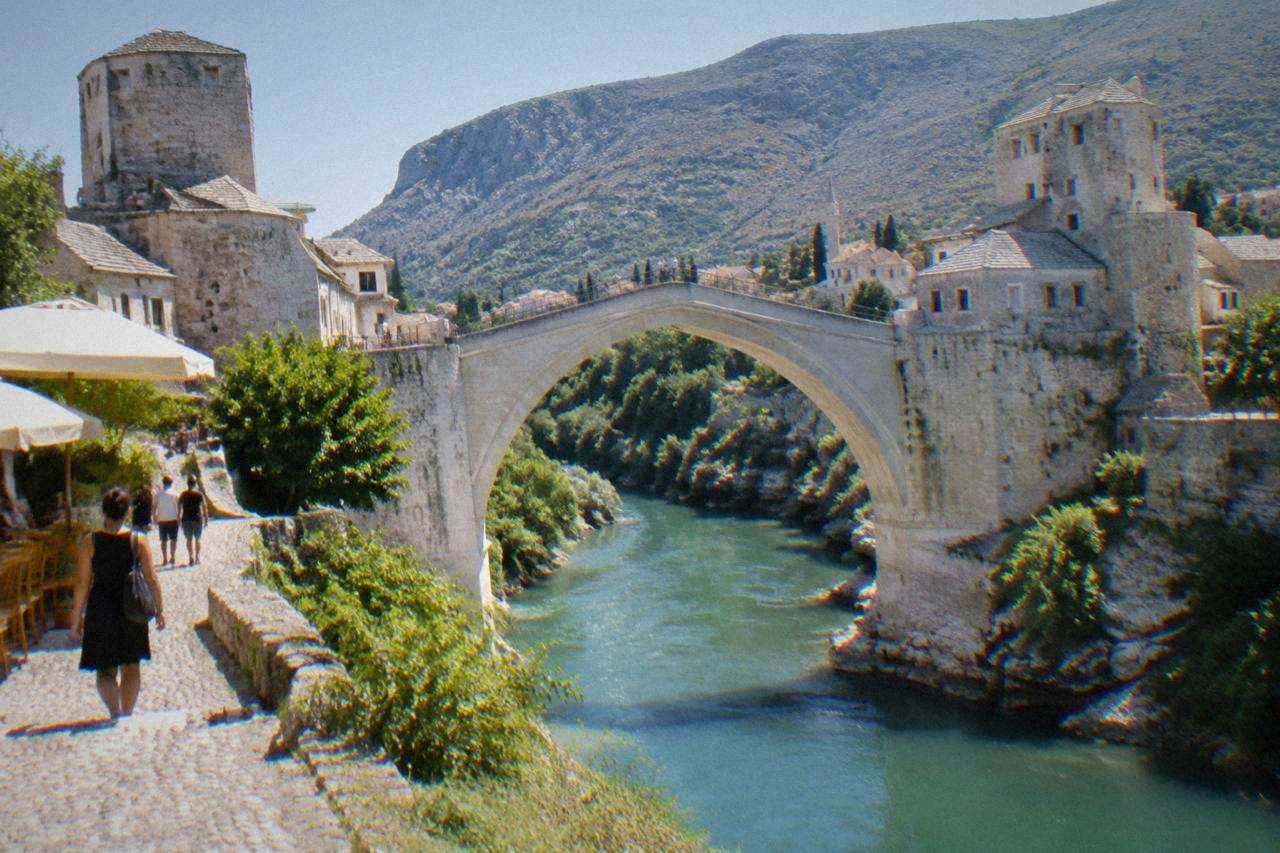
The Old Bridge of Mostar was destroyed on 9 November 1993 during the war, when the stone arch that had carried traffic over the Neretva since 1566 collapsed into the river after artillery fire. The bridge was a military target in the fighting for the city, and its loss severed the link between the two banks at the heart of the Old Town. The war in Bosnia and Herzegovina ran from 1992 to 1995, and Mostar sat on one of its most contested fault lines. The bridge, built of local tenelija limestone, took the full weight of the shelling that swept the Old Town that autumn.
Beyond the date and the physical facts, this page deliberately stays narrow. What is documented is the bridge itself: commissioned under Ottoman Sultan Suleiman the Magnificent, designed and built by the architect mimar Hajruddin following the design tradition of his master, the architect mimar Sinan, and completed in 1566. Its single stone arch spanned about 29 metres and stood about 21 to 24 metres above the Neretva, the exact height varying with the river level.
The name of the city is tied to the bridge. "Mostar" comes from "mostari", the bridge keepers who guarded the earlier wooden crossing at the same spot. The name Mostar itself appears first in a written document of 1474. When the stone arch fell in 1993, the city lost the structure it had been named after, which is part of why the rebuilding that followed mattered so much to the city's identity.
The wider war context, the politics of the siege and the question of responsibility are subjects this page does not adjudicate. The UNESCO record frames the bridge's significance instead: it was inscribed as a symbol of multicultural coexistence, reconciliation and international cooperation, and that framing, adopted in 2005, is the register official sources use. For the fuller span of the city's past, the Mostar history guide carries the timeline.
When Exactly Did Stari Most Fall, And When Did It Reopen?
Stari Most was destroyed on 9 November 1993 and the rebuilt bridge reopened in July 2004, with the reopening date recorded as 23 July. Reconstruction used original techniques and salvaged stone recovered from the Neretva bed, supported by an international effort coordinated through UNESCO and World Bank partners. The Old Bridge Area of the Old City of Mostar was then inscribed on the UNESCO World Heritage List in 2005 under criterion (vi).
The eleven-year gap between destruction and reopening is itself the story of the reconstruction. Divers raised components of the original arch from the river. Replacement stone was quarried to match, and the arch was rebuilt using traditional methods rather than modern shortcuts. The World Heritage inscription followed a year after the reopening, covering the bridge together with the surrounding Old Town structures, with an inscribed property of 7.60 hectares and a buffer zone of 48 hectares.
The dates line up cleanly in one place:
| Date | Event |
|---|---|
| 1474 | First written mention of the name Mostar |
| 1566 | Stone bridge completed under mimar Hajruddin |
| 9 November 1993 | Stari Most destroyed during the war |
| 23 July 2004 | Rebuilt bridge reopened |
| 2005 | UNESCO World Heritage inscription, property 946, criterion (vi) |
| 26 July 2026 | 460th traditional Old Bridge diving competition held |
A reader who wants the rebuilding story in full detail, including how the salvage and stonework were organised, will find it in Has The Mostar Bridge Been Rebuilt?.
What Did The War Do To The Rest Of Mostar's Old Town?
The fighting that destroyed Stari Most in 1993 also damaged the Old Town around it, including buildings along Kujundžiluk, the old bazaar street that climbs from the bridge, and several of the Ottoman-era houses and mosques that make up the UNESCO-inscribed area. The Old Bridge Area was inscribed in 2005 precisely because the reconstruction of the bridge and its surroundings together demonstrated recovery after destruction. The inscription covers the bridge, the bazaar, the towers and the historic fabric as one property, not the arch alone.
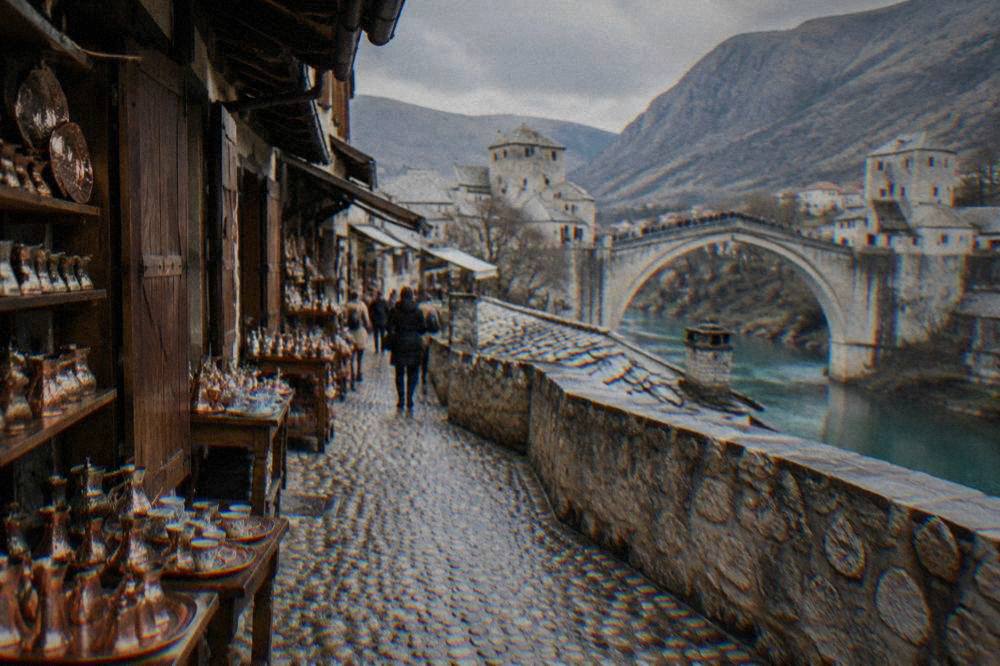
Walking the streets today, the scale of the repair is not obvious at first glance, and that is the point. The Kujundžiluk bazaar runs with shops and coppersmiths again. The Crooked Bridge, Kriva ćuprija, a smaller single-arch stone crossing over a side channel of the Neretva, stands a short walk upstream. The Koski Mehmed-pašina džamija, the mosque that sits closest to the bridge on the west bank, still overlooks the arch, with restoration work on its cultural heritage discussed as recently as 2026 in local reports.
One site outside the Old Town carries its own, quieter history: the Partisan Memorial Cemetery on the west side, designed by architect Bogdan Bogdanović and inaugurated in 1965, lost over 700 of its stone memorial markers to deliberate destruction in 2022. Europa Nostra listed it among Europe's most endangered heritage sites and presented a report in May 2026 calling for its protection and revitalisation. It stands unstaffed, with no ticket or posted hours, a reminder that heritage loss in Mostar is not only a story of 1993.
For visitors who want the war period explained on the ground rather than read off a page, a guided walk frames it well. The private group city tour of Mostar and the Old Bridge covers the bridge and the Old Town with a guide, and there are also dedicated siege-history walking tours in the city.
Choosing between a private walk and a small-group tour comes down to pace and depth. A private tour lets the guide linger at the bridge, the Tara tower and the bazaar, and adjust the route to whatever questions come up along the way, while a shared group tour keeps the price lower and follows a fixed loop. Whichever way you lean, the cancellation terms and payment options are worth a quick look before you commit.
Is The Bridge You Walk Across Today The Original?
The bridge standing over the Neretva today is a reconstruction completed in 2004, not the 1566 original, but it is a faithful one: salvaged stone from the riverbed was reused, replacement blocks were cut from the same local tenelija limestone, and traditional building techniques were followed under an international scientific committee. UNESCO inscribed the reconstructed Old Bridge Area in 2005, treating the rebuilt structure as authentic in its form, materials and setting.
That distinction matters more than it might seem. Many rebuilt landmarks are modern structures in historic costume. Here, the effort went the other way: the arch's geometry was reconstructed from documentation, recovered stone was reinstated in its original positions where possible, and a diving platform tradition resumed from the parapet soon after. The Stari Most attraction page covers what a visit involves today, including the viewing points on both banks.
The bridge in its current life is a pedestrian crossing, free and open at any hour. The Museum of the Old Bridge, reached through the Tara tower at the bridge's west end, displays material from the bridge's history and reconstruction, with reported hours of 08:00 to 16:00 daily from 1 April to 1 November; confirm admission on the spot, as figures for it circulate only in aggregator listings.
The diving tradition deserves its own mention, because it is part of what the rebuilt bridge restored. Members of the Mostari diving club jump from the parapet, roughly 21 to 24 metres up depending on the river, and they train for years before a solo jump from the arch. Visitors do not jump; no pay-to-jump option for untrained visitors is offered. The 460th traditional competition ran on 26 July 2026, and the Red Bull Cliff Diving World Series stopped in Mostar for the tenth time, from 30 July to 1 August 2026, using added platforms at 21 metres for women and 27 metres for men. The bridge diving guide explains how to watch.
How Should You Visit The Old Bridge Area Today?
Cross the bridge on foot at least twice, once in the morning and once late in the day, because the light on the tenelija limestone and the view up the Neretva change completely between the two. The crossing is free and always open, the Old Town on both banks is compact and walkable, and the classic viewpoints are the terrace of Koski Mehmed-pašina džamija on the west side and the banks below Kujundžiluk on the east. Allow a morning for the bridge, the bazaar street and one museum, and a separate block of time for viewpoints on the surrounding hills.
Practical notes are simple. The currency is the convertible mark, KM, pegged at 1 EUR = 1.95583 KM, and euro cash is often accepted in the tourist streets at a rounded rate, so confirm before paying. Bosnia and Herzegovina is not in the EU or Schengen, a point that matters if you are combining Mostar with Dubrovnik or Split, since the Croatian land border carries full checks. A reported tourist tax of 3 KM per person per night applies in the canton; confirm it at booking.
A short planning table for the immediate area:
| Sight | Access |
|---|---|
| Stari Most | Free, open around the clock, pedestrians only |
| Kujundžiluk bazaar street | Public street, free |
| Kriva ćuprija (Crooked Bridge) | Public structure, free |
| Museum of the Old Bridge (Tara tower) | Reported 08:00-16:00 daily, 1 April to 1 November; confirm admission on site |
| Koski Mehmed-pašina džamija | Small reported cash fee, more with the minaret; worship can pause access |
If the bridge and bazaar fill a first day, the Herzegovina countryside fills the second. Blagaj and its tekke at the Buna spring sit about 14 km away by road, Počitelj about 30 km, and Kravica waterfall 55.2 km, roughly 54 minutes of free-flow driving. Organised day tours bundle all three, which suits travellers without a car.
Common Questions About The Mostar Bridge Destruction
Why Was The Mostar Bridge Destroyed?
It was destroyed on 9 November 1993 during the war, when artillery fire brought the 1566 stone arch down into the Neretva. The bridge stood at the centre of the contested city and its loss cut the Old Town in two.
Was the bridge rebuilt exactly as it was?
The reconstruction, finished by July 2004, reused salvaged original stone recovered from the riverbed and newly cut tenelija limestone, rebuilt with traditional techniques. UNESCO inscribed the Old Bridge Area in 2005 under criterion (vi).
How old was the bridge when it was destroyed?
Completed in 1566 and destroyed in 1993, it had stood for more than four centuries. The rebuilt bridge has carried pedestrians since its reopening on 23 July 2004.
Can you still see parts of the original bridge?
Original stone was reinstated in the reconstruction where possible, and material relating to the bridge and its rebuilding is displayed in the Museum of the Old Bridge in the Tara tower at the west end.
Do people still dive from the bridge?
Yes, members of the Mostari diving club jump from the parapet, about 21 to 24 metres above the river depending on its level. Visitors cannot pay to jump; club members train for years first.
The bridge that fell in 1993 and the bridge that stands today are, in the end, the same idea rebuilt in stone: a single arch joining two banks. The Mostar Travel Guide covers the rest of the city around it, from the bazaar to the Herzegovina countryside.