Best Time To Visit Mostar, Season By Season
Mostar has hot, dry summers and mild, rainier winters. This guide breaks the year down season by season so you can pick the month that fits what you want from the city.
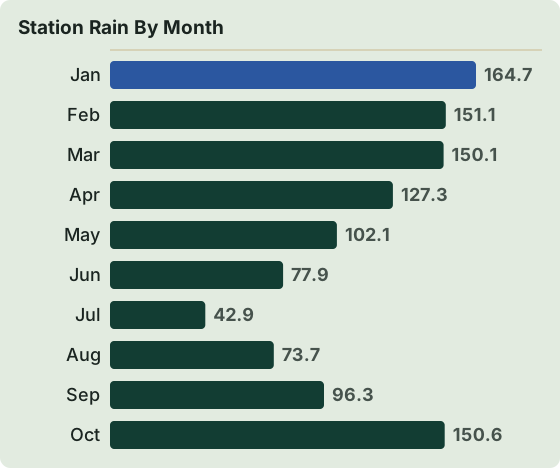
Late May, June, early July and September give you warm days, low rain and full opening hours at Kravica waterfall without the August heat. The FHMZ station record shows July averages 24.7 C with only 42.9 mm of rain, while November averages 200.0 mm, so the window between late spring and early autumn suits almost every activity.
Mostar, the main city of Herzegovina on the Neretva river, has one of the warmest climates of any inland city in the region, and the timing of a visit changes the trip more here than in many European cities. The Federal Hydrometeorological Institute's Mostar station record for 1961 to 1990 puts the July mean at 24.7 C and the January mean at 4.8 C, with rain concentrated in the cold half of the year, 200.0 mm in November against 42.9 mm in July. The Old Bridge Area of the Old City, a UNESCO World Heritage property since 2005, is walkable in every month, but swimming at Kravica waterfall, the diving competitions off Stari Most and the border queues on the way to Dubrovnik all follow the calendar. This page works through the year season by season, with the station numbers and modelled monthly highs so you can match the month to what you actually want to do.
When Is The Best Time To Visit Mostar Overall?
The best time to visit Mostar is late May through June or September, when days are warm, rain is light and every sight keeps its summer hours. The FHMZ 1961 to 1990 station record shows June averages 21.5 C with 77.9 mm of rain and September 20.4 C with 96.3 mm, against 42.9 mm in July but a mean of 24.7 C. Modelled daily highs, ERA5 reanalysis 1991 to 2020, run 26.8 C in June and 24.5 C in September.
June also carries the practical advantage of full summer hours at Kravica waterfall, 07:00 to 22:00 from June through September, with entry at 20 KM for an adult all year. September keeps those hours while shedding some of the heat. The trade-off is the events calendar: the traditional Old Bridge diving competition, its 460th edition held 26 July 2026, and the Red Bull Cliff Diving round, 30 July to 1 August 2026, both sit in high summer, so travelers who want to watch the dives from Stari Most accept the July and August temperatures.
For a deeper breakdown of temperatures across the year, the Mostar weather guide carries the full tables, and the one day in Mostar itinerary works in any of these months.
Spring deserves a mention in the same breath. May averages 17.9 C at the station with 102.1 mm of rain spread over about nine rain days, and the waterfall moved to 07:00 to 20:00 hours in May. Early spring is greener and emptier, but March still averages 9.6 C with rain on ten days of the month, so it suits travelers who prioritize quiet streets over swimming.
What Is The Weather Like In Mostar Month By Month?
The FHMZ Mostar station record, 1961 to 1990, gives a monthly mean temperature of 4.8 C in January rising to 24.7 C in July, with an absolute maximum of 41.2 C recorded in July and an absolute minimum of -10.9 C in January. Precipitation totals 1,515.4 mm a year, with November averaging 200.0 mm and July 42.9 mm.
The station table, in full:
| FHMZ 1961-1990 | Jan | Feb | Mar | Apr | May | Jun | Jul | Aug | Sep | Oct | Nov | Dec | Year |
|---|---|---|---|---|---|---|---|---|---|---|---|---|---|
| Mean temp C | 4.8 | 6.6 | 9.6 | 13.3 | 17.9 | 21.5 | 24.7 | 24.2 | 20.4 | 15.3 | 10.1 | 6.2 | 14.6 |
| Absolute max C | 18.2 | 25.0 | 27.6 | 30.8 | 34.8 | 38.4 | 41.2 | 40.8 | 38.8 | 32.5 | 23.8 | 19.3 | 41.2 |
| Absolute min C | -10.9 | -8.6 | -6.5 | 0.4 | 4.0 | 8.2 | 8.4 | 10.2 | 6.4 | -0.1 | -4.8 | -7.2 | -10.9 |
| Precipitation mm | 164.7 | 151.1 | 150.1 | 127.3 | 102.1 | 77.9 | 42.9 | 73.7 | 96.3 | 150.6 | 200.0 | 178.7 | 1515.4 |
| Days over 1 mm | 11 | 10 | 10 | 11 | 9 | 8 | 5 | 6 | 6 | 8 | 11 | 11 | 106 |
The modelled highs and lows, which the ERA5 reanalysis computes for 1991 to 2020 and which are not a station record, fill in the daily range:
| ERA5 1991-2020 | Jan | Feb | Mar | Apr | May | Jun | Jul | Aug | Sep | Oct | Nov | Dec |
|---|---|---|---|---|---|---|---|---|---|---|---|---|
| Mean daily high C | 8.4 | 9.7 | 13.4 | 17.7 | 22.3 | 26.8 | 29.9 | 30.5 | 24.5 | 19.5 | 14.1 | 9.3 |
| Mean daily low C | 0.2 | 0.3 | 3.3 | 7.0 | 11.4 | 15.3 | 17.7 | 18.1 | 14.0 | 9.8 | 5.7 | 1.4 |
| Rain mm | 142.8 | 143.5 | 142.9 | 150.9 | 116.1 | 72.4 | 45.4 | 52.6 | 142.0 | 186.8 | 235.8 | 200.0 |
Two readings of these numbers matter for planning. First, the two sources disagree by design: the station records a mean, the reanalysis a daily high, and the valley floor around the Old Town runs hotter than the model grid suggests. Second, the rain pattern is strongly seasonal, with 42.9 mm in July against 200.0 mm in November at the station, roughly a factor of 4.7. Snow cover in the station record is thin, with a maximum snow depth of 37 cm in the whole series, and none recorded from May through October.
Is Summer In Mostar Too Hot For Sightseeing?
Summer in Mostar is genuinely hot but sightseeing still works with early starts and shade, because July averages 24.7 C at the station while the modelled daily high, ERA5 reanalysis 1991 to 2020, reaches 29.9 C in July and 30.5 C in August, and the absolute maximum on record is 41.2 C. Rain barely interrupts anything: July averages 42.9 mm over five rain days. The Neretva stays cold even in August, so the river does not offer cooling swims.
The practical pattern in July and August is to walk the Old Town, Kujundžiluk and Stari Most before midday, rest through the peak afternoon, and come back out for the evening, when the bridge and the bazaar are at their liveliest. August has the highest modelled daily high of the year at 30.5 C, a touch above July, and both months keep rain to five or six days. If heat is the deciding factor, the page on Mostar in summer and the answer to whether Mostar is too hot in August cover it in depth.
Summer is also the season of the bridge dives. The traditional Old Bridge diving competition, organised by the Mostari diving club, held its 460th edition on Sunday 26 July 2026, and the Red Bull Cliff Diving World Series followed from 30 July to 1 August 2026, the tenth Mostar stop, with women diving from 21 m platforms and men from 27 m. Club members jump from the bridge itself, about 21 to 24 metres above the river depending on the water level, and there is no pay-to-jump option for visitors. The Mostar bridge diving guide explains the tradition.
Kravica waterfall is the classic summer escape, 55.2 km and about 54 minutes by road from Stari Most, free-flow. Its park hours run 07:00 to 22:00 from June through September, entry is 20 KM for an adult all year, and swimming is allowed in the designated pool below the falls in summer, with no lifeguard reported, so check the park's rules on arrival.
What Is Mostar Like In Spring?
Spring in Mostar warms quickly from a March mean of 9.6 C to a May mean of 17.9 C, with modelled daily highs rising from 13.4 C to 22.3 C, ERA5 reanalysis 1991 to 2020, and rain easing from 150.1 mm in March to 102.1 mm in May at the station. Kravica waterfall extends its hours to 07:00 to 20:00 in May. April and May each average 11 and 9 rain days, so a light rain layer still earns its place.
April is the quiet pivot of the year: the station mean of 13.3 C feels warm in the sun, the Old Bridge Museum reports daily hours of 08:00 to 16:00 from 1 April to 1 November, and the crowds of July are still months away. The Blagaj Tekke, the dervish lodge at the Buna spring 13.7 km and about 19 minutes by road from Stari Most, reports hours of 08:00 to 22:00 from April through October, with shoulders and knees covered and wraps provided.
Spring also suits the walking tours, because the siege history walk covers its ground comfortably before the June heat arrives. The walk through Mostar war history pairs naturally with it.
Spring events are thinner than summer's. The calendar fills from late June, when Mostarsko ljeto ran 25 June to 7 August in 2026, so a May visit trades festivals for empty streets and mild temperatures, a fair exchange for travelers who come for the Ottoman Old Town rather than the spectacles.
What Is Mostar Like In Autumn?
Autumn is the sweet spot after summer: September still averages 20.4 C at the station with 96.3 mm of rain and a modelled daily high of 24.5 C, ERA5 reanalysis 1991 to 2020, while Kravica keeps its 07:00 to 22:00 hours through September before dropping to 07:00 to 19:00 in October. Rain climbs steeply after that, from 150.6 mm in October to 200.0 mm in November over 11 rain days.
September carries almost all of summer's advantages, swimming at the waterfall included, with modelled highs four to six degrees below August. October turns the valley autumnal, 15.3 C at the station, and the rain days double from six in September to eight. Early October is still a strong month for the countryside loop, Blagaj at 13.7 km, Počitelj at 30.0 km and Kravica at 55.2 km by road from Stari Most, and the Herzegovina road trip guide covers the full circuit.
November is the month the rain record argues against. The station shows 200.0 mm, 11 rain days and a mean of 10.1 C, and the ERA5 reanalysis puts November rainfall at 235.8 mm for 1991 to 2020. That said, an indoor-heavy plan works: the burek masterclass runs whatever the weather, the Old Bridge Museum keeps hours to 1 November, and the Museum of the Holy Trinity Orthodox Cathedral, opened in May 2025, is a roofed stop. Other pages covering the same trip are gathered on Mostar Travel Guide.
Is Winter A Good Time To Visit Mostar?
Winter in Mostar is mild by continental standards, with a January mean of 4.8 C, an absolute minimum of -10.9 C in the whole station record and modelled daily highs of 8.4 C in January and 9.7 C in February, ERA5 reanalysis 1991 to 2020, but it is also the rainiest season, 164.7 mm in January and 178.7 mm in December. Snow is occasional, with a record snow depth of 37 cm. Kravica keeps reduced winter hours, 07:00 to 17:00.
The winter case is quiet and cheap, and the question does it ever snow in Mostar gets a full answer elsewhere. What winter does not offer is the full Herzegovina circuit: the waterfall hours shorten, the river stays cold, and the daylight runs to about 9 hours in December, computed from the ERA5 file. The Old Bridge Area itself is free and open around the clock in every month, and the museum hours move to organised visits outside the 1 April to 1 November window, so confirm locally.
December has one honest advantage, atmosphere over the holidays, and January and February have the lowest modelled highs of the year at 8.4 C and 9.7 C with rain on 11 and 10 days. Travelers who accept the weather get an Old Town that photographs well in low sun and moody cloud.
A short table of what each season delivers:
| Season | Station mean | Modelled high | Rain at station | Best for |
|---|---|---|---|---|
| Spring | 9.6 to 17.9 C (Mar to May) | 13.4 to 22.3 C | 150.1 to 102.1 mm | Green valleys, quiet streets, Tekke hours from April |
| Summer | 21.5 to 24.2 C (Jun to Aug) | 26.8 to 30.5 C | 77.9 to 73.7 mm | Bridge dives, swimming at Kravica, festivals |
| Autumn | 20.4 to 10.1 C (Sep to Nov) | 24.5 to 14.1 C | 96.3 to 200.0 mm | Warm water in September, autumn colours in October |
| Winter | 6.2 to 4.8 C (Dec to Feb) | 8.4 to 9.7 C | 164.7 to 178.7 mm | Low crowds, low light, indoor museums |
Which Month Gets The Most Rain In Mostar?
November gets the most rain in Mostar, 200.0 mm at the FHMZ 1961 to 1990 station across 11 rain days, and July gets the least, 42.9 mm across five rain days, a difference of about 4.7 times. The ERA5 reanalysis for 1991 to 2020 agrees on the pattern, with 235.8 mm in November against 45.4 mm in July, and October second at 186.8 mm. Rain in Mostar is a winter phenomenon, not a summer one.
This inverts the pattern travelers know from Atlantic Europe. A July or August visit carries a low chance of a washed-out day, while a November visit should assume some rain. The rainiest stretch, November through January, brings the three heaviest station months of the year in a row, and together they account for a large share of the annual 1,515.4 mm.
| Month | Station rain mm | Rain days | Modelled rain mm, ERA5 1991-2020 |
|---|---|---|---|
| Jan | 164.7 | 11 | 142.8 |
| Feb | 151.1 | 10 | 143.5 |
| Mar | 150.1 | 10 | 142.9 |
| Apr | 127.3 | 11 | 150.9 |
| May | 102.1 | 9 | 116.1 |
| Jun | 77.9 | 8 | 72.4 |
| Jul | 42.9 | 5 | 45.4 |
| Aug | 73.7 | 6 | 52.6 |
| Sep | 96.3 | 6 | 142.0 |
| Oct | 150.6 | 8 | 186.8 |
| Nov | 200.0 | 11 | 235.8 |
| Dec | 178.7 | 11 | 200.0 |
Wet days still have uses: the Mostar in the rain guide lists covered options, from the Old Bridge Museum to the Ottoman houses, Bišćević House and Muslibegović House among them, with a small cash fee reported at each.
What Events Happen In Mostar Through The Year?
Mostar's event year concentrates in summer: the traditional Old Bridge diving competition ran 26 July in 2026 in its 460th edition, the Red Bull Cliff Diving round ran 30 July to 1 August 2026, Mostarsko ljeto ran 25 June to 7 August 2026 and the Mostar Jazz Fest ran 23 to 25 August 2026. Winter has no comparable festival block, so event-driven trips should target late June through August.
The 2026 calendar, as a picture of the annual rhythm:
| Event | 2026 dates | Notes |
|---|---|---|
| Mostarsko ljeto | 25 June to 7 August | Concerts and exhibitions across institutions |
| Mostar Summer Fest | 2 to 4 July | Outdoor music program |
| Mostar Blues And Rock Festival | 24 and 25 July | 24th edition, free entry reported |
| Old Bridge diving competition | 26 July | 460th edition, diving club Mostari |
| Red Bull Cliff Diving World Series | 30 July to 1 August | Women 21 m, men 27 m platforms |
| Mladifest, Međugorje | 1 to 6 August | Youth festival, 37th edition |
| Mostar Jazz Fest | 23 to 25 August | Three evenings of concerts |
No 2027 dates are set out anywhere official, so check the festival pages before locking flights for a specific event. Mladifest sits 28.3 km away in Međugorje, about 40 minutes by road, and pairs with the town's pilgrimage sites, which are free and open around the clock.
How Does The Season Change Day Trips Around Mostar?
The season changes Herzegovina day trips mainly through Kravica waterfall's hours and swimming, 07:00 to 22:00 from June to September with summer swimming in the designated pool, against 07:00 to 17:00 in January, February, November and December, while Blagaj, Počitelj and Stolac stay reachable year-round on roads of 13.7 to 36.8 km from Stari Most. Entry to Kravica is 20 KM for an adult in every month.
The driving framework, computed free-flow times with no border queues:
| Day trip from Stari Most | Road km | About minutes |
|---|---|---|
| Blagaj Tekke | 13.7 | 19 |
| Počitelj | 30.0 | 31 |
| Radimlja necropolis | 33.5 | 42 |
| Stolac | 36.8 | 47 |
| Hutovo blato | 48.1 | 62 |
| Kravica waterfall | 55.2 | 54 |
| Konjic | 69.0 | 80 |
| Trebinje | 116.5 | 142 |
Cross-border trips add a second calendar. The Croatian border is a Schengen external border with full checks since 1 January 2023, and waits are reported at up to about 30 minutes, longer at summer peaks, so a Dubrovnik day, 145.5 km and about 150 minutes free-flow from Stari Most, carries a real time cost in July and August. The Croatia Bosnia border crossing guide and the border and route pages from Dubrovnik cover the crossings at Doljani-Metković and Bijača-Nova Sela.
Summer also changes what you pack for the trips: the sun is strong, water at Kravica is a swimming lake rather than a cold river, and the Neretva itself stays cold even in August. In spring and autumn the same roads serve hikers, and the hiking near Mostar routes and the via ferrata on Hum run outside the peak heat.
Common Questions About The Best Time To Visit Mostar
What is the best time to visit Mostar?
Late May through June and September. The FHMZ station record shows warm means, 21.5 C in June and 20.4 C in September, with light rain, and Kravica waterfall keeps its 07:00 to 22:00 hours in both months.
Is July too hot in Mostar?
July averages 24.7 C at the station, with a modelled daily high of 29.9 C, ERA5 reanalysis 1991 to 2020, and an absolute maximum of 41.2 C on record. Sightseeing works with early starts and afternoon shade.
What is the rainiest month in Mostar?
November, with 200.0 mm of rain over 11 days at the FHMZ 1961 to 1990 station, against 42.9 mm over five days in July.
Does it snow in Mostar?
Occasionally. The station record shows a maximum snow depth of 37 cm in the whole series, with 31 cm possible in January and none recorded from May through October.
When can you swim at Kravica waterfall?
Swimming is allowed in the designated pool below the falls in summer, in the June to September hours of 07:00 to 22:00, with no lifeguard reported. Entry is 20 KM for an adult all year. Check the park's rules on arrival.
When is the Old Bridge diving competition?
It runs in late July. The 460th edition was held on Sunday 26 July 2026, organised by the diving club Mostari, followed by the Red Bull Cliff Diving round from 30 July to 1 August 2026.
Whenever you choose, book the room and the tours with the calendar in hand: a June visit and a November visit are two different trips, and Mostar rewards matching the plan to the month.
