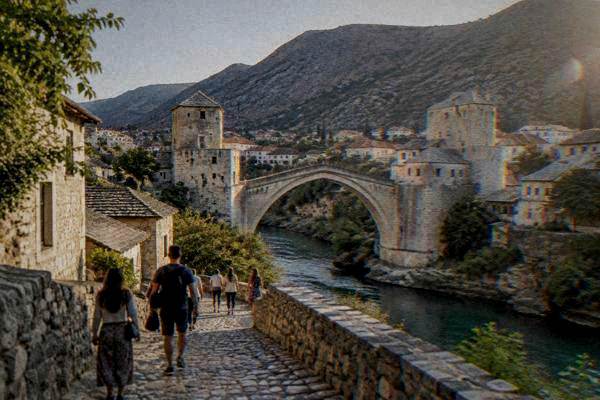
Is Mostar An Islamic City?
Mostar is a mixed city in Herzegovina with a strong Ottoman and Islamic heritage alongside Catholic, Orthodox and secular life. Here is what that means for a visitor.
Mostar sits inland on the Neretva river in Herzegovina, the southern region of Bosnia and Herzegovina, and its skyline of minarets around Stari Most is the first thing that frames the question. The city has no official religion, no religious law and no religious government. What it has is an Ottoman-built core, a Bosniak Muslim community that is one of the city's constituent peoples, Catholic and Orthodox communities with their own churches and cathedrals, and a public life, from café terraces to bar streets, that is thoroughly secular. Calling it "an Islamic city" would miss the second half of that sentence, but understanding its Islamic heritage is the key to reading its architecture.
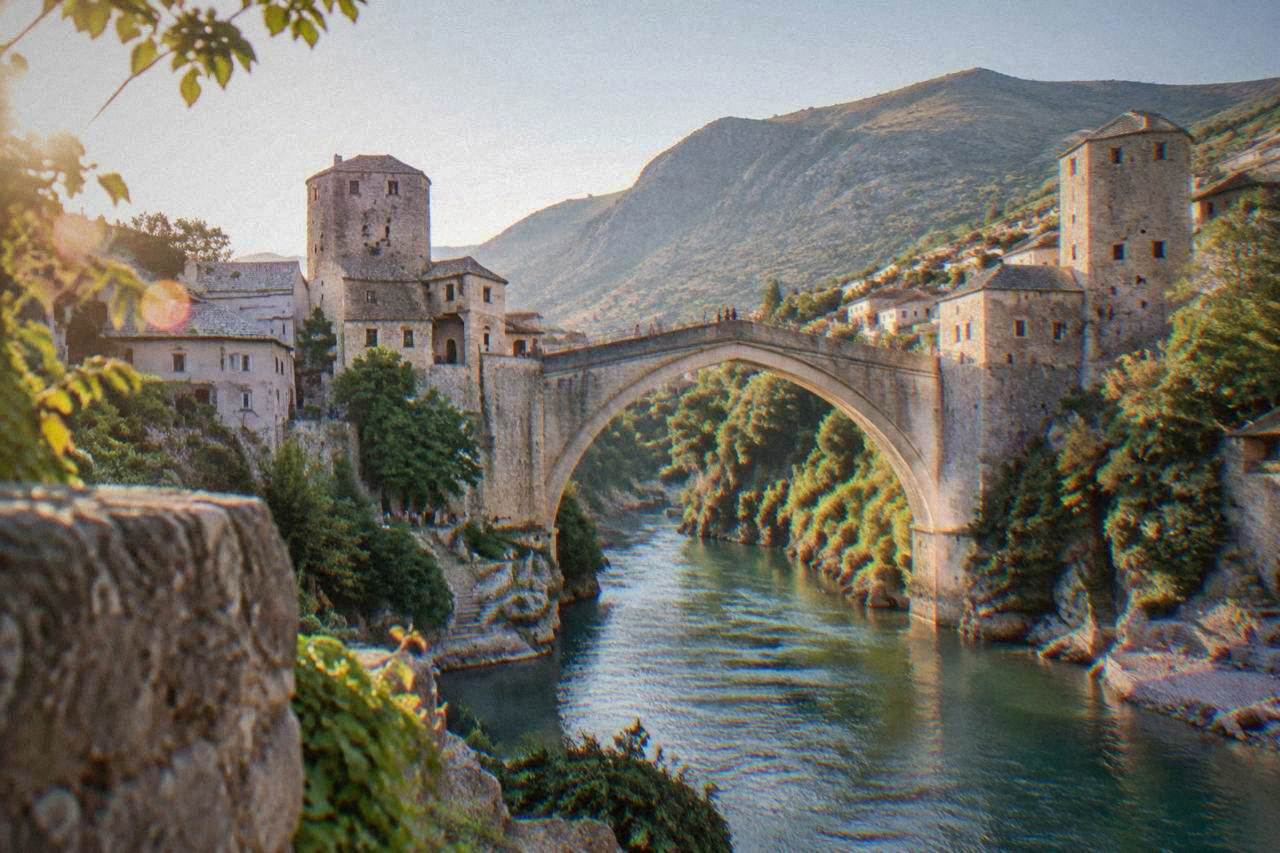
No, Mostar is not an Islamic city in a legal, political or official sense: Bosnia and Herzegovina is a secular country, and Mostar is a mixed city whose Old Town was built under Ottoman rule. Its Bosniak Muslim community shares the city with Catholic Croat and Orthodox Serb communities, its mosques stand alongside a Catholic cathedral and an Orthodox church, and the name Mostar, first written down in 1474, simply meant the keepers of the bridge.
The confusion usually starts with the skyline. Koski Mehmed-pašina džamija rises a few metres from the bridge, Karađoz-begova džamija dominates the eastern bank, and the call to prayer carries across the Neretva several times a day. That is Ottoman city planning, not an Islamic state. The Ottomans ruled Herzegovina for centuries, and the city's market quarter, Kujundžiluk, its hammam, its cobbled lanes and its stone bridge, completed in 1566, all date from that period. The bridge was destroyed on 9 November 1993 during the war and rebuilt and reopened in July 2004, and the Old Bridge Area of the Old City of Mostar was inscribed by UNESCO in 2005 as a symbol of multicultural coexistence, which is the exact opposite of a single-faith label.
The mix is visible on foot. The Catholic cathedral tower and the Franciscan church and bell tower stand west of the Old Town, the Orthodox cathedral, whose museum of the Holy Trinity opened in May 2025, stands in the centre, and the Muslibegović and Bišćević Ottoman houses operate as museums on the eastern side. The question of what makes the city special is covered in more detail at what is so special about Mostar, and the bridge's own fame at why is the Mostar bridge so famous.
| Religious site in Mostar | Tradition | Visitor access |
|---|---|---|
| Koski Mehmed-pašina džamija | Islamic | Open to visitors for a small cash fee, more with the minaret |
| Karađoz-begova džamija | Islamic | Working mosque in the Old Town |
| Stari Most and Kujundžiluk | Ottoman public space | Free, open around the clock |
| Franciscan church and bell tower | Catholic | Check locally for tower access |
| Cathedral of Mary Mother of the Church | Catholic | Check locally for hours |
| Museum of the Holy Trinity Orthodox Cathedral | Orthodox | Opened May 2025 |
What Is The Religious Make-Up Of Mostar?
Mostar is a shared city of Bosniak Muslims, Catholic Croats and Orthodox Serbs, the three constituent peoples of Bosnia and Herzegovina, and it is governed as one single city with one council. The country itself is secular with no state religion, and its official languages are Bosnian, Croatian and Serbian. The city counted about 105,000 people at the 2013 census, and no religious community holds legal status in the city's institutions.
The word to hold on to is "constituent". Bosniaks, who are overwhelmingly Muslim, Croats, who are overwhelmingly Catholic, and Serbs, who are overwhelmingly Orthodox, are all founding peoples of the state, and Mostar is one of the places where all three histories run in parallel. The Bosniak community is strongly present on the eastern side of the Neretva, the Catholic community around the western centre, and the Orthodox community around its cathedral, but the city's institutions, its university, its airport and its tourism board serve all of them together. Local elections in 2020 were the first the city held in 12 years, and they produced a single shared city council.
For a visitor this means the city is genuinely plural rather than one thing. A walk from Spanish Square east to the bridge crosses a Catholic parish heart, a commercial centre, an Orthodox cathedral and an Ottoman bazaar in under a kilometre. A private guide can walk that line with you and explain each layer, and the private city walk does exactly that route with a local guide; you can check availability on the operator's live listing.
Do You Need To Dress Or Behave Differently In Mostar?
No special rules apply: Mostar is a secular city where ordinary European dress is normal everywhere, including the Old Town, and the only place with a dress code is the interior of a working mosque, where shoulders and knees are covered. Wrap-around scarves are typically provided at mosque entrances, shoes come off inside, and outside the mosques, cafés, river beaches and nightlife venues run on the same casual norms as anywhere else in the region.
The practical version is simple. For Koski Mehmed-pašina džamija or any working mosque, cover shoulders and knees, remove shoes at the door, and avoid walking in front of someone at prayer. That courtesy applies to churches here too. Everywhere else, summer in Mostar is hot, with modelled mean daily highs of 30.5 C in August (ERA5 reanalysis, 1991 to 2020), and the streets fill with people dressed for heat. Alcohol is sold and drunk openly, as explained at can you drink alcohol in Mostar, pork appears on menus, and the evening café culture runs late.
One cultural note worth carrying: religion here is identity as much as practice. Families may tick "Muslim", "Catholic" or "Orthodox" on a census form and still be entirely secular in daily life, so the minaret and the cathedral tower are heritage markers as much as active worship sites. The language question works the same way, and the three official languages, Bosnian, Croatian and Serbian, are mutually understandable, as covered at what language do they speak in Mostar.
| Situation | What is normal |
|---|---|
| Walking the Old Town and Kujundžiluk | Ordinary streetwear |
| Entering a working mosque | Shoulders and knees covered, shoes off, scarves often provided |
| Cafés, restaurants, river beaches | Casual summer dress |
| Alcohol and nightlife | Openly available across the city |
| Friday midday at a mosque | Busier than usual, plan mosque visits around it |
Where Does Mostar's Islamic Heritage Come From?
Mostar's Islamic heritage comes from roughly four centuries of Ottoman rule in Herzegovina, beginning before the city's first written mention of the name in 1474 and stamped by the bridge of 1566, commissioned by Suleiman the Magnificent and completed by the architect Hajruddin. The Old Town's mosques, hammam, bazaar lanes and tower houses all date from that era, which is why the UNESCO inscription of 2005 recognises the area as a symbol of multicultural coexistence rather than a purely Islamic monument.
Ottoman city-building followed a template: a bridge, a bazaar, a mosque complex and a hammam, arranged along the river. Mostar still reads that way. Kujundžiluk, the coppersmiths' bazaar, runs along the Neretva from the bridge; Koski Mehmed-pašina džamija sits at its southern end; Karađoz-begova džamija anchors the upper old town; and Kriva ćuprija, the smaller and quieter Crooked Bridge, crosses a side channel a few minutes north of Stari Most. The Ottoman-era Bišćević and Muslibegović houses, both open as museums, show how the merchant class of that period lived, with divans, courtyards and rooms arranged for family privacy.
Later administrations added their own layers: the Austro-Hungarian era brought the western administrative quarter, and the socialist period that followed layered apartment blocks onto both banks. So the Islamic character is concentrated, literally, in the oldest hundred metres of the city. The rest of Mostar looks Mediterranean, Central European and socialist in turn, which is one of the reasons people debate whether Mostar or Sarajevo is better as a city break: Sarajevo is larger and more overtly eastern-facing, Mostar more compressed and Ottoman at its core.
Is There Anything Religious To See Around Mostar?
Yes, several of Herzegovina's significant religious sites sit within an hour of the city: the pilgrimage town of Međugorje is 28.3 km and about 40 minutes by road from Stari Most, the Blagaj Tekke, a Dervish monastery at the Buna spring, is 13.7 km and about 19 minutes, and the Radimlja stećci necropolis near Stolac, part of a UNESCO inscription of 2016, is 33.5 km and about 42 minutes. Međugorje's sites are free and open around the clock.
Međugorje is a Catholic pilgrimage destination of international scale, with Apparition Hill and Cross Mountain walkable at any hour and no charge; the town is 28.3 km from Stari Most, about 40 minutes by road. Blagaj is the Ottoman-Islamic counterpart: a Tekke, a Dervish lodge, built into the cliff at the Buna spring, with a reported entry of 10 KM and hours that run longer in summer, and visitors should confirm both on arrival. Radimlja's medieval stećci tombstones belong to a Bosnian Christian tradition that predates both the mosques and the cathedral, inscribed by UNESCO in 2016, with a reported entry of 8 KM.
| Religious site near Mostar | Tradition | Road distance from Stari Most | Drive time | Entry |
|---|---|---|---|---|
| Blagaj Tekke | Islamic (Dervish lodge) | 13.7 km | about 19 min | 10 KM reported |
| Međugorje, St James church | Catholic pilgrimage | 28.3 km | about 40 min | Free |
| Počitelj old town | Ottoman | 30.0 km | about 31 min | Free village |
| Radimlja necropolis, Stolac | Medieval stećci, UNESCO | 33.5 km | about 42 min | 8 KM reported |
A day tour strings all of these together comfortably, and the Herzegovina loop from Mostar that takes in Kravica waterfall, Blagaj and Počitelj is the single practical way to see the region's religious and natural sights in one move. The full itinerary question is covered at how many days in Mostar is enough, and a one-day plan at the money page for things to do in Mostar.
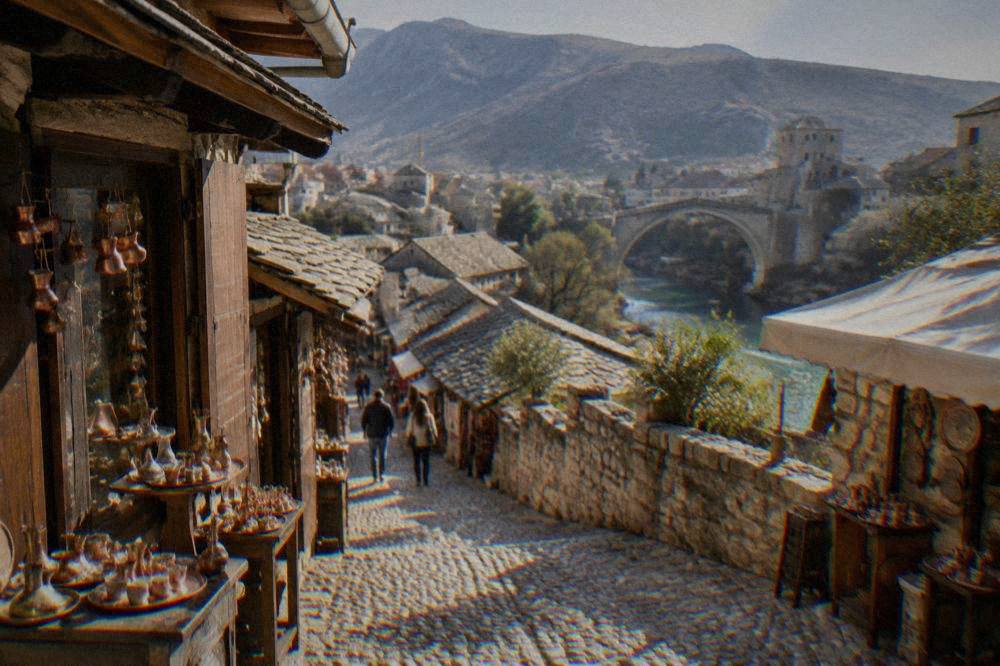
Choosing how to spend a second or third day in this region comes down to whether the Ottoman core or the countryside pulls harder. A private walk covers the mosques, the bridge quarter and the layered histories of the two banks in a single morning; the Herzegovina loop covers a Dervish lodge, a pilgrimage town and a waterfall in a single day; and a cooking class turns the cuisine that all three communities share into the evening meal. All three sit below, with live prices and dates on the operators' listings.
Common Questions About Islam And Life In Mostar
Is Mostar An Islamic City?
No. Mostar is a secular, mixed city in Bosnia and Herzegovina with a Bosniak Muslim community, Catholic and Orthodox communities, and an Ottoman-built Old Town. Islam shaped its oldest architecture, not its laws or its government.
Will I hear the call to prayer in Mostar?
Yes, in the Old Town and near any mosque. The call to prayer sounds several times a day from Koski Mehmed-pašina džamija and Karađoz-begova džamija, and it is simply part of the soundscape of the eastern side of the city.
Can I visit the mosques in Mostar?
Yes. Koski Mehmed-pašina džamija admits visitors for a small cash fee, with a higher combined fee reported for the mosque and minaret. Cover shoulders and knees, take off your shoes inside, and avoid prayer times, especially the midday prayer on Fridays.
Is alcohol available in Mostar?
Yes, openly. Bars, restaurants and shops across the city sell alcohol, and the nightlife around the Old Town runs late. Bosnia and Herzegovina is a secular country and Mostar's café and bar culture reflects that.
Is Mostar safe for visitors who are not Muslim?
Yes. Mostar receives visitors of every background and religion, and its tourism is built around a UNESCO World Heritage old town that the inscription itself describes as a symbol of coexistence. Standard travel care applies, as anywhere.
What religion built the Old Bridge?
The bridge was built in the Ottoman period, commissioned by Suleiman the Magnificent and completed in 1566 by the architect Hajruddin. It is an Ottoman Islamic-era monument, rebuilt and reopened in July 2004 after its destruction in the war, and UNESCO inscribed the Old Bridge Area in 2005.
The short version: Mostar is a European city with an Ottoman heart. Its mosques, bazaar and bridge carry four centuries of Islamic-era building, its people belong to three faith traditions and often to none in practice, and its daily life, from the call to prayer over the Neretva to the late-night café terraces, runs on the plural, secular arrangements of modern Bosnia and Herzegovina. That combination is what Mostar Travel Guide exists to explain, one plain question at a time.