What Are Some Hidden Gems In Bosnia And Herzegovina?
Hidden gems across Bosnia and Herzegovina, mapped from Mostar: Blagaj, Počitelj, Kravica waterfall, Vjetrenica, Hutovo blato, Radimlja, Konjic and Trebinje, with road distances and entry facts.
Mostar, the main city of Herzegovina in Bosnia and Herzegovina, sits inland on the Neretva river with no sea coast, and it works unusually well as a base for the country's quieter corners. The Old Bridge Area of the Old City is a UNESCO World Heritage property, inscribed in 2005, and the crowds gather there. The gems listed below sit anywhere from twenty minutes to about two and a half hours away by road, and each one carries a real figure: a road distance computed from Stari Most, an entry price where one is on file, or a UNESCO inscription number. Mostar Travel Guide keeps every one of them measured from the bridge, because that is where a visitor's day starts.
The strongest hidden gems within reach of Mostar are the Blagaj Tekke at the Buna spring, the fortified village of Počitelj, Kravica waterfall, the Vjetrenica cave system, the Hutovo blato wetland, the Radimlja stećci necropolis, the ARK D-0 bunker near Konjic and the town of Trebinje, with Blagaj just 13.7 km and about 19 minutes by road from Stari Most and Trebinje 116.5 km and about 142 minutes. Each is described below with its distance, entry figure and season.
That list is deliberately built outward in rings. The first ring is Herzegovina's karst country south and west of the city, where the sights cluster so tightly that a single day tour reaches three of them. The second ring pushes east toward Stolac and Trebinje, and north toward Konjic and Jablanica, where the landscape changes to lakes and canyon country. Few of these places appear on a first page of search results for the country at all, and several carry UNESCO or national designations that would make them famous anywhere more crowded.
One structural fact helps plan all of it: Bosnia and Herzegovina uses the convertible mark (KM), pegged at 1 EUR = 1.95583 KM, and euro cash is often accepted in tourist areas at a rounded rate, so confirm before handing it over. More on the country's listed sites is in Bosnia's UNESCO sites explained.
Herzegovina's Karst Secrets Within An Hour Of Mostar
Blagaj, Počitelj and Kravica waterfall form Herzegovina's classic gem ring: the Blagaj Tekke is 13.7 km and about 19 minutes from Stari Most, Počitelj is 30.0 km and about 31 minutes, and Kravica waterfall is 55.2 km and about 54 minutes, with Blagaj Tekke entry reported at 10 KM, Počitelj's village free to walk, and Kravica at 20 KM for an adult all year round.
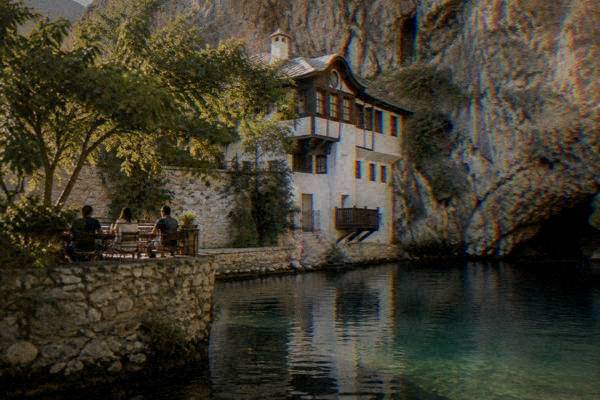
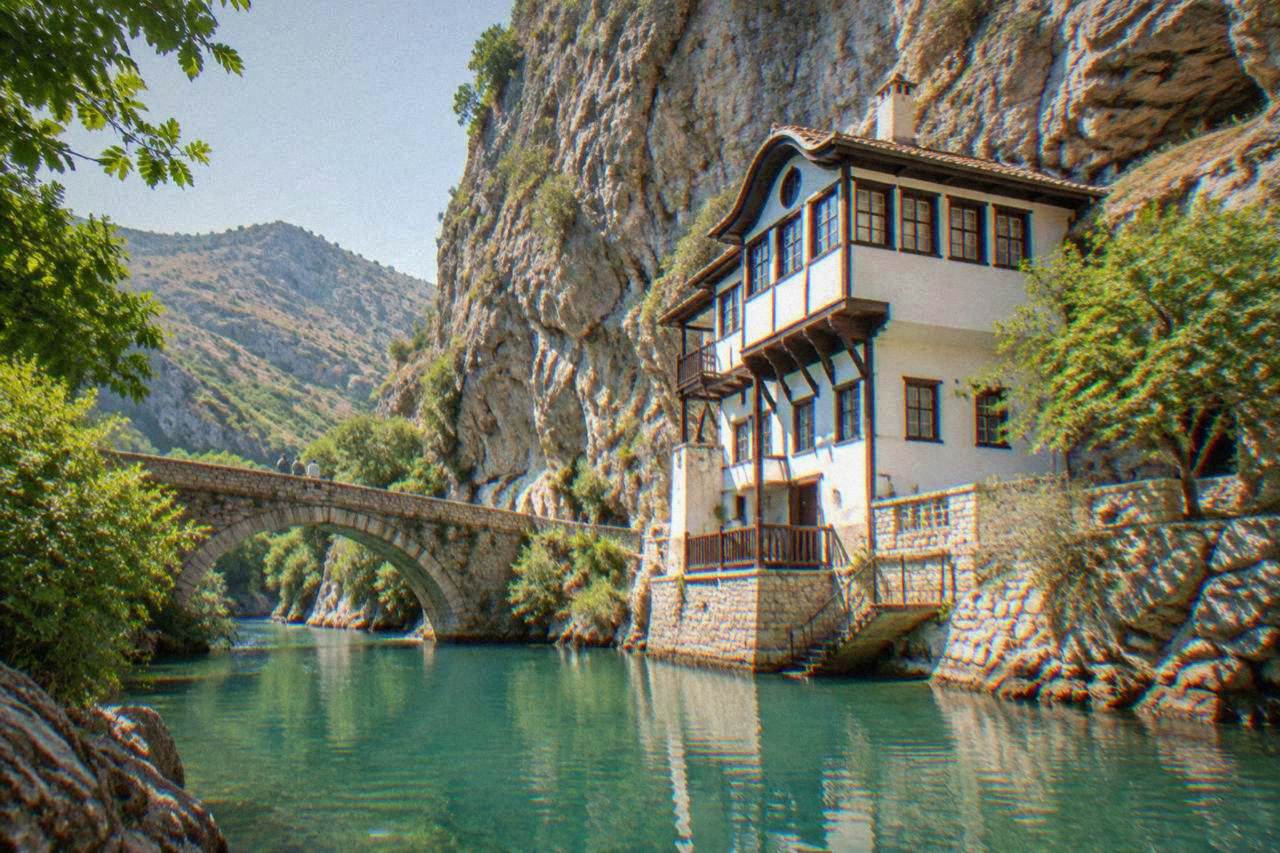
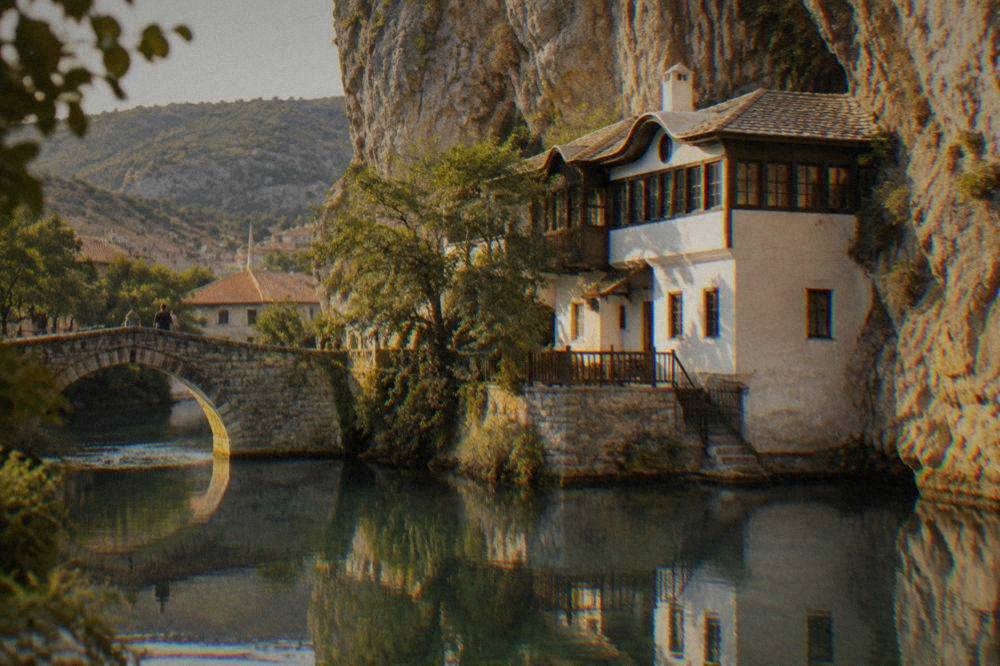
The Blagaj Tekke is a Dervish lodge built at the mouth of the Buna spring, where the river bursts fully formed from a cliff face. Entry is reported at 10 KM, with hours of 08:00 to 22:00 from April to October and 09:00 to 17:00 from November to March, and shoulders and knees covered inside, with wraps provided at the entrance. Above the village, the Stjepan-grad fortress ruin is 13.9 km and about 20 minutes from Stari Most, a stiff walk on a hot day. The Buna runs cold year-round, fed by karst springs.
Počitelj is a stone village stacked on a hillside above the Neretva, with a fortress tower you can climb and a mosque at its centre. The village streets are free to wander, with only small optional fees reported at individual buildings. Kravica waterfall, 55.2 km out near Ljubuški, is a wide karst cascade with a pool you can swim in through the summer months in a designated area; the park's own visitor page lists adult entry at 20 KM all year, 10 KM for residents of Bosnia and Herzegovina, and free entry for children under 7, with hours that stretch to 07:00-22:00 from June to September. Hours by month are worth checking before a winter trip, because they shorten to 07:00-17:00 in January, February, November and December.
| Gem | Road km from Stari Most | Free-flow minutes | Entry figure on file |
|---|---|---|---|
| Blagaj Tekke | 13.7 | 19 | 10 KM reported |
| Stjepan-grad fortress | 13.9 | 20 | none printed |
| Međugorje (St James church) | 28.3 | 40 | sites free |
| Počitelj | 30.0 | 31 | village free |
| Kravica waterfall | 55.2 | 54 | 20 KM adult, all year |
This ring is exactly what a guided day covers, and several operators run it as a circuit with the driving handled. A full-day tour from Mostar that strings Blagaj, Počitelj and Kravica together is the simplest way to see all three without a hire car, and the related tour on this page includes an optional zipline stop; details and live pricing are on the operator's listing.
Anyone starting from the Croatian coast can reach the same ring on a long day trip from Dubrovnik, and travellers based in the capital can join a Sarajevo departure that adds Konjic to the circuit. Both options are carded above.
Vjetrenica Cave, Hutovo Blato And The Stećci Landscapes
The second ring holds three genuinely overlooked sites: Vjetrenica cave, 77.2 km and about 104 minutes from Stari Most, is a guided karst cave with entry reported at about 20 to 25 KM; Hutovo blato, 48.1 km and about 62 minutes, is a bird-rich wetland park with entry reported at about 5 KM and boat trips at about 20 KM; and the Radimlja stećci necropolis near Stolac, 33.5 km and about 42 minutes, is part of a UNESCO World Heritage property inscribed in 2016.
Vjetrenica means "wind cave", and the name is literal: the cave breathes, with a draught at its mouth strong enough to feel on a summer day. Visits are guided and seasonal, typically April to November, with hourly departures through the day; confirm times before driving out, because winter access is limited. Hutovo blato, east toward Čapljina, is the same karst system seen from above ground, a chain of lakes and marshes that is one of the largest wintering grounds for waterbirds in Europe; entry is reported at about 5 KM, boat safaris at about 20 KM, and the season runs roughly April to November. Bird life peaks outside the summer holidays, which is worth knowing when the coast is at its most crowded.
Radimlja is the face of the stećci, the medieval stone tombstones scattered across Bosnia and Herzegovina and neighbouring countries. The necropolis near Stolac holds dozens of carved monoliths, some with shields, riders and spirals, and forms part of the serial UNESCO property 1504, inscribed in 2016. Entry is reported at 8 KM for individuals and 5 KM for groups and citizens of the country. Stolac itself, 36.8 km and about 47 minutes out, is a quiet town on the Bregava river with an old quarter worth the extra few kilometres.
For travellers weighing this ring against more time in the city, is Mostar worth visiting? covers what the city itself offers.
The second ring rewards an early start but does not require one: Radimlja and Hutovo blato sit within an hour of each other, and Vjetrenica pairs naturally with a Trebinje overnight rather than a rushed return. A day tour with entry fees already handled also exists on the Sarajevo departure, carded in the band above, for anyone routing north afterwards.
Eastern And Northern Detours: Trebinje, Konjic And Jablanica
Trebinje, 116.5 km and about 142 minutes southeast, is a stone old town of plazas and plane trees with an abbey on the hill; Konjic, 69.0 km and about 80 minutes north, guards a stone bridge over the Neretva and the ARK D-0 bunker, 77.0 km and about 93 minutes out, reported at 40 KM for foreign visitors with booking required; and Jablanica, 47.4 km and about 57 minutes, holds riverside bridge ruins on the Neretva.
Trebinje is the country's quiet southern alternative, close enough to the Dubrovnik hinterland that it stays off most itineraries. Its old town, river bridges and hilltop church are free to wander, and the town sits at the foot of the hills that lead down to the Adriatic, though the sea itself is across the border in Croatia. Allow the full drive time: this is the longest single hop on the list, at about two and a half hours free-flow, without border queues.
Konjic, by contrast, is a natural stop on the route between Mostar and Sarajevo, which makes it one of the easiest add-ons in the country. Its claim to fame is ARK D-0, the nuclear bunker built for Yugoslavia's leadership inside a hill, now open for guided visits reported at 40 KM for foreign visitors and 20 KM for citizens, cash only, with tours Tuesday to Sunday and booking required in advance. Jablanica, short of Konjic on the same road, has the broken spans of the old Neretva bridge on the riverbank and a small museum on the wartime rescue of the wounded, with an entry fee of a few KM; the official page prints two different price lists, so confirm at the desk.
For a full route across the country, the Bosnia and Herzegovina itinerary guide on this site strings these northern stops into a multi-day plan, and how many days in Mostar is enough? helps size the city portion of the trip. Independent drivers should stay on marked paths in rural Herzegovina because of suspected mine areas, a rule that applies to the whole country's countryside.
Quiet Corners Of Mostar Itself
Mostar's own overlooked corners are the Partisan Memorial Cemetery by architect Bogdan Bogdanović, inaugurated in 1965, with no ticket and no staffed hours but a fragile condition after over 700 of its stone markers were destroyed in 2022; the Kriva ćuprija, or Crooked Bridge, a free public miniature of Stari Most on a side channel; and the Hum hill above the city, reached on foot for the widest view.
The Partisan Memorial Cemetery is the most sobering of these. Europa Nostra listed it among Europe's most endangered heritage sites and published a landmark report in 2026 calling for urgent revitalisation, after the destruction of more than 700 memorial markers in 2022. It remains a national monument, open, unstaffed and free, and visitors should treat it as a gravesite rather than a viewpoint. The Crooked Bridge, a short walk upstream from Stari Most, is a smaller stone arch across a tributary channel, free to cross at any hour and usually quiet even when the main bridge is packed. For the city's backstory, see what is so special about Mostar?.
Hum, the hill with the cross on the skyline, gives the widest panorama of the Neretva valley, and a via ferrata route on its flank is the active way up for anyone with a head for heights. Neretva water is cold even in August, fed by karst springs, which is worth remembering before any idea of a river swim.
How To Plan A Hidden-Gems Route From Mostar
A workable plan is one day for the Blagaj, Počitelj and Kravica ring, a second day for Radimlja, Hutovo blato or Vjetrenica, and a morning inside Mostar for the Crooked Bridge and the Partisan Memorial Cemetery, holding Trebinje or Konjic for a day when the route north or east fits the wider itinerary. Entry fees across the whole set total well under 100 KM per person, and a reported tourist tax of 3 KM per person per night applies in the canton.
Two practical notes finish the picture. Bosnia and Herzegovina is not in the EU or Schengen, and since 1 January 2023 the Croatian land border carries full checks, so budget extra time on any loop that dips to the coast; typical waits run up to about 30 minutes, longer at summer peaks. The reported tourist tax of 3 KM per person per night took effect from 1 January 2026; confirm it at booking. And the seasons matter: the cave and wetland parks close roughly November to April, while Kravica keeps its 20 KM entry all year with shorter winter hours. Given how tightly the gems cluster, a guided day tour from Mostar remains the most efficient first move, and the band below carries the three departures this site rates for the job, from Mostar, Dubrovnik and Sarajevo.
For anyone who would rather move at their own pace between the waterfall and the tekke, a dedicated half-day Kravica departure also runs from Mostar, carded below with live dates and pricing on the operator's listing.
Common Questions About Hidden Gems In Bosnia And Herzegovina
What Are Some Hidden Gems In Bosnia And Herzegovina?
Blagaj Tekke, Počitelj, Kravica waterfall, Vjetrenica cave, Hutovo blato, the Radimlja stećci necropolis, Konjic with the ARK D-0 bunker, Jablanica and Trebinje, all measured in the sections above from Stari Most in the city centre.
Which hidden gem is closest to Mostar?
The Blagaj Tekke at the Buna spring, 13.7 km and about 19 minutes by road from Stari Most, with entry reported at 10 KM and a dress code of covered shoulders and knees inside.
Are the hidden gems open in winter?
Kravica waterfall stays open all year at 20 KM adult entry with hours shortened to 07:00-17:00 in winter months, while Vjetrenica cave and Hutovo blato run seasonal operations roughly April to November; confirm locally in the shoulder weeks.
Can you visit the Blagaj Tekke, Počitelj and Kravica waterfall in one day?
Yes, the three sit in a 55 km ring from Mostar and guided day tours cover all three, which is how the related tour on this page is built.
Do you need a car for Bosnia and Herzegovina's hidden gems?
A car helps for Vjetrenica, Hutovo blato and Trebinje, but the Blagaj-Počitelj-Kravica ring and Konjic both work on guided day tours, and local buses run to Blagaj and Međugorje from the city bus station.
What currency do you need at the hidden gems?
The convertible mark, KM, pegged at 1 EUR = 1.95583 KM; euro cash is often accepted in tourist spots at a rounded rate, so carry marks for small sites and confirm the rate before paying.