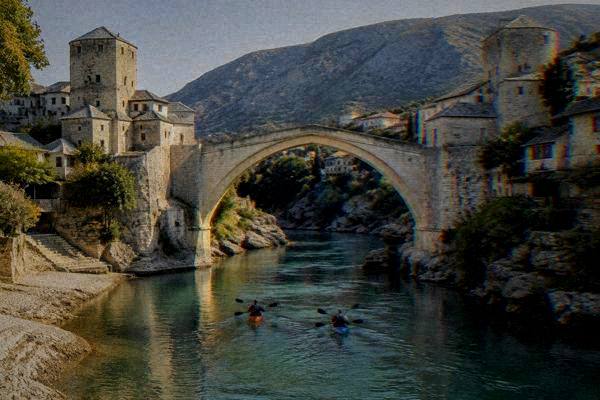
The Neretva River: Colour, Cold Water And Bridges
The Neretva is the river that made Mostar: it gives the city its name, its UNESCO-listed bridge and its unmistakable emerald colour, and it stays cold even in August.
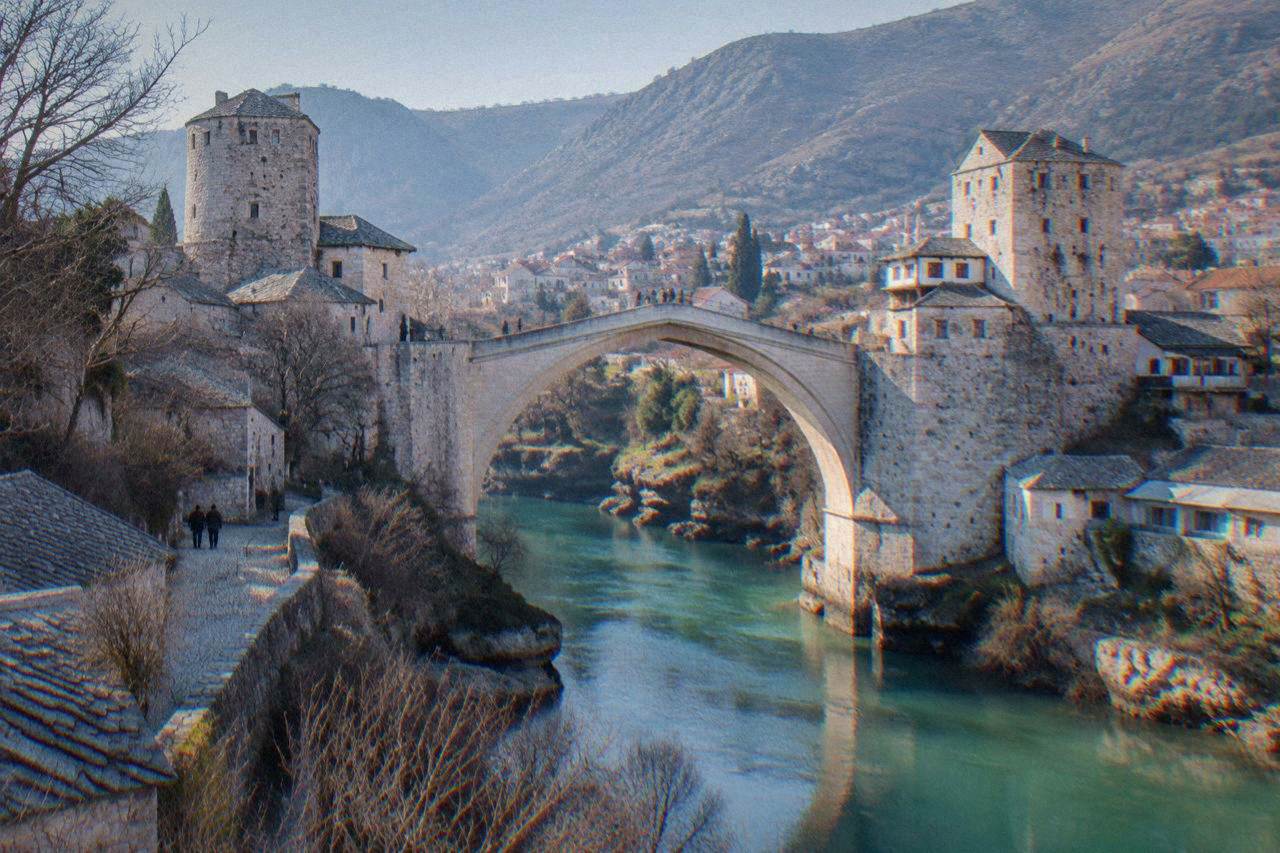
The Neretva is an inland karst river flowing through Mostar in Herzegovina, Bosnia and Herzegovina. Its water is famously cold even at the height of summer, its colour comes from limestone sediment, and it is spanned in the city by Stari Most, rebuilt and reopened in July 2004.
Mostar sits on the Neretva river in Herzegovina, the southern region of Bosnia and Herzegovina, and the city exists because of that water. The name itself comes from "mostari", the bridge keepers who guarded an earlier wooden crossing on the same spot, first written down in a Dubrovnik document of 1474. Today the river runs cold and green beneath the Old Bridge, Stari Most, the centrepiece of a UNESCO World Heritage property inscribed in 2005, and every practical question about the city, from its summer heat to its day trips, sooner or later runs back to the Neretva. This page gathers what the river means for a visit: its colour, its temperature, its bridges, the walks and viewpoints along it, and the trips out of the city that follow it downstream.
What Is The Neretva River To Mostar?
The Neretva is the inland river that flows through the middle of Mostar, dividing the city in two and joining it again with its bridges, and it is the reason the city stands here at all. Settlement on this crossing point grew from the 15th century, and the UNESCO-listed Old Bridge Area of the Old City of Mostar, inscribed in 2005 under criterion (vi), sits directly on its banks. The river rises in the Dinaric mountains and runs south through Herzegovina toward the Adriatic basin, and by the time it reaches Mostar it has cut a valley that defines the whole setting: the Old Bridge Area on one bank, the hum of the bazaar above the water, and hillsides stacked on both sides.
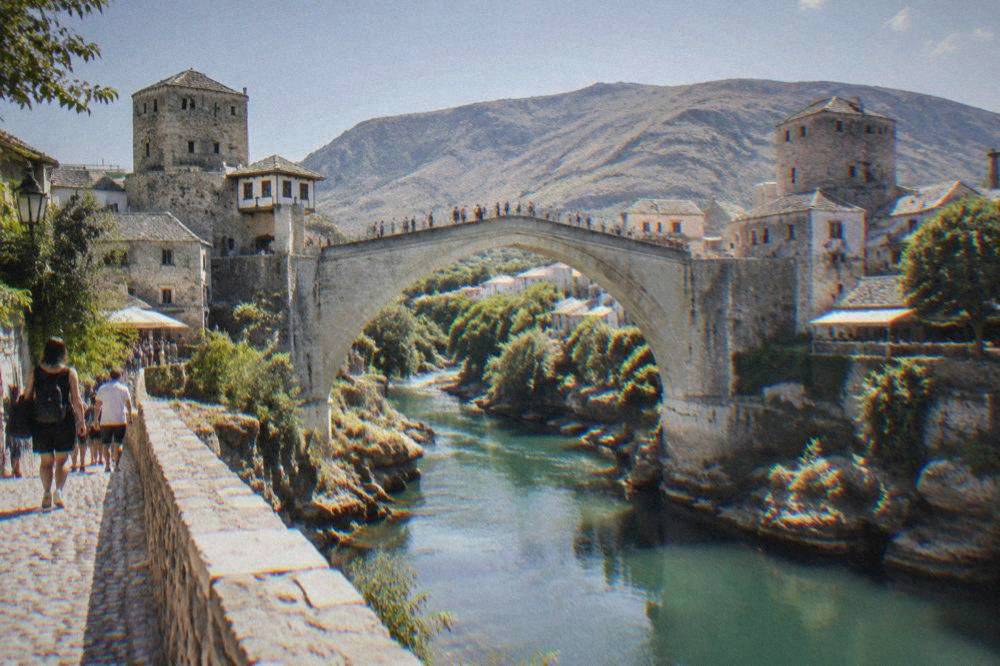
The name Mostar literally comes from the bridge keepers, and the bridge they kept led across this river. When Stari Most was completed in 1566 under Suleiman the Magnificent, built by mimar Hajruddin following the design tradition of his master Sinan, it crossed the Neretva with a single stone arch of about 29 m, standing about 21 to 24 metres above the water depending on the river level. That height is not a fixed number: the Neretva rises and falls through the year, and the clearance changes with it.
For planning purposes, one point matters most: the river is an inland waterway, and Mostar has no sea coast. Everything people describe as "waterside" in the city refers to the Neretva. The waterfront promenades, the terraces above the water, the bridge views, all of it belongs to this one cold green river, and the best of the city's walks, covered in the Mostar walking tour guide, trace its banks from end to end.
Why Is The Neretva Water So Cold Even In Mostar Summers?
The Neretva is fed by karst sources and mountain runoff, and its water stays cold even in August, while the city above it bakes in some of the warmest summer conditions in the region: the ERA5 reanalysis, 1991 to 2020, puts the mean daily high in July at 29.9 C and August at 30.5 C for Mostar. That contrast is the defining summer experience of the river. The FHMZ station record for 1961 to 1990 shows an absolute maximum air temperature of 41.2 C in July, and on days like that the riverbank is where the city breathes.
The reason is geology rather than distance. Herzegovina is limestone country, and the Neretva's catchment collects snowmelt and karst spring water that stays cold through the year. A dip in the Neretva on a 30 C afternoon is a shock, not a bath.
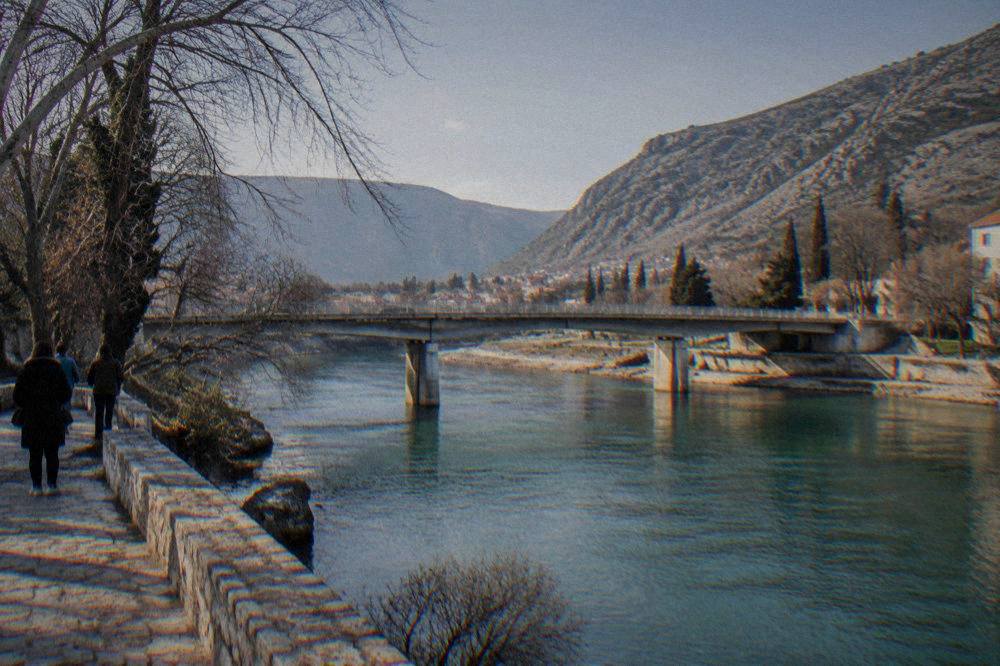
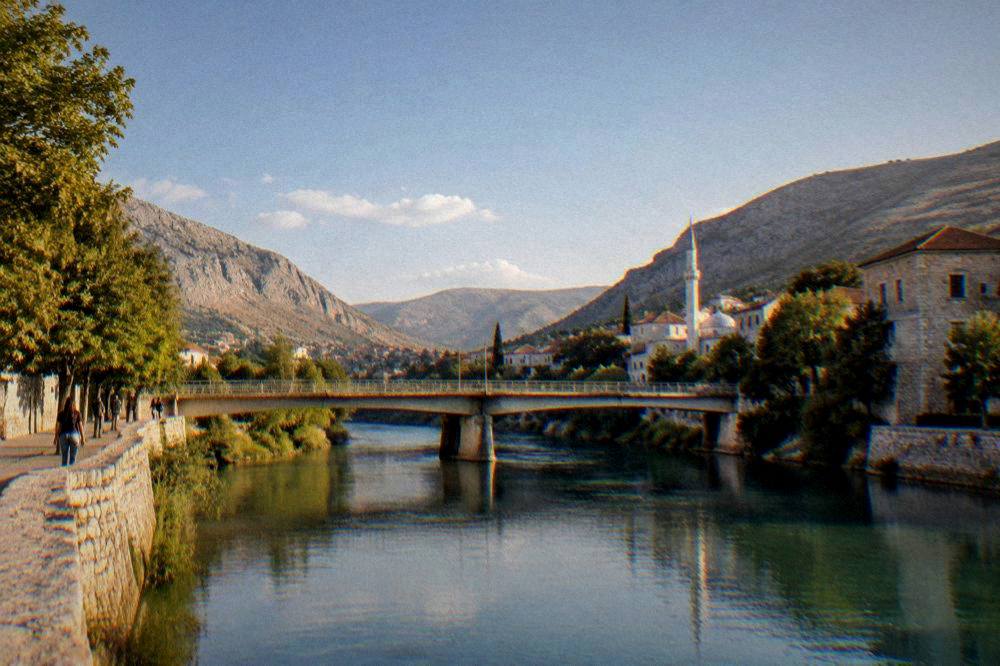
The colour is the other constant question. The river's turquoise-to-emerald tone comes from fine limestone sediment suspended in the water, and it shifts with the light and the flow: deeper green in the morning, almost blue under a hard midday sun. Photographers who want the colour at its best aim for morning light on the upstream side of Stari Most, when the sun is low over the valley and the water is not yet glared out.
A practical corollary: the river valley also drives Mostar's heat. The FHMZ Mostar station table, 1961 to 1990, shows a mean annual temperature of 14.6 C, warm for the latitude, because the valley traps warm air in summer. The full picture, month by month, is in the Mostar weather guide, and if heat is your concern when to come, the best time to visit Mostar lays out the trade-offs.
Which Bridges Cross The Neretva In Mostar?
Two historic pedestrian bridges cross the Neretva in Mostar's Old Town core: Stari Most, the 1566 Ottoman arch rebuilt and reopened in July 2004 after its destruction on 9 November 1993, and Kriva ćuprija, the Crooked Bridge, a smaller single-arch stone bridge over a side channel a short walk upstream, free to cross at any hour. Stari Most is a public crossing, open 24 hours a day with no ticket; the bridge itself is free, and only the adjacent museum in the Tara tower carries a reported admission.
The story of the big bridge is told factually: destroyed on 9 November 1993 during the war, rebuilt using original materials and techniques with support from UNESCO and World Bank partners, and reopened in July 2004. The following year, 2005, the surrounding Old Bridge Area of the Old City of Mostar was inscribed on the World Heritage List. The diving tradition belongs to the bridge too: members of the Mostari diving club jump from about 21 to 24 metres above the river, and the 460th traditional competition ran on 26 July in 2026. Visitors do not jump; that is club members only, with training measured in years.
Beyond the two old bridges, the modern crossings are road and rail bridges that carry the city's traffic, and they frame the river valley from the viewpoints on the hills. For a fuller account of the Old Bridge itself, its architecture, its diving club and its viewing angles, see the dedicated Stari Most guide.
| Bridge | What it is | Crossing it |
|---|---|---|
| Stari Most (Old Bridge) | Single stone arch of about 29 m, completed 1566, destroyed 9 November 1993, reopened July 2004 | Free, open 24/7 |
| Kriva ćuprija (Crooked Bridge) | Small Ottoman stone arch over a side channel of the Neretva | Free, public street |
| Old Town road bridges | Modern road crossings east and west of the Old Town | Public roads |
Where Are The Best Neretva Viewpoints In Mostar?
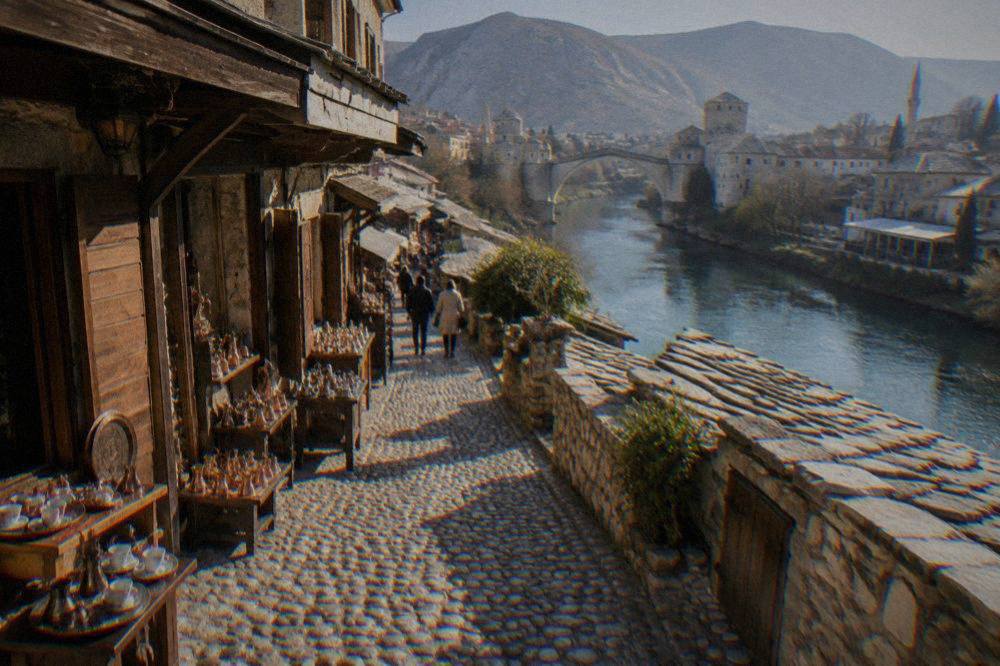
The clearest views of the Neretva in Mostar are from the Old Bridge itself, from the terrace of Koski Mehmed-pašina džamija on the west bank, from the riverside path below Kujundžiluk, and from the hills of Hum and the Fortica ridge above the city, each giving a different angle on the river's bend through town. The mosque terrace sits closest to the water of any elevated spot in the Old Town; the bazaar-side path runs right at water level past old mills; and the heights give the long view where the river's colour reads strongest against the stone.
Below the bazaar, the riverbank path is flat and continuous, and it connects naturally to the smaller-scale sights of the Old Town, including Bišćević House on the south side, an Ottoman house museum set in a garden a few steps from the water; the details are in the Bišćević House guide. Across the river, Donja Mahala, the quarter on the right bank, has its own slower river frontage with cafés and plane trees, mapped in the Donja Mahala area guide.
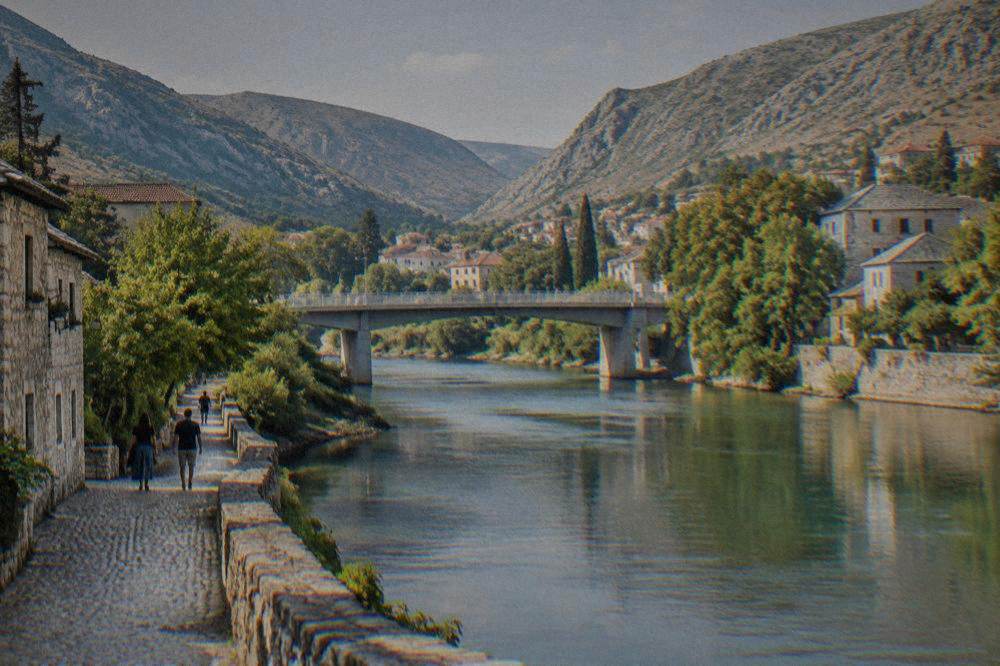
Upstream of the Old Town, the Neretva runs quieter, and the walk along it toward the modern bridges is where locals swim from the banks in summer. Downstream, the river passes under the city's newer crossings and heads toward the gorge country that a kayaking trip explores. For the full sweep of vantage points, with what each one is good for and when, the Mostar viewpoints guide collects them in one place.
| Viewpoint | Where it is | What it shows |
|---|---|---|
| Stari Most deck | Old Town core | The river canyon and rooftops from the arch itself |
| Koski Mehmed-pašina džamija terrace | West bank, near the bridge | Water-level-to-rooftops view over the bend |
| Kujundžiluk riverside path | East bank below the bazaar | Mills, weirs and the bridge from below |
| Hum hillside | West of the centre | The whole valley and both banks |
| Fortica ridge | Above the city | Long view down the Neretva valley |
Can You Swim Or Kayak In The Neretva At Mostar?
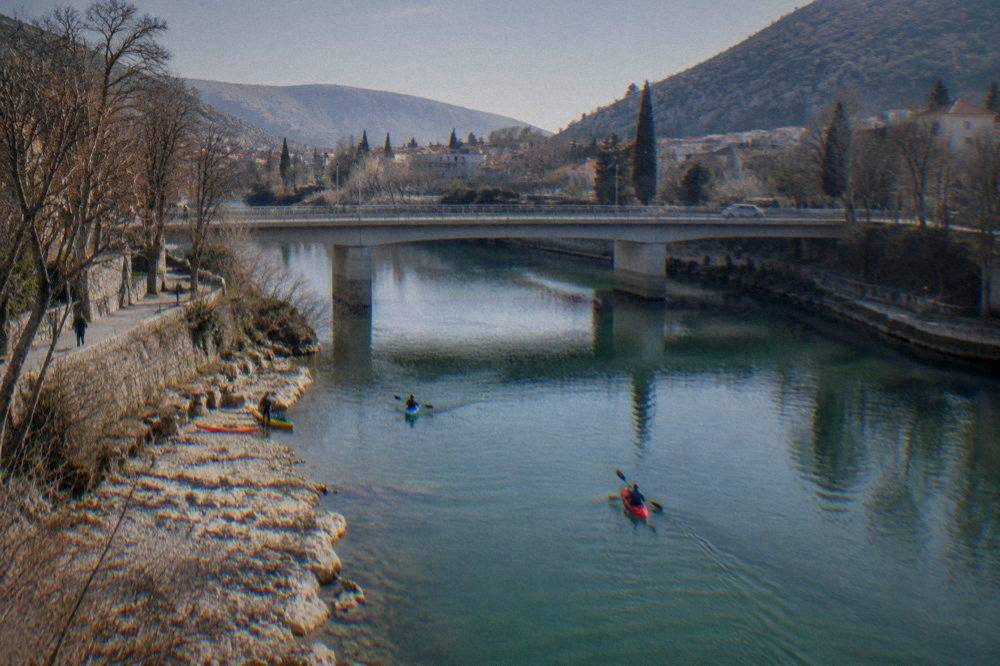
Yes, locals swim in the Neretva at Mostar from riverbanks and informal spots in summer, and yes, guided kayaking runs on the river near the city, but the water is cold even in August and the swimming is unsupervised, so it is a short-dip activity rather than a warm-water swim. The city has no designated lifeguarded river beach; what it has is cold, clear water on hot afternoons, entered from banks and rocks. The question of whether swimming is sensible for you is covered in full in can you swim in the river at Mostar.
Kayaking is the more structured way onto the water. Trips run on the Neretva in the canyon country outside the city and on the wider reaches near Jablanica to the north, with gear, guide and instruction included. The canyon sections are the scenic ones: steep banks, quiet water and the river's colour seen from a centimetre above the surface. One established option is the Jablanica Neretva canyon kayaking tour, which covers the river upstream of the city, and you can Check availability if paddling the Neretva is on your list.
Rafting is the third water option. The upper Neretva and its tributaries carry white-water sections in spring when the snowmelt is high, and the season, grades and logistics are all laid out in the Neretva rafting guide. One safety note that applies to all of it: in rural Herzegovina, stay on marked paths and established access points, because parts of the countryside carry suspected mine contamination, and the national clearance authority BHMAC maintains the mapped suspected areas.
A note on expectations. The water is cold, the current in the main channel is real, and the swimming culture here is dip-and-dry, not lounging. Bring something to stand on, expect to gasp, and treat the river with the respect its temperature demands.
Which Day Trips From Mostar Follow The Neretva?
The river basin holds the classic Mostar day trips: Blagaj Tekke on the Buna spring is 13.7 km and about 19 minutes from Stari Most by road, Počitelj is 30.0 km and about 31 minutes, Jablanica on the Neretva is 47.4 km and about 57 minutes, Hutovo blato is 48.1 km and about 62 minutes, and Kravica waterfall is 55.2 km and about 54 minutes, all free-flow times with no border queues. The Neretva either runs through these places or defines the karst landscape they sit in, which is why the standard Herzegovina circuit feels like one long river story.
Blagaj, closest of all, is where the Buna, a karst spring river of the Neretva system, boils out of a cliff face beneath a fortress-crowned ridge, with the Blagaj Tekke, a Dervish lodge, built at the water's edge. Počitelj, downstream, is a walled stone village on a hillside above the valley. Jablanica, upstream to the north, is where the wartime bridge over the Neretva stood and where a museum, the Museum Battle for the Wounded on the Neretva, tells the story of the fighting along this river, entry a few KM. Each has a full page: Blagaj, Počitelj, Jablanica and Hutovo blato, the last a wetland park on the Neretva's underground outflow, where boat trips cross the lakes.
Grouped day tours stitch these together efficiently, and the river sits at the heart of the standard route. One long-standing option is the full-day Herzegovina tour with Blagaj, Počitelj and Kravica waterfalls; you can check availability alongside it. Kravica itself, 55.2 km out, is a karst waterfall on the Trebižat, a Neretva-basin river, with entry of 20 KM for an adult all year, 10 KM for residents of Bosnia and Herzegovina, children under 7 free, and summer hours of 07:00 to 22:00 from June to September per the park's own visitor page.
| Place | Road km from Stari Most | About minutes | What the river gives it |
|---|---|---|---|
| Blagaj Tekke | 13.7 | 19 | The Buna spring at the base of the cliff |
| Počitelj | 30.0 | 31 | Hillside setting above the valley |
| Jablanica | 47.4 | 57 | Neretva gorge, bridge ruins, river museum |
| Hutovo blato | 48.1 | 62 | Lakes and boat trips on the karst outflow |
| Kravica waterfall | 55.2 | 54 | Trebižat basin falls, swimming in summer |
How Does The Neretva Valley Shape Mostar's Weather?
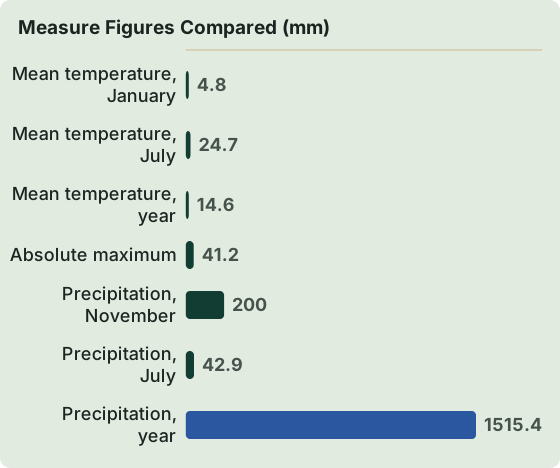
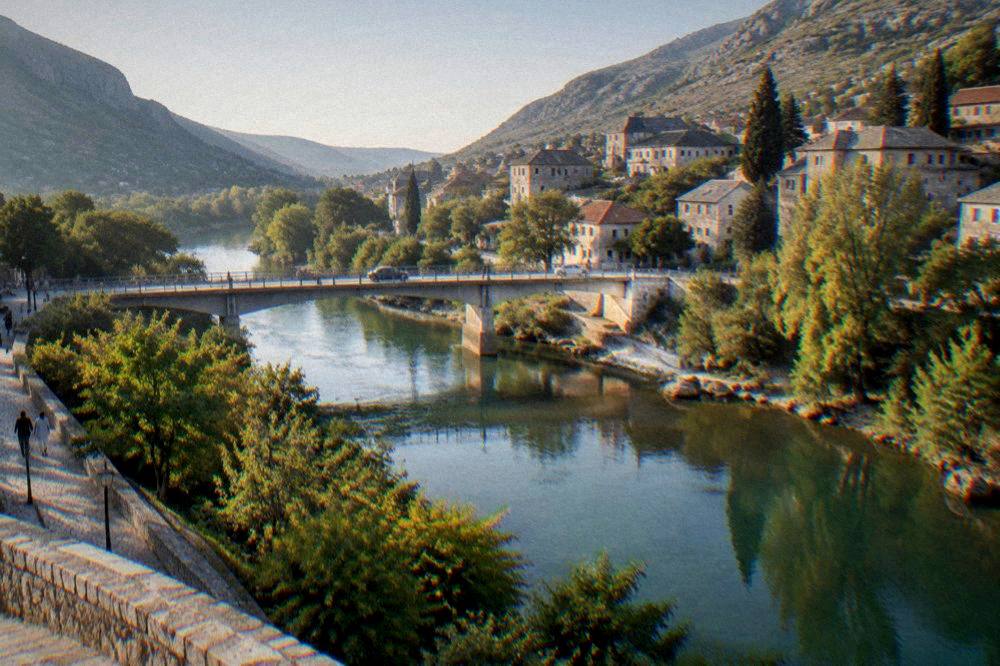
The Neretva valley gives Mostar a warm climate: the FHMZ Mostar station table, 1961 to 1990, shows a mean July temperature of 24.7 C, an absolute maximum of 41.2 C, and a mean annual temperature of 14.6 C, while the ERA5 reanalysis, 1991 to 2020, puts modelled mean daily highs at 29.9 C in July and 30.5 C in August. Rain concentrates in the cold half of the year, with November averaging 200.0 mm and July 42.9 mm on the same station record, which is why the river runs lower and clearer in summer.
The river moderates the very air immediately above it, which is why the banks are the place to be at midday in summer and why the waterside cafés fill from late morning onward. But the effect is local: climb the hundred steps to a viewpoint and the heat returns. Winter flips the pattern, with valley fog on some mornings and the river, still cold, feeling colder in a damp 6.2 C January mean.
| Measure (FHMZ Mostar station, 1961-1990) | Value |
|---|---|
| Mean temperature, January | 4.8 C |
| Mean temperature, July | 24.7 C |
| Mean temperature, year | 14.6 C |
| Absolute maximum | 41.2 C (July) |
| Precipitation, November | 200.0 mm |
| Precipitation, July | 42.9 mm |
| Precipitation, year | 1,515.4 mm |
| Modelled normals (ERA5 reanalysis, 1991-2020) | January | July | August |
|---|---|---|---|
| Mean daily high | 8.4 C | 29.9 C | 30.5 C |
| Mean daily low | 0.2 C | 17.7 C | 18.1 C |
| Rainfall | 142.8 mm | 45.4 mm | 52.6 mm |
The river's own water temperature is not published as a live figure, and no number should be trusted without checking; what the record supports is the plain statement that the Neretva is cold even in August. For heat-averse travellers the practical reading is in is Mostar too hot in August, and for the cold half of the year the rainfall numbers above explain why November is a quieter, wetter time on the riverbank.
Does The Train To Mostar Follow The Neretva?
Yes, the railway from Sarajevo to Mostar and on to Čapljina shadows the Neretva through its canyon for much of the route, with two trains a day each way, a journey of about two hours between Sarajevo and Mostar and a fare of about 14 KM one way, after regular service resumed on 15 October 2026 following a suspension that had begun on 8 September 2026. The line is one of the scenic rail routes of the Balkans precisely because the river carved the corridor it uses, threading the gorge past Jablanica and the lake country north of the city.
The service details worth knowing: two daily departures each way between Sarajevo and Čapljina via Mostar on the official timetable, with seasonal extensions toward Ploče in Croatia on restricted days. The September-to-October 2026 interruption, caused by a fire along the corridor, ended with the resumption on 15 October 2026; anyone travelling on a specific date should check the operator's current timetable before committing. Arrivals and connections in the city are covered in the Sarajevo to Mostar guide.
For a fuller treatment of reaching the city by rail, bus or air, including Mostar's own small airport with its Zagreb and Stuttgart routes, see how to get to Mostar and the Mostar airport guide. Cross-border arrivals from Croatia, including the Schengen external border checks in force since 1 January 2023, are covered in Dubrovnik to Mostar, Split to Mostar and the Croatia-Bosnia border crossing guide.
For travellers who want the river's history explained on foot rather than seen from a train window, a tailored private history walk of Mostar puts the bridge, the river and the city's story in context; you can check availability if that suits your pace.
Practical Notes For The Neretva In Mostar
Money on the riverbank is the convertible mark, KM, pegged at 1 EUR = 1.95583 KM; euro cash is often accepted in the tourist areas at a rounded rate, so confirm before paying, and the emergency number in Bosnia and Herzegovina is 112. Small riverside vendors may be cash-only, so carry some KM notes. The country is not in the EU and not in Schengen, which matters if you cross into Croatia by land, where full checks apply.
A reported tourist tax of 3 KM per person per night applies in the canton; it is normally collected through your accommodation, and the amount should be confirmed at booking. On rural walks along the river outside town, stay on marked paths because of suspected mine areas, as the national authority BHMAC advises. For the money questions in full, see the Mostar money guide; for driving out to the river spots, getting around Mostar and Mostar car rental cover the options.
Common Questions About The Neretva River In Mostar
Why is the Neretva so cold in summer?
The river is fed by karst springs and mountain runoff from limestone catchments, and that water stays cold year-round. The water is cold even in August, which is why swimming here means short dips and kayakers wear proper gear.
Why is the Neretva green?
Fine limestone sediment suspended in the water gives the river its turquoise-to-emerald colour. The tone changes with light and flow, and it reads strongest from the Old Bridge or the hills in morning light.
Can tourists jump off the Old Bridge into the Neretva?
No. Jumps from Stari Most are performed by members of the Mostari diving club, who train for years before diving from about 21 to 24 metres above the river. No pay-to-jump option for visitors has been reported.
Is it safe to swim in the Neretva at Mostar?
Locals swim from the banks in summer, but the water is cold even in August, there is no lifeguarded city beach, and the current in the main channel is real. Enter gradually, stay near the bank, and avoid alcohol before swimming.
Does the Sarajevo train really follow the river?
Yes. The rail line from Sarajevo through Mostar to Čapljina tracks the Neretva canyon for much of the way, with two trains a day each way and a journey of about two hours from Sarajevo. Regular service resumed on 15 October 2026 after a suspension that began on 8 September 2026.
The Neretva gives Mostar its name, its bridge and its colour, and it asks for one thing in return: respect for cold water. Plan around the river, morning views and afternoon shade, and the city rewards you at every turn, as Mostar Travel Guide lays out across its pages.