Is Bosnia Safe For Americans Right Now?
A plain answer for American travellers considering Mostar and Herzegovina: entry rules, day-to-day safety, landmine caution areas, health and emergency basics.
Mostar, the main city of Herzegovina in Bosnia and Herzegovina, receives American visitors year round, and the practical picture is ordinary: visa-free entry, a stable local currency, working emergency services and the same street sense any traveller keeps in a mid-sized European city. There is one caution that is specific to this country, and it is not crime. In rural Herzegovina, suspected mined areas remain on record, and the standing advice is to stay on marked paths and paved routes when walking outside towns. Inside Mostar itself, that caution barely applies.
This page answers the question plainly, section by section: entry rules for US citizens, everyday safety in Mostar, the landmine question, health and money basics, and how a first day can be organised so the city explains itself. The war is treated here the way the facts allow: dates and physical facts, nothing speculative.
Yes. Bosnia and Herzegovina is a routine destination for American travellers, and Mostar is an inland city on the Neretva river that runs on normal city precautions: watch belongings in the crowded Old Bazaar, keep to lit streets late at night, and save the real caution for the countryside. Suspected mined areas remain on record in rural parts of Herzegovina, so walk marked paths outside towns. Emergency services work, and the general number is 112.
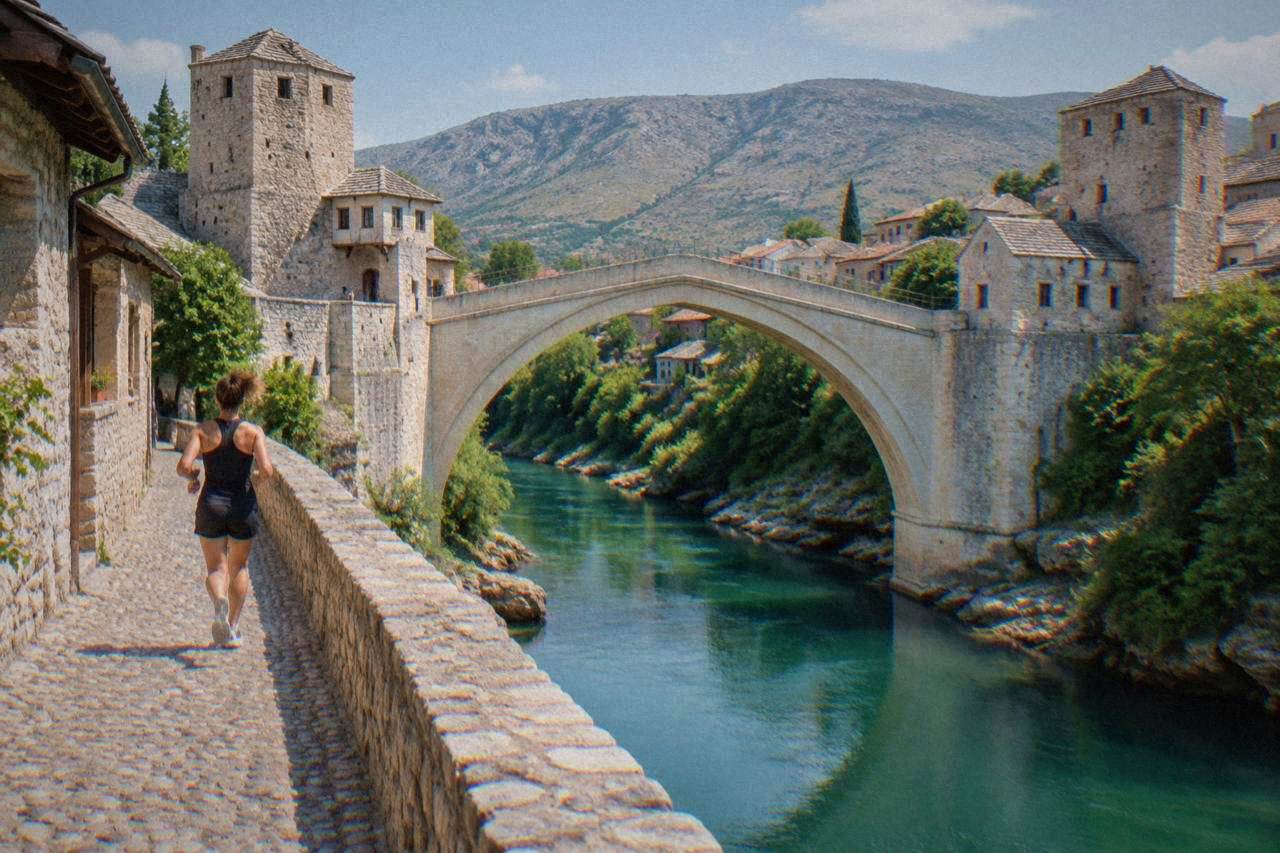
The question usually carries two worries bundled together: personal safety in the city, and the residue of the war that ended in 1995. On the first, Mostar is a compact, walkable city whose centre, the Old Bridge Area of the Old City of Mostar, has been a UNESCO World Heritage property since 2005. On the second, the visible trace of the war in the centre is mostly architectural: buildings that were destroyed and not rebuilt. The Old Bridge itself was destroyed on 9 November 1993 and rebuilt and reopened in July 2004, and it now carries pedestrians free of charge, around the clock.
What Americans sometimes trip over is not danger but admin. Bosnia and Herzegovina is not in the European Union and not in Schengen, the currency is the convertible mark (KM) rather than the euro, and the border with Croatia, since 1 January 2023, is a full Schengen external border with passport checks. None of that is a safety problem. It is just paperwork and cash planning, covered further down.
How Does An American Enter Bosnia And Herzegovina?
United States citizens need no visa for stays of up to 90 days within a six-month period from the date of first entry, under the rule the country's Service for Foreigners' Affairs publishes. A passport is required, and Bosnia and Herzegovina is neither an EU member nor a Schengen member, so each entry means a passport check. Driving in from Croatia means crossing that Schengen external border, with full checks in both directions.
That 90-day allowance is generous for a country you can cross in an afternoon. Mostar sits in the south, in Herzegovina, roughly 127.1 km by road from Sarajevo, and 145.5 km from Dubrovnik across the border in Croatia. Americans typically fly into Sarajevo or Dubrovnik and reach Mostar overland by bus, train or car; the Sarajevo to Mostar train runs twice a day each way, a line that resumed regular service on 15 October 2026 after a suspension that began in early September 2026.
Two border notes worth fixing in advance. First, no ETIAS or EU authorisation is needed to enter Bosnia and Herzegovina itself, because it is outside the EU and ETIAS is not in operation; what applies at the Croatian line is the standard passport check, with reported waits of up to about 30 minutes and longer at summer peaks. Second, if a rental car is involved, cross-border permission must come from the rental company in advance. The details of driving are covered in is it safe to drive in Bosnia as a tourist, and the wider country picture sits in the Bosnia safety guide.
| Entry basic | What applies to Americans |
|---|---|
| Visa | Not required, up to 90 days in a six-month period |
| Passport | Required at every entry |
| EU / Schengen membership | Neither; passport checks at every border |
| Croatian land border | Schengen external border since 1 January 2023, full checks |
| Currency | Convertible mark (KM, BAM), pegged 1 EUR = 1.95583 KM |
Money follows from the last row. Prices in Mostar are set in KM, euro cash is often accepted in tourist areas at a rounded rate that should be confirmed before paying, and cards work at hotels and larger restaurants while small vendors prefer cash. The full detail is in the site's money coverage.
Is It Safe To Walk Around Mostar?
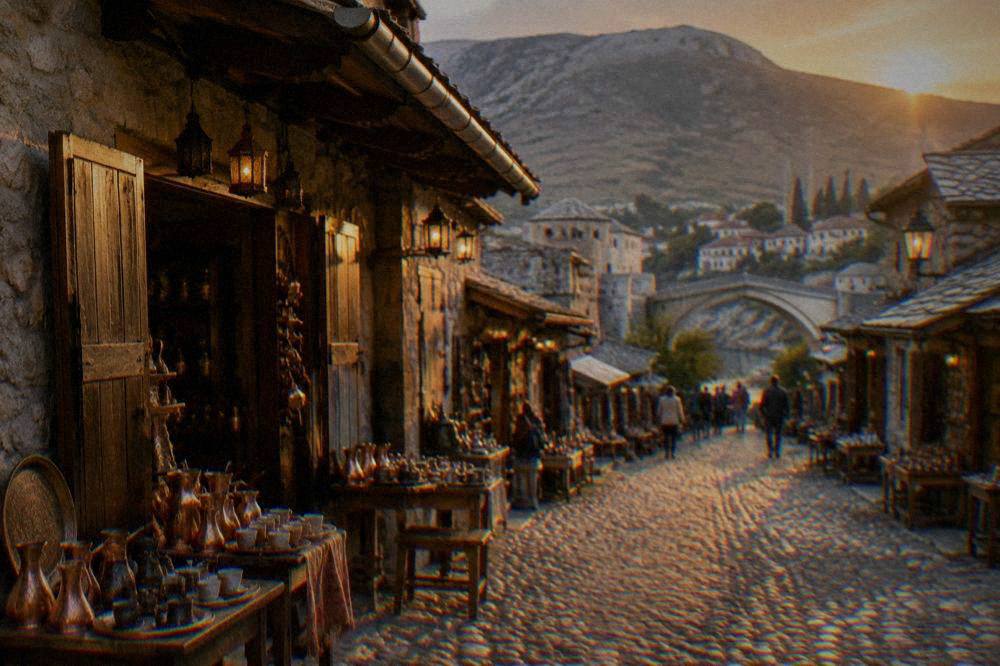
Yes. Mostar's core is compact and pedestrian-first: the Old Bridge, the Kujundžiluk bazaar street, Kriva ćuprija and the two river banks are all within a short walk of each other, and the centre stays busy into the evening in the visitor season. The ordinary precautions are the ones that apply anywhere: keep valuables close in crowds, agree taxi basics before setting off, and stick to lit streets late at night.
The city's centrepiece is free and open. Stari Most, the Old Bridge, is a public pedestrian route with no ticket and no closing time, and the streets around it, Kujundžiluk on the east bank, are open public space. The bridge stands about 21 to 24 metres above the Neretva depending on the river level, and the jumps you may see from it are made by members of the Mostari diving club, who train for years; there is no visitor jump option, and the river stays cold even in August.
Two practical cautions shape a day on foot. The limestone paving on the bridge approaches is polished smooth and slick, especially in rain, so footwear matters. And in July and August the valley heat is real: the FHMZ Mostar station table, 1961 to 1990, records an absolute maximum of 41.2 C in July, and modelled daily highs from the ERA5 reanalysis, 1991 to 2020, average 30.5 C in August. Water, shade breaks and a slower midday rhythm are the standard response, the same as anywhere hot in the Balkans. Late evening walks are covered in more depth in is it safe to walk around Mostar at night.
Is The Landmine Risk Real For Visitors?
In rural areas it is a real caution, and in cities and on established trails it is not a live concern. Suspected mined areas remain on record in Bosnia and Herzegovina, including parts of rural Herzegovina, and the standing advice is to stay on marked paths, paved roads and established trails, never to wander onto abandoned ground, farmland or ruins in the countryside. Bosnia and Herzegovina's mine action centre, BHMAC, maintains the suspected-area records.
The rule of thumb is simple and worth repeating to anyone hiking. Stay on the trail. The classic Mostar area draws, Blagaj, Počitelj, Kravica waterfall, Međugorje, are all established, managed sites reached by road, and none of them involves walking suspect ground. The caution bites when travellers improvise: cutting cross-country toward a viewpoint, exploring derelict buildings, or clambering off a trail for a photograph. Don't. The same discipline applies to the hiking country further afield, and the site's hiking near Mostar coverage sticks to established routes for exactly this reason.
For day trips, an organised excursion is one way to keep the geography disciplined, since it moves between the managed sites on a set route. The Herzegovina circuit is the obvious one: Blagaj Tekke at the Buna spring is 13.7 km and about 19 minutes by road from Stari Most, Počitelj is 30.0 km, and Kravica waterfall is 55.2 km and about 54 minutes free-flow. Entry at Kravica is 20 KM for an adult all year, per the park's own visitor page, with children under 7 free, and swimming is allowed in summer in the designated area with no lifeguard reported. Everything else covered here is indexed on Mostar Travel Guide.
What About The War History Americans Come To See?
The core sites are open and visited routinely. The Old Bridge was destroyed on 9 November 1993 during the war and rebuilt and reopened in July 2004, and the Old Bridge Area was inscribed by UNESCO in 2005. The Partisan Memorial Cemetery, inaugurated in 1965 to a design by Bogdan Bogdanović, stands neglected, with over 700 of its stone memorial markers destroyed in 2022, a loss Europa Nostra has flagged.
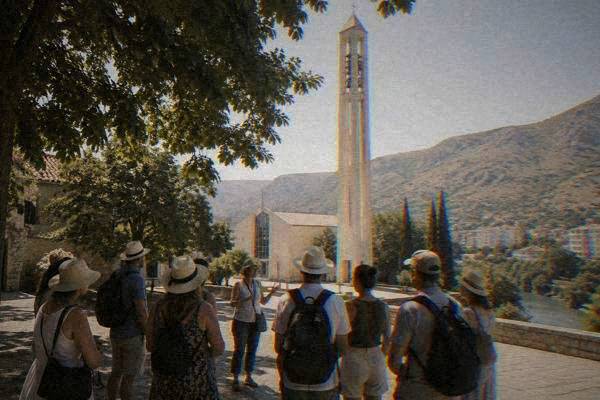
War-history walks are among the most requested guided experiences in the city, and they work best with a guide who can put buildings and dates in order. The physical record is visible from the street: the rebuilt bridge, the rebuilt towers, and the scarred buildings that still stand as they were left. The dates are firm and worth knowing before arrival: the war ran from 1992 to 1995, the bridge fell in 1993, the reconstruction reopened in 2004, and the UNESCO inscription followed in 2005. For more of that story, see why was the Mostar bridge destroyed and has the Mostar bridge been rebuilt.
This is also where a guide earns their fee, and where Mostar Travel Guide would point a first-time American visitor: a private walk turns a scenic Old Town into a legible one. The Mostar Private Walking Tour is the site's featured pick for exactly this, and it can be checked against your dates via Check availability.
What Health And Practical Basics Should Americans Know?
Emergency numbers are 112 for general emergencies, 122 for police, 123 for fire and 124 for ambulance. Tap water in Mostar is generally treated, though some travellers carry bottled water as a precaution. Plugs are type C and F at 230 V, so Americans need an adapter, and US health insurance typically does not travel, so a travel medical policy is the standard preparation for any European trip.
The health picture is unremarkable, which is the good news. Pharmacies are ordinary city pharmacies, the food and water are not a special-risk category, and the main physical stressors are the summer heat and the terrain: the river banks are steep in places and the paving is polished. On money, carry some cash. The KM is the currency, pegged to the euro at 1 EUR = 1.95583 KM, and while cards work widely in the centre, small vendors, market stalls and some taxis run on cash. A reported tourist tax of 3 KM per person per night applies in the canton from 1 January 2026; confirm at booking how your accommodation handles it.
| Practical item | The situation in Mostar |
|---|---|
| Emergency numbers | 112 general, 122 police, 123 fire, 124 ambulance |
| Tap water | Generally treated; bottled water is a common precaution |
| Plugs | Type C and F, 230 V, adapter needed for US devices |
| Cash and cards | KM is the currency; cards widely taken in the centre, cash for small vendors |
| Heat in summer | Modelled August daily highs average 30.5 C, ERA5 reanalysis 1991-2020 |
One nuance on the heat, because Americans from dry states underestimate it. Mostar's rainfall has a winter maximum, November averaging 200.0 mm against July's 42.9 mm on the FHMZ 1961-1990 table, so summer days are dry, bright and hot rather than humid. The response is pacing: out early, indoors or in shade mid-afternoon, back out in the evening, which is also when the Old Town is at its best.
How Should An American Plan A Safe First Day In Mostar?
Start in the centre, walk the Old Bridge and Kujundžiluk while the light is good, add one viewpoint or the riverside below the bridge, and leave the countryside day trips for day two with a route that sticks to the established sites. Entry needs no visa for stays within 90 days, the currency is the KM, and the one standing rural caution, staying on marked paths because of suspected mined areas, never applies to the Old Town circuit.
A first day that works for safety and sense alike: the bridge early, when the stones are dry and the crowds thin, then the bazaar street, then lunch, then shade. The Neretva runs cold even in August, and the banks below the bridge give a proper sense of the gorge the city sits in. Swimming in the river at Mostar is its own question, answered in can you swim in the river at Mostar; the short version is that the cold is the main issue, not safety equipment.
From there the city opens outward. The things to do in Mostar page is the full index, and questions like is Mostar worth visiting and how many days in Mostar is enough settle the itinerary maths. For orientation and history on day one, a guided walk remains the most efficient hour-and-a-bit a first-time visitor can spend, and it can be booked against your dates.
Common Questions About American Travelers In Bosnia
Is Bosnia Safe For Americans Right Now?
Yes. Mostar and the established visitor sites run on ordinary city precautions, with emergency number 112 in service. The one standing caution is rural: stay on marked paths outside towns because suspected mined areas remain on record.
Do Americans need a visa for Bosnia and Herzegovina?
No. US citizens may stay up to 90 days within a six-month period from first entry, visa-free. A passport is required at each border, since the country is outside the EU and Schengen.
Is the Croatian border crossing difficult?
It is a Schengen external border with full passport checks in both directions. Reported waits run up to about 30 minutes, longer at summer peaks, so build buffer time into same-day plans.
What is the emergency number in Bosnia and Herzegovina?
112 for general emergencies, with 122 for police, 123 for fire and 124 for ambulance.
Are there landmines near Mostar?
Suspected mined areas remain on record in rural Herzegovina. The centre of Mostar and the established sites, Blagaj, Počitelj and Kravica waterfall, are managed roadside destinations. Stay on marked paths in open countryside.
Can Americans drink the tap water in Mostar?
Tap water in Mostar is generally treated. Some travellers carry bottled water as a precaution, which is a reasonable habit anywhere unfamiliar.