West Mostar: Bulevar, Rondo And The Newer City
West Mostar is the newer half of Herzegovina's main city: the Bulevar, the Rondo roundabout, shopping streets and administrative buildings that sit on the western bank of the Neretva, facing the Old Bridge and the Ottoman quarter across the river.
West Mostar is the modern, western-bank half of the city of Mostar in Bosnia and Herzegovina, centred on the Bulevar national thoroughfare and the Rondo roundabout. It holds the bus station, the university, hotels and cafes, and it is a ten-to-fifteen minute walk from the Old Bridge and the UNESCO-listed Old Town.
West Mostar is the newer, western half of the city of Mostar, an inland city on the Neretva river in Herzegovina, Bosnia and Herzegovina, with no sea coast anywhere near it. The neighbourhood runs along the Bulevar, the long north-south thoroughfare officially named after the national revolution, and gathers around the Rondo, the large roundabout that works as the west bank's central crossroads. Everything here faces the river: cross any of the bridges and you are in the Ottoman Old Town and the UNESCO World Heritage area around Stari Most, inscribed in 2005. This page covers what the western side actually contains, how it connects to the old quarter, and how it works as a base for seeing the rest of Herzegovina.
What Is West Mostar And Where Does It Begin?
West Mostar is the part of the city that lies on the western bank of the Neretva river, and it begins at the water's edge: step off any bridge heading away from the Old Bridge and you are in it. Its spine is the Bulevar, and its central point is the Rondo roundabout, from which streets run west toward the bus station, the university buildings and the residential neighbourhoods beyond. The name is practical rather than administrative. Locals use it the way city dwellers everywhere use "the other side of the river": the west bank holds the newer city, the east bank holds the Ottoman core around Kujundžiluk, the bazaar street that leads down to Stari Most. The division is physical before it is anything else, because the Neretva cuts the city in two and every trip between the halves is a bridge crossing.
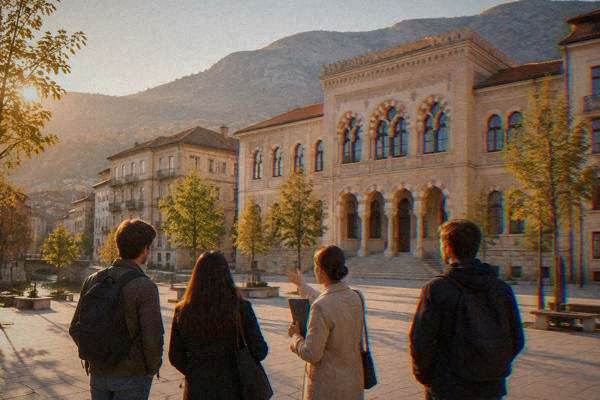
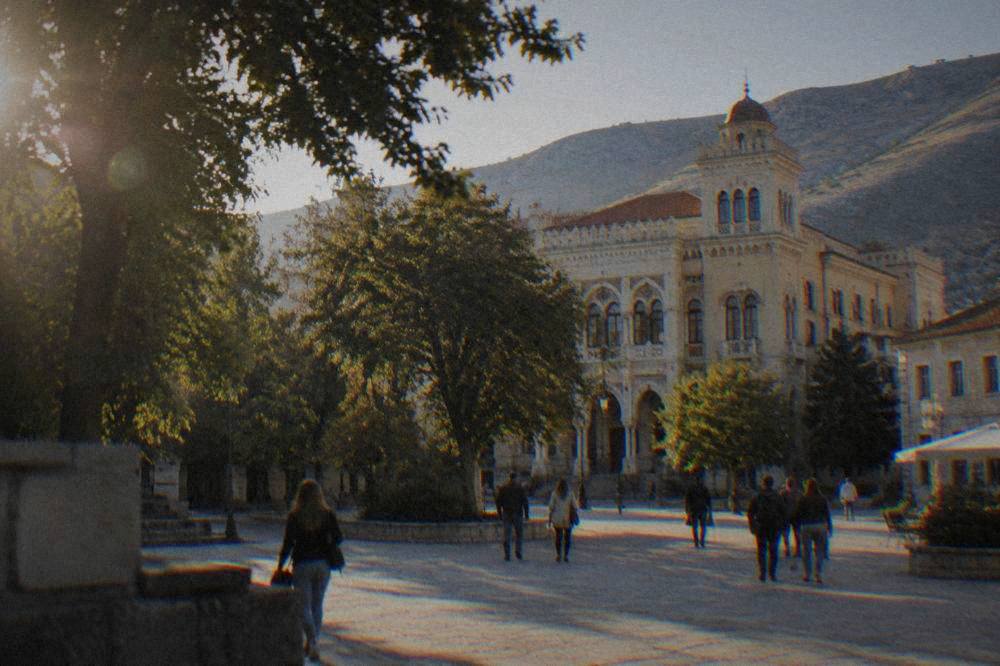
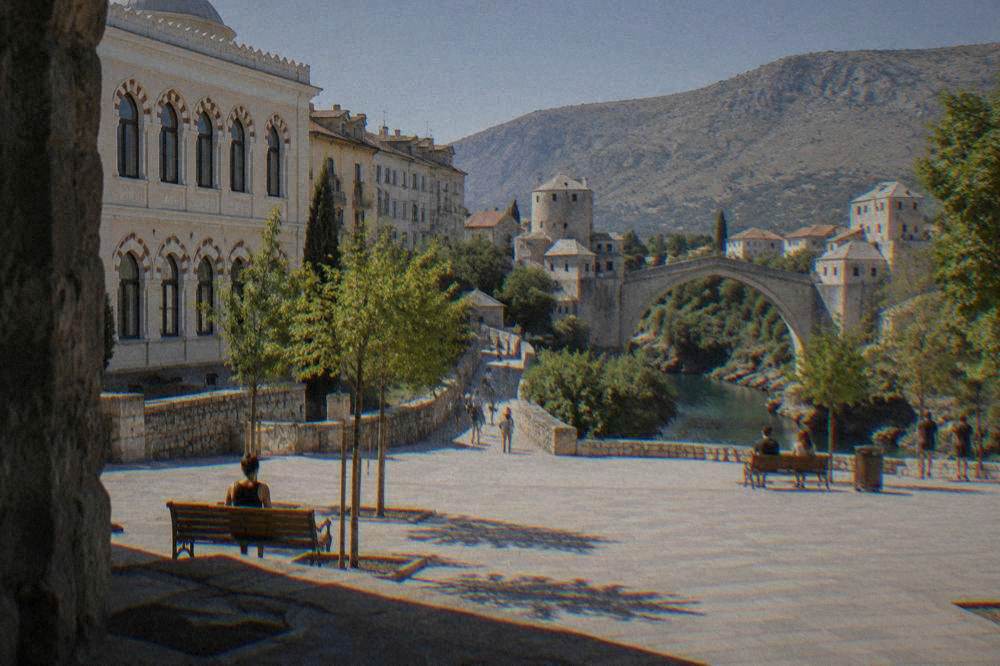
The west bank grew as the modern city's administrative and commercial centre, and that is still its job. Banks, government offices, the main post office, hotels, cafes and shops line the Bulevar and the streets running off it. Spanish Square, the paved open space that anchors the western edge of the centre, is the city's main public gathering point, and the Gymnasium Mostar building beside it is one of the most recognised structures in the country. A good way to see how the two halves interlock is the free walking tour of Mostar, which typically starts on the western side and works toward the river.
For orientation, think of the west side as a grid of broad streets sloping gently down to the Neretva, with Hum, the wooded hill topped by the large cross, rising over it. The Old Town, by contrast, is a dense web of cobbled lanes. They are five to fifteen minutes apart on foot depending on where you start, which is why the west bank is where a large share of the city's hotel capacity sits: it is quiet at night and close to everything by day. The one day in Mostar itinerary shows how a single day splits naturally between the two banks.
What To See On The Bulevar And Around The Rondo In Mostar?
The Bulevar and the Rondo give you Spanish Square and the Gymnasium, the city's main shopping streets, the daily rhythm of cafes and market stalls, and the climb to the Hum hillside viewpoints, all within a walk of no more than twenty minutes end to end. None of it needs a ticket. Spanish Square is the anchor. It is a wide, stone-paved plaza used for public events, and in summer 2026 it sat inside the programme of Mostarsko ljeto, the city-wide cultural festival that ran from 25 June to 7 August. The square is also the natural start or finish point for walks, because every street of consequence eventually leads back to it.
From Spanish Square, the shopping streets run east toward the river. This is where the city buys its clothes, phones and coffee, and where the cafe culture is at its most local: terraces fill in the late morning and again after dark in summer. The Rondo, a few minutes south, is the roundabout where the west bank's traffic arteries meet, and around it cluster more cafes, small businesses and apartment blocks built from the Austro-Hungarian period onward. None of the individual buildings here carries the weight of Stari Most or the Old Bridge museum, but that is the point: the west side shows the living city rather than the museum city.
Two sights on the western side deserve a deliberate detour. The first is the Partisan Memorial Cemetery on Vukovarska street, the hillside monument designed by architect Bogdan Bogdanović and inaugurated in 1965. It is unstaffed, has no ticket and no posted hours, and it is in fragile condition: over 700 of its stone memorial markers were destroyed in 2022, and Europa Nostra's 2026 report lists it among Europe's most endangered heritage sites. Read the Partisan Memorial Cemetery guide before going, because access is limited and caution is advised. The second is the view from Hum, the hill whose cross is visible from across the city; the trail up is popular at sunset.
For travellers who want the west side's story told rather than self-guided, the themed walks are strong. The street art and murals of the newer city have become a draw in their own right, and the Mostar Street Art & Murals tour covers exactly this territory, on the western and modern side of the river. History walks that deal with the war and the collapse of Yugoslavia also run largely on this bank, where the former front line ran, and the Death of Yugoslavia tour in Mostar is the best-known of them; the site's own Mostar war history pages set out what those tours cover.
What Are The Best Things To Do In West Mostar Beyond The Bulevar?
Beyond the Bulevar, west Mostar offers the university quarter, the Carinski bridge river walk, hill climbs on Hum, shopping malls and the city's main green spaces, plus a growing food workshop scene built around burek and Bosnian home cooking, several of which run in kitchens minutes from the Rondo. The river walk is the underrated one. The path along the western bank of the Neretva gives the classic view of Stari Most from river level without the crowds on the bridge itself, and it connects the newer bridges downstream with the old quarter. In the other direction it climbs toward the Razvitak and Ivana Krndelja streets that form the west's secondary shopping core.
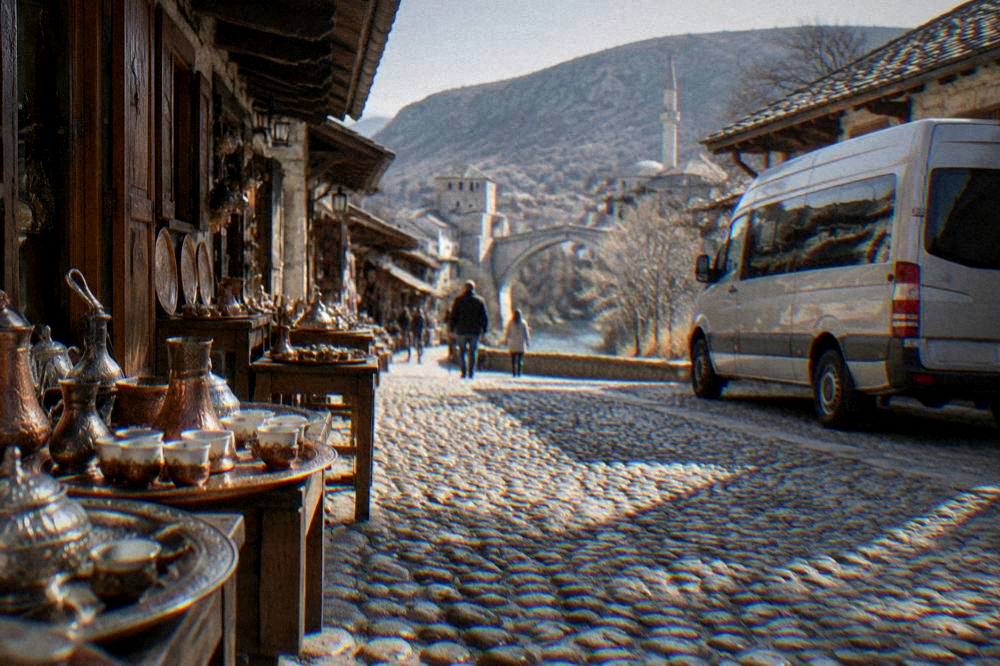
The Carinski bridge, the modern road bridge just north of Stari Most, is where photographers go for the postcard view at dawn, when the light comes down the valley and hits the Old Bridge full on. Walk south instead and the path leads under the cliffs toward the Blagaj tekke departure points used by day-tour vans, since many Herzegovina day trips pick up from hotels on the west bank. That matters for planning: staying west does not cost you anything in day-trip access, it usually helps.
The food workshops are the west side's genuine addition to a Mostar visit. Burek, the rolled pastry filled with meat or cheese, is the everyday food of the city, and hands-on classes teach the rolling, the baking and the eating, usually with Bosnian coffee to follow. The Bosnian coffee guide explains the ritual that surrounds the cup, and the burek guide covers the pastry itself. Two bookable options stand out: a burek masterclass in Mostar, and a longer Bosnian cooking class with burek, lunch and drinks. Both sit within easy reach of the west-bank centre.
For something a little different, the west side is also where the active tours gather. The Neretva kayak safari puts in on the river that separates the two halves of the city, and the via ferrata routes on Hum are reached from the western side. The water deserves respect even in August: the Neretva is karst-fed and stays cold, and swimmers should read the site's guidance on swimming in the Neretva at Mostar before jumping in anywhere.
How Does West Mostar Connect To The Old Town Of Mostar On Foot?
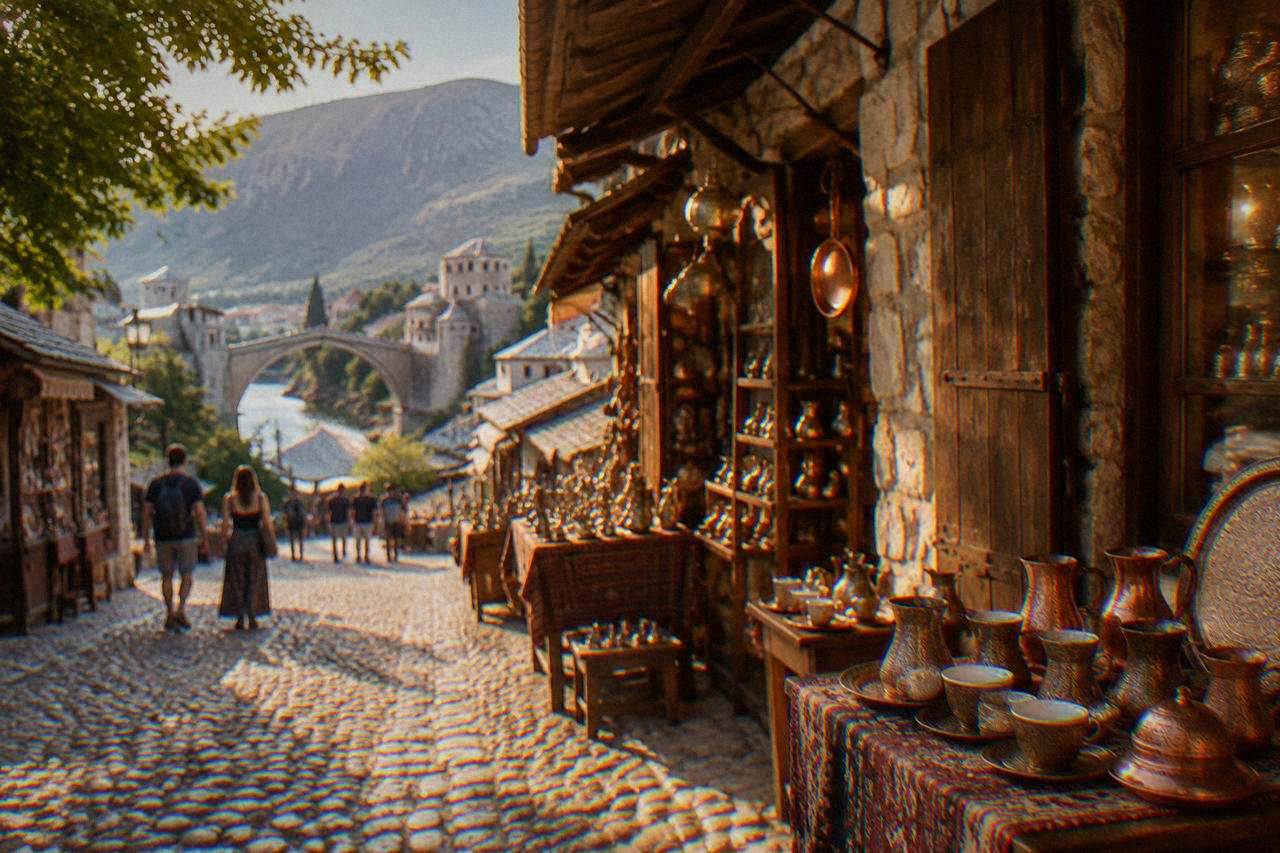
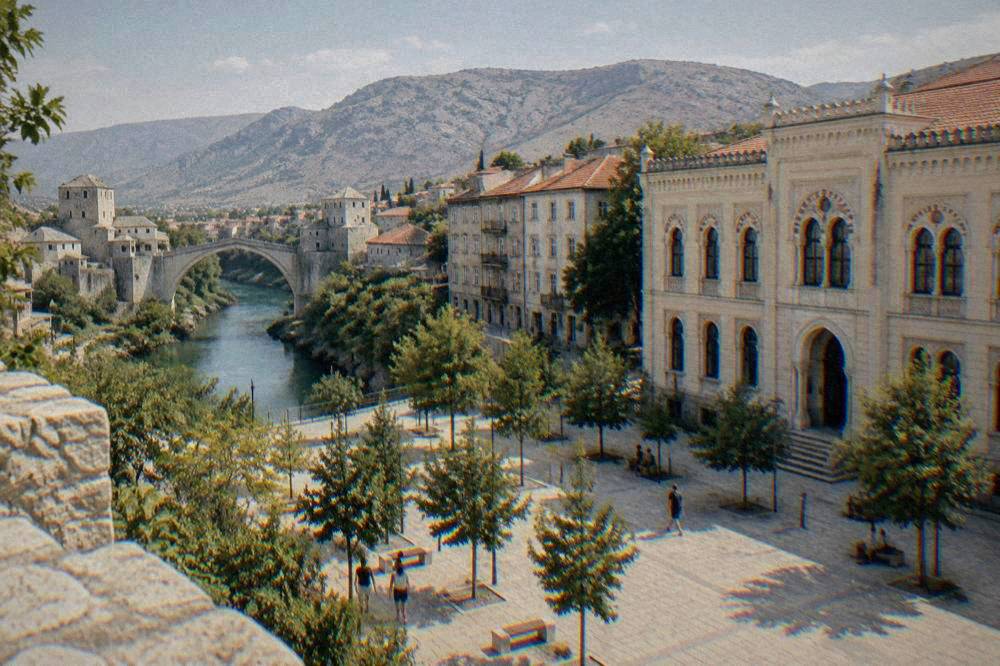
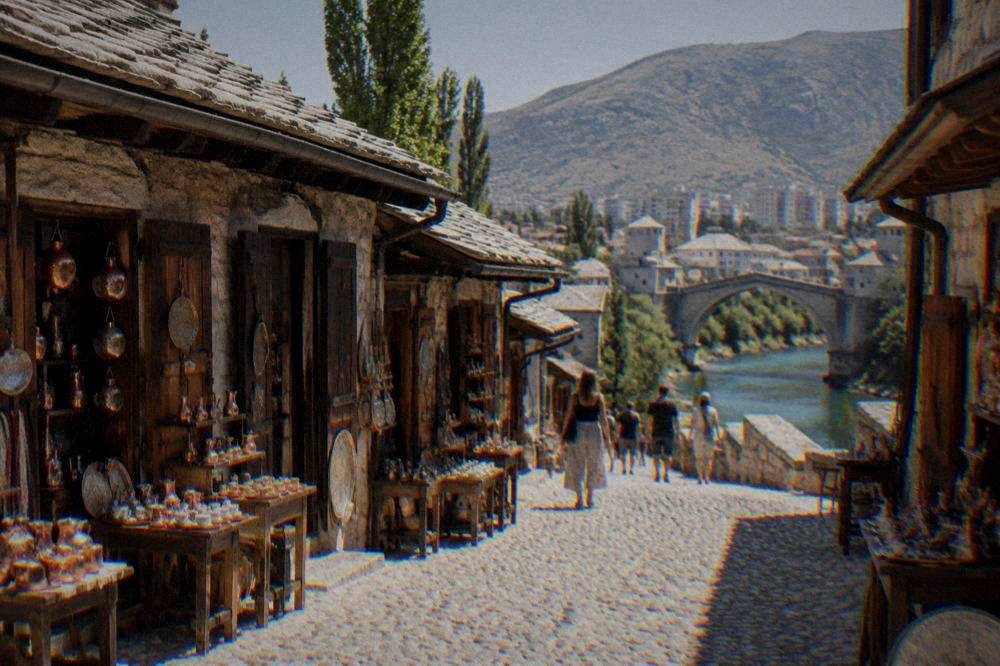
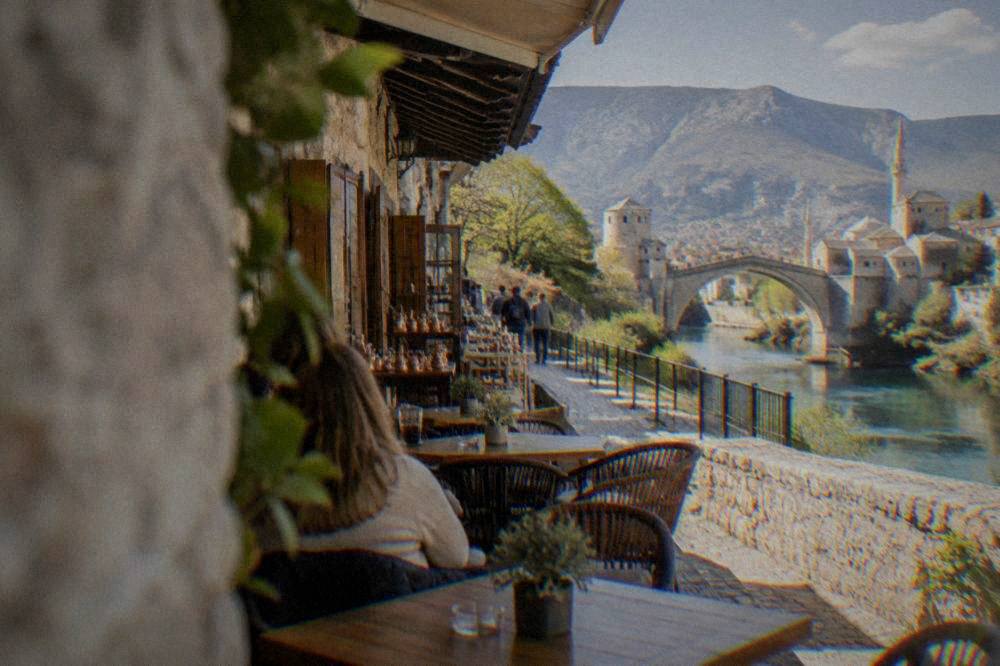
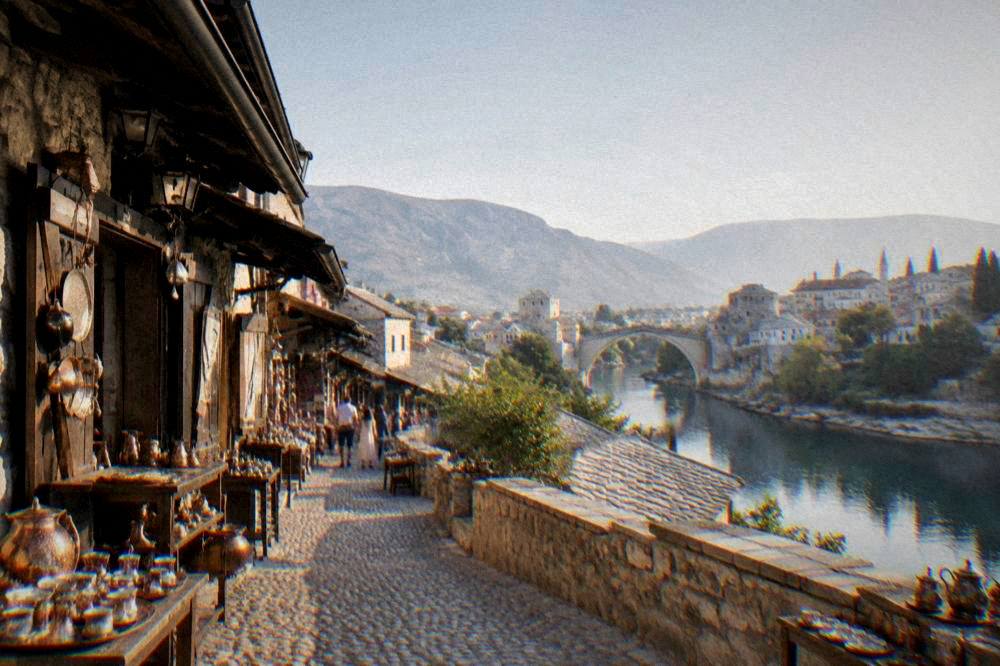
West Mostar connects to the Old Town across the Neretva by a chain of bridges, with Stari Most itself the famous link at the southern end; the walk from the Rondo to the Old Bridge takes roughly ten to fifteen minutes, downhill on the way there and gently uphill on the way back, and the whole city centre is comfortably walkable without transport. The most natural route runs from Spanish Square down the pedestrian streets toward the river, arriving at the Crooked Bridge, the small single-arch stone bridge over the Radobolja stream that is often described as a miniature rehearsal for its larger neighbour, and from there into Kujundžiluk, the coppersmiths' bazaar street.
The alternatives matter at busy times. The Carinski bridge upstream carries regular road traffic and gives the elevated view of Stari Most without setting foot in the crowds. Downstream, the pedestrian bridges near the university buildings connect the newer west with the eastern neighbourhoods around the Muslibegović House and Bišćević House, the two Ottoman courtyard houses on the east side that sit only a few minutes' walk from the west's hotels. Distance here is trivial: the entire stretch from the Rondo to the far end of Kujundžiluk is under two kilometres.
The surface is the one thing to plan for. The west bank's pavements are modern and even; the Old Town's lanes are cobbled and polished smooth, and the bridge approaches slope. Anyone building a day around both banks should follow the two days in Mostar itinerary, which deliberately puts one bank per day in a sensible order, and the walkable city answer page addresses mobility questions directly.
Where Should You Stay In West Mostar?
West Mostar is the practical base for a first visit: its hotels and apartments cluster along the Bulevar and the streets between Spanish Square and the river, putting you five to fifteen minutes on foot from Stari Most while keeping you clear of the late-night noise of the bazaar streets. The trade-off is straightforward. East-bank accommodation inside the Old Town puts you inside the postcard but inside the crowds too, and in high summer the lanes around Kujundžiluk stay busy late. West-bank rooms trade atmosphere for sleep and space, and the walk across the river is short enough that it stops feeling like a commute by the second day.
Three zones make sense on the western side. Around Spanish Square and the streets immediately east of it, everything is walkable and the cafe choice is wide. Along the Bulevar itself, hotels sit above the bus routes that run north-south, which helps if day trips are on the plan. Further west toward the university and the Rondo, apartments are quieter and cheaper, at the cost of a longer evening walk home. The full comparison, including the east-bank options around Koski Mehmed-pašina džamija and Donja mahala, is in the site's where to stay in Mostar guide. The wider set of guides lives on Mostar Travel Guide.
One cost to factor into any stay anywhere in the canton: a tourist tax reported at 3 KM per person per night has applied in Herzegovina-Neretva Canton from 1 January 2026. It is normally collected by the accommodation at check-in or checkout; confirm the amount with your host when booking, because it is separate from the room rate. Prices themselves vary by season, so treat any figure you see online as a snapshot rather than a rule.
What Is The Modern History Behind West Mostar's Streets?
West Mostar's modern face was shaped in the Austro-Hungarian period from 1878 to 1918, when administration and commerce spread west of the river, and later still, when the Bulevar became the showcase street of a growing industrial city; the oldest structure visitors cross, Stari Most itself, was completed in 1566, destroyed on 9 November 1993 and reopened in July 2004. The city's name is older than all of it: Mostar is first mentioned in writing in 1474, and the name comes from the bridge keepers, the "mostari", who guarded the earlier wooden crossing on the Neretva. The stone bridge followed under Suleiman the Magnificent, and the Ottoman town grew on the eastern bank around it.
The west bank's rise came later and differently. Administration, rail, banking and schools arrived with the Austro-Hungarian period from 1878 to 1918, and the later years added the Bulevar's apartment blocks, the Gymnasium, the university and the residential neighbourhoods that now stretch toward Hum. The war from 1992 to 1995 damaged the modern city heavily; the facts that matter for a visitor are physical and dated, and guided history walks handle them with care. The Mostar history guide and the war history overview carry the full chronology, and the guided walks mentioned above, including the Death of Yugoslavia walking tour, cover the former front line through the western neighbourhoods.
Building continues on this bank today, and two projects reported in local media in 2026 show the direction of travel. Construction of the new HNK Mostar theatre building is under way, with completion estimated in spring 2028, and the reconstruction of the former Hotel Ero on the west side into a cantonal administrative headquarters is expected to begin after a tender process concluded in late 2025, at an estimated total cost of about 23 million KM. Neither will change a visit tomorrow, but both explain the cranes visible from the Bulevar.
Is West Mostar A Good Base For Day Trips Around Herzegovina?
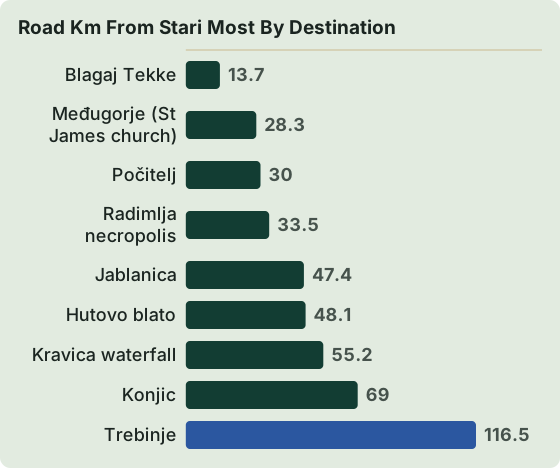
West Mostar works well as a day-trip base because the Herzegovina highlights sit in a tight ring around the city: Blagaj and its tekke at the Buna spring is 13.7 km and about 19 minutes away by road, Počitelj is 30 km and about 31 minutes, and Kravica waterfall is 55.2 km and about 54 minutes free-flow, all computed from Stari Most with no border queues. Add Međugorje at 28.3 km, the Radimlja stećci necropolis near Stolac at 33.5 km, Hutovo blato at 48.1 km and Konjic at 69 km, and the pattern is clear: nearly everything the region is known for is a short drive or an easy organised tour from the west bank, whose hotels and pickup points are where the tour vans begin their loops.
The standard one-day circuit is Blagaj, Počitelj and Kravica waterfall, and it is the trip to book if you book only one. The site's Blagaj, Počitelj and Kravica in one day guide breaks down the sequence, costs and timing. Entry at Kravica is 20 KM for an adult all year, 10 KM for residents of Bosnia and Herzegovina, with children under 7 free, and the park opens every month of the year with hours that stretch to 07:00-22:00 from June to September. The Blagaj tekke charges a reported 10 KM, with a dress code of covered shoulders and knees, wraps provided at the entrance; confirm current fees on arrival.
| Destination | Road km from Stari Most | Free-flow minutes |
|---|---|---|
| Blagaj Tekke | 13.7 | 19 |
| Međugorje (St James church) | 28.3 | 40 |
| Počitelj | 30.0 | 31 |
| Radimlja necropolis | 33.5 | 42 |
| Jablanica | 47.4 | 57 |
| Hutovo blato | 48.1 | 62 |
| Kravica waterfall | 55.2 | 54 |
| Konjic | 69.0 | 80 |
| Trebinje | 116.5 | 142 |
Guided tours remove the driving and, on the best of them, the queueing. A private option such as the private Kravica, Blagaj, Počitelj, Buna channel and skywalk tour covers the headline circuit with a driver-guide, while shared minivan versions cover the same ground for less. If Herzegovina as a whole is the goal, the Herzegovina road trip itinerary strings the region together over several days from a west-bank start.
Cross-border trips need a different kind of planning. Bosnia and Herzegovina is not in the EU and not in Schengen, so the Croatian land border is a Schengen external border with full passport checks; reported waits run up to about 30 minutes, longer at summer peaks. Dubrovnik is 145.5 km and about 150 minutes of free-flow driving from Stari Most, and Split is 174.1 km and about 131 minutes, both before border time. The site's border crossing guide covers the crossings, and the day trip from Dubrovnik and day trip from Split pages cover the reverse journey for anyone based on the coast.
What Practical Facts Should You Know For West Mostar?
West Mostar runs on the convertible mark (KM, BAM), pegged at 1 EUR = 1.95583 KM, on type C and F plugs at 230 V, and on three official languages, Bosnian, Croatian and Serbian; euro cash is often accepted in tourist areas at a rounded rate of about 2 KM to the euro, so confirm the rate before paying, and the general emergency number is 112. The currency board peg is exact, so there is no exchange-rate guessing between the euro and the mark: the fixed rate is published to five decimal places. Cards work at hotels, larger restaurants and supermarkets, while small vendors and markets prefer cash, and bank ATMs are dense along the Bulevar.
The climate deserves a sentence of respect. The FHMZ station table for Mostar, 1961 to 1990, records a July mean temperature of 24.7 C and an absolute maximum of 41.2 C, with annual precipitation of 1,515.4 mm concentrated in a winter maximum: November averages 200.0 mm against July's 42.9 mm. Modelled figures, ERA5 reanalysis 1991-2020, put August's mean daily high at 30.5 C and January's mean daily low at 0.2 C. In plain terms: summer afternoons are seriously hot and winter days are often mild with cold nights, and the Mostar weather and best time to visit pages carry the month-by-month detail.
| Month | Mean temp C (FHMZ 1961-1990) | Rain mm (FHMZ 1961-1990) | Mean daily high C (ERA5 1991-2020) |
|---|---|---|---|
| January | 4.8 | 164.7 | 8.4 |
| April | 13.3 | 127.3 | 17.7 |
| July | 24.7 | 42.9 | 29.9 |
| August | 24.2 | 73.7 | 30.5 |
| November | 10.1 | 200.0 | 14.1 |
Two safety notes apply to the region rather than the neighbourhood. In rural Herzegovina, stay on marked paths because of suspected mine areas from the war; the BHMAC authority maintains the suspected-area data, and marked trails everywhere in the region reflect it. In the city itself, ordinary urban caution is enough: the site's night safety answer page addresses the question directly.
Getting in and out shapes the practical side too. Mostar International Airport is 8.2 km and about 12 minutes by road from Stari Most, with reported routes to Zagreb and Stuttgart kept through the winter 2026/27 schedule; most long-haul visitors arrive via Sarajevo or Dubrovnik airports. The train to Sarajevo resumed on 15 October 2026 with two departures each way daily, and the bus station on the west side runs coaches to Sarajevo, Dubrovnik and Split among others. The getting around Mostar guide has the full picture.
| Service | Number |
|---|---|
| General emergency | 112 |
| Police | 122 |
| Fire | 123 |
| Ambulance | 124 |
What Does A West Mostar Budget Look Like?
A west Mostar budget is moderate by European standards: accommodation, cafe coffee, bakery burek and city-centre sights are inexpensive, the two headline paid sights on the two banks, the Old Bridge museum at a reported 10 KM and Kravica waterfall at 20 KM, are the exceptions, and a tourist tax of 3 KM per person per night, reported from 1 January 2026, applies across the canton. The currency helps planning: because the mark is pegged to the euro at 1.95583, every price converts the same way every day, and the common rounded euro-acceptance rate of about 2 KM to 1 EUR tells you instantly what a vendor is really charging when they quote both.
The city-centre costs are low or zero. Crossing Stari Most costs nothing at any hour. Kujundžiluk, the bazaar street, is a public street. The Ottoman courtyard houses on the east bank charge small reported fees, about 8 KM at Muslibegović House and about 4 KM at Bišćević House, and Koski Mehmed-pašina džamija charges a small cash fee, more with the minaret climb; confirm each on site, since none is published on an official page. On the west bank, Spanish Square, the river walk, Hum's trails and the Partisan Memorial Cemetery are all free, the last with the access caution noted above.
| Sight | Side of the river | Fee | Status |
|---|---|---|---|
| Kujundžiluk bazaar | East | Free | Public street |
| Muslibegović House | East | About 8 KM | Reported |
| Bišćević House | East | About 4 KM | Reported |
| Old Bridge Museum | East | 10 KM | Reported |
| Spanish Square and river walk | West | Free | Public space |
Tours and day trips are the flexible part of any budget. Beyond that, the Mostar budget guide and the free things to do in Mostar guide give the low-cost and no-cost sides of the city in full, and the is Mostar expensive answer settles the headline question.
Common Questions About West Mostar
How Far Is West Mostar From The Old Bridge?
The Rondo, the west bank's central roundabout, is roughly a ten to fifteen minute walk from Stari Most, downhill toward the river on the way there. Spanish Square sits about midway, and the whole centre of Mostar, both banks included, is comfortably walkable without transport.
Is West Mostar A Good Place To Stay In Mostar?
Yes, for a first visit it is the practical choice: hotels and apartments cluster between Spanish Square and the river, five to fifteen minutes on foot from the Old Town, away from the late-night noise around the bazaar. The trade-off is atmosphere, since the Ottoman quarter is on the eastern bank.
What Is The Bulevar In Mostar?
The Bulevar is the main north-south thoroughfare of the western half of the city, lined with shops, cafes, banks and administrative buildings. It runs from the north of the city down toward the Rondo roundabout and the streets leading to the river crossings.
Can You Walk From West Mostar To The Old Town?
Yes, and walking is the normal way to do it. The route from Spanish Square leads down to the Crooked Bridge over the Radobolja stream and into Kujundžiluk, the coppersmiths' bazaar street, which ends at Stari Most. The cobbles in the Old Town are polished and can be slippery when wet.
What Currency Do You Need In West Mostar?
The convertible mark (KM, BAM), pegged to the euro at 1 EUR = 1.95583 KM. Euro cash is often accepted in tourist areas at a rounded rate of about 2 KM to the euro; confirm the rate before paying, and prefer marks at small vendors and markets.
Do Day Trips To Blagaj And Kravica Leave From West Mostar?
Yes. Organised Herzegovina day trips typically pick up from west-bank hotels and central points before looping Blagaj, Počitelj and Kravica waterfall. Blagaj is 13.7 km and about 19 minutes from Stari Most by road; Kravica waterfall is 55.2 km and about 54 minutes free-flow.
West Mostar rewards exactly the kind of slow attention the Old Town crowds make difficult: a plaza that doubles as the city's living room, a river walk with the best free view of the bridge, a hillside monument that asks for quiet, and a cooking class where the city's everyday food is rolled, baked and eaten within sight of the river that divides and joins the two halves of this Herzegovinian city.