Free Things To Do In Mostar
Mostar gives away its best view for nothing. The Old Bridge crossing, the Kujundžiluk bazaar, the Crooked Bridge, the viewpoints over the Neretva valley and two free, tip-based walking tours all cost 0 KM, and this guide lists them with the distances and figures that matter.
The free core of Mostar is walkable and needs no tickets: crossing Stari Most is free at any hour, Kujundžiluk and Kriva ćuprija are public streets, the Partisan Memorial Cemetery has no ticket or staffed hours, and two GuruWalk free tours run on a pay-what-you-want basis.
Mostar, the main city of Herzegovina on the Neretva river, is one of those destinations where the headline attraction costs nothing to see. Crossing the Old Bridge, Stari Most, is free at any hour of the day or night, the Old Bazaar around it is a public street, and the UNESCO World Heritage property that frames the whole scene, inscribed in 2005, is open air. Add two free, tip-based walking tours, a string of viewpoints above the valley and villages like Počitelj that charge no entrance, and a low-spend visit is genuinely workable. The paid layer exists, from the Old Bridge Museum to guided day trips, but nothing on this page requires a ticket unless it says so. This desk publishes the fuller paid picture elsewhere, starting with the root guide to things to do in Mostar; this page is the 0 KM version.
What Can You See In Mostar Without Paying Anything?
The essential sights of Mostar that cost nothing are the Old Bridge crossing, the Kujundžiluk bazaar, the Crooked Bridge (Kriva ćuprija), the streets and squares of the Old Town, the Partisan Memorial Cemetery, the Spanish Square and the bluff of Hum above the city, all of them public spaces with no ticket, no gate and no opening price. The bridge, the bazaar and the riverside are within a five-minute walk of one another, so the free core is compact and flat except where the valley sides rise. Nothing on that list closes for the night, though unlit paths above the river are a different matter after dark.
The pattern to understand is simple: Mostar charges for interiors, not views. Mosques, museums and Ottoman house museums ask a small cash fee to step inside, while the streets, bridges, squares and hillsides they sit among are public. A visitor who plans the day around exteriors and public space loses very little. The Old Bridge Area of the Old City of Mostar, the UNESCO property, is precisely that kind of asset: an urban landscape rather than a gated site.
The table below is the honest inventory of the free list, sight by sight.
| Sight | What it is | Cost |
|---|---|---|
| Stari Most (Old Bridge) | Public pedestrian bridge, free to cross at any hour | Free |
| Kujundžiluk bazaar | Old Bazaar street on the east bank | Free, public street |
| Kriva ćuprija (Crooked Bridge) | Small stone bridge on the Radobolja stream | Free, public structure |
| Old Town streets and squares | Ottoman-era street network, UNESCO property | Free |
| Spanish Square | Central city square | Free |
| Partisan Memorial Cemetery | Hillside monument by Bogdan Bogdanović, inaugurated 1965 | No ticket, no staffed hours |
| Hum hill | Ridge above the city with a cross at the top | Free to walk |
One entry deserves a caveat. The Partisan Memorial Cemetery is a national monument in poor condition: over 700 of its stone memorial markers were destroyed in 2022, and Europa Nostra listed the site among Europe's most endangered in 2026. There is no ticket desk and no staff. Treat it as a place to walk and read rather than a polished attraction, and go in daylight. The deeper story of the city, including that monument, is covered in the Mostar war history guide.
Which Old Town Sights Cost Nothing To Enter?
Every outdoor sight in Mostar's Old Town is free: the bridge, the bazaar, the Crooked Bridge, the Radobolja streamsides and the lanes climbing to the mosques' courtyards, while the interiors beside them, the Old Bridge Museum at a reported 10 KM, Koski Mehmed-pašina džamija at a small reported cash fee and the Ottoman house museums, are the only paid layer. The split matters for planning. A walk that keeps to streets, riverbanks and courtyards costs 0 KM from end to end. The moment you step through a doorway, a few marks usually change hands, and those fees are best confirmed on the spot since they shift.
Start the free loop at the bridge itself, which needs no introduction and no ticket. Walk it in both directions: the arch reads differently from each bank, and the river below stays cold even in August, fed by karst springs. On the east bank, Kujundžiluk runs downhill parallel to the water, a cobbled bazaar street of coppersmiths and small shops. Halfway along, side lanes drop to the Radobolja stream, where Kriva ćuprija, a modest stone arch that prefigures the great bridge in miniature, crosses quietly and with no crowd fee because there is no crowd. The full loop, bridge to bazaar to Crooked Bridge and back along the west bank, is a walk of minutes, not hours.
For anyone who wants the same ground explained rather than merely walked, a guided option exists that pairs well with a tight budget, since the paid sights can then be chosen deliberately afterwards rather than on impulse. The private walking tour from this site's roster covers the Old Town on foot with a guide, and there is a fuller write-up on the Mostar private walking tour page.
For readers weighing the paid interiors against a purely free day, the comparison is straightforward.
| Experience | Inside or outside | Typical cost |
|---|---|---|
| Crossing Stari Most | Outside | Free |
| Kujundžiluk bazaar | Outside | Free |
| Kriva ćuprija | Outside | Free |
| Old Bridge Museum (Tara tower) | Inside | Reported 10 KM |
| Koski Mehmed-pašina džamija interior | Inside | Small reported cash fee, more with the minaret |
| Muslibegović House | Inside | Reported about 8 KM |
| Bišćević House | Inside | Reported about 4 KM |
The house-museum fees above are reported figures rather than posted tariffs, so confirm at the door. Koski Mehmed-pašina džamija is covered in detail, including its courtyard and minaret, in the Koski Mehmed Pasha Mosque guide.
Is The Old Bridge Really Free To Cross, And When Is It Best?
Yes, crossing the Old Bridge in Mostar is free and open at every hour, because Stari Most is a public pedestrian route with no ticket, no gate and no closed period, and the best free times to be on it are early morning before the bazaar fills and the hour before sunset when the light comes down the Neretva valley. The bridge stands about 21 to 24 metres above the river depending on the water level, and its single stone arch, completed in 1566 to a design attributed to the architect Hajruddin, spans roughly 29 metres. None of that costs a mark to look at or walk over.
The bridge's story is physical fact, plainly told. It was destroyed on 9 November 1993 during the war and rebuilt with original techniques and salvaged stone, reopening in July 2004. The surrounding Old Bridge Area joined the UNESCO World Heritage List in 2005. None of this history is paywalled either: it is written on the site itself, on plaques and in the streetscape, and a visitor who reads before walking gets far more from the free crossing than one who treats it as a photo stop.
One free spectacle deserves a specific mention: the bridge divers. Members of the Mostari diving club jump from the parapet through the warmer months, typically late morning to early afternoon, after collecting tips from the banks. The jumps are done by trained club members only; there is no pay-to-jump option for visitors, and no one should treat the parapet as anything but a viewing point. The tradition peaks at the annual competition, whose 460th edition ran on 26 July in 2026, and the Red Bull Cliff Diving round followed from 30 July to 1 August 2026. Watching either costs nothing from the banks. The full picture, including platform heights of 21 m for women and 27 m for men at the Red Bull event, is in the Mostar bridge diving guide.
For travellers who would rather have the schedule and the stories sorted by a local expert than assemble them from guides, a mid-visit option is worth one click.
Where Are The Best Free Viewpoints Over Mostar?
The free viewpoints over Mostar are the west-bank terraces below Koski Mehmed-pašina džamija, the stairs and lanes climbing the east side of the valley, the heights of Hum across the river, and the road bends toward Fortica above the city, all of them public ground with no entry charge, with the classic postcard angle of the Old Bridge found from the rocky platforms just downstream on the east bank. Sunrise belongs to the east-bank climbs, when the sun hits the bridge from behind the west bank; late afternoon reverses the favour and lights the arch from the west. Neither costs anything but the walk up.
The climbs are short but real: Mostar sits in a valley, and every good angle is earned by stairs. The east side rises steeply behind Kujundžiluk, and the lane network there delivers rooftop-level bridge views within a few minutes of walking. Hum, the long ridge opposite, is a longer undertaking on foot and best treated as a half-morning objective with water and sensible shoes. In summer, take the heat seriously: the FHMZ station series for Mostar, 1961 to 1990, records an absolute maximum of 41.2 C in July, and the modelled ERA5 reanalysis for 1991 to 2020 puts mean daily highs at 29.9 C in July and 30.5 C in August. Climb early, rest at midday. More of these guides are collected on Mostar Travel Guide.
| Viewpoint | What you see | Effort |
|---|---|---|
| East-bank rocks below Stari Most | The classic bridge and river angle | A short scramble |
| Lanes behind Kujundžiluk | Rooftops, minarets, bridge from above | Steep stairs, minutes |
| West-bank terrace by the mosque | Bridge, river and east-bank cliff | Flat, steps down |
| Hum ridge | Whole city and valley | Long uphill walk |
| Road toward Fortica | City basin and surrounding hills | Steady climb |
The full inventory, including what each angle adds, is in the dedicated Mostar viewpoints guide. In every case the rule above applies: the view is public, the vertical is the only price.
Are There Free Walking Tours In Mostar?
Yes, Mostar has two free, pay-what-you-want walking tours listed on GuruWalk, an English-language platform for tip-based walks: "Mostar All in One, Free Tour" and "From the Spanish Square to the Old Bridge: Mostar Uncovered", both free to book with the guru paid by tip at the end, and both covering the Old Town core on foot. The first is the broader circuit; the second, as its name says, runs from the Spanish Square down to the bridge. Neither has a fixed price, and neither should be presented as anything other than free or pay-what-you-want.
The tip-based model suits Mostar well, because the city's story is layered and a local guru can move a walk between the Ottoman streets, the bridge history and the recent past in a way signage cannot. Meeting points, days and start times sit on each walk's listing and shift with the season, so check the listing before turning up. Budget the tip as you would a coffee or a lunch: it is the entire pay for the person leading the walk.
Details for the first of the two, including where it fits among this site's tour pages, are on the Mostar All in One free tour page. The companion option, the Old Town free walk guide on this site, explains the GuruWalk model in more depth for travellers who have not used a tip-based walk before.
What Free Day Trips Can You Make From Mostar?
The best free day trips from Mostar are Počitelj, a fortified village 30.0 km and about 31 minutes by road, and the pilgrimage sites of Međugorje, 28.3 km and about 40 minutes, both of which charge no entrance to their public sites, while Blagaj's village, riverbank and the view of the Buna spring are free even though the Blagaj Tekke itself charges a reported 10 KM to enter. Stolac's old town is likewise free to wander, 36.8 km and about 47 minutes out. The pattern repeats: villages, fortresses viewed from outside and hillsides cost nothing; interiors and organised rides do.
Počitelj is the strongest of these. The stone village climbs a hillside above the Neretva, its fortress tower and mosque silhouettes visible from the road, and the village lanes themselves are public. Reports mention a small optional fee for entering the mosque, in the region of a couple of euros, so treat the interior as optional and the rest as free. Međugorje's hills and church are free and open around the clock, with modest dress expected at the church. Blagaj deserves the drive for the Buna spring alone: the river bursts from a cliff base beneath Stjepan-grad, and the riverside paths and views cost nothing.
| Destination | Road distance from Stari Most | Free-flow drive time | Public sites free? |
|---|---|---|---|
| Blagaj (village and Buna spring) | 13.7 km | about 19 min | Yes; Tekke interior reported 10 KM |
| Međugorje (St James church) | 28.3 km | about 40 min | Yes, all sites |
| Počitelj | 30.0 km | about 31 min | Village free; small optional mosque fee reported |
| Stolac | 36.8 km | about 47 min | Old town lanes free |
| Kravica waterfall | 55.2 km | about 54 min | No, entry is 20 KM all year |
Kravica waterfall sits on the list for contrast: it is the one Herzegovina highlight that is firmly paid, at 20 KM for an adult all year, 10 KM for residents of Bosnia and Herzegovina and free entry for children under 7. It appears here so nobody plans a "free waterfall afternoon" around it. Organised trips bundle the logistics; the options reaching Blagaj, Počitelj and Kravica together are compared in the Kravice, Blagaj and Počitelj in one day guide, and the wider paid picture sits in the Mostar budget companion.
Getting to these villages without a car is the catch. Local buses reach Blagaj and Međugorje on published lines, and the practical detail is in getting around Mostar. For drivers, cross-border plans toward Dubrovnik bring the Croatian border into play, covered in the Croatia-Bosnia border crossing guide.
How Do You Keep A Mostar Day At Nearly Zero Cost?
A near-zero day in Mostar works by pairing the free core, the bridge, the bazaar, the Crooked Bridge and a viewpoint climb, with the free or tip-based GuruWalk walk, eating from bakeries rather than restaurants, drinking the public tap water, which is treated and generally safe, and reserving every mark for one deliberate paid interior if the budget allows. The tourist tax, reported at 3 KM per person per night in Herzegovina-Neretva Canton from 1 January 2026, applies to overnight stays and is worth confirming at booking, but it does not touch a day's sightseeing.
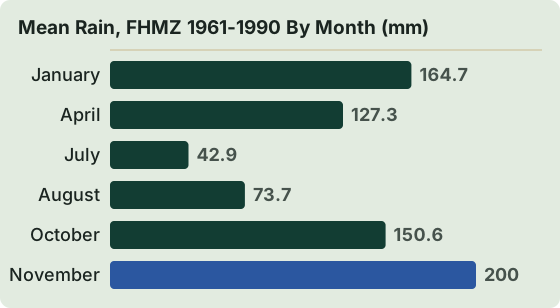
Weather shapes the plan more than money does. Mostar's rain has a winter maximum: the FHMZ station table for 1961 to 1990 shows November averaging 200.0 mm against July's 42.9 mm, roughly 4.7 times more. A free itinerary built on streets, hillsides and riverbanks needs the dry months more than a museum-heavy one does, which is one honest argument for summer despite the heat, or for late spring and early autumn as the compromise. The full monthly picture, including the modelled ERA5 normals for 1991 to 2020, is in the Mostar weather guide, and the seasonal trade-offs are weighed in the best time to visit Mostar.
| Month | Mean temp, FHMZ 1961-1990 (C) | Mean rain, FHMZ 1961-1990 (mm) | Modelled daily high, ERA5 1991-2020 (C) |
|---|---|---|---|
| January | 4.8 | 164.7 | 8.4 |
| April | 13.3 | 127.3 | 17.7 |
| July | 24.7 | 42.9 | 29.9 |
| August | 24.2 | 73.7 | 30.5 |
| October | 15.3 | 150.6 | 19.5 |
| November | 10.1 | 200.0 | 14.1 |
A few closing habits protect the budget without pinching the trip. Carry a refillable bottle. Confirm any interior fee at the door rather than from memory, since the reported figures for mosques and house museums move. Keep taxi rides short and few; the free core is entirely walkable. And if one paid experience earns its place, make it a guided one, either the tip-based walk above or a food-side detour such as the burek masterclass below, where the cost buys a skill that outlasts the trip.
Common Questions About Free Sightseeing In Mostar
Is the Old Bridge in Mostar free to cross?
Yes. Stari Most is a public pedestrian route with no ticket, open at every hour, and the surrounding Old Bridge Area is an open-air UNESCO World Heritage property.
What is free in Mostar's Old Town?
The bridge, the Kujundžiluk bazaar, the Crooked Bridge, the Old Town lanes and the riversides are all public and free. Interiors such as the Old Bridge Museum and the Ottoman house museums charge small reported fees.
Are there free walking tours in Mostar?
Yes.
Can you visit Kravica waterfall for free?
No. Entry is 20 KM for an adult all year, 10 KM for residents of Bosnia and Herzegovina, and children under 7 enter free, per the park's own visitor page.
Which day trips from Mostar are free?
Počitelj's village and fortress exterior, Međugorje's hills and church, Stolac's old town and Blagaj's riverside are free to wander. The Blagaj Tekke interior charges a reported 10 KM.
When is the best free time to see the Old Bridge?
Early morning before the bazaar fills, or the hour before sunset. The bridge is public at all hours, so the choice is about light and crowds, not opening times.
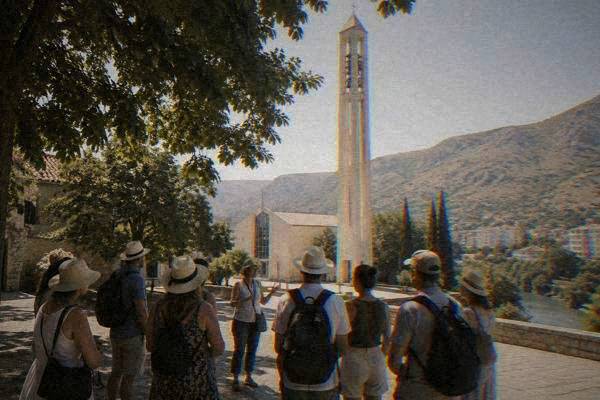
Before you go, the pick for this guide:
Free Tour, All in One
★ 4.68 134 reviews · Free, pay what you want
See this free tour on GuruWalk →