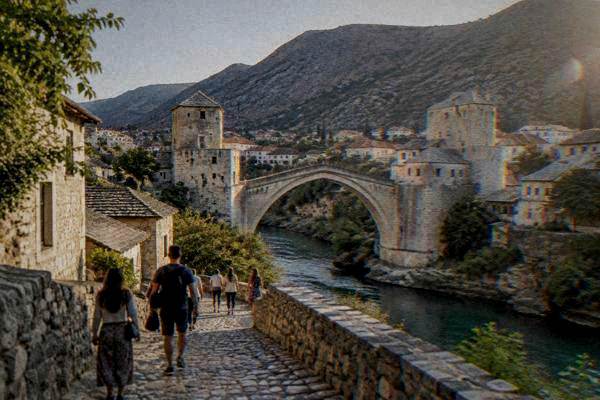
Visiting Mostar's Mosques: Tickets, Dress And Minarets
Mostar's mosque skyline is one of the defining images of Herzegovina's main city. Here is what entry costs, what to wear, when visits pause for prayer and which minarets you can climb.
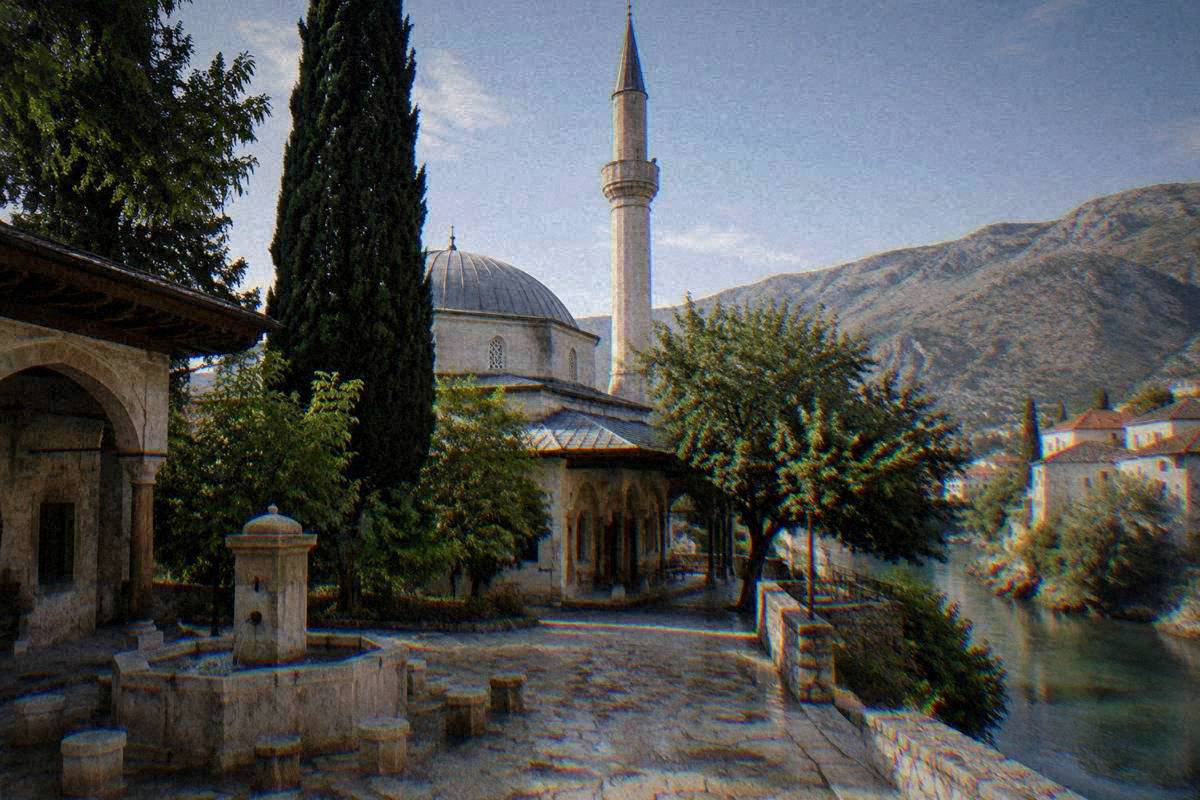
Mostar's mosques are working places of worship: entry costs a small cash fee (about 10 KM at Koski Mehmed-pašina džamija, more with the minaret), shoulders and knees must be covered, visits pause at prayer times, and no fee or hours are published for Karađoz-begova džamija, so confirm on arrival.
The minarets of Mostar rise above the roofline of the Old Town as clearly today as they did when Ottoman masons built them, and visiting them is one of the more rewarding parts of any stay in Herzegovina's main city. This page covers the practical side of visiting mosques in Mostar: what entry costs where a fee is known, how dress rules work, when visits pause for prayer, which minarets you can climb, and how the etiquette differs from a church or a museum visit. The two names to know are Koski Mehmed-pašina džamija, which stands directly beside the Neretva below Stari Most, and Karađoz-begova džamija, uphill from the Old Bazaar toward the city centre; both are living mosques first and sightseeing stops second.
What Does It Cost To Enter The Mosques In Mostar?
Entry to Koski Mehmed-pašina džamija is reported at about 10 KM in cash for the mosque itself, with the mosque plus minaret climb reported at about 18 KM, and reports elsewhere run as high as 14 to 18 KM, so treat these as ballpark figures and confirm at the door. No fee or opening hours have been published for Karađoz-begova džamija, so plan to check on arrival. The currency is the convertible mark (KM, BAM), pegged at 1 EUR to 1.95583 KM.
The fee situation in Mostar is genuinely uneven, and it helps to arrive with cash in small mark notes rather than an expectation of a ticket desk like a museum's. Koski Mehmed-pašina džamija is the one mosque where a fee structure is repeatedly reported, because the minaret climb with its view over Stari Most and the Neretva bend is the headline experience. Reports vary between about 10 KM for the mosque floor alone and about 18 KM including the minaret staircase, so the honest instruction is to bring cash and ask before you climb. For Karađoz-begova džamija, no published fee or hours exist at all; if the doors are open, ask inside, and if worship is in progress, come back later.
Around the same circuit, several secular Ottoman-era houses charge their own small fees: Muslibegović House is reported at about 8 KM and Bišćević House at about 4 KM, both cash-first heritage sites rather than mosques. The contrast is worth planning around. A mosque visit is short, quiet and partly outdoors; the house museums are longer sits with courtyards and exhibits.
| Site | Reported entry | Notes |
|---|---|---|
| Koski Mehmed-pašina džamija (mosque only) | About 10 KM, cash | Reports vary; confirm at the door |
| Koski Mehmed-pašina džamija (with minaret) | About 18 KM | Some reports give 14 to 18 KM |
| Karađoz-begova džamija | No fee published | Check on arrival |
| Muslibegović House | About 8 KM | Ottoman house museum, not a mosque |
| Bišćević House | About 4 KM | Ottoman house museum, not a mosque |
| Stari Most and Kujundžiluk | Free | Public bridge and street, open at any hour |
How Should You Dress To Visit A Mosque In Mostar?
Shoulders and knees must be covered for both men and women, shoes come off at the entrance to the prayer hall, and headscarves for women are expected inside, with wraps or scarves usually available to borrow at the entrance of sites that charge admission, as reported at the Blagaj Tekke downstream of Mostar. Clothing that leaves the midriff or shoulders bare will stop you at the door, and this applies in the heat of an August afternoon exactly as it does in April.
The dress logic is straightforward: a mosque is a place of worship in daily use, and the standard is modest coverage rather than any specific garment. Long trousers or a long skirt, and a top with sleeves, cover it for men and women alike. In summer, when the ERA5 reanalysis for Mostar, 1991-2020, puts the average August daily high at 30.5 C, the temptation is shorts and a vest, so carry a light scarf or a spare layer in your day bag if a mosque visit is on the itinerary. The Neretva valley runs hot, but the requirement does not bend for the weather.
Shoes come off before you step onto the carpet of the prayer hall, and socks are a kindness to yourself in winter when stone floors are cold. At the Blagaj Tekke, the dervish lodge at the Buna spring 13.7 km and about 19 minutes by road from Stari Most, the same rule applies and wraps are provided free at the entrance, per local visitor guides; whether every Mostar mosque keeps loaner scarves is not stated anywhere, so bring your own rather than rely on it.
| Item | Rule | Practical tip |
|---|---|---|
| Shoulders | Must be covered | A light scarf or shawl packs flat |
| Knees | Must be covered | Long trousers, a long skirt or a kaftan |
| Head covering | Women cover the hair inside the prayer hall | Bring your own scarf; loaners are not guaranteed |
| Shoes | Removed at the prayer hall door | Wear socks in colder months |
| Talking | Keep voices low | Worship may be in progress at any hour |
When Do Mosque Visits Pause For Prayer?
Mosque visiting pauses five times a day at the regular prayer times, which shift with the solar day through the year, and access to the prayer hall itself is suspended while worship is in progress, while the courtyard usually remains open. There is no published tourist timetable for prayer pauses in Mostar; the workable approach is to avoid the midday Friday prayer, the week's main communal service, and to simply return 20 to 30 minutes later if you arrive during any other prayer.
The five daily prayers fall at dawn, early afternoon, late afternoon, sunset and nightfall, and because they follow the sun, a mosque that was quiet at 14:00 in July may be full at 14:00 in October. No printed schedule for visitors exists, and none is needed: the sign that worship is in progress is simply that the hall fills and sightseeing stops. Friday midday is the one slot worth planning around, since the communal sermon draws the largest congregation of the week and can close the interior to visitors for a longer stretch.
Outside prayer times, the doors of a working mosque are generally open, and quiet entry is normal. Koski Mehmed-pašina džamija sits on the river bank steps below Stari Most, so it is easy to fold into a loop of the Old Town: cross the bridge, walk down the Kujundžiluk bazaar lane, and the mosque is on the left before the Radobolja confluence. Karađoz-begova džamija stands uphill from the bazaar's upper end, a few minutes' walk toward the centre, with its large dome and slender minaret visible from much of the eastern Old Town.
A guided walk stitches these into context that a plaque cannot: the Check availability link shows the operator's live listing for the Mostar city Tour, which covers the Old Town's landmarks in a single circuit, and the site's own Mostar walking tour guide lays out the same route for independent walkers.
Which Mosques Should You Actually See In Mostar?
Koski Mehmed-pašina džamija is the one to prioritise for its riverside terrace below Stari Most and its climbable minaret, and Karađoz-begova džamija is the second stop for its scale and its place in the city's Ottoman skyline; together they frame a half-day of the Old Town that needs no car and no ticket bought in advance. Both sit inside or beside the UNESCO-listed Old Bridge Area of the Old City of Mostar, inscribed in 2005.
Koski Mehmed-pašina džamija is the mosque on every photograph's edge: squat stone walls, a broad low dome, and a minaret standing over the green Neretva a short walk downstream of the bridge. The terrace at the water's edge is the closest thing Mostar has to a riverside balcony, and the minaret staircase, narrow and steep, opens onto the single most useful elevated view of Stari Most for anyone who wants the bridge and the river bend in one frame. The climb is part of the higher reported fee tier, so ask at the desk what the ticket includes before you pay.
Karađoz-begova džamija, uphill from the bazaar, is the larger of the two and the dominant feature of the eastern skyline's religious architecture, with a spacious interior and a courtyard that feels removed from the souvenir lanes below. Because no fee or hours are published for it, treat a visit as opportunistic: walk up, try the door, and if it is shut or worship is running, the walk itself passes through the oldest streets of the Old Town. The Karađoz Bey Mosque page covers the building's history in detail.
Beyond these two, mosque architecture fans can extend the theme on day trips. The Blagaj Tekke at the Buna spring is a dervish lodge rather than a mosque, but it carries the same dress rules and a reported 10 KM entry fee with hours of 08:00 to 22:00 from April to October and 09:00 to 17:00 from November to March. Počitelj, 30.0 km and about 31 minutes by road from Stari Most, has its own hillside mosque inside the fortified town, free to walk around as part of the village.
Can You Climb A Minaret In Mostar?
Yes, at Koski Mehmed-pašina džamija, where the minaret staircase is part of the higher reported ticket of about 18 KM and delivers a rooftop view over Stari Most, the Neretva and the red tiles of the Old Bazaar; the stairs are narrow, stone and single-file in places, so anyone uncomfortable with tight spiral staircases should stay on the terrace level instead. No minaret access is reported at Karađoz-begova džamija, so treat that building as a ground-level visit.
The minaret at Koski Mehmed-pašina džamija is a working stairway, not a public observation tower. You share it with anyone coming down, the steps are worn smooth, and the viewing platform at the top is small, which is precisely why the view rewards the climb: the bridge appears downstream with its single stone arch, and the river bend spreads out in both directions. The bridge's height above the Neretva is about 21 to 24 metres depending on the river level, and from the minaret you look down on that drop with stone between you and the void. The rest of the planning pages sit on Mostar Travel Guide.
Photography from the top is fine, and morning light falls on the western bank, so an early visit gives the clearer pictures. Loud conversation on the stair and at the top is the main etiquette point: the minaret's ordinary function is the call to prayer, and the space deserves the same quiet as the hall below. If the mosque is hosting worship when you arrive, the minaret is off-limits along with the interior until it ends.
What Etiquette Matters Inside A Working Mosque?
Walk in quietly, remove your shoes at the prayer hall threshold, keep your voice low, do not walk directly in front of someone praying, and keep photography discrete and flash-free; prayer can be in progress at any hour of the day, and the interior remains a place of worship first and an attraction second. Children are welcome but should stay close and quiet, and food and drink stay outside the hall.
The single most useful mental adjustment is that no part of a mosque visit is a tour of a monument. The congregation using Koski Mehmed-pašina džamija on a Tuesday morning is doing exactly what congregations did there across centuries of Ottoman rule and after the rebuilding that followed the war; the bridge area was inscribed by UNESCO in 2005 under criterion (vi) precisely for this continuity of urban life, and the mosques are the living half of it. A visitor's job is to add nothing to the noise.
Practical points follow from that. Stand or sit at the back or sides of the hall rather than crossing the carpet in front of worshippers. If the call to prayer sounds while you are inside, finish your look and step out rather than lingering. Ask before photographing people, and never photograph anyone mid-prayer. Touching the Qur'an or items on the minbar, the pulpit, is out of bounds for visitors. None of this is restrictive; a mosque visit takes ten unhurried minutes and costs nothing in comfort.
| Situation | What to do |
|---|---|
| Worship in progress on arrival | Wait outside or return 20 to 30 minutes later |
| Inside during the call to prayer | Leave the hall quietly |
| Photographing the interior | Permitted discreetly, no flash, no people mid-prayer |
| Children | Welcome, kept close and quiet |
| Unsure where to stand | Back and sides of the hall, never in front of worshippers |
How Do Mostar's Mosques Fit Into Ottoman Herzegovina?
Mostar grew from a bridge-keepers' settlement on the Neretva into an Ottoman town whose first written mention under its present name dates from 1474, and its mosques, from the grand Karađoz-begova džamija to the riverside Koski Mehmed-pašina džamija, were the institutional anchors of that town's neighbourhoods; Stari Most itself was completed in 1566 under Suleiman the Magnificent, and the Old Bridge Area was inscribed on the UNESCO World Heritage List in 2005.
The Ottoman urban pattern explains why the mosques stand where they do. A mosque complex anchored each mahala, or neighbourhood, pairing the prayer hall with a fountain for ablutions, a school and shops; walk from Karađoz-begova džamija down through Kujundžiluk to the river and you are walking the commercial spine that such complexes were built to serve. Kriva ćuprija, the Crooked Bridge over the Radobolja a short walk upstream of Stari Most, is read locally as a small-scale rehearsal for the great bridge's single-arch design, and the whole ensemble of bridge, bazaar, mosques and houses is what UNESCO cited in its 2005 inscription.
The war reached this fabric directly. The Old Bridge was destroyed on 9 November 1993 and rebuilt and reopened in July 2004, and much of the surrounding Old Town, mosques included, was reconstructed afterward using original materials and techniques. The Mostar war history guide covers that period in depth; on this page the point is simply that the mosques you enter today are restored working buildings standing on their original footprints, which is why the interior details, the painted decoration and the carpentry, repay a slow look.
What Is The Best Time Of Day To Visit?
Early morning, between opening and about 10:00, gives the coolest stone, the emptiest terraces and the clearest light on the western bank of the Neretva, while late afternoon after 16:00 softens the heat and still leaves workable hours before the sunset prayer; midday is the slot to avoid, since the FHMZ Mostar station table for 1961 to 1990 puts July's average temperature at 24.7 C with an absolute maximum of 41.2 C.
Heat is the planning variable. The minaret staircase and the riverside terrace at Koski Mehmed-pašina džamija are unshaded for much of the day, and a climb at 13:00 in July is a different experience from the same climb at 09:00. Rain matters less: annual precipitation at the FHMZ Mostar station averages 1,515.4 mm with a winter maximum, November at 200.0 mm against July's 42.9 mm, so summer visits are overwhelmingly dry and winter visits should carry a layer rather than a plan B.
Friday remains the day with the longest midday pause, and the diving-competition and cliff-diving weeks in late July, when the 460th traditional competition ran on 26 July 2026 and the Red Bull Cliff Diving round from 30 July to 1 August 2026, fill the riverbank with spectators; a mosque terrace that is normally serene becomes a viewing platform above a crowd. If your trip lands in that window, go early. The best time to visit Mostar guide and the Mostar weather guide give the month-by-month detail.
How Do You Combine The Mosques With The Rest Of The Old Town?
Koski Mehmed-pašina džamija, Stari Most, Kriva ćuprija and the Kujundžiluk bazaar form one continuous walking loop of under an hour at a stroll, with Karađoz-begova džamija a short uphill add-on, so the practical plan is a single Old Town morning: start at the bridge, descend to the mosque terrace, walk the bazaar lane, climb to Karađoz-begova džamija, and finish at the house museums or a coffee stop, all without transport.
The geography is compact. Stari Most is free to cross and open at any hour, the Old Bridge Museum in the Tara tower is reported at about 10 KM with hours of 08:00 to 16:00 daily from 1 April to 1 November, and the two mosques sit a few minutes apart on foot. The Ottoman house museums, Bišćević House at about 4 KM and Muslibegović House at about 8 KM reported, extend the same architectural story into domestic interiors, courtyards and carved ceilings, and both reward the walk west along the Radobolja.
For depth rather than breadth, the food and coffee traditions of the city slot neatly after a mosque circuit: the Bosnian coffee guide explains the ritual that anchors every Old Town cafe, and the Bosnian food guide covers the dishes that follow it. A burek masterclass pairs especially well, since rolling and baking the pastry is a morning activity and the Old Town's mosques are at their quietest before noon.
| Stop | Reported entry | Walking order |
|---|---|---|
| Stari Most | Free, open at any hour | Start: the bridge itself |
| Koski Mehmed-pašina džamija | About 10 KM, more with minaret | Second: down the steps from the bridge |
| Kujundžiluk bazaar | Free street | Third: north along the lane |
| Karađoz-begova džamija | No fee published | Fourth: uphill from the bazaar's top |
| Bišćević House | About 4 KM | Optional fifth, toward the Radobolja |
| Muslibegović House | About 8 KM | Optional sixth, west of the centre |
What Should Visitors Know About Money And Access?
The currency is the convertible mark (KM, BAM), pegged at 1 EUR to 1.95583 KM, euro cash is often accepted in tourist areas at a rounded rate of about 1 to 2 but that is not an official rule so confirm before paying, and cash is the reliable way to pay mosque and house-museum entry fees, since small heritage sites do not guarantee card terminals.
A reported tourist tax of 3 KM per person per night applies in the canton from 1 January 2026, which your accommodation collects rather than the mosques.
Practical basics around a mosque visit are simple. Carry small KM notes; a 10 KM reported fee paid with a 50 risks delay or refusal. ATMs are easy to find in the central streets, and choosing to be charged in KM at the machine avoids an unfavourable conversion. Bosnia and Herzegovina is not in the EU or Schengen, and the Croatian land border carries full checks, which matters if your mosque morning is part of a wider Balkan route; the Croatia and Bosnia border crossing guide covers waits, and the Mostar money guide covers cash, cards and exchange in full.
Getting to the Old Town itself needs no planning beyond a map: the mosques sit inside a pedestrian district, and every approach, from the getting around Mostar guide to arrivals described in how to get to Mostar, ends with the same short walk into the Old Town's stone lanes. Tap water in the city is generally treated and safe, and the emergency number is 112.
Common Questions About Visiting Mosques In Mostar
Do you have to pay to enter mosques in Mostar?
Entry to Koski Mehmed-pašina džamija is reported at about 10 KM for the mosque, about 18 KM with the minaret climb. No fee is published for Karađoz-begova džamija; confirm on arrival and carry cash in KM.
Can women visit mosques in Mostar?
Yes. Women are welcome as visitors. Shoulders and knees must be covered and the hair covered inside the prayer hall; bring your own scarf rather than counting on a loaner.
Can non-Muslims enter mosques in Mostar?
Yes, outside prayer times. Step out if worship begins, keep your voice low, remove your shoes at the hall threshold and avoid photographing anyone mid-prayer.
Can you climb the minaret at Koski Mehmed-pašina džamija?
Yes, as part of the higher reported ticket of about 18 KM. The staircase is narrow and single-file in places and closes during worship, and the platform gives a full view over Stari Most and the Neretva.
What should you wear to visit mosques in Mostar in summer?
Long trousers or a long skirt and a sleeved top, with a scarf for women. The requirement does not change with the heat, and the ERA5 reanalysis for 1991 to 2020 models August daily highs at 30.5 C, so light loose layers are the comfortable answer.
Are Mostar's mosques open on Friday?
Generally yes, but the midday Friday prayer is the week's main communal service and closes the interior to sightseeing for the longest stretch, so plan around midday Friday and visit early or late in the day instead.
The mosques of Mostar ask little and return much: a small cash fee where one applies, covered shoulders and knees, quiet feet and a little patience at prayer time. Plan a morning, carry a scarf, and the interiors, terraces and one climbable minaret of Herzegovina's main city will sit alongside Stari Most itself among the strongest memories of the trip, as they have for every generation of visitors since the town's bridge keepers gave it a name.