Franciscan Church Of Saints Peter And Paul: The Bell Tower View
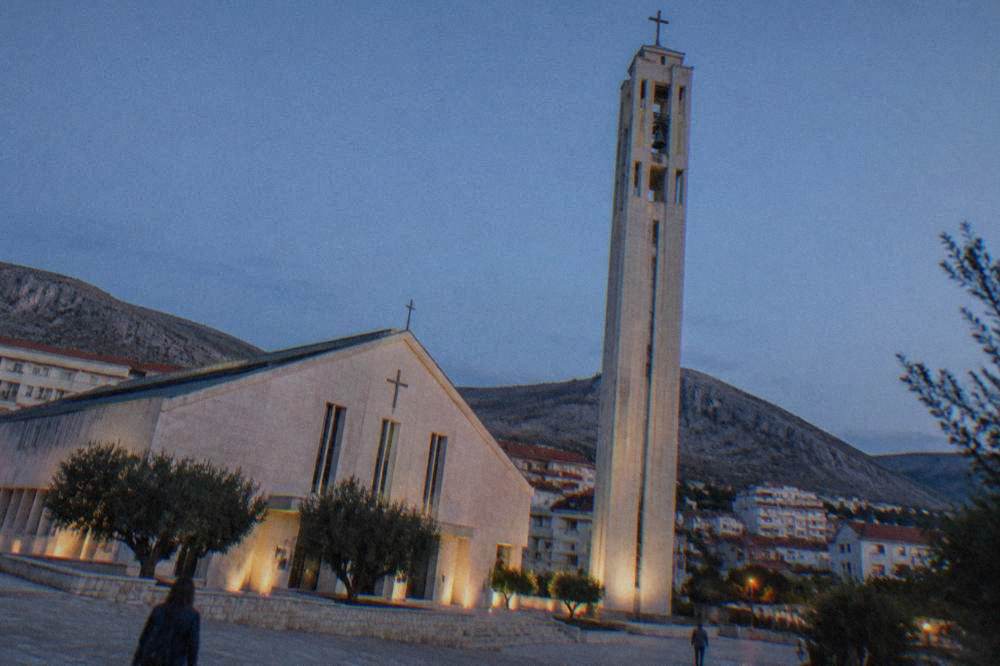
The Franciscan Church of Saints Peter and Paul stands in western Mostar, and its bell tower is one of the most visible structures in the city. This guide covers how to reach it, what the climb involves and what you can see from the top.
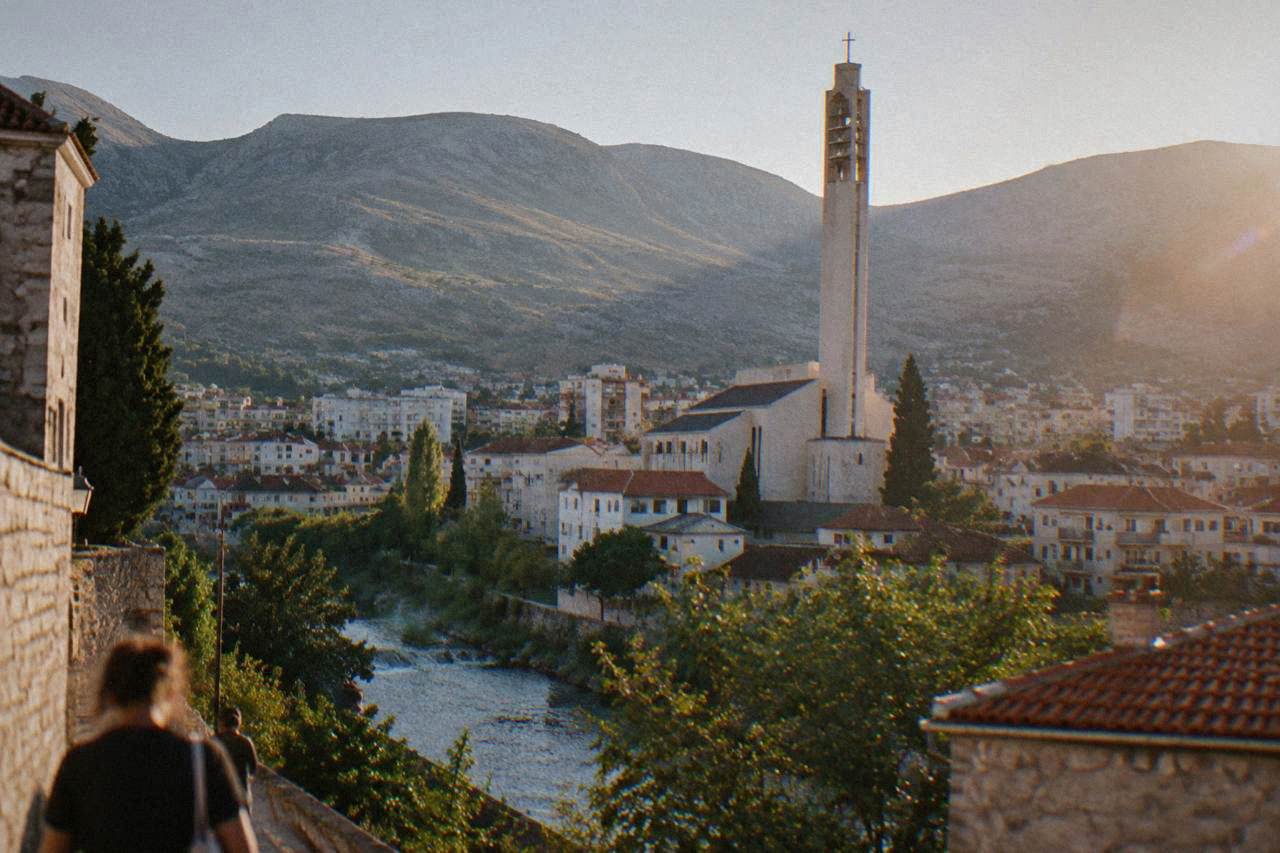
The bell tower belongs to the Franciscan Church of Saints Peter and Paul in western Mostar, a short walk or taxi ride from the Old Town. The tower is a city landmark with views over the Neretva valley, Stari Most and the hills of Herzegovina. Opening details and any climbing fee are not published in a fixed official form, so confirm on site before you plan the ascent.
The Franciscan Church of Saints Peter and Paul is one of the first large structures travellers notice when they arrive in western Mostar, and its bell tower dominates a stretch of the skyline that belongs to the modern city rather than the Ottoman Old Town. The church sits inland on the Neretva river, in Herzegovina, far from any coast, and it makes a natural pairing with the Old Bridge Area, the UNESCO World Heritage property inscribed in 2005 that sits a modest distance to the east. Where Stari Most and Kujundžiluk carry the Ottoman centuries, the Franciscan complex carries the modern era and the Catholic tradition of Herzegovina, and the two halves of the city read very differently when you stand above them.
This page walks through what the church and its tower are, how to get there from the Old Town, what the view covers, and how the tower compares with the other viewpoints around the city. A practical word up front: hours and any climbing fee for the tower are not published in a fixed form, so treat the on-site notice as the authority and check it when you arrive.
What Is The Franciscan Church Of Saints Peter And Paul In Mostar?
The Franciscan Church of Saints Peter and Paul is a large Catholic church and monastery complex in western Mostar, in Herzegovina, Bosnia and Herzegovina, and its tall bell tower is one of the most recognisable structures in the modern part of the city. The Franciscans have a long presence in Herzegovina, and this complex is their principal base in Mostar. The church stands away from the Ottoman Old Town, on the western side of the river, and it serves an active parish. The tower that rises beside it functions as a landmark and, at permitted times, as a viewing platform over the Neretva valley.
The complex belongs to the Catholic tradition, and the parish remains active, which means the building is first a place of worship and only second a sight. Dress modestly if you enter the church itself, shoulders and knees covered, the same standard applied at the Blagaj Tekke and at mosques such as Koski Mehmed-pašina džamija across the river. Visitors climb the tower at the times the parish allows, and those times are posted locally rather than published centrally, so the on-site notice is what counts.
The church replaced an earlier structure on or near the same site, and its modern form reflects rebuilding after the war years in the first half of the 1990s. In line with how this site handles that period everywhere: the facts are dates and physical changes, and the register stays factual. The tower as it stands today is a product of that reconstruction era, and its clean vertical profile is what makes it readable from so many points in the city, from the R435 bends above the valley to the banks of the Neretva in the Old Town.
For orientation, the church sits on the main western axis of the city, the same broad direction as Spanish Square, which functions as the hinge between the modern centre and the historic east. Walking that axis from the square westward brings you into the church's neighbourhood within a short stretch. The Spanish Square guide covers that modern heart of the city in detail, and the full things to do in Mostar page places the tower in the wider list of sights.
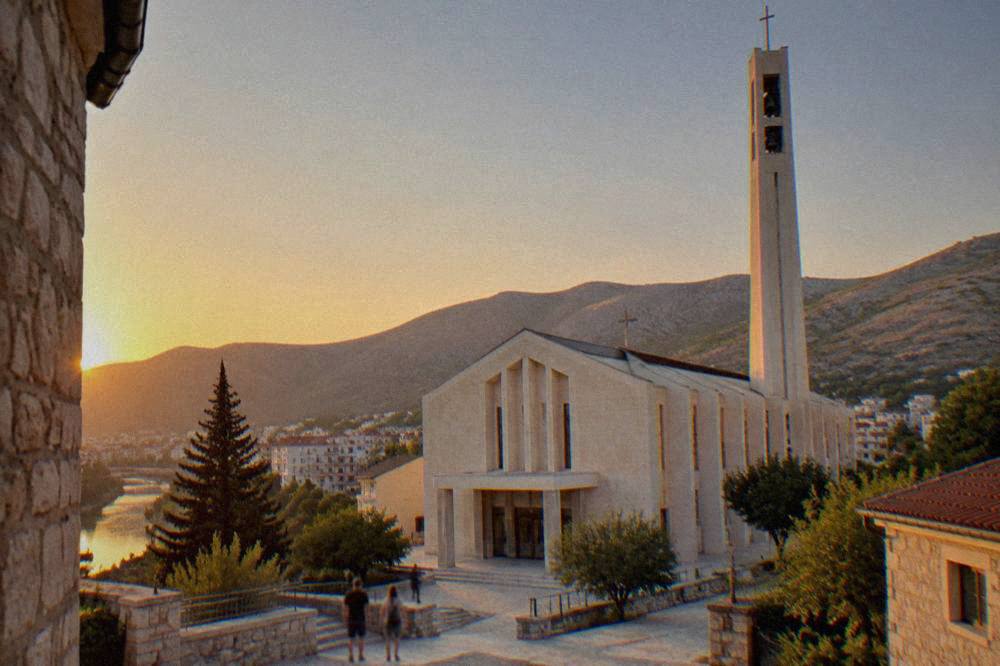
How Do You Get To The Mostar Bell Tower From The Old Town?
The Franciscan church and its bell tower sit in western Mostar, on the opposite side of the Neretva from the Old Town core but still within comfortable walking range of Stari Most, roughly 15 to 20 minutes on foot along the city's main westward axis. The walk crosses the modern centre rather than the bazaar streets, passing Spanish Square and continuing west. Taxis are an alternative for anyone staying further out or arriving from the bus station, and the fare is short and inexpensive by European standards, with the meter set in convertible marks, the country's currency.
The route is simple. From Stari Most, head west away from Kujundžiluk, cross into the modern street grid, and continue along the main boulevard toward the church district. The tower is visible for much of the way, which makes navigation self-correcting: if you can see the tower, you are walking roughly the right direction. The terrain is flat along this corridor, unlike the climbs to Hum or the Fortica viewpoint above the city, so the walk suits anyone regardless of fitness.
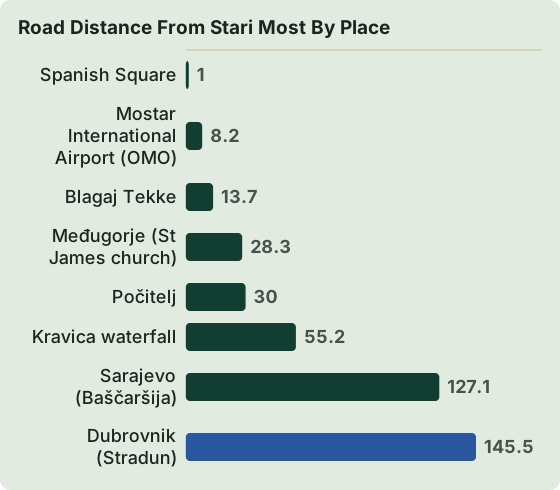
For visitors arriving from further afield, the table below places the church district in the city's road geography. Distances are road distances from Stari Most, computed free-flow driving times with no border or traffic queues included.
| Place | Road distance from Stari Most | Free-flow drive time |
|---|---|---|
| Spanish Square | under 1 km | a few minutes by car |
| Mostar International Airport (OMO) | 8.2 km | about 12 min |
| Blagaj Tekke | 13.7 km | about 19 min |
| Međugorje (St James church) | 28.3 km | about 40 min |
| Počitelj | 30.0 km | about 31 min |
| Kravica waterfall | 55.2 km | about 54 min |
| Sarajevo (Baščaršija) | 127.1 km | about 134 min |
| Dubrovnik (Stradun) | 145.5 km | about 150 min |
Two practical notes for the journey. First, the currency is the convertible mark (KM, BAM), pegged at 1 EUR = 1.95583 KM, and euro cash is often accepted in tourist areas at a rounded rate, though confirming the rate before paying is wise. Second, Bosnia and Herzegovina is not in the EU or Schengen, which matters if you are combining the tower visit with a trip to or from Croatia across the land border, where full passport checks apply.
If you would rather have the city's geography explained while you walk it, the siege-history walk is the strongest fit for this part of town, because the modern western axis is where much of that story plays out, and the tower's own history belongs to that same era. The operator's live listing carries full details.
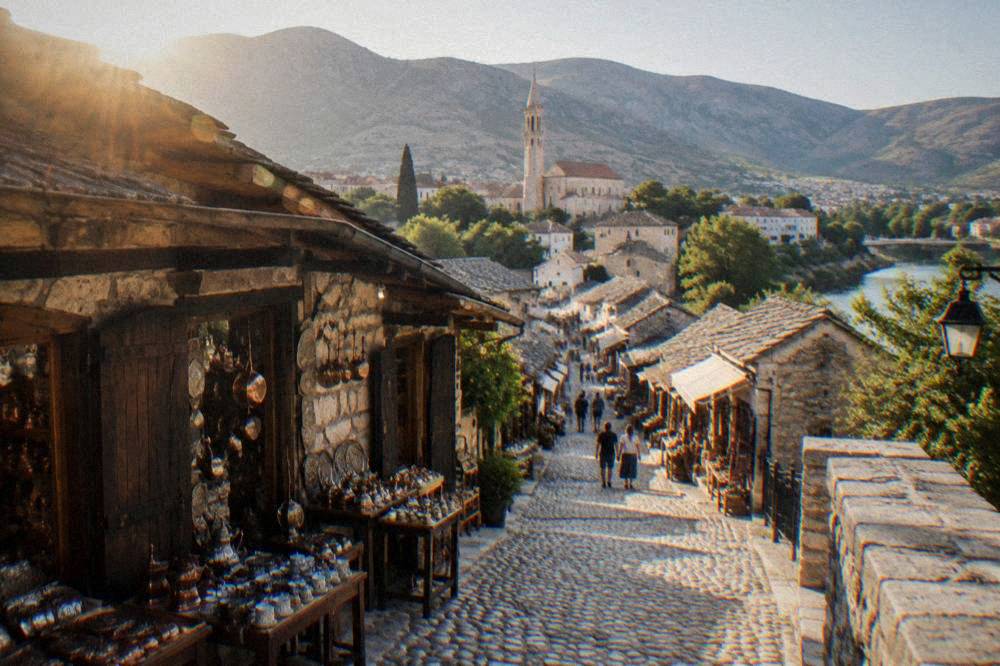
The walk, at its own pace, is also a study in how quickly Mostar changes character. The coppersmith lanes of Kujundžiluk give way to the wide pavements and cafe terraces of the west, and the Mostar walking tour guide maps several ways to join the two halves into one loop.
What Can You See From The Bell Tower In Mostar?
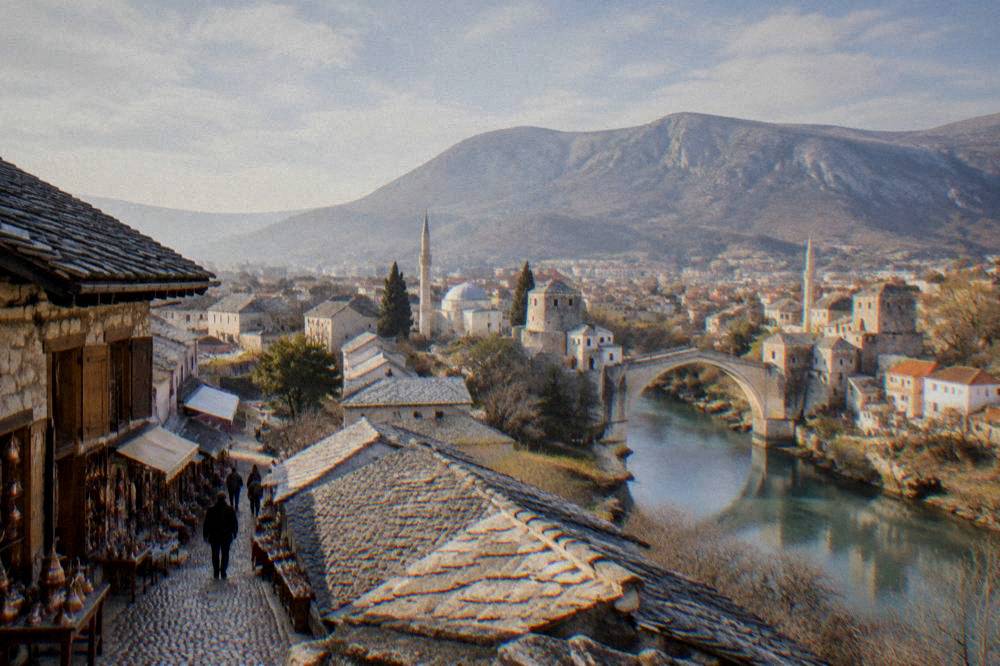
From the top of the Peter and Paul bell tower the view sweeps across the whole Neretva basin at Mostar: the red roofs of the western districts, the green line of the river cutting through the city, the Old Bridge Area and its minarets to the east, and the rocky walls of Hum and the surrounding Herzegovinian hills framing everything. It is one of the few elevated points from which the city reads as a single composition, with the Ottoman east and the modern west visible in one glance. On clear days the horizon carries the hills toward Blagaj and the plateau country beyond.
The view works in layers. The nearest layer is the church's own neighbourhood, low apartment blocks and tree-lined streets. The middle layer is the river corridor itself, where the Neretva's cold water, which stays cold even in August, runs pale green against the stone. The far layer is hill country: Hum stands over the city's south side, and the Hum hill guide covers the walking route up its slopes for anyone who wants the opposite perspective, looking back at the tower.
To the east, the silhouette of Stari Most sits roughly two kilometres away by road, and from height its single stone arch, completed in 1566 and rebuilt and reopened in July 2004, is easier to appreciate as a piece of engineering than it is from the bridge deck itself. The span is about 29 metres, and the height above the river is about 21 to 24 metres depending on the water level. The Stari Most guide covers the bridge and its diving tradition, and the museum of the Old Bridge adds the exhibit inside the Tara tower at its western end.
Photography rewards the hours around morning and late afternoon, when the low sun models the hills and the roofscape. Summer haze can flatten the far layers in the middle of the day, and July and August are the months when the valley heat builds, with modelled mean daily highs of 29.9 C in July and 30.5 C in August (ERA5 reanalysis, 1991 to 2020). Carry water for the climb regardless of season.
Want the view paired with food? A burek-making class runs in the city and pairs well with a morning tower visit, with the class and the climb together filling a half day. Check availability on the operator's live listing.
For travellers deciding how to spend a fuller day, the standard trio of Blagaj, Počitelj and Kravica waterfall is the classic Herzegovina loop, and the tower makes a calm morning bookend before the drive south. These three options cover the pairing.
Is Climbing The Mostar Bell Tower Difficult?
The climb is an indoor stair ascent inside the tower shaft, steady rather than technical, with no equipment or guide required, though it does involve continuous stairs in an enclosed space and anyone with mobility limits or trouble with confined stairwells should expect a real workout rather than a casual stroll. There is no via ferrata, no ladder and no exposed section, which separates it from the Hum hill climb or the Fortica ridge. The reward arrives in stages, with the openings in the shaft letting in light as you rise.
The stairs are the whole experience, so pace them. In summer the shaft can be warm even though the church district itself is not high-altitude, and the ERA5 reanalysis for 1991 to 2020 puts August mean daily highs at 30.5 C for Mostar, with the valley floor often running hotter than that in the afternoon. Climb early in that season. In winter the January mean temperature is 4.8 C (FHMZ 1961 to 1990 station series), so the shaft is cool but the stairwell shelters you from the wind that can affect the open viewpoints.
What to bring is a short list: flat shoes, water in the warm months, and a camera or phone with a strap, because the openings at the top are more comfortable to photograph with both hands free. Modest dress applies to the church interior below, so plan the outfit for both the climb and the nave. There is no cafe at the top, naturally, so take water up with you.
| Viewpoint | Character of the climb | What the view centres on | Exposure |
|---|---|---|---|
| Peter and Paul bell tower | Enclosed indoor stairs | Whole city basin, west and east in one frame | Sheltered |
| Hum hill | Open hillside path | City from the south, Neretva bend | Full sun, wind |
| Fortica | Cable car or path above the west bank | City, river gorge and hills | Open platforms |
| Koski Mehmed-pašina džamija minaret | Narrow spiral stairs | Old Town rooftops and Stari Most at close range | Enclosed, tight |
| Sniper tower | Unmaintained ruin, unsignposted | East bank rooftops | Not a managed sight |
The comparison matters because Mostar has several ways to get above the roofs, and they are not interchangeable. The minaret of Koski Mehmed-pašina džamija gives the closest look at Stari Most but a narrow one; the Koski Mehmed-pašina džamija page covers that ascent and its reported cash fee. The bell tower is the one that shows both halves of the city at once, which is exactly the argument for making the climb.
When Is The Best Time To Visit The Bell Tower In Mostar?
Morning is the most reliable window for the bell tower in Mostar: the air is cooler, the western light falls on the Old Town side of the view, and the afternoon haze that builds in the valley in July and August has not yet formed, so the whole Neretva basin reads cleanly from the top. The FHMZ 1961 to 1990 series for Mostar gives July a mean temperature of 24.7 C and an absolute maximum of 41.2 C, which tells you how sharp the summer afternoons can become. From late spring to early autumn, aim to be at the top before midday.
Rain governs the rest of the year. The FHMZ series records 1,515.4 mm of precipitation annually with a winter maximum: November averages 200.0 mm against July's 42.9 mm. November through March brings the rainiest stretch, with 11 days of rain over 1 mm in each of November, December and January. Winter still offers clear, cold spells with mean January temperatures of 4.8 C, and the tower being enclosed means a dry winter morning can deliver a crisp view that summer never manages. More of these guides are collected on Mostar Travel Guide.
| Month | Mean temp (FHMZ 1961-1990) | Precipitation mm (FHMZ 1961-1990) | Notes for the tower visit |
|---|---|---|---|
| January | 4.8 C | 164.7 | Cold, 11 rain days; dress for the stairwell |
| March | 9.6 C | 150.1 | Changeable; watch for clear windows |
| May | 17.9 C | 102.1 | Long light, green hills |
| July | 24.7 C | 42.9 | Climb early; haze risk at midday |
| August | 24.2 C | 73.7 | Heat peaks, absolute max 40.8 C |
| October | 15.3 C | 150.6 | Autumn colour, more rain |
| November | 10.1 C | 200.0 | Rainiest month; luck-dependent |
Festival timing can add a reason to be up high. Mostarsko ljeto ran from 25 June to 7 August in 2026, the Mostar Summer Fest ran 2 to 4 July, and the Red Bull Cliff Diving World Series stop ran 30 July to 1 August, with the traditional Old Bridge diving competition, its 460th edition, held on 26 July 2026. Those are 2026 editions of annual events, not fixed future dates, but late July is the period when the city's calendar peaks, and any of those weeks makes a climb worthwhile for the atmosphere below.
What Else Is Near The Mostar Bell Tower?
The church sits in western Mostar close to the city's modern civic spine: Spanish Square and its cafe terraces lie a short walk east, the university and hospital district spreads nearby, and the road west leads out toward the Rama lake country and the uplands of central Herzegovina. The neighbourhood is the everyday city, low-rise and leafy, which makes it a useful counterweight to the Old Town's density.
The walking loop is easy to build. Start at the church, walk east to Spanish Square for coffee, continue to the Crooked Bridge, the small single-arched bridge that prefigures Stari Most in miniature, then finish at the Old Bridge itself. Along the way the Bišćević House and Muslibegović House show the Ottoman domestic interior, each with a small reported cash entry fee. The whole loop is flat except the final drop to the river.
If you have a car or a driver, half-day and full-day options fan out from the church district in every direction. The computed road figures below are free-flow times from Stari Most, so add a little from the church itself, which sits a similar distance west.
| Direction | Destination | Road km | Free-flow time |
|---|---|---|---|
| South | Blagaj Tekke | 13.7 | about 19 min |
| South | Stjepan-grad fortress | 13.9 | about 20 min |
| Southeast | Počitelj | 30.0 | about 31 min |
| Southwest | Kravica waterfall | 55.2 | about 54 min |
| North | Jablanica | 47.4 | about 57 min |
| North | Konjic | 69.0 | about 80 min |
| Southeast | Trebinje | 116.5 | about 142 min |
Kravica waterfall deserves its line in any planning table because the figures get misquoted constantly. Entry is 20 KM for an adult all year, 10 KM for residents of Bosnia and Herzegovina, 10 KM for school groups aged 7 to 18, and free for children under 7, per the park's own visitor page. Hours run by month: 07:00 to 22:00 from June to September, 07:00 to 20:00 in May, 07:00 to 19:00 in October, 07:00 to 18:00 in March and April, and 07:00 to 17:00 in November through February. It is 55.2 km and about 54 minutes by road from Stari Most, not the 15 minutes some listings claim.
For lake country, Rama lake is the quiet upland alternative, a reservoir ringed by hills and village roads, best from spring to autumn. Further still, Boračko jezero country above Konjic extends the same mountain theme, 89.9 km and about 113 minutes out.
How Does The Bell Tower Compare With Other Mostar Viewpoints?
The Peter and Paul tower is the sheltered, city-centre option: enclosed stairs, a full read of both halves of Mostar from one spot, and no weather exposure at the top, whereas Hum and Fortica are open hillside climbs with bigger horizons and the minaret of Koski Mehmed-pašina džamija gives the closest but narrowest view of Stari Most. Choosing between them is a matter of season, leg strength and what you want in the frame rather than a ranking. In summer heat the enclosed shaft beats an exposed ridge; on a dry winter morning the reverse can be true.
Practical differences do the deciding. The tower is a managed parish structure with posted access times, so the visit is short and contained. Hum is a hill, free and always there, but the Hum hill route means sun, wind and loose ground. The Fortica area above the west bank adds a zipline and a ridge walk, and the Fortica page covers it. Each has its own character, and a two-day visit can comfortably include two of them.
One honest note on the remaining tall structure on the east bank skyline: the former bank tower known as the sniper tower is an unmaintained ruin, not a managed sight, and entering it is not something this site advises. Its story is told on the sniper tower page, and the safer way to understand that building is from street level with a guide who can recount the siege years, which is precisely what the war-history walk does while passing beneath it.
A guided pairing does the comparison for you if you would rather not plan it. The full-day Herzegovina option below combines the city with Blagaj, Počitelj and Kravica, and the walk covers the urban story; either slots neatly around a bell tower climb.
How Much Time Should You Allow For The Bell Tower In Mostar?
Allow 30 to 45 minutes for the tower itself, the stair climb, time at the top and a look inside the church below, and treat the visit as the anchor of a half-day western loop that adds Spanish Square and the riverside walk for a total of two to three hours. The tower is not an all-morning sight on its own. Its value is as the single elevated point from which the rest of your Mostar plans make sense, because from the top you can see the Old Town, Hum, the river corridor and the western districts, and decide what deserves the rest of your day.
For a one-day city visit, a workable shape is the tower and church first, the walk east through Spanish Square to the Old Bridge and Kujundžiluk through the middle of the day, and an afternoon at one of the Ottoman houses or the Old Bridge Museum, whose reported adult fee is about 10 KM with hours of 08:00 to 16:00 daily from 1 April to 1 November. For longer stays, the day-trip table above takes over, and the Herzegovina loop to Blagaj, Počitelj and Kravica is the one repeat travellers describe as the standard second day.
Money planning is straightforward. The currency is the convertible mark, cards work at hotels and larger venues while cash rules at small vendors, and the ATM advice is standard everywhere: choose to be charged in KM. A tourist tax is reported at 3 KM per person per night in the canton from 1 January 2026, so confirm at booking how your accommodation handles it. Emergency numbers are 112 for general use, 122 police, 123 fire and 124 ambulance. In rural Herzegovina, on any day trip beyond the city, stay on marked paths because of suspected mine areas, per the national mine-action centre's standing advice.
Common Questions About The Mostar Bell Tower
Is the bell tower of the Franciscan church in Mostar open to visitors?
Access is managed by the parish rather than a ticketing office, and posted times at the church are the authority. Confirm on site when you arrive, since hours are not published in a fixed official form. The church itself is an active place of worship and can be entered outside service times, dressed modestly.
How far is the bell tower from Stari Most in Mostar?
The church sits in western Mostar, a flat walk of roughly 15 to 20 minutes from the Old Bridge along the main westward axis through the modern centre. The tower is visible for much of the route, so the walk is easy to get around without a map.
Is the bell tower climb in Mostar suitable for children?
The ascent is an enclosed stairwell with no exposed sections, which suits supervised children comfortable with continuous stairs. The enclosed shaft also means the climb is sheltered from sun and wind, an advantage in the July and August heat, when modelled mean daily highs reach 29.9 C and 30.5 C respectively (ERA5 reanalysis, 1991 to 2020).
Which is the better viewpoint in Mostar, the bell tower or Hum hill?
They answer different questions. The tower shows both halves of the city in one sheltered frame; Hum is an open hillside climb south of the city with a wider horizon. In summer the enclosed tower is the safer choice; on a dry winter morning Hum gives the clearer air.
Can you see Stari Most from the bell tower?
Yes. The Old Bridge Area, the UNESCO World Heritage property inscribed in 2005, lies to the east, and from the top the stone arch of Stari Most, rebuilt and reopened in July 2004, is visible along with the minarets and rooftops of the Old Town.
Is there an entry fee for the bell tower in Mostar?
No fixed official fee is published. Any charge for the climb is posted at the church, and the parish's notice on site is the authority; bring a little cash in convertible marks in case a small contribution is requested.
Whether the tower is your first stop in Mostar or your last, it earns its place by making the whole city legible in one upward look, and the western parish that keeps it adds a layer of the city's story that the Old Town alone never tells. Pair the climb with a slow walk east, and Mostar stops being two separate skylines and starts being one place.
