Mostar Nightlife: Bars, Riverside Terraces And Late Spots
Mostar is a small inland city on the Neretva, and its nightlife concentrates in a walkable strip between the Old Bazaar and the river: terraces under the Old Bridge, café tables on cobbled lanes, and a summer festival calendar that fills the warm months.
Mostar nightlife is compact and evening-focused: riverside terraces around Stari Most and Kujundžiluk, café life on the boulevard, live music during the July festival weeks, and quiet, safe streets after dark. The city is walkable, prices are in convertible marks, and the last few hours before midnight are the busiest.
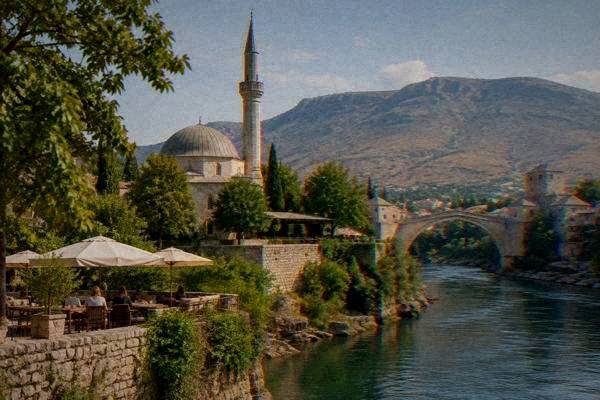
Mostar after dark is a story of one river, one bridge and a few hundred metres of cobbled lanes. The city, the main centre of Herzegovina in Bosnia and Herzegovina, sits inland on the Neretva with no coast, and its evening life folds into the hollow of the valley around the Old Bridge Area, a UNESCO World Heritage property since 2005. Day-trippers head back to Dubrovnik or Split in the late afternoon, and what remains is a slower, warmer city: terraces a few steps above cold green water, lamps on stone, and a sound of conversation rather than engines.
The shape of the evening matters more here than in a big capital. Dinner starts late by northern European habit, terraces fill as the heat drops, and the city quiets again well before a metro-city closing time. This guide walks through where evenings happen, what the summer festival calendar adds, how the valley heat shapes the clock, what a night out costs in convertible marks, and how the same streets feel after dark. For the daytime half of the picture, start with things to do in Mostar.
What Is Mostar Nightlife Really Like?
Mostar nightlife is small, outdoors-oriented and centered on two zones: the Old Bazaar lanes of Kujundžiluk running down to Stari Most, and the café-and-bar strip around the boulevard and the west bank terraces. The night spreads along the river terrace by terrace rather than in a single nightclub district, with a low-volume, tables-and-glasses character in the protected Old Town lanes and bigger music nights reserved for the summer festivals. Evenings run late into the night in July and August, when the FHMZ station table for Mostar shows a July mean temperature of 24.7 C, and much earlier in winter, when January averages 4.8 C. There is no single nightclub district; the night spreads along the river instead, terrace by terrace.
The rhythm is set by heat and by day-trip flows. In high summer the valley is punishing in the afternoon, so the city empties between lunch and late afternoon and refills after sunset. The Neretva stays cold even in August, fed by karst springs, and the breezes off it are part of why the riverside terraces below the bridge are the fullest tables in town once the sun drops behind Hum.
What the night is not is loud in the packaged sense. The protected Old Town lanes keep a low-volume, tables-and-glasses character, and the bigger music nights belong to the summer festivals rather than to permanent venues. A visitor planning a big-city bar crawl will want to reset expectations; a visitor after a long riverside evening with the bridge lit over the water will be exactly in the right place.
Where To Go Out In Mostar At Night?
The evening map of Mostar has three anchors: Kujundžiluk and the terraces around Stari Most on the east bank, the west bank row overlooking the river with the bridge in full view, and the boulevard strip around Spanish Square where café tables line the wider streets. All three sit within a short walk of each other; the whole nightlife zone is comfortably covered on foot, and there is no need for a taxi between areas.
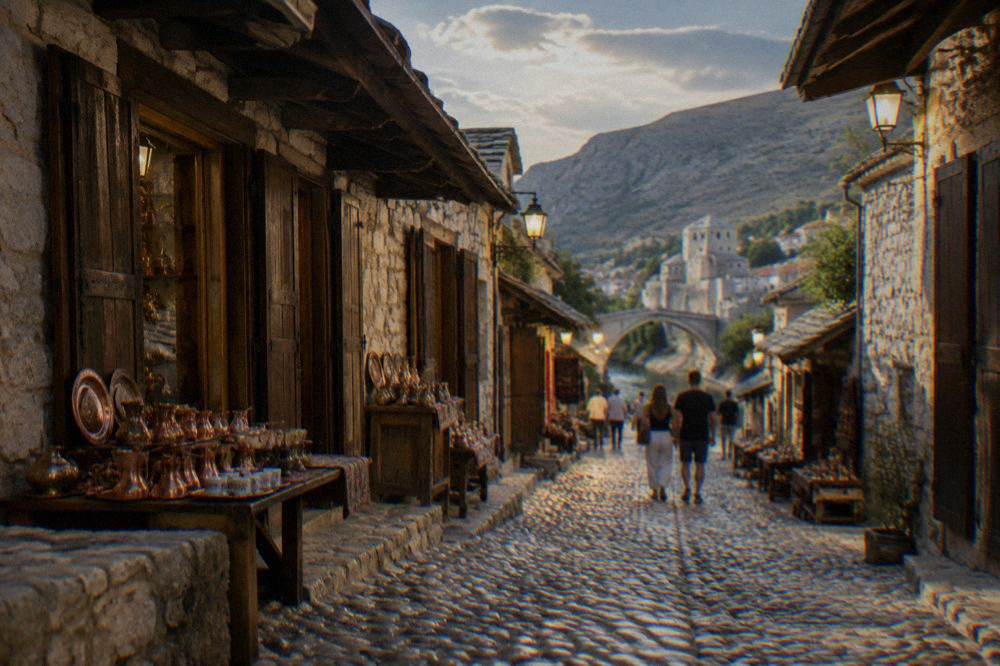
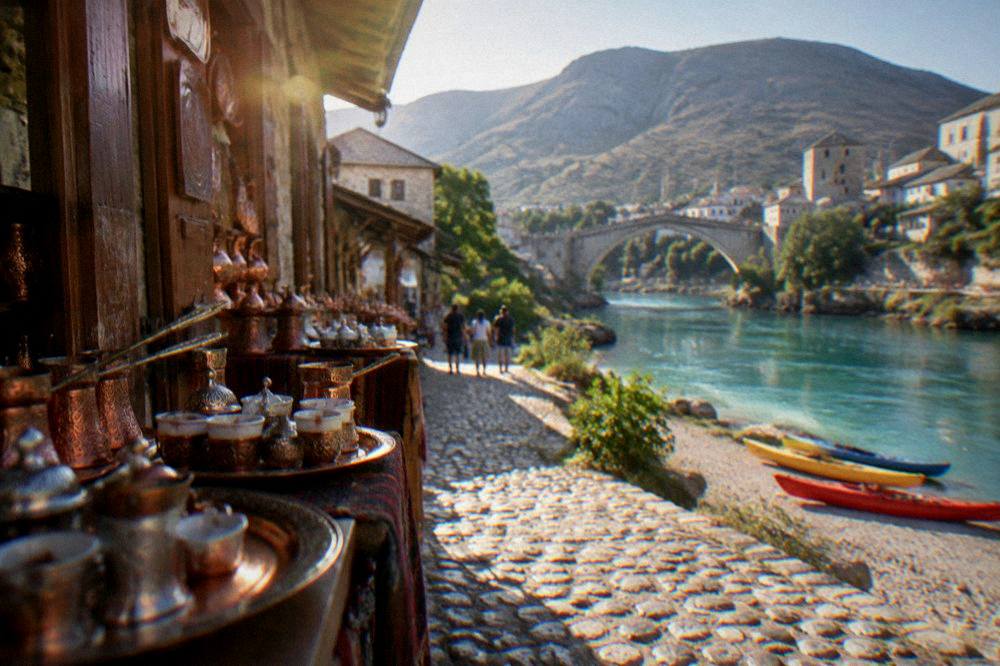
Kujundžiluk, the old bazaar street, is the atmospheric core. Copper workshops close in the early evening and the lane hands itself over to tables. Down at the water, the terraces directly beneath the Old Bridge look straight up at the arch, and on evenings when members of the Mostari diving club jump, the banks fill with watchers; jumps by club members are most frequent in the May to October stretch, and a jump night below the lit bridge is the single most dramatic free show the city offers. The bridge itself is a public crossing, free and open at any hour.
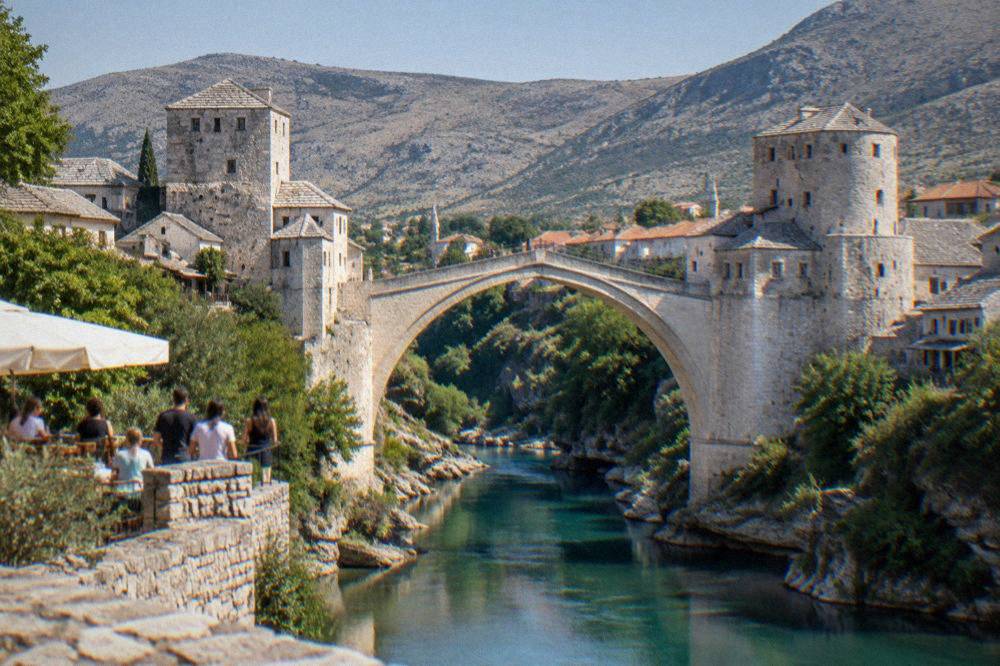
Across the river, the west bank row holds the classic full-frontal view of Stari Most, and it is where the bridge photographs happen at blue hour. Uphill toward Spanish Square the streets widen, the tables spread along the pavements, and the mood shifts from old-stone intimate to boulevard lively. For the geography in daylight, the Mostar walking tour guide covers the same three zones street by street.
A guided walk of the Old Town is the natural pairing with a first night out: it fixes the layout, the history and the short list of lanes worth returning to after dark, so the evening can be spent at a table rather than over a map.
What Time Does Evening Start In Mostar, And Why So Late?
Evening in Mostar starts late because of valley heat: the ERA5 reanalysis, 1991-2020, puts the mean daily high at 30.5 C in August and 29.9 C in July, so locals move outdoors after sunset and terraces fill from about 20:00 through midnight in the warm months. In winter the same city shifts early, with a January mean of 4.8 C on the FHMZ 1961-1990 station table, and the evening compresses into indoors tables soon after dark.
The numbers behind that clock are worth a look side by side, because they explain the whole rhythm of a Mostar summer night.
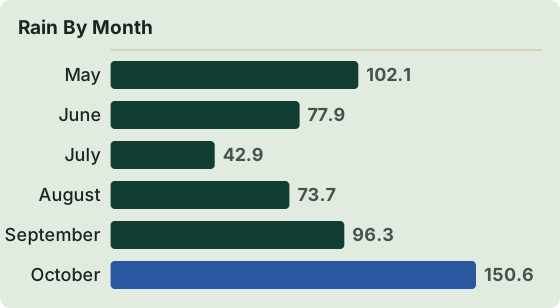
| Month | Mean temp C (FHMZ 1961-1990) | Modelled mean daily high C (ERA5 1991-2020) | Rain mm (FHMZ 1961-1990) |
|---|---|---|---|
| May | 17.9 | 22.3 | 102.1 |
| June | 21.5 | 26.8 | 77.9 |
| July | 24.7 | 29.9 | 42.9 |
| August | 24.2 | 30.5 | 73.7 |
| September | 20.4 | 24.5 | 96.3 |
| October | 15.3 | 19.5 | 150.6 |
July is the dry anchor of that table, with 42.9 mm of rain across the month, and November is the wet end of the year at 200.0 mm on the same FHMZ series. Rain in summer most often arrives as short, heavy evening storms rather than all-day drizzle, and terrace staff in Herzegovina are well practised at moving tables fast when one rolls down the valley.
Daytime heat is exactly why water-based trips sell so well here: a kayaking run on the Neretva or a waterfall swim fills the hot afternoon, and the terrace evening becomes the reward. The Neretva canyon trip is the outdoor option this site features most for that pairing.
Live Music And Festivals In Mostar In Summer
Mostar's live-music year peaks in a six-week summer window: Mostarsko ljeto ran 25 June to 7 August in 2026, Mostar Summer Fest ran 2 to 4 July, the Mostar Blues & Rock Festival ran 24 and 25 July with free entry, and the Mostar Jazz Fest closed the run from 23 to 25 August. All are annual events; the 2026 dates are the latest editions, and next year's dates are not yet announced.
The bridge itself hosts the loudest spectacle of the summer. The traditional Old Bridge diving competition, organised by the Mostari diving club, held its 460th edition on 26 July 2026, and the Red Bull Cliff Diving World Series followed from 30 July to 1 August 2026, its 10th Mostar stop, with men diving from 27 m platforms and women from 21 m. Those two late-July weekends are the fullest the riverbanks get all year, and the evenings around them run long and loud.
| Event | 2026 dates | Character |
|---|---|---|
| Mostarsko ljeto | 25 June to 7 August | City-wide summer culture programme |
| Mostar Summer Fest | 2 to 4 July | Open-air music festival |
| Mostar Blues & Rock Festival | 24 and 25 July | Free entry, 24th edition |
| Traditional Old Bridge diving | 26 July | 460th edition, Mostari club |
| Red Bull Cliff Diving | 30 July to 1 August | 10th Mostar stop |
| Mostar Jazz Fest | 23 to 25 August | Three evenings of concerts |
Practically, festival weeks change the evening calculus: terraces near the stage areas fill early, and a visit planned around the diving weekend should treat the riverbank as a venue, not a stroll. Away from those weeks, live music in Mostar is a terrace-and-guitar affair, listed week to week rather than fixed, so ask at your table or accommodation what is on that evening. The full festival picture, including the Međugorje youth festival in early August, is covered in the site's best time to visit Mostar guide.
Is It Safe To Walk Around Mostar At Night?
Mostar's nightlife zone is compact, walkable and busy until late in the warm months, and the streets between Kujundžiluk, the west bank terraces and Spanish Square are all lit, level and short; the emergency number is 112, with police on 122. The ordinary big-city cautions apply: keep valuables out of back pockets in dense crowds on bridge-watching nights, and take a taxi rather than a long walk to outlying accommodation.
Two local specifics are worth more than generic advice. First, the streets are cobbled and the lanes drop steeply to the river in places, so shoes that grip matter more on a Mostar night out than in any smoother city. Second, rural Herzegovina around the city carries suspected-mine areas, a legacy managed by BHMAC: that has no bearing on the central nightlife zone, but it is a firm reason to skip dark riverside paths and unofficial trails on the valley edges at night. Stay on the made paths and streets. Other pages covering the same trip are gathered on Mostar Travel Guide.
For a fuller treatment, including the border and driving angle for visitors arriving from Croatia, read Bosnia and Herzegovina travel tips.
How Much Does A Night Out In Mostar Cost?
A night out in Mostar is paid in convertible marks (KM, BAM), the currency pegged at exactly 1 EUR = 1.95583 KM, and the honest planning range is wide because Herzegovina serves everything from a basic local beer at a lane-side table to full restaurant dinners with Herzegovina wine; euro cash is often accepted in tourist areas, usually rounded to about 2 KM per euro, so confirm the rate before paying. Cards are taken at hotels and larger restaurants, while smaller terrace bars and market stalls prefer cash, and ATMs are easy to find in the centre.
The fixed, citable figures are few, and they are worth separating from what shifts:
| Item | Figure | Notes |
|---|---|---|
| Currency | Convertible mark (KM, BAM) | 1 EUR = 1.95583 KM, fixed peg |
| Euro cash | Often accepted in tourist areas | Rounded rate, confirm before paying |
| Tourist tax | Reported at 3 KM per person per night from 1 January 2026 | Charged via accommodation; confirm at booking |
| Emergency | 112 (general), 124 (ambulance) | Free call |
The tourist tax is the one line visitors most often miss: it is reported at 3 KM per person per night in the Herzegovina-Neretva Canton from 1 January 2026, collected through your accommodation rather than at any bar, and it is worth confirming at booking. Beyond that, the practical rule is simple: carry some KM in cash for the smaller tables, decline any euro rounding you are not happy with, and check the Mostar money guide for the ATM and card detail.
Eating is a night out in itself here. Herzegovina's grilled-meat tradition, from ćevapi to the burek bakeries that stay busy into the evening, is the backbone of a Mostar night, and the food pages on this site, including Bosnian food, ćevapi and burek, cover what to order and how it is served. A full restaurant directory with a night-out slant sits in the best restaurants in Mostar.
Sunset And Night Views Over Stari Most
The single best-known evening view in Mostar is the Old Bridge from the west bank terrace row at blue hour, when the arch is lit and its reflection sits on the dark Neretva; after that, the panorama points are the terraces on the east bank below Kujundžiluk and, for height, the viewpoints up toward Hum on the city's hill. All of them cost nothing to stand at, and the light in the valley moves fast in the twenty minutes after sunset.
The bridge photographs differently by season as well as by hour. The river runs high with winter rain, lower in late summer, and the height of the arch above the water, about 21 to 24 metres depending on the river, changes the whole frame. On diving evenings the west bank fills early; on ordinary evenings it belongs to whoever claims a rail first. The full viewpoint-by-viewpoint rundown, including the daytime climbs, is in Mostar viewpoints.
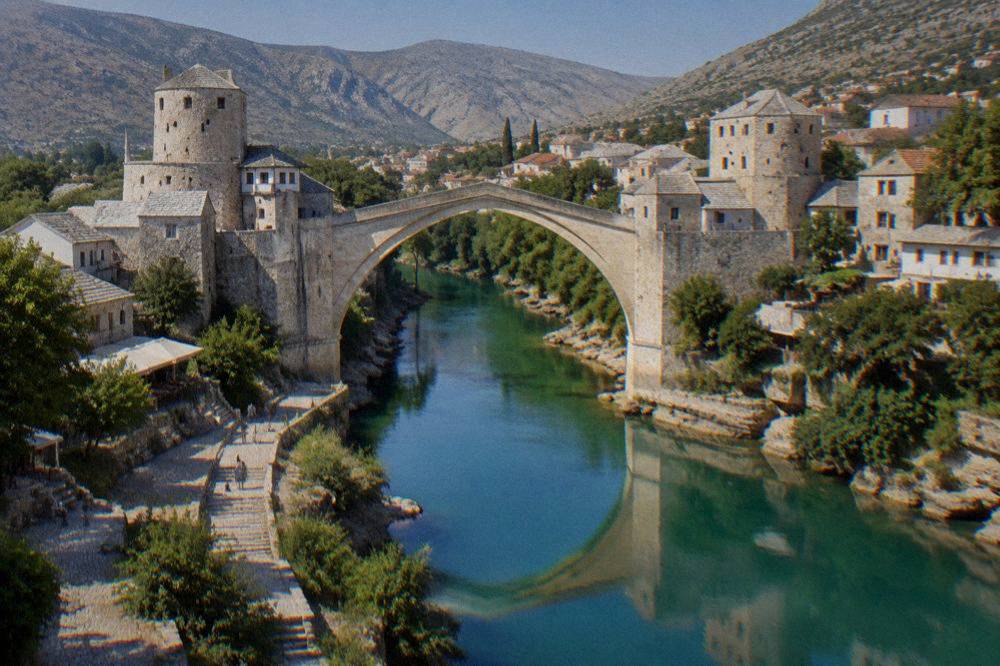
A slow night walk makes a natural circuit of it: down Kujundžiluk to the water, along the east bank past the terrace row, over the bridge itself, which is free and open around the clock, and back along the west bank. Add the Crooked Bridge, Kriva ćuprija, a few lanes upstream, and the loop still takes well under an hour without sitting down. The bridge's own story, including the diving tradition in detail, is told in the site's Mostar bridge diving page.
Pairing Days And Nights: Trips That End At A Terrace
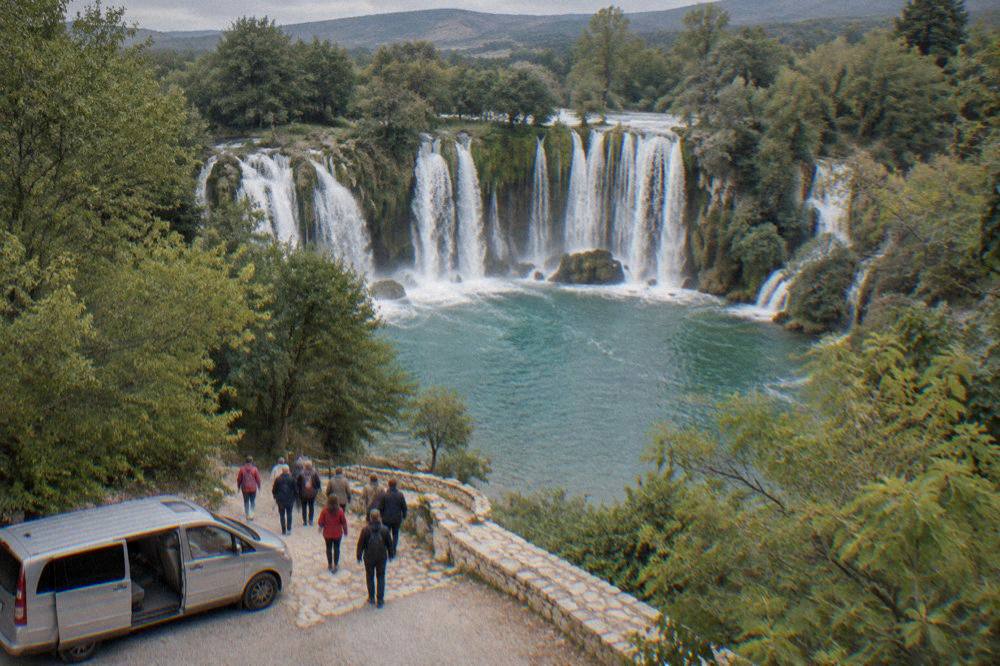
The most natural Mostar pattern is a water day followed by a terrace night: the Kravica waterfall pool, the Neretva kayak runs and the Blagaj springs all sit within an hour's drive of Stari Most, close enough that a full daytime trip still lands you back at a riverside table before sunset. Kravica is 55.2 km and about 54 minutes by road; Blagaj Tekke is 13.7 km and about 19 minutes.
| Trip | Road km from Stari Most | Free-flow minutes | Evening pairing |
|---|---|---|---|
| Blagaj Tekke and the Buna spring | 13.7 | about 19 | Riverside dinner back in Mostar |
| Počitelj fortified village | 30.0 | about 31 | Bridge blue-hour walk |
| Kravica waterfall | 55.2 | about 54 | Terrace night after a swim day |
| Jablanica and the Neretva canyon | 47.4 | about 57 | Kayak day, late dinner |
| Međugorje | 28.3 | about 40 | Quiet evening, early night |
Kravica carries the one figure in this list that blogs routinely get wrong: entry is 20 KM for an adult all year, 10 KM for residents of Bosnia and Herzegovina, and free for children under 7, with the park open every month of the year. It is not a summer-only venue, and it is not a short hop; budget the best part of an hour each way. Swimming in the pool below the falls is allowed in summer in the designated area, with no lifeguard reported, and the park's own rules section should be checked on arrival. The site's Kravica waterfall guide carries the monthly hours and the full price table.
A half-day Kravica trip is the least disruptive way to fold the waterfall into an evening-centric day: it leaves the late afternoon and the whole night free for the Old Town.
Blagaj deserves its own evening mention: the Buna spring bursts from a cliff face below the tekke, and the short 13.7 km distance means a late-afternoon visit dovetails into a Mostar dinner without any rush. The Blagaj guide covers the tekke's dress code, its reported 10 KM entry and its seasonal hours.
Late Season And Winter Nights In Mostar
Mostar's nightlife season runs far past August: September still shows a mean of 20.4 C on the FHMZ station table, the Jazz Fest landed on 23 to 25 August in 2026, and terrace evenings continue into October at a 15.3 C mean before the city folds indoors for a 4.8 C January. Winter nights are quiet, early and inexpensive, built around interior tables, rakija and the occasional clear, cold walk to see the bridge floodlit with winter light.
What changes in the cold half of the year is the clock, not the map. The same three zones stay open, tables move from terraces to interiors, and the evening that ran to midnight in July ends at 22:00 or earlier in January. The FHMZ series puts November at 200.0 mm of rain and December at 178.7 mm, both far above July's 42.9 mm, so a winter visit should carry a rain plan alongside the terrace plan. Snow does fall in the valley, with the station series recording a maximum snow cover of 31 cm in January, and a snow-dusted Old Bridge at night is one of the city's quietest photo moments.
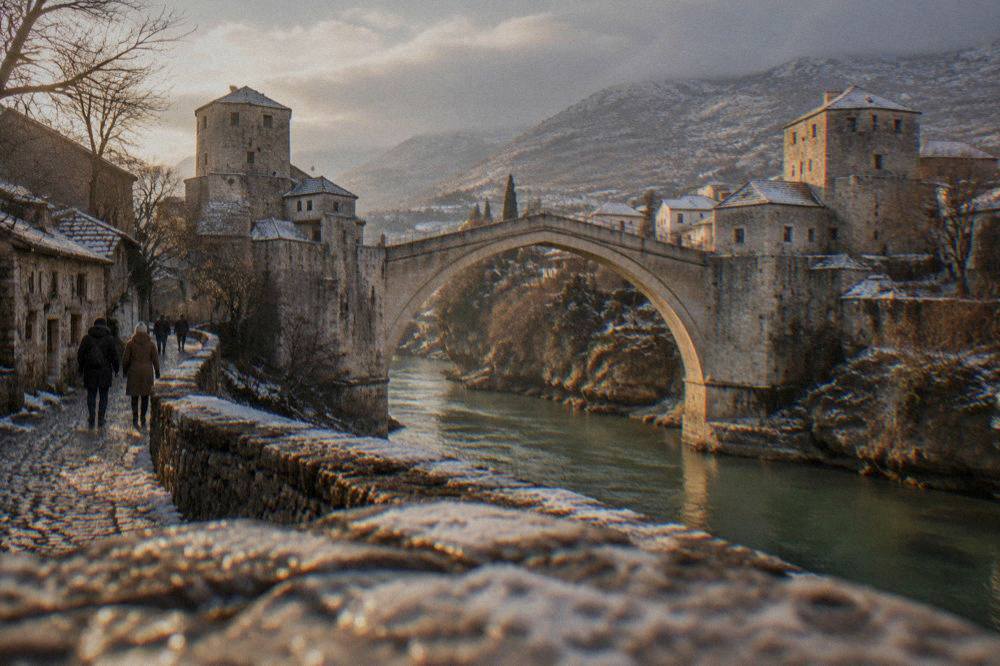
Off-season visitors get the trade the summer crowd does not: tables without booking, the bridge banks without crowds, and room rates and terrace prices that sit below the July peak. The seasonal detail, month by month, is laid out in Mostar weather, and the year-round case for the city is made in is Mostar worth visiting.
Getting Home After A Late Night In Mostar
Mostar's nightlife zone is small enough that nearly every night out ends on foot, and a taxi, when needed, is a short, inexpensive ride from the Old Town to any central accommodation; the two daily Sarajevo trains and the daytime bus schedules are irrelevant to a night out, so plan the last leg before the second rakija rather than after it. The train corridor's evening service, resumed on 15 October 2026 after the September suspension, is a daytime affair, not a night option.
The walkability is the whole point. From Stari Most to Spanish Square is a few minutes on foot, and the main accommodation clusters sit inside that triangle or a short extension of it; the site's where to stay in Mostar guide maps the neighbourhoods against exactly this night-walk distance. If your bed is out toward the airport side or beyond, take a taxi for the last leg; meters start at about 2 to 2.5 KM, a figure worth agreeing or watching on the meter. For anything further, the getting around Mostar page covers buses, taxis and car hire, and Mostar car hire covers the drive-home question for visitors with a rental.
One border note for visitors basing themselves in Croatia and crossing over for a night: Bosnia and Herzegovina is not in the EU or Schengen, so the Croatian land border carries full checks, with waits reported and longer at summer peaks. A late return to Dubrovnik or Neum after a Mostar evening should budget for that queue, and the detail lives in the Croatia-Bosnia border crossing guide.
A canyon day on the Neretva pairs with the evening plan better than anything else on this site's roster: cold water in the afternoon heat, a downstream finish, and a short transfer back to the Old Town while the terraces are still setting up.
Common Questions About Mostar Nightlife
Is Mostar nightlife good?
Mostar nightlife is good on its own terms: a compact, walkable riverside scene centred on Stari Most and Kujundžiluk, terrace dining into the late evening, and a strong summer festival calendar headlined by the late-July diving events. It is not a big-city club scene, and visitors wanting one will need to adjust expectations.
What time do bars close in Mostar?
Exact closing hours vary by venue and season, and no fixed legal closing time is published in the site's facts. In practice the warm-month evening runs late, with terraces busiest from about 20:00 to midnight, and winter evenings wind down well before then. Confirm locally on the night.
Can you drink alcohol in Mostar?
Yes. Alcohol is freely sold and served in Mostar's restaurants, bars and shops, alongside the city's wine and rakija traditions. The fuller answer, including where it fits culturally, is on the site's page can you drink alcohol in Mostar.
Is it safe to walk around Mostar at night?
The central nightlife zone between Kujundžiluk, the west bank and Spanish Square is lit, busy and short, and the emergency number is 112. Take ordinary care with valuables in bridge-watching crowds, wear grippy shoes for the cobbles, and stick to made streets and paths rather than dark riverside trails. The site's dedicated page is it safe to walk around Mostar at night has the detail.
Do I need cash for a night out in Mostar?
Yes, carry some. The currency is the convertible mark (KM), pegged at 1 EUR = 1.95583 KM, cards are accepted at larger venues but smaller terrace bars prefer cash, and euro notes are often accepted at a rounded rate you should confirm before paying.
When is the best month for a night out in Mostar?
July packs the most into the evenings, with the diving competition on 26 July 2026, the Red Bull Cliff Diving stop from 30 July to 1 August, and the Blues & Rock Festival on 24 and 25 July, all on top of dry, warm weather. September is the quieter compromise, still averaging 20.4 C on the FHMZ station table with thinner crowds.
The long version of the evening, then: claim a west-bank rail for blue hour, cross the empty bridge at midnight, and let the last terrace of the night decide when the evening ends.